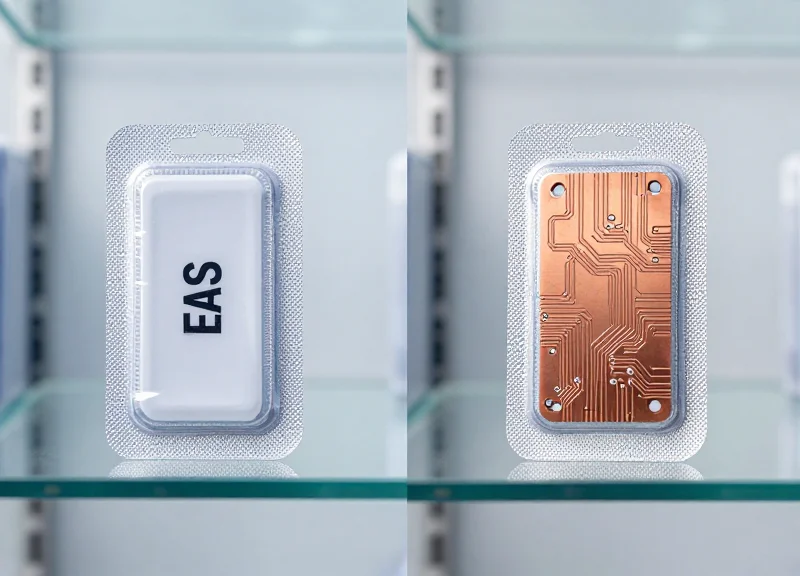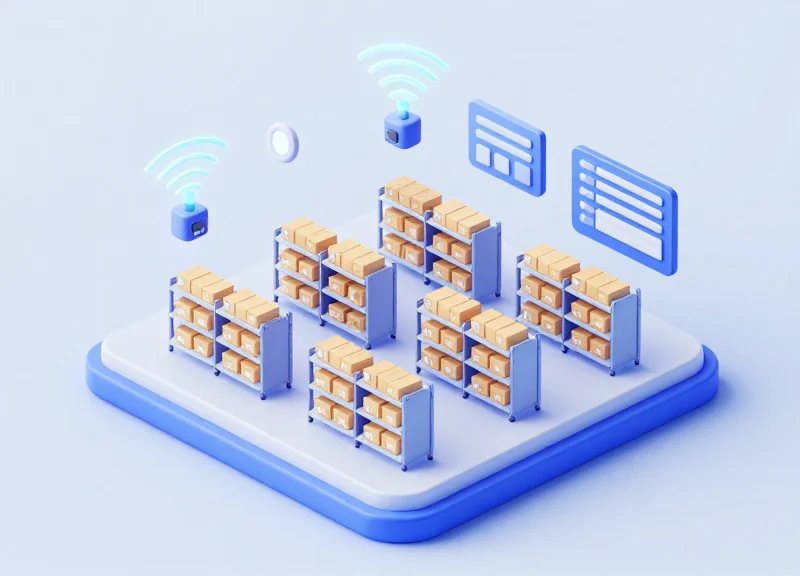
In the hyper-competitive modern retail landscape, the ability to maintain 99.9% inventory accuracy is the difference between a thriving brand and a logistical failure. Traditional manual counting for a store with 10,000+ SKUs can take days and results in significant human error. This technical blueprint explores the transition to UHF RFID technology, enabling retailers to perform full-store counts in minutes. We will dive into the physics, hardware, and software integration required to achieve unprecedented operational speed.
The Evolution of Inventory Management: Why UHF RFID?
UHF RFID (Ultra-High Frequency Radio Frequency Identification) represents the final stage in the digital transformation of inventory logistics, shifting the paradigm from 'one-at-a-time' manual scanning to 'bulk-at-once' autonomous data capture. By utilizing the 860 MHz to 960 MHz band, UHF RFID enables the simultaneous identification of thousands of individual items without requiring a direct line-of-sight, effectively reducing the time required to count a 10,000-SKU store from several man-hours to less than five minutes.
| Feature | Barcode / QR Code | HF RFID (NFC) | UHF RFID (RAIN) |
|---|---|---|---|
| Read Range | Centimeters to Meters | Up to 10 cm | Up to 12+ Meters |
| Reading Speed | 1 item per scan | 1-5 items per second | 700-1,000+ items per second |
| Line of Sight | Required | Not Required | Not Required |
| Bulk Inventory | Impossible | Very Limited | High Density Optimization |
The fundamental reason UHF RFID dominates in high-density environments like retail and warehousing is its ability to handle 'Tag Collision.' In a store with 10,000+ SKUs, signals from thousands of tags arrive at the reader simultaneously. UHF protocols, specifically GS1 EPC Gen2, use advanced anti-collision algorithms (like the slotted Aloha method) to rapidly isolate and acknowledge individual tags, a feat impossible for legacy barcode or even standard HF systems.
Why is UHF RFID better than Barcode for 10,000+ SKUs?
Barcodes require human intervention and manual orientation. For 10,000 items, even a 3-second scan per item results in over 8 hours of labor. UHF RFID eliminates the labor cost by reading the entire floor in one pass.
Can HF RFID (NFC) be used for store-wide counting?
No. HF RFID has a very short read range (near-field). It is excellent for secure payments or item-level authentication but lacks the power and range required for bulk store inventory.
What is the 'Long-Tail' benefit of UHF RFID?
Beyond speed, it provides sub-meter location accuracy. You don't just know you have the SKU; you know exactly which shelf or backroom bin it is located in.
Expert Insight: In my 20 years of implementing retail tech, I've observed that the 'Minute-Level' inventory goal isn't just about speed—it is about the 'Accuracy Decay Curve.' Traditional stores lose about 1% of inventory accuracy every day due to misplacement and theft. By moving to UHF RFID, stores can perform 'cycle counts' multiple times per day, effectively flattening that decay curve and maintaining 99%+ accuracy year-round.
Critical Hardware Components for Rapid Scanning
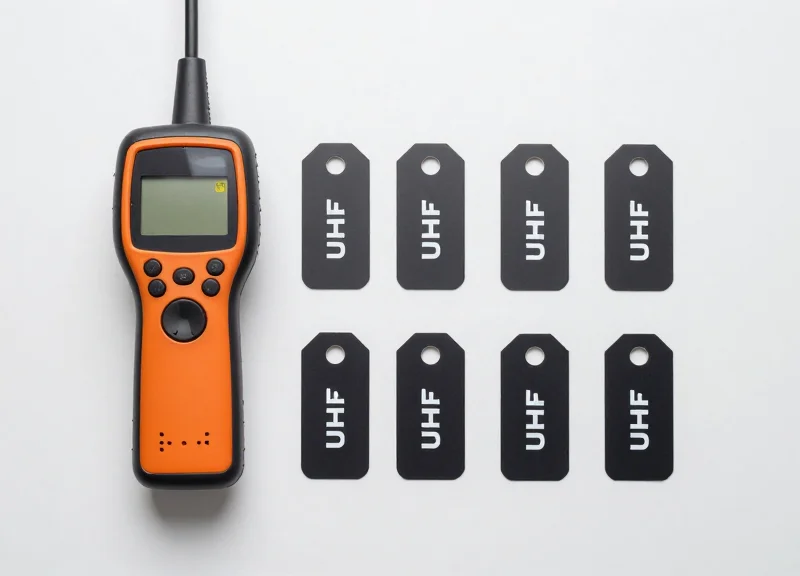
To bridge the gap between theoretical performance and a 60-second full-store count, the hardware layer must prioritize 'high-concurrency throughput.' Unlike standard inventory tasks, minute-level counting for 10,000+ SKUs demands a chipset—typically the Impinj E710 or E910 series—capable of processing hundreds of signals simultaneously without collision errors. The hardware is not merely a reader; it is a high-speed data processor that must filter noise, manage signal reflection, and maintain a consistent read field across dense SKU environments.
| Component Type | Key Specification | Role in Rapid Scanning |
|---|---|---|
| Handheld Readers | 33dBm Output / -82dBm Sensitivity | Mobile agility for 'blind spot' coverage in deep shelving. |
| Fixed Antennas | 9dBi High Gain / Circular Polarized | Constant monitoring of high-traffic zones and exit/entry points. |
| Overhead Gateways | Phase-Array Beamforming | Automated wide-area scanning without manual intervention. |
| Processor Chipset | Impinj E-Series (E710/E910) | The 'engine' that enables 700-1000+ tags/sec read rates. |
- Antenna Polarization: Always opt for Circular Polarization. While linear antennas offer longer range, circular polarization ensures tags are read regardless of their orientation on the product—critical when items are haphazardly stacked.
- Receiver Sensitivity: A sensitivity rating of -80dBm or better is non-negotiable. This allows the reader to 'hear' the faint backscatter of a tag buried deep within a pile of 50 other tagged items.
- Heat Dissipation Architecture: Continuous high-speed scanning generates significant thermal load. Hardware with magnesium alloy heat sinks prevents 'thermal throttling,' which can drop read rates by 50% after just three minutes of operation.
Expert Tip: Don't ignore the 'Polarization Dead Zone.' Even with circular antennas, a tag perfectly perpendicular to the signal path can be missed. For a true minute-level count of 10,000 SKUs, we recommend a 'Dual-Antenna Cross-Fire' configuration. By positioning two antennas at 45-degree opposing angles, you eliminate the geometric nulls that cause 2-3% of tags to remain 'invisible' during high-speed passes.
Can I use standard warehouse scanners for retail inventory?
Generally, no. Warehouse scanners are optimized for range and singular pallet reads. Retail 'Full-Store' counts require high-density anti-collision algorithms to prevent the 'masking' effect where one tag blocks another.
How many readers are needed for 10,000 SKUs?
For handheld-only counting, one high-performance reader can cover 10,000 SKUs in roughly 2-3 minutes of walking. For a 60-second 'hands-free' count, you require fixed overhead infrastructure spaced every 15-20 feet.
Does the reader's OS matter?
Yes. Readers running Android 10 or higher provide better memory management for the massive 'tag-event' buffers generated during 700+ tags/second bursts, preventing app crashes.
UHF RFID Tagging Strategy for 10,000+ SKUs
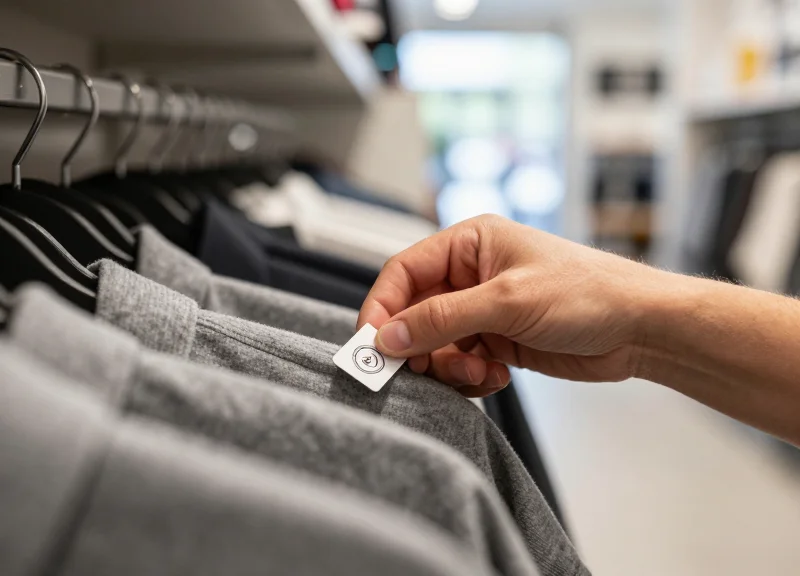
A high-performance UHF RFID tagging strategy for 10,000+ SKUs is defined by the technical selection of specialized tags that ensure 99.9% readability across diverse material types and high-density environments. This strategy moves beyond generic 'one-size-fits-all' labels, utilizing high-sensitivity Integrated Circuits (ICs) and specific antenna geometries to maintain signal integrity against RF-unfriendly materials such as metal reflectors and liquid absorbers. By matching the tag's impedance to the product's dielectric constant, stores can achieve the minute-level inventory speeds required for modern omnichannel retail.
| Product Category | Material Challenge | Recommended Tag Type | Key Feature |
|---|---|---|---|
| Apparel & Textiles | High Density Stacking | General Purpose Inlay | Omni-directional Read Pattern |
| Electronics / Tools | Metal Interference | On-Metal (PCB/Foam) | Back-shielding isolation |
| Beauty / Beverage | Liquid Absorption | Flag Tags / Spacers | Physical separation from liquid |
| Jewelry / Small Items | Small Surface Area | Micro-Tags (Loop) | High-gain near-field coupling |
- Phase 1: RF Material Audit: Categorize the 10,000+ SKUs into 'RF-Friendly', 'RF-Reflective' (Metals), and 'RF-Absorptive' (Liquids) to determine the baseline tag requirements for each group.
- Phase 2: IC Selection: Prioritize latest-generation ICs, such as the Impinj M700 or NXP UCODE 9, which offer higher sensitivity (-24 dBm) to allow for smaller tag sizes without sacrificing read range.
- Phase 3: Placement Optimization: Conduct 'Orientation Sensitivity' tests to find the sweet spot on packaging that avoids 'tag shadowing' when products are shelved or stacked closely together.
Expert Insight: The biggest mistake in large-scale deployments is ignoring 'Tag Detuning.' When a tag is applied to a high-dielectric material (like glass or dense plastic), its resonant frequency shifts, often falling outside the optimized UHF range (860-960 MHz). For a 10,000+ SKU environment, we recommend using 'Wideband' antenna designs that maintain performance even when detuned by the product's surface, ensuring consistent reads regardless of packaging changes.
How do we handle foil-lined packaging?
Foil acts as a Faraday cage. We utilize 'Shielded Inlays' or placement on the non-metallic edge of the package to ensure the RF signal can reach the chip without being reflected.
Why is 'Dry Inlay' vs 'Wet Inlay' important?
Wet inlays include an adhesive backing and are easier to convert into labels, whereas dry inlays are used when the RFID is embedded directly into hangtags during manufacturing, reducing per-unit cost.
Can one tag work for all 10,000 SKUs?
Rarely. While a high-quality universal tag can cover 80% of retail items, the remaining 20% (liquids/metals) usually require specialized form factors to avoid 'dead zones' during a high-speed scan.
{
  "tag_mapping": {
    "SKU_RANGE_001_500": "Metal-Mount_PCB_Tag",
    "SKU_RANGE_501_9000": "Standard_Paper_Inlay_M730",
    "SKU_RANGE_9001_10000": "Flag_Tag_Liquid_Optimized"
  },
  "target_read_rate": "700_tags_per_second",
  "min_sensitivity": "-23dBm"
}
The Physics of Speed: Anti-Collision Algorithms
To achieve minute-level counting for 10,000+ SKUs, the system must solve the 'Reader-to-Tag' communication bottleneck: if multiple tags respond to a reader's signal simultaneously, their signals overlap, causing a collision that makes the data unreadable. The industry standard, EPCglobal Gen2v2, employs a sophisticated 'Slotted Aloha' based anti-collision mechanism known as the Dynamic Q-Algorithm. This algorithm manages the air interface by dividing time into discrete slots; tags choose a random slot to transmit their data, while the reader dynamically adjusts the number of available slots (the 'Q' value) based on the frequency of collisions and empty slots observed in real-time.
| Parameter | Static Q-Value | Dynamic Q-Value (Gen2v2 Standard) |
|---|---|---|
| Efficiency | Low; inefficient with varying tag densities. | High; adapts to the number of tags in the field. |
| Inventory Speed | Fixed; causes long delays in dense zones. | Variable; speeds up as tag population decreases. |
| Typical Application | Fixed conveyor belts with single items. | High-density retail stores and warehouses. |
| Collision Management | None; suffers from 'Capture Effect' issues. | Predictive; adjusts slot count (2^Q) on the fly. |
- Select & Query: The reader broadcasts a Query command containing a Q-parameter (e.g., Q=4, meaning 16 slots). All tags in range generate a random number between 0 and 2^Q-1.
- Slot Selection & RN16 Response: Tags that generated '0' respond immediately with a 16-bit random number (RN16). Tags with non-zero values wait for a 'QueryRep' command to decrement their counters.
- ACK and EPC Transmission: The reader acknowledges the RN16. The tag then backscatters its full EPC (Electronic Product Code). If multiple tags respond at once, a collision is flagged, and the reader adjusts Q.
- Dynamic Recalibration: If the reader senses too many empty slots, it decreases Q to save time; if it senses too many collisions, it increases Q to spread the tags out.
Expert Insight: The 'Mute' Strategy for 100% Accuracy. In high-density environments with 10,000+ SKUs, the biggest hurdle isn't just the collision—it's the 'shouting' tags that have already been read. A critical tactic for minute-level speed is utilizing the 'Session' and 'Inventoried Flag' settings (S1 or S2). By moving successfully read tags into a 'Muted' state temporarily, you effectively shrink the 'active' tag population every millisecond. This reduces the Q-value requirements progressively during the scan, allowing the reader to focus its spectral energy on the remaining 1-2% of 'stubborn' tags that might be shadowed or poorly oriented.
How many tags can the Q-algorithm handle per second?
High-end readers can process 700 to 1,000 tags per second in ideal conditions. However, in a real-world store with 10,000 SKUs, effective rates average 300-500 tags per second due to environment-induced retries.
Does a higher Q-value always mean better accuracy?
No. An excessively high Q-value creates too many empty slots, leading to 'idle time' where the reader is waiting for responses that won't come. This increases total inventory time without improving accuracy.
Can software help with anti-collision?
While the algorithm is hardware-level (Firmware), software can optimize 'Search Modes' (Dual-target vs. Single-target) to dictate how the reader interacts with the Gen2v2 anti-collision flags.
Network Infrastructure and Edge Computing Needs
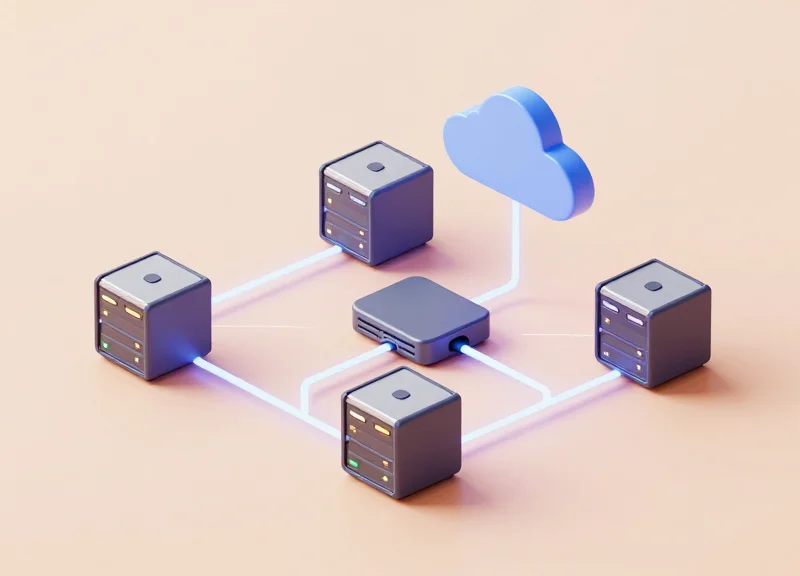
To achieve a minute-level full-store count for 10,000+ SKUs, the network architecture must transition from a 'pipe to the cloud' to a distributed processing model. Edge computing acts as the critical buffer, performing real-time data filtering and deduplication at the store level. Without local processing, the simultaneous burst of thousands of Electronic Product Codes (EPCs) creates a 'data storm' that causes application-layer latency, often resulting in lost packets or mismatched inventory states in the centralized ERP.
| Requirement | Edge-Centric Model | Cloud-Only Model |
|---|---|---|
| Latency | < 10ms (Local processing) | 200ms - 1s (Round-trip dependent) |
| Data Payload | Filtered summaries (Small) | Raw Tag Reads (Massive) |
| Offline Resilience | Full local operation | System halt during outage |
| Network Usage | Efficient burst uploads | Continuous high-bandwidth drain |
### The Power of Local Deduplication One of the most significant challenges in UHF RFID is the redundant read. In a single 60-second scan, a fixed reader or handheld might hit the same tag 50 to 100 times. Multiplying this by 10,000 SKUs results in a million data points that provide zero additional value. An Edge Gateway (such as an industrial PC or a high-performance Raspberry Pi cluster) uses logic to compress these million reads into exactly 10,000 unique unique identifiers before the data ever touches the WAN.
- Edge Gateway Deployment: Install local processing units within the store's LAN to interface directly with the LLRP (Low-Level Reader Protocol) streams from hardware.
- Redundancy Filtering: Implement time-windowed deduplication where only the first and strongest RSSI (Received Signal Strength Indicator) read is registered per epoch.
- Local Database Caching: Store the current 'state of the store' in a local Redis or SQLite instance for instant reconciliation against the last known count.
- Asynchronous Cloud Syncing: Push the final reconciled inventory update to the global ERP via MQTT or Webhooks, ensuring high availability even if the internet connection is unstable.
### Expert Insight: The 'RSSI Threshold' Strategy In high-density environments, signal leakage—reading tags through walls or from neighboring rooms—is a major source of 'inventory noise.' A sophisticated edge layer doesn't just count tags; it analyzes the RSSI data of every read. By setting a dynamic signal threshold at the edge, you can programmatically exclude tags that are physically distant, ensuring that your 'full-store' count isn't accidentally including stock from the loading dock or the basement.
Does 10,000 SKUs require a 1Gbps fiber connection?
No. If you use edge computing for deduplication, your data upload is less than 500KB per full scan. The internal LAN (Reader to Edge) should be Gigabit Ethernet, but the outward WAN can be a standard broadband connection.
Why is MQTT preferred over REST for these updates?
MQTT is a lightweight publish/subscribe protocol designed for low-bandwidth, high-latency environments. It handles the 'bursty' nature of RFID data much better than the overhead-heavy HTTP/REST protocol.
Can I run the Edge Logic on the reader itself?
Modern 'Smart Readers' with onboard Linux processors can handle some filtering, but for 10,000+ SKUs and complex business logic, a dedicated Edge Gateway is recommended to prevent CPU throttling on the hardware.
Software Middleware: Filtering and Data Cleaning

In a high-density environment with 10,000+ SKUs, an RFID reader can generate upwards of 1,000 reads per second. RFID middleware is the critical intelligence layer situated between the hardware and the ERP/WMS; its primary function is to transform this 'noisy' stream of raw radio frequency data into clean, actionable business events. Without robust filtering, your system will suffer from 'stray reads'—tags picked up through walls or from the backroom—which compromises inventory integrity.
| Filter Type | Mechanism | Primary Use Case |
|---|---|---|
| RSSI Filtering | Signal strength thresholding (e.g., ignore < -60dBm) | Eliminating tags from adjacent rooms or distant aisles. |
| Event Smoothing | Time-windowed de-duplication (e.g., 500ms bins) | Reducing data volume from tags read multiple times per second. |
| GPIO Triggering | Physical sensors (IR/Laser) activate the reader | Start/Stop inventory based on employee movement or door opening. |
| Logical Masking | Filtering by EPC patterns (e.g., SGTIN-96 headers) | Ignoring non-inventory tags like employee badges or shipping pallets. |
Expert Insight: The 'RSSI Variance' Strategy. A common mistake is setting a static RSSI (Received Signal Strength Indicator) floor. High-performance systems use a dynamic 'RSSI Variance' analysis. By tracking the standard deviation of a tag's signal strength during a scan, middleware can distinguish between a stationary item in a 'cold spot' and a stray read leaking through a partition. If the signal is weak but perfectly stable, it is likely a stray read from a fixed location behind a wall; if it fluctuates, it is more likely an item being actively scanned in-store.
- Data De-duplication: The middleware collapses thousands of tag observations into a single 'Seen' event to prevent overloading the backend database.
- Spatial Filtering (Zone Management): Logic that assigns a tag to a specific zone (e.g., 'Sales Floor' vs. 'Fitting Room') based on which antenna reported the highest average RSSI.
- Phantom Read Elimination: Algorithms that require a tag to be seen X number of times across Y antennas before it is considered 'present' to avoid ghost reads caused by RF interference.
{
  "filter_config": {
    "min_rssi": -65,
    "min_read_count": 3,
    "deduplication_window_ms": 1000,
    "epc_mask": "3034*",
    "exclude_zones": ["backroom_antenna_04"]
  }
}
How do you prevent reading tags through a drywall partition?
Combine RSSI thresholding with 'Read Rate' filtering. Tags in the same room as the reader typically show a 30-40% higher read success rate compared to those attenuated by a wall.
What is the biggest challenge in middleware for 10,000+ SKUs?
The 'Data Storm'—when many tags respond simultaneously. Effective middleware must use edge-processing to filter 99% of the noise before sending data to the cloud.
Can middleware help with misplaced items?
Yes, by comparing the current scan zone to the 'Last Known Location' in the database, the middleware can trigger 'Misplaced Item' alerts in real-time.
Step-by-Step Implementation Workflow
Implementing a minute-level UHF RFID inventory system for 10,000+ SKUs requires a systematic transition from physical environmental mapping to automated data synchronization. Unlike traditional barcode deployments, RFID implementation centers on managing electromagnetic zones to ensure that high-density SKU environments achieve 99.9% read accuracy without data collisions or 'ghost' reads from backstock.
- Phase 1: RF Site Survey and Heat Mapping: Conduct a comprehensive radio frequency (RF) audit of the retail space to identify 'dead zones' and potential interference sources like metal shelving or water-based products. Map the store layout to determine optimal fixed antenna placement and handheld scan paths.
- Phase 2: SKU-to-Tag Sensitivity Calibration: Apply specialized tags to the 10,000+ SKUs based on material composition. Perform 'dry-run' scans to calibrate the power output (dBm) required for different product categories, ensuring deep penetration into packed shelving.
- Phase 3: Middleware Logic and Filter Configuration: Configure the RFID middleware to apply 'Region of Interest' (ROI) filters. This ensures the system distinguishes between floor stock being counted and items located behind walls in the stockroom using RSSI (Received Signal Strength Indicator) thresholds.
- Phase 4: Parallel Run and Accuracy Auditing: Execute 'Shadow Counting' where RFID scans are conducted alongside legacy barcode audits. This phase identifies discrepancies and allows for fine-tuning of the anti-collision algorithms and scan speed parameters.
- Phase 5: Full-Scale ERP/WMS Integration: Connect the edge-processed RFID data to your Enterprise Resource Planning (ERP) system via API. Transition to 'Live' status where inventory levels update in real-time as the minute-level counting cycle completes.
| Implementation Phase | Primary Objective | Key KPI |
|---|---|---|
| Site Survey | Interference Mitigation | Noise Floor < -90 dBm |
| Calibration | Tag Sensitivity Optimization | First-Pass Read Rate > 98% |
| Parallel Run | Data Integrity Verification | Zero Discrepancy vs. Manual Audit |
| Integration | Real-time Data Sync | < 5s Latency to ERP |
Expert Tip: To achieve truly 'minute-level' counts for 10,000+ SKUs, implement 'Zonal RSSI Fingerprinting.' By setting specific signal strength profiles for different sections of the store, the system can mathematically exclude tags that are outside the target counting zone, even if their signal reaches the reader. This eliminates the need for physical shielding and significantly reduces the processing time for massive datasets.
Integrating RFID with ERP and ESL Systems

Integrating RFID with ERP and ESL systems represents the final stage of the 'Single Source of Truth' architecture, where physical inventory counts directly drive business logic and customer-facing information. By bridging the gap between UHF RFID middleware and the backend Enterprise Resource Planning (ERP) system, retailers can automate replenishment triggers and financial reporting. Simultaneously, connecting this data to Electronic Shelf Labels (ESL) ensures that the price and stock availability displayed to the customer are 100% accurate, reflecting the exact inventory detected by the minute-level RFID scans.
| Feature | Legacy Manual Workflow | RFID-Integrated Workflow |
|---|---|---|
| Inventory Sync | Daily or Weekly batch updates | Real-time (Minute-level) streaming |
| ESL Accuracy | Often shows 'In Stock' for items sold out | Displays 'Out of Stock' the moment tag leaves |
| ERP Data Entry | Manual scanning or hand-counts | Automated API-driven ingestion |
| Dynamic Pricing | Limited to manual schedule changes | Adjustable based on real-time stock velocity |
- API Handshake & Webhook Setup: Establish a secure RESTful API or gRPC connection between the RFID middleware and the ERP. Use webhooks to 'push' inventory changes only when a threshold is met to avoid unnecessary network traffic.
- Data Mapping and Normalization: Map the unique EPC (Electronic Product Code) from the RFID tag to the SKU or GTIN used within the ERP and ESL databases to ensure cross-system compatibility.
- ESL Controller Synchronization: The middleware sends an update command to the ESL gateway, which refreshes the e-ink display on the shelf. This can include 'Low Stock' warnings for staff or 'Only 2 Left' marketing messages for customers.
- Automated Reconciliation: The ERP compares the RFID scan result against the point-of-sale (POS) records to identify 'shrinkage' or misplacement in real-time.
{
  "event_type": "inventory_update",
  "timestamp": "2023-10-27T10:15:00Z",
  "sku": "UHF-10293-BLU",
  "previous_count": 45,
  "current_count": 42,
  "action_required": {
    "erp_replenishment_trigger": false,
    "esl_display_update": "Only 3 items sold in 1 hour",
    "esl_led_alert": "OFF"
  }
}- How does the ESL know when to update?: The ESL system receives a command from the RFID middleware via an integration layer (like Node-RED or a custom microservice) as soon as the 'Available Stock' count changes in the local edge database.
- Can RFID integration help with omnichannel fulfillment?: Yes. By knowing exact inventory levels, the ERP can confidently enable 'Buy Online, Pick Up In Store' (BOPIS) without the risk of a customer arriving for an out-of-stock item.
- Expert Tip: The 'Visual Beacon' Restocking Method: Many modern ESLs include a programmable LED. A unique high-value strategy is to program the RFID system to trigger a 'flashing blue LED' on the shelf label when it detects the SKU count has dropped below 3 units. This allows staff to find and restock the shelf immediately without checking a handheld device.
ROI Analysis: Labor Reduction vs. Technology Investment
Transitioning to minute-level inventory tracking represents a fundamental shift from a labor-intensive CapEx model to an automated OpEx optimization strategy. For a store with 10,000 SKUs, the Return on Investment (ROI) is primarily driven by the 'Accuracy Dividend'—the elimination of human error and the recovery of lost sales due to phantom inventory. While the initial investment in readers, antennas, and tags is significant, the break-even point typically occurs within 12 to 18 months through the drastic reduction in manual audit hours and improved stock turnover rates.
| Metric | Manual Audit (Quarterly) | RFID Automated (Daily) |
|---|---|---|
| Labor Time (10k SKUs) | 80 - 120 Man-Hours | 3 - 5 Minutes |
| Accuracy Level | ~70% to 80% | 99.5% to 99.9% |
| Cost per Count | $2,500 - $4,000 | <$1.00 (Electricity/Software) |
| Shrinkage Detection | Reactive (Delayed 3 months) | Proactive (Near Real-Time) |
| Out-of-Stock Recovery | Slow/Manual | Automated Alerts |
Expert Insight: The Inventory Velocity Multiplier. Most ROI models focus solely on labor savings, but the real 'hidden' value lies in the reduction of Safety Stock. When inventory accuracy jumps from 75% to 99%, retailers can safely reduce their backstock buffers by 10-15% without risking out-of-stock scenarios. In a 10,000 SKU environment, this release of tied-up working capital often pays for the entire RFID infrastructure before the first year of operation concludes.
- Identify Baseline Labor Costs: Calculate the total annual spend on manual inventory counts, including staff wages, third-party auditing fees, and store closure opportunity costs.
- Quantify 'Ghost Inventory' Losses: Estimate the revenue lost when customers cannot find items that the system incorrectly claims are in stock.
- Calculate Tagging & Infrastructure Amortization: Factor in the cost of source-tagging (per SKU) and the 5-year depreciation of fixed overhead readers and handhelds.
- Measure Omni-channel Fulfillment Speed: Assign a value to the reduction in 'order cancellation rates' for Buy-Online-Pick-Up-In-Store (BOPIS) services caused by inaccurate local stock data.
Is the cost of individual tags a barrier for low-margin items?
With UHF RFID tag prices dropping below $0.05 in high volumes, the 'tag tax' is now negligible compared to the 2-4% lift in sales typically seen after implementation.
How does RFID affect shrinkage and theft?
RFID provides a digital trail. By knowing exactly when an item was last seen, retailers can pinpoint 'internal shrink' windows, reducing theft by up to 20% through better accountability.
What is the typical 'Payback Period'?
For high-volume retail, the payback period is usually 12-14 months. This includes the cost of software integration and hardware installation.