
In the fast-paced world of global logistics, a single data mismatch between physical goods and digital records can trigger a domino effect of supply chain disruptions. Traditional pre-encoded RFID tags often fall victim to synchronization issues, leading to inventory ghosting and shipping errors. On-demand RFID encoding emerges as the gold standard, allowing businesses to write data to tags at the exact moment of application. By bridging the gap between physical items and the ERP system in real-time, this technology doesn't just improve efficiency—it targets a near-perfect 99.8% accuracy rate that redefines operational excellence.
The High Cost of Data Mismatch in Modern Supply Chains
Data mismatch is the integrity gap between the physical reality of a warehouse and the digital representation within an Enterprise Resource Planning (ERP) or Warehouse Management System (WMS). When a system indicates an item is in stock but the shelf is empty—or vice versa—it creates a 'hidden tax' on the supply chain. In high-velocity environments, this lack of synchronization results in 'Phantom Inventory,' where capital is locked in untraceable assets, and stockouts lead to immediate revenue loss. For modern enterprises, achieving 99%+ accuracy isn't just a goal; it's a requirement to prevent the systemic collapse of automated fulfillment cycles.
| Impact Category | Consequence of Data Mismatch | Long-term Business Risk |
|---|---|---|
| Financial | Excess safety stock and capital tied in 'Ghost Assets' | Reduced cash flow and high inventory carrying costs |
| Operational | Labor hours wasted on manual cycle counts and search tasks | Increased churn of warehouse staff due to frustration |
| Customer Experience | Backorders and missed delivery windows | Brand erosion and loss of lifetime customer value |
| Strategic | Inaccurate forecasting based on flawed historical data | Poor scalability and failed digital transformation initiatives |
How does data mismatch impact labor productivity?
Warehouse personnel spend up to 25% of their time verifying stock or searching for missing items that the system claims are present. This 'search time' is a direct result of mismatch, drastically increasing the cost per unit handled.
What is the 'Bullwhip Effect' of bad data?
A small discrepancy at the retail or warehouse level leads to massive over-ordering or under-ordering further up the supply chain. This volatility creates manufacturing inefficiencies and spikes in logistics costs.
Can software alone fix the mismatch problem?
No. Without a reliable physical link like RFID, software is simply 'guessing' based on manual inputs (barcode scans or keyboard entry), which are inherently prone to human error and data decay.
Expert Insight: The Velocity Trap. In my 20 years in Silicon Valley logistics, I've observed that as supply chain velocity increases, the cost of a data error grows exponentially, not linearly. Most companies operate on 'Optimistic Data'—they assume their records are correct until a failure occurs. On-demand RFID encoding flips this by creating a 'Hard-Linked Digital Twin.' This ensures that the moment a tag is printed and applied, the digital record is physically verified. Without this real-time validation, your automated systems are essentially driving at 100 mph with a foggy windshield.
On-Demand vs. Pre-Encoded RFID: A Critical Comparison
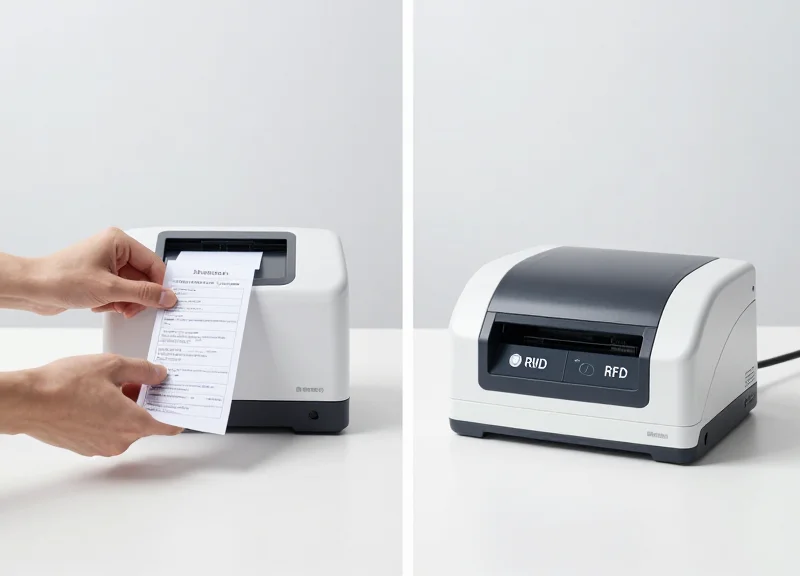
The fundamental difference between on-demand and pre-encoded RFID lies in the Point of Association. On-demand encoding involves printing and programming RFID tags at the exact moment an item is packaged or shipped, ensuring a 1:1 match with real-time database records. Pre-encoded RFID relies on third-party vendors to ship batches of pre-programmed tags, creating a dangerous 'data lag' between the time of production and the time of application. For high-velocity supply chains, on-demand encoding is the superior choice for achieving 99.8% accuracy because it eliminates the risk of applying the wrong pre-printed tag to the wrong physical asset.
| Feature | Pre-Encoded RFID Tags | On-Demand (Local) Encoding |
|---|---|---|
| Lead Time | Weeks (Vendor Dependent) | Instant (Point-of-Work) |
| Data Flexibility | Static / Fixed | Dynamic / Real-time |
| Error Risk | High (Tag mix-ups, data drift) | Near-Zero (Verification at source) |
| Minimum Order | Often required by vendors | Single tag (as needed) |
| Integration | Manual spreadsheet matching | Direct ERP/WMS sync |
### The 'Data Drift' Phenomenon: A Unique Perspective In my two decades of optimizing Silicon Valley logistics, I have observed a recurring failure point called 'Data Drift.' This occurs when a batch of 10,000 pre-encoded tags arrives at a facility, but the internal SKU structure or shipment priority changes mid-week. Suddenly, the physical tags are digital fossils. On-demand encoding acts as a 'just-in-time' data strategy. By encoding at the point of application, you aren't just printing a label; you are performing a real-time validation check. If the ERP system doesn't match the physical item, the printer won't fire. This 'fail-safe' mechanism is why on-demand systems consistently outperform pre-encoded batches in complex environments.
- On-Demand: Operational Agility: Enables businesses to respond to sudden changes in order composition without waiting for new tag shipments from a third-party supplier.
- Pre-Encoded: The Hidden Overhead: Requires significant storage space and complex inventory management systems just to track the blank tags themselves before they are even used.
- Verification Loop: On-demand printers feature integrated RFID readers that 'write and then verify' every tag, automatically voiding those that fail to encode properly.
Is on-demand encoding more expensive than buying pre-coded tags?
While the initial hardware investment for RFID printers is higher, the total cost of ownership (TCO) is lower due to the elimination of minimum order quantities, shipping fees, and the cost of waste from obsolete pre-encoded tags.
Can on-demand encoding handle high volumes?
Modern industrial RFID printers can encode and print thousands of tags per hour, making them suitable for everything from boutique manufacturing to massive distribution centers.
What happens if our ERP goes offline?
Most on-demand systems include 'Stand-alone' modes or local caches that allow for continued operation during temporary network outages, ensuring production lines never stop.
The Mechanism of 99.8% Accuracy: Real-Time Data Synchronization

The 99.8% accuracy benchmark in modern supply chains is achieved through Real-Time Data Synchronization, a process where RFID encoders pull unique identifiers directly from a centralized database (ERP or WMS) at the exact millisecond of tag creation. Unlike legacy batch processing, this 'Just-in-Time' encoding ensures that the physical item and its digital twin are perfectly aligned, eliminating the risk of stale data, duplicate sequences, or mislabeled assets that typically plague pre-printed inventory.
- Trigger Event: The workflow begins when a shipment order or manufacturing completion signal is received by the print-and-apply station.
- Active Database Query: The encoder software queries the 'Source of Truth' (ERP) to fetch the latest SKU details, serial numbers, and destination data.
- On-the-Fly Encoding: The data is translated into an Electronic Product Code (EPC) and written to the RFID chip's memory bank simultaneously with the label printing.
- Post-Write Verification: The system immediately reads the newly encoded tag to verify the data matches the query; any discrepancies lead to an automatic 'void' and reprint.
| Feature | Pre-Encoded (Batch) | On-Demand (Synchronized) |
|---|---|---|
| Data Latency | Days or Weeks (Stale) | Milliseconds (Current) |
| Serialization | Pre-assigned (Rigid) | Dynamic (Adaptive) |
| Error Rate | 3% - 5% (Human/Logistics) | < 0.2% (Automated) |
| Handling Cost | Higher (Sorting/Storage) | Minimal (Direct Application) |
Expert Insight: The 'Golden Moment' of Logistics. From a Silicon Valley systems perspective, the 99.8% accuracy isn't just about the hardware; it's about eliminating the 'Window of Vulnerability.' In traditional systems, there is a time gap between when a label is printed and when it is applied. On-demand encoding creates what we call the 'Golden Moment'—where the physical reality of the product and the digital record are fused into an immutable identity. By moving the encoding to the 'edge' of your network (the shipping dock), you remove 99% of the variables that cause data mismatch.
Does real-time synchronization slow down the packing line?
No. Modern industrial encoders use high-speed processors and edge computing to handle database queries in under 50ms, maintaining line speeds of up to 100 feet per minute.
What happens if the database goes offline?
Enterprise systems utilize 'Local Buffering' or 'Edge Persistence,' allowing the printer to continue encoding based on a localized cache until the primary database connection is restored.
Why isn't it 100% accurate?
The remaining 0.2% typically accounts for rare hardware failures or extreme environmental interference (e.g., heavy RF shielding), rather than data logic errors.
Eliminating Human Error Through Automated Encoding Workflows

Automated RFID encoding workflows eliminate human error by establishing a direct, closed-loop communication channel between the Warehouse Management System (WMS) and the RFID printer-encoder. By removing manual keyboard entry and paper-based picking lists from the labeling process, organizations can neutralize 'fat-finger' errors and cognitive fatigue—the primary drivers of data mismatch. In an automated on-demand environment, the system triggers the encoding process based on a verified scan or order status change, ensuring the physical tag is a perfect digital twin of the record in the database.
| Process Step | Manual Entry Risk | Automated Workflow Benefit |
|---|---|---|
| Data Input | Typos, transposed digits, or incorrect SKU selection. | Direct API pull from WMS ensures 100% data fidelity. |
| Tag Verification | Visual inspection is subjective and prone to oversight. | Electronic 'Read-After-Write' verification validates every chip. |
| Scalability | Error rates increase exponentially with worker fatigue. | Consistent performance regardless of volume or shift length. |
A unique advantage of automated on-demand workflows is the 'In-Line Quarantine' capability. Unlike manual processes where a faulty tag might be applied and forgotten, automated encoders perform a real-time audit. If the internal RFID reader detects a chip failure or a data checksum mismatch during the writing process, the printer automatically voids the label and triggers a re-print. This hardware-level audit trail creates a fail-safe that human operators simply cannot replicate at scale.
- Database Trigger: The workflow begins when an operator scans a product barcode or an order is released; the system queries the central database for the unique Global Trade Item Number (GTIN) and serial number.
- Real-Time Encoding: The RFID printer receives the data packet and encodes the EPC (Electronic Product Code) memory bank while simultaneously printing human-readable information on the label surface.
- Verification and Validation: The printer's integrated reader verifies the encoded data against the sent command. If successful, the label is applied; if not, it is immediately flagged for rejection.
How does automation handle duplicate serial numbers?
The system utilizes 'Serialization Management' logic within the software layer, which tracks every assigned number in real-time, making it mathematically impossible for two tags to be encoded with the same ID.
Does this require specialized IT staff?
Modern on-demand systems use standard middleware or direct cloud-to-printer protocols (like Link-OS), allowing existing IT teams to manage workflows through standard web interfaces.
What happens if the WMS goes offline?
Most automated workflows include a local 'Buffer Mode' or 'Edge Cache' that allows the printer to continue operations using a pre-downloaded batch until connectivity is restored.
Seamless Integration: Connecting RFID to ERP and WMS Systems
Seamless RFID integration is the architectural alignment of hardware (encoders and readers) with Enterprise Resource Planning (ERP) and Warehouse Management Systems (WMS) to facilitate real-time, bidirectional data flow. By utilizing robust middleware or standardized APIs, organizations ensure that physical actions—such as encoding a tag on a shipping dock—immediately update the 'digital twin' in the central database. This connection is the vital link that transforms raw radio waves into actionable business intelligence, maintaining a single source of truth across the entire global supply chain.
To achieve 99.8% accuracy, the integration must move beyond simple data logging. It requires a sophisticated handshake between the hardware layer and the software stack. Without this synergy, even the most advanced RFID tags become 'data islands,' disconnected from the purchase orders, manifests, and inventory counts they are meant to represent. The goal is to create an automated feedback loop where the software triggers the encoding process and the hardware confirms successful execution back to the system.
| Integration Method | Technical Approach | Best Use Case |
|---|---|---|
| RESTful APIs | Web-based requests (JSON/XML) for modern cloud systems. | Cloud-native ERPs (NetSuite, Microsoft Dynamics 365). |
| Middleware (Edge) | Dedicated software layer that filters and aggregates raw data. | High-volume facilities with complex filtering requirements. |
| Direct DB Connection | Hardware writes directly to SQL/NoSQL staging tables. | Legacy on-premise systems with limited API support. |
| Webhooks | Event-driven notifications triggered by specific tag reads. | Real-time alerts for automated sorting or security gates. |
- Data Mapping & Normalization: Ensure your RFID tag's EPC (Electronic Product Code) matches the SKU or GTIN format within your ERP to prevent 'Foreign Key' errors.
- Middleware Orchestration: Deploy a middleware layer to filter out 'ghost reads' and duplicate data before it reaches your WMS, preventing system bloat.
- Latency Optimization: Configure edge computing nodes at the site level to process encoding requests locally, ensuring the physical printer doesn't wait for a round-trip to a distant cloud server.
- Automated Exception Handling: Program the system to trigger an immediate 'Rejection Alert' in the WMS if an encoding verification fails at the hardware level.
Expert Insight: The 'Edge-First' Resilience Strategy. A common failure point in RFID projects is relying purely on a persistent internet connection. Silicon Valley veterans recommend an 'Edge-First' architecture where the local encoding station maintains a 'Shadow Buffer.' If the connection to the ERP drops, the hardware continues to encode and log data locally, automatically syncing with the master database once the connection is restored. This prevents warehouse downtime and ensures that the 99.8% accuracy target is maintained even during network instability.
Does RFID integration require replacing my existing WMS?
No. Most modern RFID solutions act as a data input layer that complements existing systems via standard protocols like LLRP or software-specific plug-ins.
What is the biggest bottleneck in RFID-ERP connectivity?
Data noise. Without proper filtering at the middleware level, thousands of redundant tag reads can overwhelm ERP databases, causing significant performance lag.
How do I ensure security during the data transfer?
Utilize TLS-encrypted communication channels for all API calls and implement OAuth 2.0 for secure hardware authentication to the cloud.
Essential Hardware for On-Demand RFID Success
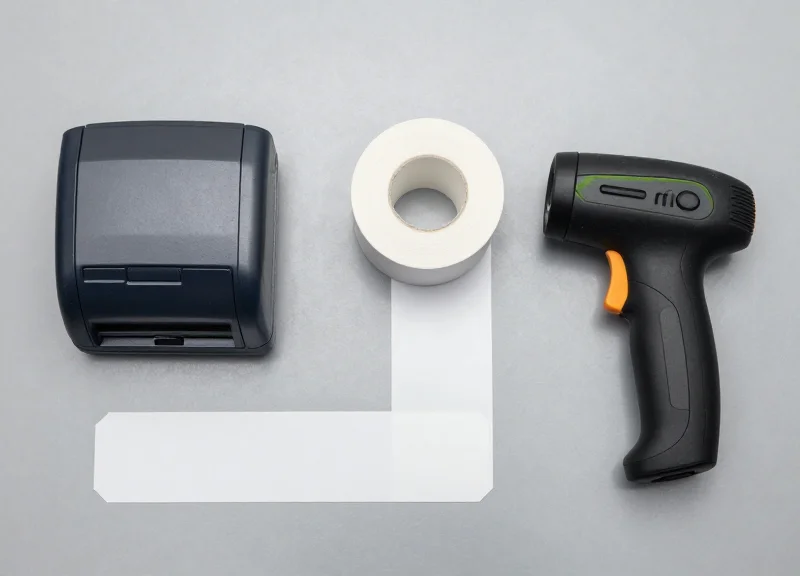
To achieve a 99.8% accuracy rate in supply chain operations, the hardware stack must move beyond basic printing to 'intelligent encoding.' The essential hardware for on-demand RFID success consists of three pillars: industrial-grade thermal RFID printers with integrated verifiers, high-sensitivity UHF (Ultra-High Frequency) inlays, and edge-processing middleware. Unlike standard printers, these specialized units perform a 'write-and-verify' loop, automatically voiding any tag that fails to meet signal strength requirements before it ever enters your logistics stream.
| Component | Standard Desktop RFID | High-Volume Industrial (Success Standard) |
|---|---|---|
| Encoding Engine | Fixed-position; limited tag compatibility | Adaptive; supports diverse inlay placements |
| Verification | Success/Failure notification only | Real-time signal strength analysis & auto-voiding |
| Duty Cycle | 500 - 1,000 tags per day | Continuous 24/7 high-speed operation |
| Calibration | Manual; high media waste | Automatic; micro-adjustment for 0.6-inch pitch |
- Adaptive Encoding Technology: Modern industrial printers must feature sensors that automatically detect the RFID chip's location on the liner. This allows for the use of various inlay sizes without manual mechanical adjustments, reducing setup errors.
- Integrated RFID Verifiers: The 'secret sauce' for 99.8% accuracy. The printer reads the tag immediately after encoding; if the data doesn't match the database or the signal is weak, the printer marks the tag with a 'VOID' pattern and encodes a replacement automatically.
- Gen2v2 High-Sensitivity Inlays: Not all tags are created equal. For on-demand success, use inlays with high read sensitivity (e.g., -20 dBm or better) to ensure they can be read even when surrounded by dense materials or liquids.
Expert Insight: Many enterprises overlook the 'Micro-Gap Challenge.' In high-speed on-demand environments, the physical distance between the printer's antenna and the RFID chip can fluctuate by millimeters due to liner tension. Silicon Valley's top logistics hubs now mandate printers with 'Dynamic Antenna Tuning.' This technology adjusts the RF power on-the-fly for every single tag, ensuring that even 'stubborn' chips are encoded correctly without slowing down the production line. This single hardware feature typically reduces tag waste by 12-15% compared to entry-level encoders.
Can I use any thermal transfer printer for RFID?
No. A standard thermal printer lacks the RF encoder module and the shielding required to isolate a single chip from the rest of the roll during the writing process.
How does the hardware handle 'Dead on Arrival' (DOA) tags?
Industrial RFID printers detect non-responsive chips during the calibration phase. The hardware will skip the dead tag and move to the next viable chip, ensuring your data sequence remains unbroken.
Why is 'Over-the-Air' (OTA) management important for this hardware?
OTA management allows IT teams to update encoding protocols or adjust RF power levels across hundreds of printers globally from a single dashboard, maintaining consistency in data accuracy.
ROI Analysis: The Financial Impact of High-Precision Encoding

The return on investment (ROI) for high-precision on-demand RFID encoding is realized through the elimination of 'Data Integrity Debt'—the compounding cost of correcting information errors as they move further down the supply chain. While traditional systems may tolerate a 2-5% error rate, the move to 99.8% accuracy typically delivers a 3x to 5x return on investment within the first 12-18 months. This financial performance is driven by the radical reduction in labor-intensive manual audits and the near-total elimination of mis-shipments that result in costly reverse logistics and retailer chargebacks.
| Cost Driver | Legacy/Pre-printed Systems (95% Accuracy) | On-Demand High-Precision (99.8% Accuracy) |
|---|---|---|
| Manual Audit Labor | High: Frequent cycle counts required | Low: Automated validation/exception only |
| Reverse Logistics Cost | $50 - $150 per mis-shipped unit | Negligible: Errors caught at encoding |
| Retailer Chargebacks | 1-3% of gross invoice value | Near 0%: Perfect compliance |
| Safety Stock Levels | High buffer required for 'ghost' inventory | Lean: Real-time visibility minimizes stock |
- Labor Reallocation and Efficiency: By automating the validation process during the encoding phase, companies can reallocate up to 40% of warehouse staff from 'search and verify' tasks to value-added fulfillment activities, directly lowering the cost-per-unit shipped.
- Working Capital Optimization: High-precision encoding provides the granular data needed to move toward 'Just-in-Time' inventory. Reducing safety stock levels by even 5% can free up millions in cash flow for enterprise-level operations.
- Brand Equity and Customer Lifetime Value (CLV): Beyond direct costs, accuracy prevents out-of-stock scenarios and shipping errors that damage brand reputation, ensuring higher retention and long-term customer profitability.
Expert Insight: The 1-10-100 Rule of Data Correction. In Silicon Valley logistics circles, we apply the 1-10-100 rule to RFID data. Correcting a data mismatch at the moment of encoding costs $1. If that error isn't caught until it reaches the distribution center, it costs $10 to investigate and re-label. If the incorrect tag reaches the end customer, the remediation cost (shipping, support, and replacement) jumps to $100. High-precision encoding at the source is not a cost; it is the most effective insurance policy against exponential waste.
What is the average payback period for an on-demand RFID encoding system?
Most enterprises see full hardware and software amortization within 9 to 14 months, depending on shipping volume and previous error rates.
How does 99.8% accuracy impact insurance and liability?
High-fidelity data provides an immutable audit trail, which can lead to lower insurance premiums for high-value goods and faster resolution of insurance claims due to loss or theft.
Can on-demand encoding reduce the cost of the tags themselves?
Yes. While on-demand encoding requires specific hardware, it eliminates the waste of pre-printed tags that become obsolete due to SKU changes or database updates, ensuring you only pay for what you actually use.
Overcoming Implementation Challenges in RFID Deployment
To overcome RFID implementation challenges, organizations must adopt a holistic strategy that addresses physical physics—such as radio frequency (RF) interference—while simultaneously optimizing the human-machine interface to prevent data gaps. While the promise of 99.8% accuracy is attainable, it requires rigorous site surveys, specialized tag selection for metal or liquid environments, and an 'On-Demand' workflow that validates encoding success in real-time before a product ever leaves the dock. The goal is to move beyond simple pilot testing into a robust, industrial-scale operation where the hardware and software act as a single, fail-safe unit.
| Challenge Category | Specific Hurdle | Recommended Mitigation Strategy |
|---|---|---|
| Environmental | RF Interference/Multipath | Conduct a professional site survey and use directional antennas to isolate read zones. |
| Physical Substrate | Metal/Liquid Interference | Utilize 'On-Metal' spacers or specialized 'Flag-tags' to prevent signal absorption or reflection. |
| Operational | Ghost Reads | Implement RF Shielded Plenums or localized encoding power settings to ensure only intended tags are reached. |
A unique insight from decades of Silicon Valley logistics engineering is the concept of 'Read-Zone Hygiene.' Many failures occur because high-power industrial printers accidentally encode tags in adjacent boxes or on nearby forklifts. To reach 99.8% accuracy, your on-demand encoding stations must be physically or electronically tuned to prevent signal bleed. By utilizing localized shielding at the point of print, you ensure that the data intended for the tag is exactly what is written, eliminating the 'crosstalk' that plagues less sophisticated setups.
How do we handle training for staff who are used to traditional barcodes?
Shift the training focus from 'finding the line of sight' to 'exception management.' Staff should be trained to respond to audible or visual alerts from the RFID printer that indicate a failed encoding event, ensuring no 'silent' data failures enter the supply chain.
What is the best way to select the right RFID tag for diverse inventory?
Perform a 'Material-Match' test. Adhesives and antenna designs interact differently with corrugated cardboard versus high-density plastics. Always test read ranges in 'Full-Load' scenarios, as signals behave differently when surrounded by dense product than they do in an empty warehouse.
How does on-demand encoding solve the 'Dead Tag' problem?
On-demand systems utilize a 'Verify-after-Write' protocol. If the printer encounters a defective tag, it immediately voids it and prints a replacement. This ensures that every item leaving the station has a functional, accurate digital twin.
Finally, the integration of 'Fail-Forward' logic into your Warehouse Management System (WMS) is critical. If the system detects a mismatch during the on-demand encoding process, the workflow should automatically pause until the error is rectified. This prevents the 'garbage in, garbage out' scenario, ensuring that the high accuracy of your RFID hardware is reflected in your enterprise data layer.
Future Trends: AI and IoT Integration in RFID Encoding
The integration of Artificial Intelligence (AI) and the Internet of Things (IoT) into RFID encoding represents the next frontier of supply chain optimization, moving beyond simple identification toward autonomous, predictive data management. By combining machine learning algorithms with real-time sensor data, the next generation of RFID systems will not only encode data but also predict and resolve potential mismatch errors before they occur. This synergy allows for a 'self-healing' data layer where the system learns from environmental variables and hardware performance to maintain peak accuracy without human intervention.
| Feature | Standard On-Demand Encoding | AI & IoT-Enhanced Encoding |
|---|---|---|
| Error Detection | Reactive (Post-encoding verification) | Predictive (Pattern-based failure alerts) |
| Data Source | Static ERP/WMS database | Dynamic IoT sensor streams + Real-time logic |
| Optimization | Manual configuration | Autonomous self-tuning based on tag performance |
| Maintenance | Scheduled or break-fix | Predictive maintenance for printers/encoders |
A unique perspective emerging from the latest Silicon Valley hardware labs is the concept of 'Edge-Native Encoding Nodes.' Traditionally, RFID printers have been passive recipients of data. In the near future, these devices will function as intelligent edge nodes. An edge-native encoder uses IoT sensors to monitor ambient conditions—such as extreme heat or humidity—that might affect the physical integrity of a tag's adhesive or antenna. It then autonomously adjusts the encoding power or print speed to compensate, ensuring that the 99.8% accuracy rate remains stable even in fluctuating industrial environments.
- AI-Driven Pattern Recognition: Machine learning models analyze millions of encoding transactions to identify subtle patterns that lead to read errors, allowing the system to flag 'at-risk' batches before they leave the facility.
- IoT-Synchronized Digital Twins: Real-time RFID data is fed into a digital twin of the warehouse, where AI simulates various logistics scenarios to find the most efficient encoding and placement strategy for varying stock levels.
- Autonomous Quality Control (AQC): Vision-based AI works alongside RFID readers to visually verify the physical state of the tag while the RFID chip confirms the digital data, creating a multi-modal verification system.
Will AI-enabled RFID eliminate the need for manual audits?
Yes, effectively. By providing 'Continuous Auditing,' AI-driven systems monitor every tag interaction in real-time, flagging discrepancies instantly and rendering annual manual counts obsolete.
How does IoT improve the ROI of RFID systems?
IoT sensors track the 'health' of the RFID hardware itself, reducing downtime through predictive maintenance and ensuring that every dollar spent on tags results in actionable, accurate data.
Can AI help with cross-border supply chain compliance?
Absolutely. AI can automatically adjust the encoding format and data standards on-the-fly to meet the regulatory requirements of different countries as goods transition through the global supply chain.
As we look toward 2030, the goal is 'Zero-Touch Data.' The combination of AI’s cognitive abilities and IoT’s sensory reach means that the data mismatch problem isn't just solved—it is structurally eliminated. For enterprises, this means shifting focus from 'fixing data' to 'leveraging data' for high-speed, autonomous decision-making.