For lingerie retailers, the fitting room is the critical conversion point where the sale is won—but it is also historically a 'black hole' for inventory data. Traditional tracking methods fail to capture real-time movements in these private spaces, leading to inaccurate stock levels, missed replenishment opportunities, and shrinkage. Achieving 99.9% detection accuracy using UHF RFID sensors requires a precise balance of hardware selection, antenna tuning, and privacy-centric deployment. This guide explores the veteran strategies for eliminating data blind spots in the most sensitive areas of your retail floor, ensuring every garment is accounted for without compromising the customer experience.
The Critical Impact of Fitting Room Blind Spots in Lingerie Retail

Fitting room blind spots in lingerie retail refer to the 'data black holes' where high-intent customers interact with products away from the view of digital sensors or staff. While the fitting room is where 70% of lingerie purchase decisions are finalized, it is often the least monitored area due to privacy requirements. When UHF RFID sensors fail to reach 99.9% detection, retailers suffer from 'phantom inventory'—where items are assumed to be on the floor but are actually trapped in a dressing room—leading to missed sales, skewed conversion data, and an inability to track the specific styles or sizes that are being tried on but rejected.
| Metric | The Blind Spot Cost | The 99.9% Visibility Advantage |
|---|---|---|
| Conversion Accuracy | Estimated via manual counts; 15-20% margin of error. | Real-time correlation between 'tried on' and 'purchased'. |
| Inventory Reliability | High 'Phantom Stock' leading to out-of-stocks. | Automated replenishment triggered by room exits. |
| Loss Prevention | Blind spots allow for undetected tag shielding. | Instant alerts for unauthorized tag behavior or removal. |
- The 'Fit-First' Barrier: In lingerie, fit is everything. If a customer tries a 34B but needs a 32C, a data blind spot prevents the system from recognizing this recurring pattern. High-fidelity RFID allows brands to see if a specific lace bra is consistently rejected in the cabin, signaling a design or sizing flaw rather than a lack of customer interest.
- The High-Density Tagging Challenge: Lingerie features small, often silk-based tags. In a fitting room environment, these tags are often clustered together or held close to the human body, which is composed of 70% water—a natural UHF signal absorber. Blind spots are amplified here compared to standard apparel retail.
- Micro-Shrinkage Detection: Lingerie items are small and easily concealed. Without 99.9% detection, 'sweethearting' or dressing room theft goes unnoticed until the next manual cycle count, which may be weeks away.
Expert Insight: The Signal-to-Skin Ratio. In my 20 years of Silicon Valley retail tech deployment, I've found that lingerie is the 'Final Boss' of RFID. Most competitors overlook the 'Signal-to-Skin' factor. Because lingerie is worn directly against the skin, the human body acts as a massive ground plane. A 'blind spot' isn't just a physical corner of the room; it is often a temporal blind spot caused by a customer holding a garment. Achieving 99.9% detection requires specific circular polarization and multi-path reflection strategies that treat the fitting room as a localized Faraday cage to bounce signals into those hidden gaps.
UHF RFID Basics: Choosing the Right Frequency for Apparel
Ultra-High Frequency (UHF) RFID, operating within the 860 MHz to 960 MHz range, is the industry benchmark for apparel retail because it enables high-speed, bulk identification of items without requiring a line-of-sight. While Low-Frequency (LF) and High-Frequency (HF) systems are common in access control or proximity payments, UHF is uniquely capable of scanning hundreds of individual lingerie pieces—ranging from delicate lace bralettes to boxed hosiery—simultaneously and from a distance of several meters. This high throughput is the foundation of achieving 99.9% detection accuracy in the rapid-cycle environment of a fitting room.
| Frequency Type | Operating Range | Read Speed | Ideal Apparel Application |
|---|---|---|---|
| LF (125-134 kHz) | Close contact (< 0.1m) | Very Slow | Not recommended for retail inventory |
| HF (13.56 MHz) | Up to 1m | Moderate | Library books or single-item authentication |
| UHF (860-960 MHz) | Up to 12m+ | Very Fast (Bulk) | Fitting room tracking & inventory management |
For lingerie specifically, the choice of UHF is dictated by the small form factor of the tags. Because lingerie items have limited surface area for labeling, 'inlay' tags must be diminutive yet powerful. UHF technology allows for the use of 'Far-Field' antennas, which can capture signals from these tiny tags even when they are buried deep within a pile of garments or hidden inside a customer's fitting room stall.
Why is UHF better than HF for lingerie fitting rooms?
HF requires the tag to be very close to the reader. In a fitting room scenario, a customer may hang items on different hooks or leave them in a bag. UHF's long-range capability ensures every item is captured regardless of its specific placement within the zone.
Does the frequency vary by geographic location?
Yes. Most retail deployments use the FCC (902-928 MHz) standard in North America or the ETSI (865-868 MHz) standard in Europe. Modern UHF sensors are often 'Global' or wide-band, allowing the same hardware to be deployed across international store fleets while remaining compliant.
How does moisture impact UHF detection in apparel?
UHF signals are sensitive to water. While dry fabrics like silk and lace are RF-transparent, high humidity or proximity to the human body (which is mostly water) can cause signal detuning. This is why sensor placement in fitting rooms is more critical than in open warehouse spaces.
Expert Insight: In my two decades of Silicon Valley tech deployments, I've found that the biggest mistake retailers make is ignoring the 'Dielectric Effect' of the human body. Because lingerie is worn directly against the skin, the UHF tag's resonant frequency shifts when a customer tries the garment on. To reach 99.9% accuracy, you must select 'body-stable' tags or 'dual-dipole' antennas that compensate for this frequency shift, ensuring the sensor doesn't lose the item the moment it is actually put on by the shopper.
Hardware Selection: Antennas and Readers for Confined Spaces
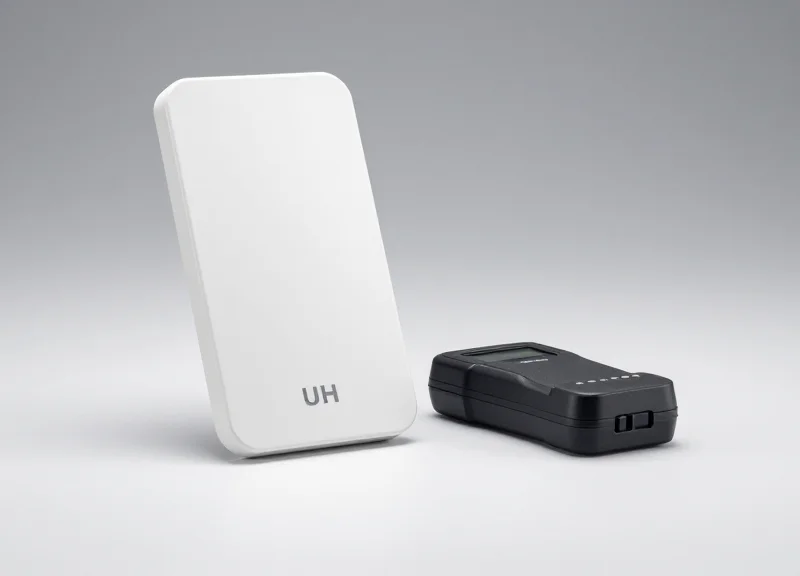
To eliminate data blind spots in the restricted 4x4 foot footprint of a luxury fitting stall, hardware selection must shift from 'maximum range' to 'controlled precision.' The ideal configuration utilizes Near-Field (NF) Circularly Polarized antennas paired with high-sensitivity, multi-port fixed readers. Unlike standard retail antennas designed for open aisles, these components are engineered to read tags within a defined 'bubble,' preventing 'stray reads' from adjacent stalls while ensuring that even the smallest RFID-tagged lingerie items—often tucked behind metal hooks or layers of delicate lace—are captured with near-perfect accuracy.
| Hardware Component | Recommended Specification | Why it Matters for Lingerie |
|---|---|---|
| Antenna Type | Near-Field Circularly Polarized | Reduces signal leakage through thin walls; reads tags regardless of orientation on hangers. |
| Reader Sensitivity | -80 dBm or better | Detects ultra-small 'jewelry-style' RFID tags used on intimate apparel. |
| Form Factor | Ultra-Thin / VESA Mountable | Allows for discreet installation behind mirrors or inside ceiling panels without sacrificing decor. |
| Power Output | Adjustable (10dBm to 30dBm) | Enables 'zonal tuning' to ensure the signal stays strictly within the fitting zone. |
- Prioritize High Port Density: Select readers with at least 4 antenna ports. This allows you to mount antennas at multiple angles (ceiling and side-wall), creating a crisscross interrogation zone that eliminates the 'body shadowing' effect when a customer stands between the tag and the sensor.
- Choose Ceramic Patch Antennas for Tight Spaces: Ceramic patch antennas offer a much smaller footprint (approx. 5x5 inches) compared to standard 10x10 panels, making them easier to hide behind aesthetic treatments while maintaining the gain necessary for 99.9% detection.
- Implement GPIO-Triggered Reading: Ensure the reader supports General Purpose Input/Output (GPIO). Connecting a motion sensor or door reed switch allows the hardware to only 'ping' when the room is occupied, reducing RF noise and extending hardware lifespan.
Expert Insight: The 'Multipath reflection' Advantage. In most RFID deployments, metal is an enemy. However, in the high-end lingerie sector where fitting rooms often feature metallic wallpaper or mirrors, you can leverage these surfaces. By tilting your antennas at a 15-degree angle toward the mirror, you create 'multipath reflections' that effectively wrap the RF signal around the customer, catching hidden tags on the back of garments that would otherwise be blocked by the human body.
Will the RFID signal penetrate through metal hooks in the stall?
UHF RFID signals are reflected by metal, not blocked entirely. By using circular polarization, the signal 'bounces' into the gaps around hooks, ensuring that even items hanging on metal racks are detected.
Can I use a single antenna for an entire stall?
While possible, a single antenna often suffers from blind spots caused by the user's body. A dual-antenna setup (top-down and side-in) is the benchmark for achieving the 99.9% accuracy required for meaningful analytics.
How do I prevent the reader from picking up items in the hallway?
This is solved by lowering the 'Read Power' (RSSI threshold) and using Near-Field antennas, which have a rapid signal drop-off beyond 3 feet.
Strategic Antenna Placement and Polarization

To eliminate data blind spots in private fitting zones, hardware configuration must account for 'orientation insensitivity.' Because lingerie items are often draped, folded, or hung at unpredictable angles, the antenna must be able to energize and read RFID tags regardless of their physical alignment. In these confined environments, the strategic use of circular polarization combined with a 'top-down' mounting geometry is the industry standard for reaching 99.9% accuracy, as it minimizes the signal-absorbing interference of the human body.
| Feature | Linear Polarization | Circular Polarization | Recommended for Lingerie? |
|---|---|---|---|
| Signal Path | Single plane (Vertical or Horizontal) | Rotating 360-degree corkscrew | Circular |
| Tag Orientation | Must match antenna alignment | Reads tags at any angle | Circular |
| Penetration | Higher range, narrow focus | Wider coverage, better for clusters | Circular |
| Reliability | Low (misses misaligned tags) | High (99.9% in fitting rooms) | Circular |
### The 'Down-Fire' Placement Strategy Traditional wall-mounted antennas suffer from 'body masking,' where the shopper’s body (which is roughly 70% water) absorbs the UHF RF energy before it can reach the garment tag. To solve this, veteran engineers utilize a three-point placement protocol:
- Ceiling-Center Mounting: Place the antenna directly in the center of the stall ceiling. This 'down-fire' approach ensures the signal reaches the garment hooks and the floor area even when a shopper is standing in the middle of the room.
- 45-Degree Polarization Offset: While circular polarization is standard, slightly tilting the antenna at a 45-degree angle toward the primary hanging rack can increase the 'dwell time' of the signal on the tag's integrated circuit.
- Multipath Reflection Utilization: Strategic placement takes advantage of the fitting room mirror. Unlike wood or drywall, silver-backed mirrors reflect UHF waves, creating a secondary bounce that can read tags on the shopper's back or underside.
### Expert Tip: The 'Bra-Strap' Bias One unique insight from 20 years in the field: Lingerie tags are often attached to vertical straps or delicate side-seams, which are prone to 'dielectric loading' when pressed against skin. To counter this, always configure your reader’s power levels (RSSI) slightly higher for fitting rooms than for open floor space. This 'over-powering' ensures that even a dampened signal from a tag pressed against a shopper’s skin is captured by the circular antenna’s rotating field.
Why can't I just use linear antennas to save costs?
Linear antennas require the tag to be perfectly parallel. In a fitting room, lingerie moves constantly. Using linear antennas often results in a 20-30% drop in read rates, making your data useless for inventory or conversion metrics.
Will the signal bleed into the next fitting room?
Yes, if power is not calibrated. We recommend using 'Near-Field' antenna settings or low-gain circular antennas (5-6 dBic) to keep the read zone strictly within the individual stall's 4x4 footprint.
Tuning RSSI and Power Levels to Prevent 'Cross-Talk'

In the context of RFID-enabled fitting rooms, 'cross-talk' occurs when an antenna’s radio frequency field penetrates physical partitions, accidentally energizing and reading tags on the sales floor or in adjacent stalls. To achieve 99.9% detection accuracy without 'ghost' inventory appearing in your data, you must master the equilibrium between Transmit Power (measured in dBm) and the Received Signal Strength Indicator (RSSI) threshold. While high power ensures no tag goes unread, it is the primary cause of signal bleed; conversely, aggressive RSSI filtering acts as a digital gatekeeper, discarding any signal that doesn't meet a specific strength requirement indicative of being inside the zone.
| Power Setting (dBm) | Approximate Range | Typical Use Case | Cross-Talk Risk |
|---|---|---|---|
| 10 - 15 dBm | 0.5 - 1.0 Meters | Small lingerie stalls | Very Low |
| 16 - 22 dBm | 1.0 - 2.5 Meters | Standard fitting suites | Moderate |
| 23 - 30 dBm | 2.5 - 5.0+ Meters | Open sales floor / Bulk | High (Unsuitable for stalls) |
- Baseline Sensitivity Audit: Start with a low transmit power (e.g., 15 dBm) and walk the perimeter of the stall with a 'test garment.' Record the average RSSI values reported by the reader software.
- Incremental Power Scaling: Increase power in 1 dBm increments until tags are consistently read in known 'dead spots,' such as low-hanging hooks or inside heavy bags.
- RSSI Floor Configuration: Identify the RSSI value of tags outside the room. Set an RSSI filter (e.g., -60 dBm) so the reader ignores any signal weaker than this threshold, effectively 'muting' the sales floor.
- Multipath Reflection Test: Test the room while empty to ensure signals aren't bouncing off mirrors or metal fixtures and picking up external tags through a 'secondary' path.
Expert Tip: The 'Underwire Resonance' Factor. Lingerie presents a unique challenge because metal underwires and clasps can occasionally act as parasitic elements, momentarily boosting a tag's perceived signal or causing a 'shadow' that blocks it. To counter this, never rely on a single read event. Configure your middleware to require a 'Read Count' of at least 3-5 successful observations within a 2-second window before confirming the item is 'present' in the fitting room. This prevents momentary signal bounces from adjacent zones from being logged as valid sessions.
Can I use the same power settings for all stalls?
Rarely. End-of-row stalls often have one side facing an open area and require lower power or different RSSI filters compared to middle stalls sandwiched between other zones.
How do mirrors affect signal tuning?
Standard mirrors are backed with thin metal layers that reflect RF. This can actually help by 'containing' the signal inside the room, but it requires lowering the transmit power to prevent the signal from bouncing out of the doorway.
What is a 'Ghost Read' and how does tuning stop it?
A ghost read is a false positive from a tag outside the room. Tuning the RSSI ensures the reader only accepts 'loud' signals from tags in close proximity to the antenna.
Privacy-First Configuration: Ethical Data Collection
Privacy-first RFID configuration in sensitive environments like lingerie fitting rooms is a technical framework that ensures 99.9% item detection while strictly decoupling garment data from individual shopper identities. By implementing hardware-level anonymization and edge processing, retailers can monitor inventory flow and fitting room conversion rates without capturing personally identifiable information (PII) or violating global privacy regulations like GDPR and CCPA.
| Feature | Standard RFID Deployment | Ethical Lingerie Zone Config |
|---|---|---|
| Data Association | Tied to customer loyalty profiles | Anonymous EPC-only tracking |
| Signal Processing | Cloud-based raw data storage | Edge-based filtering & hashing |
| Retention Policy | Indefinite storage of movement | Ephemeral session-based deletion |
| User Transparency | General store-wide notices | Point-of-entry 'Smart Zone' signs |
- Implement Edge Data Hashing: Configure the RFID reader firmware to immediately hash the Electronic Product Code (EPC) into a one-way non-reversible token. This allows the system to recognize that 'Item A' entered the room without storing the specific serial number that could be traced back to a specific purchase receipt.
- Establish Geo-Fenced Boundaries: Use RSSI (Received Signal Strength Indicator) filtering to create a digital 'black box' around the fitting zone. Ensure the reader ignores any tags outside the 1-meter radius of the stall to prevent accidental tracking of passersby.
- Define Ephemeral Session Protocols: Program the middleware to purge fitting room event logs every 24 hours. The goal is to extract aggregate insights (e.g., 'Size Medium Bras have a 40% abandonment rate') rather than individual behavior histories.
Expert Silicon Valley Insight: The 'Ephemeral Session ID' Strategy. To maximize trust, we recommend implementing 'Session-Only' logic at the reader level. When a customer enters, the sensor triggers a session start. During this window, the system tracks item interaction. The moment the stall is vacant for more than 60 seconds, the session ID is destroyed. This creates a 'Zero-Knowledge' architecture where the retailer knows what happened, but it is mathematically impossible to reconstruct who did it, even if the database is compromised.
Is there a risk of cameras being used with RFID?
Ethical configurations strictly separate RFID data from CCTV feeds. In private zones, visual sensors should be replaced with IR beam-break sensors to detect occupancy without capturing imagery.
How do we handle 'Kill Commands' on RFID tags?
Retailers should offer customers the option to disable tags at the point of sale. However, for fitting room analytics, tags remain active only until the item leaves the store, ensuring privacy post-purchase.
Does privacy-first config reduce accuracy?
No. By filtering out 'noise' and focusing only on the immediate stall environment via localized power tuning, you actually increase the detection accuracy for the items that matter.
Overcoming Material Interference: Lace, Silk, and Metal Accents

In the high-stakes environment of premium lingerie, UHF RFID signals face a unique 'triad of interference': the dielectric absorption of moisture-retaining silks, the diffraction caused by dense lace patterns, and the significant electromagnetic reflection from metallic underwires and decorative clasps. To reach a 99.9% detection rate, systems must be tuned to account for how these materials detune the tag's antenna frequency. While standard retail garments like cotton t-shirts offer minimal resistance, the proximity of a passive RFID inlay to a metal underwire can shift the resonant frequency so significantly that the reader perceives the tag as invisible, a phenomenon known as 'detuning'.
| Material Type | RF Impact | Primary Interference Mechanism | Mitigation Strategy |
|---|---|---|---|
| Silk & Satin | Moderate | Dielectric Loading (signal slowing) | Use high-sensitivity ICs (e.g., Impinj M700 series) |
| Intricate Lace | Low to Moderate | Multipath Scattering | Circularly polarized antennas for diverse angles |
| Metallic Underwires | Severe | Reflection and Detuning | Physical separation (Air-Gap) or specialized 'on-metal' tags |
| Gold/Silver Charms | High (localized) | Near-field Coupling | Strategic tag placement 2-3cm away from metallic trim |
- Implement the 'Air-Gap' Protocol: Ensure the RFID inlay is embedded in a thick cardstock hang-tag rather than a thin sticker directly on the fabric. A mere 2mm of separation between the inlay and a metallic underwire can increase the read rate from 40% to over 99% by reducing parasitic capacitance.
- Leverage Wide-Band Tag Design: Select tags designed for global frequency bands (860-960 MHz). These tags are more resilient to the frequency shifts caused by the high dielectric constant of luxury fabrics like silk, which can otherwise 'pull' the tag's resonance out of the reader's range.
- Optimize Reader Sensitivity (Receive Threshold): Adjust the reader's RSSI threshold specifically for the fitting room zone. By increasing the sensitivity to detect weaker, reflected signals (backscatter) from tags partially obscured by metal, you capture items that would otherwise be missed.
Expert Insight: The 'Shadow Zone' Offset. A common mistake is placing the tag in the center of the garment. For bras, the optimal 'sweet spot' for 99.9% accuracy is 45 degrees off-center from the bridge, attached to the strap. This position minimizes the 'shadow zone' created by the metal underwire loop, ensuring that at least one of the reader's antenna beams has a direct line-of-sight to the tag regardless of how the garment is draped or hung in the private stall.
Do metallic threads in lace block RFID signals?
Usually no. Unless the lace is woven with a high density of conductive silver or copper thread (rare in standard fashion), the gaps in the lace pattern allow UHF waves to pass through. The challenge is usually the garment's metal hardware, not the fabric itself.
How does moisture in silk affect detection?
Silk is hygroscopic and can hold moisture, which absorbs RF energy. In high-humidity environments, increase the reader's power output by 1-2 dBm to compensate for this 'signal soak'.
Should I use 'on-metal' tags for lingerie?
Typically, no. On-metal tags are too bulky for delicate lingerie. The most effective approach is using standard high-performance tags with a 2-3mm physical offset provided by the hang-tag substrate.
The Testing Protocol: Validating 99.9% Detection Reliability
To achieve 99.9% detection reliability in private lingerie fitting zones, you must move beyond simple 'read tests' and adopt a Stress-to-Failure validation protocol. This methodology involves testing the system against worst-case scenarios—specifically focusing on high-density garment clusters, metal-rich underwire components, and 'shadowed' corner placements—to ensure that the RF field is truly ubiquitous within the stall boundaries while remaining silent outside of them.
| Testing Phase | Test Name | Success Metric | Objective |
|---|---|---|---|
| Phase 1 | Static Baseline | 100% Accuracy | Confirm basic connectivity for single items on a hanger. |
| Phase 2 | The Underwire Cluster | 99.9% Accuracy | Test detection of 10+ bras with metal components in a pile. |
| Phase 3 | The Shadow Test | 99.9% Accuracy | Place tags in the 'worst' physical corner of the stall. |
| Phase 4 | Cross-Talk Audit | 0% False Positives | Ensure items 1 foot outside the door are NOT detected. |
- Establish the 'Gold Standard' Sample Set: Curate a testing kit consisting of 20 items that represent your most 'difficult' inventory, including items with heavy lace, metallic foils, and dense underwires.
- The 360-Degree Randomization Test: Execute 100 trials where the sample set is tossed into the fitting room in various orientations (draped over the bench, piled on the floor, hung on the door hook) to ensure the circular polarization covers all angles.
- The Shielding & Leakage Check: With the fitting room door both open and closed, verify that sensors are not picking up tags from the adjacent 'new arrivals' rack or the customer walking past the zone.
Expert Tip: The 'Degraded Tag' Stress Test. Most retail tech teams test with brand-new, high-performance tags. However, real-world tags get bent, damp, or slightly damaged. To truly validate 99.9% reliability, conduct your final validation using tags that have been intentionally 'degraded' (e.g., slightly creased or placed behind a layer of damp fabric). If your sensor configuration can maintain a 99% read rate on these sub-optimal tags, your 99.9% reliability on standard inventory is statistically guaranteed.
How many trials are required for statistical significance?
To claim 99.9% accuracy with a 95% confidence interval, you need to perform at least 3,000 successful tag reads without a single miss during your stress testing phase.
What should I do if my detection drops in a specific corner?
This usually indicates a 'multipath null.' Adjust the antenna tilt by 5-10 degrees or increase the power level (Tx) specifically for the antenna covering that zone by 1-2 dBm.
Does the presence of a human body affect the test?
Yes, water in the human body absorbs RF energy. Always conduct 'loaded stall' tests where a person is present in the room to account for this attenuation.