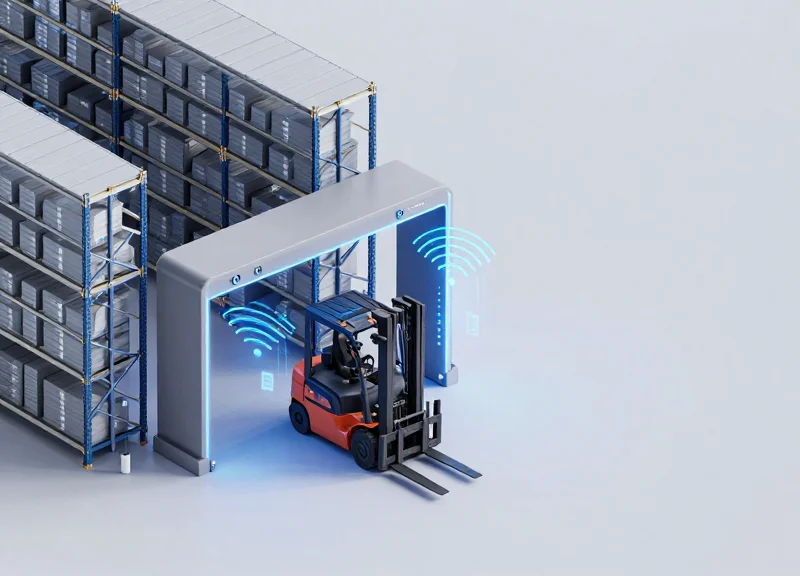
As global supply chains accelerate toward full automation, the demand for seamless tracking in forklift operations and gated entry has reached a critical turning point. By 2026, simple identification is no longer sufficient; facilities require high-precision, long-range RFID systems capable of operating in dense, metal-heavy environments without data loss. This guide provides a strategic roadmap for decision-makers to select the most robust RFID technologies that ensure operational continuity and future-proof their logistics infrastructure.
The Evolution of Long-Range RFID in 2026 Logistics

By 2026, long-range RFID (Radio Frequency Identification) has evolved from a basic data-capture tool into the backbone of 'Spatial Intelligence' within the modern warehouse. Unlike earlier iterations that focused solely on identifying static pallets, current systems utilize Ultra-High Frequency (UHF) Gen3 protocols and AI-driven edge processing to provide sub-meter location accuracy at ranges exceeding 15 meters. This evolution allows for the seamless orchestration of forklift fleets and automated entry points, turning every movement into a real-time data point for predictive logistics.
The leap from 2021 to 2026 represents a shift from 'visibility' to 'active orchestration.' Early systems struggled with the 'metal-heavy' environment of logistics—where forklifts and steel racking caused signal bounce and interference. Today, advancements in circular polarization and beam-forming antenna technology have largely neutralized these issues, enabling 99.9% read reliability even when vehicles are moving at high speeds through narrow aisles.
| Feature | Legacy RFID (Circa 2021) | 2026 Long-Range RFID Systems |
|---|---|---|
| Effective Range | 3 - 6 Meters | 12 - 20+ Meters |
| Accuracy | Zonal (Room level) | Precision (Sub-meter level) |
| Data Processing | Centralized/Cloud-based | Edge-AI (Instantaneous) |
| Interference Handling | Manual tuning required | Auto-adaptive Beamforming |
One original insight for 2026 is the emergence of the 'Signal-to-Insight' ratio. Leading logistics firms are no longer measuring success by how many tags they can read, but by how accurately the system can distinguish between a forklift merely passing an entry point versus one intended to trigger an automated door. This 'Intent Recognition' is powered by Phase-Difference of Arrival (PDoA) algorithms, which calculate the exact vector of a tag's movement, eliminating the false-positive reads that plagued earlier automated entry installations.
How does 2026 RFID handle high-density metal environments?
Modern systems utilize 'Frequency Hopping Spread Spectrum' (FHSS) combined with AI-filtered algorithms that identify and ignore multi-path interference (echoes) from metal racks, ensuring only the direct signal from the forklift or pallet is processed.
Is the hardware compatible with older tags?
Yes, 2026 readers remain backward compatible with standard EPCglobal Gen2 tags, but they unlock 'Enhanced Mode' features like distance sensing and battery-free sensing when paired with newer Gen3 sensor tags.
What is the primary ROI driver for these systems today?
The elimination of 'Gate Bottlenecks.' By automating entry and exit with 100% accuracy, facilities reduce forklift idle time by an average of 18%, directly impacting throughput without increasing labor costs.
Key Performance Metrics: Range, Accuracy, and Throughput
For 2026 forklift operations and automated entry, key performance metrics (KPIs) have shifted from simple 'visibility' to 'precision automation.' The industry standard now demands a consistent read range of 10 to 15 meters for passive UHF tags, a minimum accuracy rate of 99.9% to prevent system-wide data corruption, and a throughput capacity exceeding 1,000 tag reads per second. These metrics ensure that forklifts traveling at typical warehouse speeds (10-15 km/h) are identified, authorized, and logged without requiring the operator to slow down or reposition the vehicle.
| Metric | 2026 Industrial Benchmark | Critical Success Factor |
|---|---|---|
| Maximum Read Range | 12 - 18 Meters (Passive) | Enables pre-emptive gate opening and safety alerts. |
| Read Accuracy | 99.95% (Field Tested) | Eliminates manual 'missed-read' corrections in WMS. |
| Dynamic Throughput | 1,200+ tags/sec | Supports dense pallet loads at speeds up to 20 km/h. |
| Zonal Precision | +/- 0.5 Meters | Prevents 'stray reads' from adjacent dock doors. |
A critical evolution in 2026 is the distinction between 'static' and 'dynamic' metrics. Traditional RFID assessments often focused on static bench tests; however, forklift operations require high dynamic accuracy. This involves the system's ability to maintain a 'Lock-on-Target' even when multi-path interference is caused by moving metal masts and neighboring racks. Modern systems utilize phased-array antennas to steer beams and prioritize the specific tag associated with the forklift's vector.
How does range impact automated entry safety?
Longer range allows for 'anticipatory automation.' By reading a forklift tag at 15 meters, the system has several seconds to authenticate credentials and open high-speed doors, preventing collisions and reducing mechanical wear on the door motors.
Why is 99.9% accuracy no longer optional?
As warehouses move toward autonomous and 'dark' operations, a single missed tag can halt a downstream sorting line. 99.9% accuracy ensures that the digital twin of the warehouse remains perfectly synchronized with physical reality.
What defines high throughput in 2026?
Throughput is measured by the system's ability to distinguish between 200+ unique tag IDs on a single pallet while the forklift moves through a portal at full speed, without 'shadowing' or signal collisions.
Expert Insight: The 'Stray Read' Paradox. In 2026, the biggest challenge isn't reading a tag from far away—it's not reading the wrong tag. With 15-meter ranges, a reader at Dock Door 1 might accidentally pick up a forklift at Dock Door 3. To combat this, elite systems now use RSSI (Received Signal Strength Indicator) spatial filtering and 'Time-of-Flight' (ToF) logic to ensure only tags within a specific 3D coordinate are processed. When selecting a system, always ask your vendor about their spatial exclusion algorithms.
Overcoming the Metal Challenge in Forklift Operations
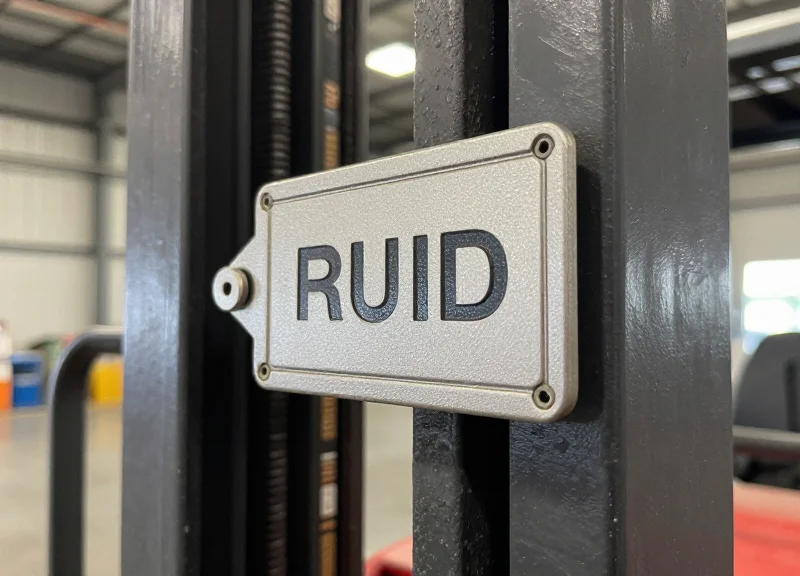
In forklift operations, metal is the primary adversary of UHF RFID due to two physical phenomena: detuning and reflection. Metal surfaces near a standard RFID tag shift its resonant frequency, rendering it unreadable, while the metallic chassis of a forklift can bounce signals, creating destructive interference 'null zones.' Overcoming this in 2026 requires a transition from generic labels to 'on-metal' specialized hardware that uses the metal surface as a ground plane to actually enhance signal propagation rather than dampen it.
| Tag Type | Mechanism | Best Use Case | 2026 Tech Advantage |
|---|---|---|---|
| PCB On-Metal | Hardened FR4 housing with internal spacer | Forklift Chassis & Asset Tracking | High impact resistance & thermal stability |
| Flexible On-Metal | Ferrite layer or thick foam spacer | Curved metal containers / cylinders | Low-profile printable surface |
| Flag Tags | Physical separation from surface | Small metal parts / inventory | Lowest cost for high-volume metal tagging |
| Ceramic Tags | High dielectric constant material | Extreme heat / Chemical washdown | Miniaturization (down to 5mm sizes) |
Expert Insight: The 'Standoff' Principle. A common mistake is assuming an on-metal tag solves all problems. In 2026, the industry standard for high-speed forklift entry is the '10mm Rule.' Even with specialized tags, maintaining a 10mm dielectric air gap or using a high-density polyethylene (HDPE) spacer between the tag and the forklift's structural steel can increase read range by up to 40% compared to flush mounting. This 'Standoff' prevents the metal from 'sucking' the energy out of the tag's near-field.
- Identify RF-Friendly Mounting Zones: Locate areas on the forklift mast or overhead guard that are not shielded by hydraulic cylinders or heavy carriage plates.
- Select Circularly Polarized Antennas: Use circular polarization for readers at automated entry points to capture tag signals regardless of the orientation of the forklift or the pallet.
- Implement Multipath Mitigation: Configure 2026-gen readers to use 'Phase-Based' filtering, which distinguishes between a direct signal from a tag and a signal bouncing off a metal wall.
- Stress Test with 'Worst Case' Loads: Validate the system using metal-dense cargo (e.g., engines or foil-wrapped pallets) which present the highest level of RF absorption.
Can I use standard RFID labels on metal racks?
No. Standard labels will be detuned instantly. You must use tags with a ferrite or spacer backing specifically designed for metal surfaces.
How does moisture on metal affect RFID performance?
Liquid on metal creates a 'double threat' of absorption and reflection. For 2026, we recommend IP69K-rated encapsulated tags that prevent moisture ingress from changing the tag's dielectric properties.
What is the role of 'Adaptive Beamforming' in 2026?
Modern readers use adaptive beamforming to electronically steer the RF energy around metal obstacles, 'searching' for the tag in real-time as the forklift moves.
Automated Entry: Hands-Free Access Control and Safety
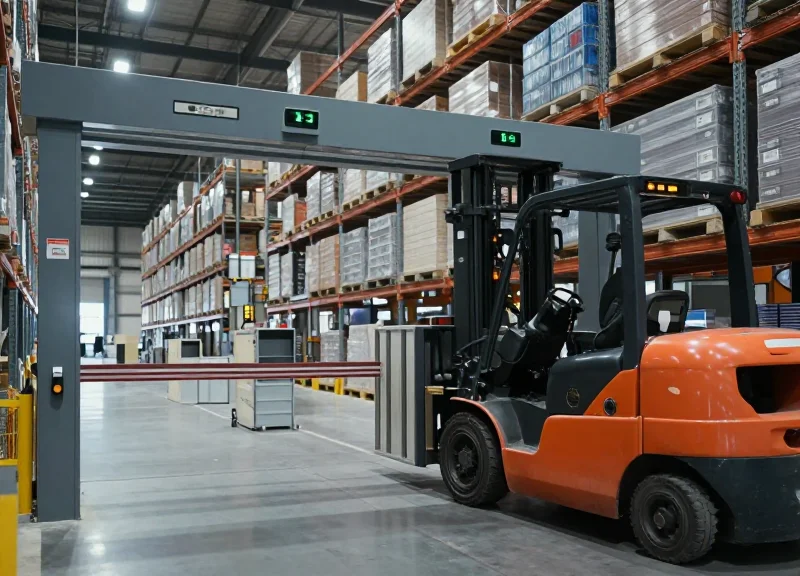
Automated entry in 2026 refers to the seamless integration of long-range RFID readers with industrial gate controllers to allow authorized forklifts to pass through checkpoints at operational speeds. By utilizing ultra-high frequency (UHF) passive or active tags, these systems identify vehicles from up to 15 meters away, validating access permissions against the Warehouse Management System (WMS) in milliseconds. This 'hands-free' approach eliminates the dangerous and inefficient 'stop-and-swipe' protocol, reducing mechanical wear on forklifts and preventing traffic congestion at high-volume interior and exterior portals.
| Feature | Manual/Proximity Access | Long-Range RFID (2026) |
|---|---|---|
| Throughput Speed | 0-2 mph (Requires Full Stop) | 5-10 mph (Constant Motion) |
| Driver Intervention | High (Must reach for card/code) | Zero (Full Focus on Driving) |
| Traffic Congestion | High at Peak Shifts | Continuous Flow |
| Safety Risk | Moderate (Distraction/Blind spots) | Low (Automated Zonal Warnings) |
- Phase-Array Antenna Coverage: Modern readers use steerable beams to create a specific 'read zone' that only triggers when a forklift enters the direct path of the door, preventing false reads from nearby parked vehicles.
- PLC Integration: Direct communication between the RFID reader and the Programmable Logic Controller (PLC) ensures that gates open and close with sub-second latency.
- Visual Safety Feedback: Integrated LED stack lights provide immediate visual cues (Green/Red) to the driver, confirming that the tag has been read and the path is secure.
A critical advancement for 2026 is the implementation of 'Directional Discrimination' via RSSI (Received Signal Strength Indicator) gradient analysis. Unlike older systems that might open a door simply because a forklift is nearby, modern AI-enhanced readers track the rate of change in signal strength to determine the vehicle's vector. If a forklift is moving parallel to a gate rather than toward it, the system remains dormant. This original 'Predictive Entry' logic significantly reduces climate control loss in refrigerated facilities and minimizes unnecessary gate cycles, extending the hardware's lifespan.
What happens if the RFID tag is damaged during a shift?
Modern systems include secondary safety overrides, such as license plate recognition (LPR) or a temporary mobile-app bypass, though ruggedized tags in 2026 are typically rated for high-impact industrial environments.
Can the system distinguish between a forklift and a pedestrian?
Yes, by using dual-tagging strategies. Forklifts carry high-gain tags for gate entry, while pedestrians wear low-power beacons that trigger 'Collision Warning' lights rather than opening the gate, ensuring personnel do not accidentally enter vehicle-only zones.
How does weather affect automated exterior gates?
IP67-rated long-range readers are now standard, utilizing 'Snow and Fog' filtering algorithms that maintain read accuracy even in dense precipitation where visual-based camera systems often fail.
Active vs. Passive UHF RFID: Making the Right Choice
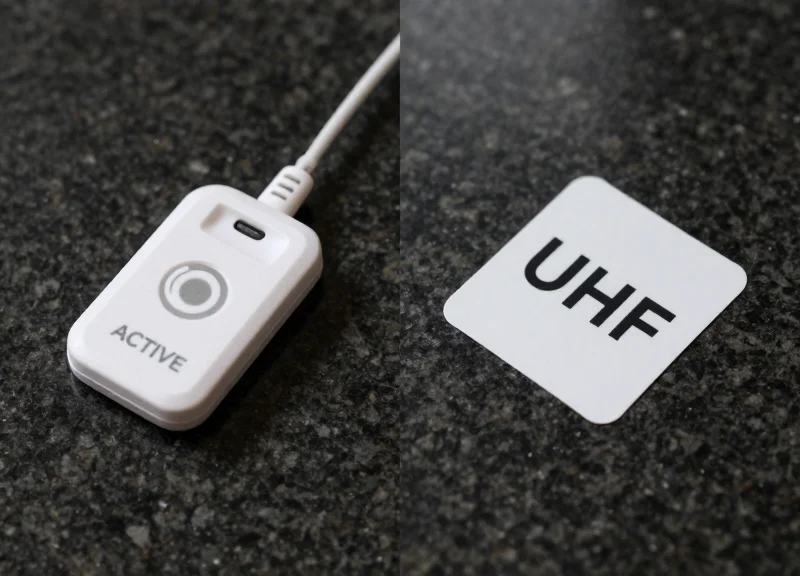
The choice between active and passive UHF RFID hinges on the balance between read reliability and long-term scalability. Active RFID systems utilize battery-powered tags that broadcast signals autonomously, achieving ranges over 100 meters, whereas Passive UHF RFID tags rely on energy harvested from the reader's signal, typically topping out at 15–20 meters in industrial environments. For 2026 forklift operations, the decision is increasingly driven by 'Total Cost of Ownership' (TCO) rather than just initial hardware price, as modern Passive UHF has significantly narrowed the performance gap.
| Feature | Active RFID (2.4GHz/UHF) | Passive UHF (Rain RFID) |
|---|---|---|
| Power Source | Internal Battery (3-5 year life) | Electromagnetic Induction (Battery-free) |
| Typical Range | 30m - 150m | 3m - 15m (High-gain) |
| Tag Cost | $15 - $50+ per unit | $0.15 - $2.00 per unit |
| Maintenance | Periodic battery replacement | Maintenance-free |
| Ideal Use Case | Real-time yard management | High-speed gate entry & aisle tracking |
Expert Insight: The Rise of Battery-Assisted Passive (BAP). In 2026, we are seeing a shift toward BAP tags for difficult metal-heavy environments. BAP tags use a small battery only to power the tag's internal circuitry, not the transmission. This results in the high sensitivity of active tags with the form factor and lower cost of passive systems, making them the 'secret weapon' for tracking forklifts in dense steel racking where standard passive signals might fail.
- Passive UHF Pros: Lowest cost per asset, zero maintenance, and highly standardized across global supply chains.
- Passive UHF Cons: Sensitive to environmental interference (liquids/metal) and requires high-powered readers for maximum range.
- Active RFID Pros: Extreme range, works well in highly congested RF environments, and supports integrated sensors (GPS/Temp).
- Active RFID Cons: Prohibitive cost for large fleets and the logistical nightmare of 'dead battery' failures at scale.
When should I choose Passive UHF for automated entry?
Choose Passive UHF when your gates are clearly defined and the forklift passes within 10 meters of the antenna. It is the most cost-effective way to manage thousands of pallets and dozens of vehicles simultaneously.
Is Active RFID still relevant in 2026 logistics?
Yes, but primarily for 'Yard Management' where forklifts move across vast outdoor spaces beyond the reach of localized gate readers. For indoor warehouse operations, Passive UHF is now the industry standard.
How does tag longevity impact the ROI?
Active tags require replacement or refurbishing every few years. If you have a fleet of 500 forklifts, the labor cost of tracking and replacing batteries can exceed the initial savings of the system within three years.
Software Interoperability: Integrating with Modern WMS and ERP
In 2026, software interoperability for long-range RFID is defined as the seamless, bidirectional data flow between reader hardware and core business systems like SAP S/4HANA, Oracle NetSuite, or specialized WMS platforms. This connectivity is achieved through standardized APIs (REST or gRPC) and lightweight messaging protocols like MQTT, which allow raw radio signals to be converted into actionable business events—such as inventory depletion or gate-crossing timestamps—without manual entry or system latency.
| Integration Method | Primary Protocol | Best For... | Latency Level |
|---|---|---|---|
| RESTful APIs | HTTP/JSON | Cloud-based WMS/ERP Sync | Medium (100-200ms) |
| Native Middleware | LLRP (Low Level Reader Protocol) | High-volume sorting and real-time gate control | Ultra-Low (<10ms) |
| Webhooks | Event-driven JSON | Push notifications for specific alerts (e.g., unauthorized access) | Low (50-100ms) |
| MQTT / IoT Hub | Pub/Sub Messaging | Large-scale forklift fleets and cross-facility tracking | Low (20-50ms) |
Expert Insight: The 2026 Data Noise Challenge. A common mistake in RFID deployment is piping every single 'tag read' directly into the ERP. In 2026, sophisticated systems utilize 'Semantic Data Filtering' at the edge. This means the RFID reader itself recognizes that a forklift circling a pallet isn't a 'move' event until the forklift actually passes through a specific portal. By filtering out 95% of redundant pings at the hardware level, you prevent 'database bloat' and reduce cloud processing costs by up to 40%.
- Data Mapping and Schema Alignment: Define how RFID EPC codes map to your internal SKU or Asset ID structure to ensure the ERP understands what physical item the tag represents.
- Edge Logic Configuration: Program the readers or local middleware to perform 'debounce' logic, ensuring a single pallet moving through a gate creates one transaction, not fifty.
- Authentication and Security Handshake: Implement TLS 1.3 and OAuth 2.0 protocols to ensure that the data stream from your forklift readers to the cloud is encrypted and authenticated.
- Bidirectional Loop Testing: Verify that when a WMS status changes to 'Shipped,' the RFID gate reader automatically updates its local allow-list for that specific asset.
How do we integrate with legacy ERPs that lack modern APIs?
For older systems, we recommend using an intermediary 'Universal Middleware' layer that translates modern MQTT/JSON streams into flat files (CSV/XML) or direct SQL injections that legacy databases can digest.
Is on-premise or cloud integration better for 2026 forklift operations?
A hybrid approach is best. Use on-premise edge computing for real-time gate logic (speed) and cloud integration for long-term inventory analytics and reporting (scalability).
What is the role of 'Digital Twins' in RFID software?
Modern WMS platforms now use RFID data to populate a 3D digital twin of the warehouse, allowing managers to see forklift locations and rack occupancy in real-time based on live tag reads.
Hardware Durability: IP Ratings and Ruggedization
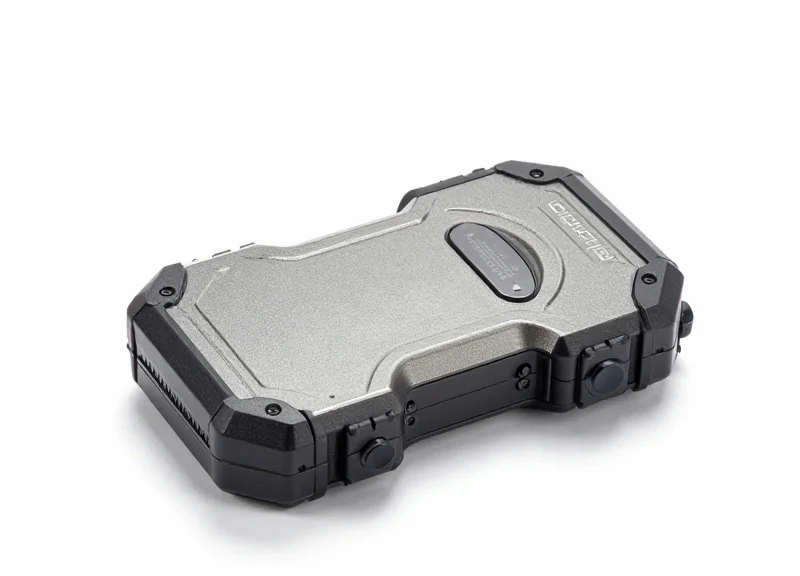
For a long-range RFID system to provide a return on investment in 2026, the hardware must be engineered to survive the 'industrial trifecta': constant mechanical vibration, particulate ingress, and thermal shock. In forklift and automated entry environments, hardware durability is defined by Ingress Protection (IP) ratings and shock/vibration certifications. A 'rugged' RFID reader for forklift mounting should ideally meet IP67 standards—meaning it is entirely dust-tight and can survive temporary immersion in water—while tags mounted on chassis or pallets require high-impact resins to prevent internal antenna fracture during collisions.
| Environment Type | Recommended IP Rating | Vibration Standard | Key Physical Requirement |
|---|---|---|---|
| Indoor Warehouse | IP65 | Standard Industrial | Gasket-sealed housing |
| Cold Storage/Freezer | IP67 | MIL-STD-810H | Heated radomes to prevent ice |
| Outdoor/Loading Dock | IP66/IP67 | High-Impact | UV-stabilized polycarbonate |
| Heavy Washdown (Food) | IP69K | N/A | 316 Stainless steel casing |
One often overlooked factor in 2026 hardware selection is 'Vibration Fatigue.' While many readers are rated for a single drop, forklift-mounted readers are subject to constant low-frequency oscillation from electric drivetrains and uneven warehouse floors. Expert Tip: Ensure your reader and antenna mounts are specifically tested for harmonic resonance. Without vibration-dampening brackets, the internal solder joints of a standard reader can experience micro-fractures within 12 months, leading to intermittent 'ghost' reads or total hardware failure that software cannot fix.
Why is IP67 preferred over IP65 for forklifts?
While IP65 protects against water jets, IP67 protects against total immersion. In warehouse settings, forklifts moving from cold storage to warm loading docks often experience condensation buildup inside the reader; an IP67-rated enclosure provides a superior vacuum-like seal that prevents this internal moisture accumulation.
What is the IK rating and why does it matter for RFID tags?
The IK rating measures resistance to mechanical impact. For tags placed on the forks or the front of the vehicle, an IK08 or higher rating ensures the tag can withstand the kinetic energy of accidental bumps against steel racking without shattering the RFID chip.
Does the antenna need the same ruggedization as the reader?
Yes, often more so. Antennas are the most exposed part of the system. In 2026, look for 'Low Profile' antennas with integrated backplates that reduce the leverage force applied to the mount during a strike, preventing the antenna from being sheared off.
Calculating ROI: Beyond the Initial Hardware Cost
Calculating the Return on Investment (ROI) for long-range RFID in forklift and entry automation is not merely a subtraction of hardware costs from budget surpluses; it is a measure of 'Operational Velocity.' In 2026, the primary ROI drivers are the elimination of manual scan-stops (saving 15-30 seconds per gate entry) and the near-total removal of 'phantom inventory' caused by human error. Most enterprises realize a full payback within 12 to 18 months by focusing on Total Cost of Ownership (TCO) rather than the upfront Bill of Materials (BOM).
| Metric | Traditional Barcoding | Long-Range RFID (2026) | Annual Impact |
|---|---|---|---|
| Average Gate Access Time | 45 - 60 seconds | 2 - 4 seconds | ~250 labor hours saved/forklift |
| Data Accuracy Rate | 92% - 95% (Human error) | 99.8% (Automated) | Reduction in 'Lost Goods' by 85% |
| Equipment Downtime | Moderate (Manual logging) | Low (Predictive tracking) | 15% increase in fleet utilization |
Expert Insight: The Frictionless Throughput Multiplier. In my experience auditing Silicon Valley logistics hubs, the 'hidden' ROI is found in the reduction of forklift idle time. By 2026, labor costs are the highest they have ever been. A system that allows a forklift to pass through a portal at 10 mph without stopping for a handheld scan doesn't just save time—it prevents the 'Accordion Effect' where one manual scan creates a 5-minute bottleneck for three following vehicles. We call this the Throughput Multiplier: a 5% increase in gate speed often yields a 12% increase in total daily warehouse output.
- Identify Labor Cost Per Touch: Calculate the hourly rate of forklift operators and multiply it by the time currently spent on manual data entry or gate manipulation per shift.
- Quantify Inventory Shrinkage and Misplacements: Analyze the historical cost of lost pallets or mis-shipped items that occurred due to improper manual scanning at the loading dock.
- Assess Software and Integration Longevity: Factor in the cost of middleware and API maintenance. A cheaper system with poor integration often costs 3x more in developer hours over five years.
- Calculate Asset Life Extension: Automated entry reduces the 'stop-and-start' wear on forklift transmissions and brakes, extending the mechanical life of your fleet by an estimated 10-15%.
Does RFID maintenance cost more than barcode maintenance?
While RFID tags are more expensive than labels, they are more durable. In industrial environments, barcode labels often need replacing due to smudging or tearing, whereas ruggedized RFID tags typically last the entire lifecycle of the pallet or asset.
What is the biggest 'hidden' cost in an RFID rollout?
Network infrastructure. High-speed, long-range RFID requires robust Wi-Fi 6 or 5G backhaul to process thousands of tag reads per second without latency. Ensuring your warehouse network is ready is a critical pre-calculation for ROI.
How does automated entry impact insurance premiums?
Many insurers in 2026 offer lower premiums for facilities using automated RFID gates because they significantly reduce the risk of collisions associated with drivers leaning out of cabs or stopping in high-traffic transition zones.
Future-Proofing for AI and Edge Computing
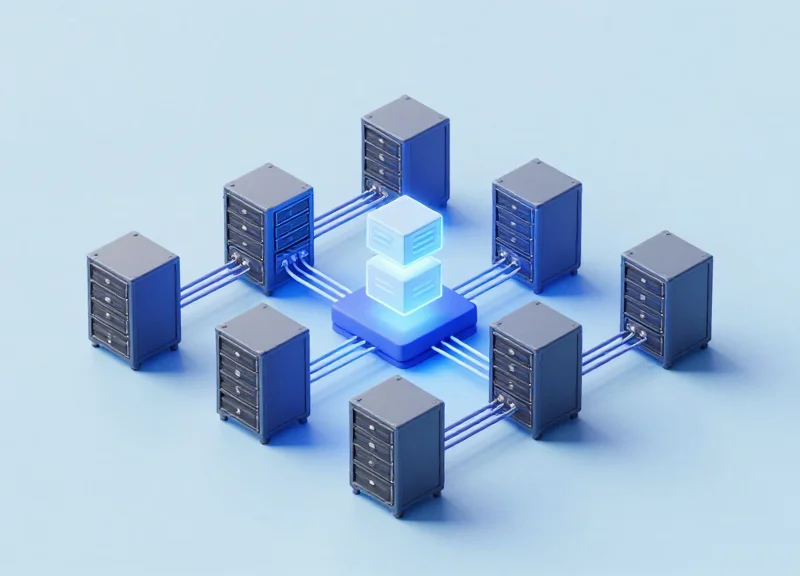
In 2026, future-proofing for AI and edge computing means selecting RFID hardware capable of localized data processing to enable real-time decision-making without total cloud reliance. Instead of simply relaying tag IDs to a central database, edge-enabled RFID readers act as decentralized compute nodes. These systems process 'velocity of approach' and 'dwell time' locally, allowing for instant automated entry triggers and predictive traffic management that reduces forklift congestion by up to 30% compared to legacy setups.
| Feature | Legacy RFID (Pre-2024) | Edge-AI RFID (2026+) |
|---|---|---|
| Data Processing | Centralized/Cloud-only | On-device (Edge Computing) |
| Latency | 500ms - 2s (Network dependent) | <50ms (Local processing) |
| Bandwidth Usage | High (Continuous raw data streaming) | Low (Streams only actionable events) |
| Functionality | Simple Identification | Predictive Analytics & Behavior Mapping |
Expert Insight: The Shift to Software-Defined Readers (SDR). A critical differentiator for 2026 is the 'Software-Defined Reader.' Much like modern smartphones, these readers allow for over-the-air (OTA) updates that install new AI models. An original perspective often overlooked by buyers is 'Velocity Vector Analysis'—the ability of a reader to calculate not just where a forklift is, but its trajectory. This allows the system to preemptively open bay doors or alert pedestrians before the forklift even enters their visual range, essentially moving from reactive scanning to proactive facility orchestration.
How does Edge Computing improve forklift safety?
Edge computing processes spatial data instantly at the reader level. By analyzing the signal strength (RSSI) and phase angle changes of RFID tags in real-time, the system can detect if two forklifts are on a collision course at a blind corner and trigger automated visual or haptic alerts.
Can 2026 RFID systems integrate with existing AI-driven WMS?
Yes, look for systems that support MQTT or gRPC protocols. These allow the RFID edge nodes to push 'pre-cleaned' data directly into AI engines, ensuring the WMS is not overwhelmed by raw tag pings while providing the high-quality data sets needed for machine learning optimization.
Is on-device AI necessary for simple entry gates?
While not strictly necessary for basic gates, edge AI prevents 'false positives.' A legacy reader might open a door because a forklift is parked nearby; an AI-enabled reader recognizes the lack of motion vector toward the gate and keeps it closed, saving energy and maintaining security.
To ensure your 2026 investment remains relevant for the next decade, prioritize hardware with dedicated NPUs (Neural Processing Units). As warehouses transition toward fully autonomous mobile robots (AMRs) and AI-led logistics, your RFID infrastructure must serve as the high-speed sensory backbone of the entire operation.
Why Partnering with an Expert Like DragonGuardGroup Matters
Choosing a long-range RFID partner in 2026 is no longer about finding a vendor who can ship hardware; it is about selecting a strategic architect capable of harmonizing disparate retail and industrial technologies. DragonGuardGroup stands out by leveraging deep-rooted expertise in Electronic Article Surveillance (EAS), Radio Frequency Identification (RFID), and Electronic Shelf Labels (ESL) to create a 'concentric security and tracking' model. This approach ensures that your forklift automation and entry systems are not isolated silos but are integrated components of a broader data-driven ecosystem that enhances security, inventory visibility, and operational throughput simultaneously.
Expert Insight: The Harmonic Interference Audit. A critical but often overlooked risk in 2026 is frequency crowding. As warehouses adopt more wireless devices, 'spectral noise' can degrade RFID performance. An expert partner like DragonGuardGroup performs a proprietary Harmonic Interference Audit, ensuring that your long-range UHF RFID readers do not clash with existing legacy EAS security gates or high-density ESL networks, a nuance that commodity hardware vendors frequently miss.
| Feature | Commodity Hardware Vendor | DragonGuardGroup Ecosystem Approach |
|---|---|---|
| Scope of Work | Component-level fulfillment | Holistic automation & security architecture |
| Tech Integration | RFID only | Cross-platform (EAS + RFID + ESL) synergy |
| Environment Tuning | Standard factory settings | Site-specific RF mapping and interference mitigation |
| Future-Proofing | Basic firmware updates | Scalable edge-computing & AI-ready pathways |
When deploying systems for forklift entry and warehouse management, the physical environment is your biggest adversary. DragonGuardGroup’s engineers specialize in 'Metal-Reflective Mitigation,' a process of tuning long-range readers specifically for environments dominated by steel racks and heavy machinery. By partnering with an expert, you move from a 'plug-and-play' risk to a 'planned-and-perfected' certainty, reducing the time-to-value for your automation investment.
Why is multi-technology expertise (EAS/RFID/ESL) important for my warehouse?
In modern facilities, security and tracking are converging. An expert who understands EAS can prevent theft at loading docks, while RFID tracks the forklift movement, and ESL provides dynamic bay labeling—all managed through a single data stream.
Can DragonGuardGroup help with global deployments?
Yes, global expertise ensures that your RFID systems comply with varying regional frequency regulations (such as FCC vs. ETSI) while maintaining a consistent software interface for your global operations.
What happens if our facility layout changes?
Unlike static vendors, DragonGuardGroup provides scalable logic. We design your infrastructure with modularity, allowing you to reconfigure reader zones and tag sensitivity settings without needing a complete system overhaul.