In the high-stakes world of luxury lingerie, the fitting room is where the final purchase decision happens. As we approach 2026, standard mirrors are no longer enough to satisfy the expectations of modern high-end consumers. Discerning customers now seek a seamless, private, and tech-enhanced experience that mirrors the exclusivity of the brand. This guide explores how RFID smart fitting room technology is revolutionizing the boutique experience, balancing intimate privacy with data-driven retail efficiency to drive conversion and brand loyalty.
The Evolution of Luxury Lingerie Retail in 2026

In 2026, the luxury lingerie sector has moved beyond traditional brick-and-mortar concepts to embrace a 'phygital' ecosystem where the fitting room is the undisputed center of the customer journey. Luxury retail is no longer defined solely by the quality of silk or lace, but by the seamless integration of invisible technology that anticipates a client's needs. The evolution focuses on 'Hyper-Personalization at Scale,' using RFID (Radio Frequency Identification) to bridge the gap between digital convenience and the intimate, high-touch service expected in premium boutiques. This shift ensures that every interaction is data-driven yet remains deeply personal and discreet.
| Feature | Traditional Luxury (Pre-2024) | 2026 Smart Boutique |
|---|---|---|
| Client Recognition | Relies on staff memory/manual CRM | Automated via RFID-enabled loyalty/appointments |
| Fitting Room Service | Manual bell or calling out for staff | Instant 'Magic Mirror' digital requests |
| Product Recommendations | Static suggestions based on floor stock | AI-driven pairings based on real-time inventory |
| Privacy Levels | Standard curtains and physical checks | Total privacy with digital item status tracking |
One of the most significant shifts in 2026 is the 'Privacy-Data Paradox.' While customers in the intimate apparel space demand the highest levels of privacy, they also expect the boutique to know their preferences, size history, and style profile perfectly. Modern RFID systems solve this by using passive sensors that identify garments without cameras, ensuring that sensitive fitting room environments remain private while still providing data-rich insights to the concierge. This 'invisible concierge' model allows staff to deliver the right size or a matching set to the door exactly when the client needs it, without the friction of multiple exits and entries.
Expert Insight: In 2026, the most successful boutiques are using 'Haptic-Digital Synchronization.' This is the practice of using RFID tags to trigger sensory content on fitting room mirrors—such as low-glare lighting changes or origin stories of the French lace—the moment a garment is brought into the room. This transforms a simple changing area into an immersive brand theater that justifies the premium price point of luxury intimate wear.
Why is RFID more critical for lingerie than other luxury goods?
Lingerie involves complex sizing and high SKU counts. RFID allows for 99.9% inventory accuracy and instant item identification in the fitting room, where the fit-to-purchase conversion is most volatile.
Does technology diminish the 'human touch' in luxury retail?
On the contrary, 2026 tech removes administrative friction (like searching for sizes), allowing staff to focus entirely on high-value styling advice and emotional connection with the client.
How does RFID improve the sustainability profile of a boutique?
By optimizing stock levels and reducing over-production through real-time demand data, boutiques can maintain an 'exclusive' feel with less environmental waste.
Strategic Benefits of RFID in Smart Fitting Rooms
RFID smart fitting rooms in luxury lingerie boutiques transform the most critical point of the customer journey—the try-on—into a data-driven, frictionless experience that increases conversion rates by up to 25% by enabling instant product details and discreet assistance. By leveraging Radio Frequency Identification, boutiques can eliminate the 'service gap' where customers feel vulnerable or neglected while undressed, replacing it with a sophisticated interface that handles size requests, color swaps, and styling suggestions without the customer ever having to leave the privacy of the suite.
| Key Metric | Traditional Fitting Room | RFID Smart Fitting Room |
|---|---|---|
| Conversion Rate | 10-15% (High abandonment) | 25-35% (Instant gratification) |
| Upsell Opportunity | Passive (Depends on staff) | Active (AI-driven screen prompts) |
| Data Insights | Anecdotal/Manual | Granular (Try-on vs. Buy ratios) |
| Customer Privacy | Low (Frequent door-knocking) | High (Digital requests only) |
- Reduced Abandonment via Instant Requests: In lingerie retail, the moment a customer realizes a size is wrong is the moment the sale is often lost. RFID allows the customer to tap a screen to request a different size, which alerts staff handhelds instantly, keeping the customer engaged and in the 'buying' mindset.
- Intelligent Cross-selling and Styling: The system automatically recognizes items in the room and suggests matching coordinates, such as a specific lace robe that complements the bra set being tried on, effectively acting as a silent, high-performance sales associate.
- Enhanced Privacy for High-End Clientele: Ultra-luxury shoppers value discretion. RFID technology allows them to interact with the boutique's inventory and staff via a digital interface, reducing the need for intrusive verbal interruptions during the fitting process.
Unique Silicon Valley Insight: The 'Hidden Basket' Analytics. Beyond simple sales, 2026-era RFID systems provide what we call 'Fitting Room Funnel' data. By tracking which specific garments are taken into the room but never purchased, boutiques can identify 'phantom fit' issues—where a designer's sizing may be inconsistent—before those items lead to high return rates or brand dissatisfaction. This is the first time physical retailers have had access to 'abandoned cart' data at the SKU level.
Does RFID technology infringe on customer privacy?
No. The technology tracks the tags on the garments, not the individual. Leading 2026 systems are designed with privacy-first protocols, ensuring that no cameras are used and that data collection is strictly limited to inventory movement and anonymized session duration.
How quickly can staff respond to digital requests?
With integrated haptic feedback on staff wearables, response times typically drop below 45 seconds, which is the 'golden window' for maintaining customer momentum in a luxury setting.
Critical Features for Lingerie-Specific Smart Fitting Rooms
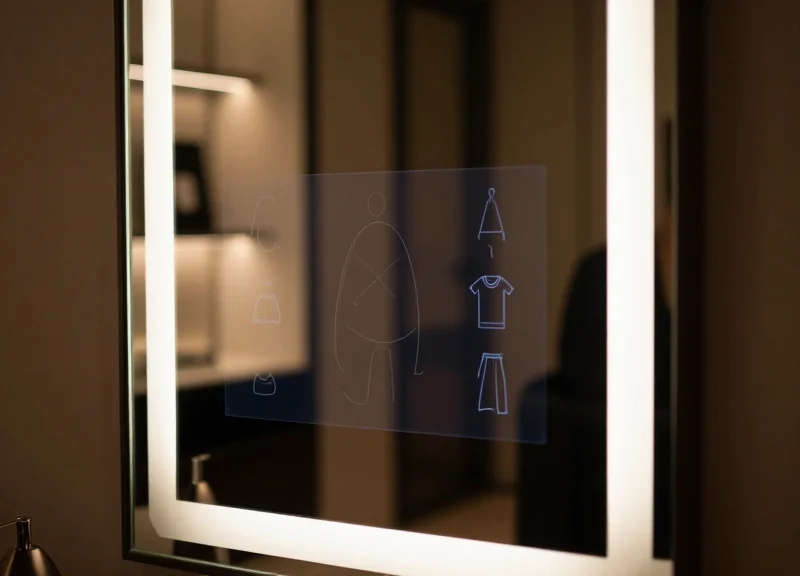
To successfully deploy smart fitting rooms in a luxury lingerie environment, technology must be invisible yet impactful. The critical features include high-sensitivity UHF RFID readers capable of penetration through dense lace and silk, 4K resolution interactive mirrors with high-CRI (Color Rendering Index) backlighting, and a privacy-first software architecture that ensures customer comfort. Unlike standard apparel, lingerie requires a nuanced balance of aesthetic elegance and high-fidelity data capture to manage low-inventory, high-complexity SKUs across various sizes and cup depths.
| Component Type | Feature Requirement | Why It Matters for Lingerie |
|---|---|---|
| RFID Hardware | Low-Profile Near-Field Antennas | Ensures 99.9% read accuracy for delicate items without bulky, visible hardware. |
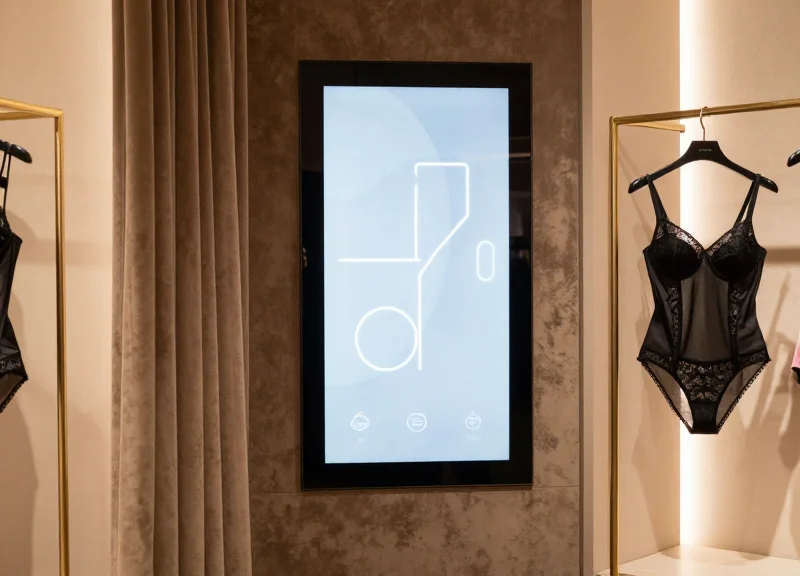
| Visual Interface | Haptic-Response Smart Mirrors | Provides a tactile, premium feel for selecting different sizes or requesting water/assistance. |
| Lighting Control | Tunable Spectrum LEDs | Allows customers to see how lingerie looks under 'Boudoir,' 'Daylight,' or 'Evening' settings. |
| Tagging Technology | Washable Soft-Micro Tags | Prevents skin irritation and ensures tags don't snag on expensive lace or embroidery. |
- Omnichannel Inventory Sync: Real-time integration with the boutique's backend ensures the mirror never suggests a size or color that is currently out of stock, preventing customer frustration.
- Privacy-Centric Motion Sensors: In 2026, premium systems use LiDAR or radar-based presence detection instead of cameras to track occupancy, maintaining 100% visual privacy while gathering dwell-time analytics.
- Stylist-to-Room Intercom: A digital 'concierge' button allows the customer to communicate with their dedicated stylist for a discrete hand-off of new items without leaving the fitting room.
Expert Tip: The 'Warmth-Factor' Calibration. A unique insight for 2026 is the integration of RFID data with automated ambient temperature controls. In luxury lingerie, the customer is often minimally dressed. Advanced smart rooms now use the RFID scan to identify the garment type and automatically increase the room's temperature by 2-3 degrees Celsius the moment the customer begins their session, ensuring physical comfort that directly correlates to higher conversion rates.
How do RFID readers handle underwire interference?
Modern 2026 RFID systems utilize circular polarization and frequency hopping to mitigate 'dead zones' caused by metallic underwires, ensuring every bra is detected regardless of orientation.
Can the mirror suggest matching sets automatically?
Yes, by utilizing the RFID 'Group ID' on the tags, the software recognizes a single item (e.g., a balconette bra) and immediately displays the matching briefs, garter belts, or robes on the mirror's sidebar.
Is the lighting adjustable for different skin tones?
The best systems use AI-driven lighting presets that allow the customer to manually adjust 'Warmth' and 'Softness' to ensure the lingerie complements their specific skin tone perfectly.
Prioritizing Privacy and Discretion in the Intimate Space
In the context of luxury lingerie, the fitting room is a sanctuary. As of 2026, the 'creepy factor' of technology is the single greatest barrier to adoption; therefore, the best RFID smart fitting room systems prioritize privacy by design. This involves using non-imaging sensors that detect radio frequency signals from garment tags rather than visual data from cameras. By decoupling the product identification from the customer's physical image, boutiques can offer high-tech assistance—such as requesting a different cup size or matching silk robe—without ever compromising the shopper's sense of security or anonymity.
| Feature | Legacy RFID Implementation | 2026 Privacy-First Standard |
|---|---|---|
| Data Storage | Permanent link to customer profile | Session-ephemeral (purged after exit) |
| Sensor Type | Broad-spectrum continuous scanning | Proximity-gated localized triggers |
| Customer Control | Passive monitoring | Explicit 'Digital Do Not Disturb' modes |
| Inventory Link | Cloud-based real-time tracking | Edge-processed anonymized SKU data |
Expert Insight: The 'Signal Shield' Protocol. One unique 2026 trend for high-end boutiques is the implementation of 'Signal Shielding' or localized Faraday zones. This ensures that the RFID reader inside a specific fitting room can only 'see' the items currently inside that cubicle, preventing the bleed-through of signals from the sales floor or adjacent rooms. This technical precision prevents embarrassing system errors where the interactive mirror suggests a size based on what a neighbor is trying on, maintaining the illusion of a dedicated, private concierge.
- Select Camera-Free Hardware: Ensure your smart mirror vendor utilizes LiDAR or IR-based motion sensors for interface control instead of optical cameras to eliminate the risk of image hacking.
- Implement Anonymized Guest Tokens: Use temporary session IDs for the fitting room duration rather than immediately linking the session to a CRM profile or credit card.
- Visible Privacy Toggles: Provide a physical or digital 'Privacy Mode' button that allows the client to completely disable the RFID reader and interactive screen at any time.
- Staff Protocol Training: Train stylists to explain that the 'magic' of the mirror is radio-based, not visual, to proactively address common customer anxieties.
Can RFID tags be tracked after the customer leaves the store?
Modern luxury RFID tags use 'kill commands' or 'sleep' functions that are triggered at the Point of Sale, ensuring the tag becomes inactive once the purchase is complete.
Is the data collected in the fitting room shared with third parties?
In a luxury 2026 environment, data should be handled via 'Edge Computing,' meaning the analysis happens locally in the store and is never uploaded to third-party advertising networks.
What happens if the system malfunctions while a client is undressed?
Premium systems include a 'Hard Reset' physical switch and fail-safe blackouts to ensure the mirror remains a standard reflection surface if the software fails.
Enhancing Cross-Selling with Smart Recommendations

In the luxury lingerie sector, the fitting room is the highest-conversion zone; smart recommendations transform this space from a static utility into a dynamic sales engine. By using RFID sensors to detect exactly which garments a client is trying on, AI-powered systems can instantly display curated 'Complete the Look' suggestions on interactive mirrors. These recommendations are not generic; they are driven by sophisticated algorithms that analyze the cut, color, and collection of the current items, suggesting the perfect silk robe, garter belt, or hosiery to complement a specific lace bra set. In 2026, this technology has evolved beyond simple up-selling to become a 'Digital Concierge' that enhances the customer's styling journey without human intrusion.
- Real-Time Inventory Mapping: The system identifies the RFID tag of the item in the room and checks real-time stock levels to ensure suggested items are actually available in the boutique in the customer’s size.
- Behavioral Contextualization: Advanced algorithms analyze if the client is looking at 'Bridal,' 'Everyday Comfort,' or 'High-Fashion' categories to align the aesthetic of the recommendations with the user's intent.
- Seamless 'Request to Room' Logic: With a single tap on the mirror, the client can request the suggested accessory, which triggers a notification on the sales associate's mobile device for discreet delivery.
| Feature | Legacy Recommendations (2022) | Advanced AI Recommendations (2026) |
|---|---|---|
| Trigger Logic | Pre-set manual links | Dynamic Neural Network Analysis |
| Personalization | Basic 'People also bought' | Hyper-personalized style profiling |
| Inventory Sync | Static/Delayed | Instant RFID-ERP integration |
| Conversion Impact | 5-8% AOV Increase | 18-25% AOV Increase |
Expert Insight: The 'Ensemble Effect' Strategy. In 2026, the most successful boutiques are moving away from item-based suggestions toward 'Mood-Based Ensembles.' Instead of suggesting a black panty for a black bra, the system suggests a 'Midnight Lounge' set including a specific perfume and silk kimono. This psychological shift from selling products to selling a vibe is where RFID technology delivers its highest ROI, as it captures the emotional high of the fitting process.
Do customers find digital recommendations intrusive?
When executed with a 'styling-first' approach rather than a 'sales-first' tone, customers view these suggestions as a premium service. The key is providing high-quality visuals and styling tips alongside the product.
How does the AI handle sizing for recommended items?
The 2026 generation of smart mirrors uses the customer's current selection to infer size. If a client is trying on a 34B, the system intelligently filters suggested corsets or slips to match that specific fit profile.
Real-Time Inventory Accuracy and Staff Efficiency

In the luxury lingerie sector, real-time inventory accuracy refers to the continuous, automated tracking of every SKU—from silk chemises to lace bralettes—as they move from the sales floor into fitting rooms. By 2026, the best RFID smart fitting room technologies will provide near 99% inventory visibility, transforming the fitting room from an operational 'black hole' into a high-functioning data node. This visibility allows staff to identify and retrieve abandoned items immediately, ensuring that high-demand sizes are never 'lost' in a booth while another customer is waiting to purchase them, effectively maximizing the sell-through rate of every unit.
| Operational Metric | Legacy Manual Process | RFID-Enabled Boutique (2026) |
|---|---|---|
| Inventory Accuracy | 65% - 75% due to human error | 98.5% - 99.9% automated |
| Staff 'Hunt Time' | 15-20 mins per hour searching | Near-zero; location is mapped |
| Restock Cycle | End-of-day or manual triggers | Instant; triggered by 'exit' event |
| Shrinkage Detection | Post-mortem (monthly audits) | Real-time alerts on item movement |
Expert Insight: Solving the 'Ghost SKU' Phenomenon. Lingerie boutiques often suffer from 'Ghost SKUs'—items that are technically in stock according to the POS but are physically misplaced or buried in a fitting room tray. An original 2026 strategy involves 'Zonal Haptic Alerts' for staff; when an item remains in a fitting room for more than 20 minutes without a customer present, the system sends a subtle haptic notification to the associate's smartwatch, ensuring the 'Lingerie Loop' (the cycle from shelf to fitting room back to shelf) is never broken.
- Automated Re-stock Triggering: The system identifies when a specific size is taken into a fitting room. If it is the last unit on the floor, the back-of-house staff is instantly notified to bring a replenishment unit to the floor before the first customer even finishes their try-on.
- Dynamic Set Matching: If a customer brings a bra into the room but forgets the matching panty, the RFID system alerts the attendant. The staff can proactively offer the matching piece, increasing UPT (Units Per Transaction) without the customer having to ask.
- Digital Abandonment Analysis: Track which items are frequently 'tried but not bought.' If a specific lace bodysuit is tried on 50 times but never purchased, the system flags a potential fit or comfort issue for the design team.
Does RFID replace the need for floor staff?
No. In luxury environments, RFID is a tool for 'Super-Human Service.' It removes the drudgery of inventory counting and searching, allowing your staff to spend 100% of their time on styling and emotional connection with the client.
How does this tech handle the small size of lingerie tags?
2026 RFID tags utilize 'Micro-Inlays' embedded within the fabric care labels or high-end swing tags, ensuring the technology is invisible to the customer but highly readable by the fitting room's short-range sensors.
Can the system detect if an item is damaged?
While RFID tracks location, staff-integrated apps allow associates to scan a tag and instantly mark an item as 'Pending Repair' or 'Dry Clean Only' if a customer leaves a makeup smudge, removing it from live inventory immediately.
Technical Integration: EAS, RFID, and Backend Systems

In the 2026 luxury retail landscape, technical integration is the invisible thread that connects customer experience with operational security. For a lingerie boutique, this means creating a 'Unified Data Fabric' where Electronic Article Surveillance (EAS), Radio Frequency Identification (RFID), and backend Enterprise Resource Planning (ERP) systems function as a single, sentient entity. This integration ensures that when a client brings a delicate lace bodysuit into the fitting room, the system simultaneously updates the 'room-in-use' status, checks the ERP for size alternatives, and monitors the security bit of the RFID tag—all without the need for bulky, damaging hard tags.
| System Component | Traditional Function | 2026 Integrated Role |
|---|---|---|
| RFID Hardware | Inventory counts | Real-time customer session analytics and item locationing |
| EAS (Security) | Theft prevention | Discreet 'Invisible Aura' loss prevention via soft-tagging |
| ERP / POS | Transaction records | Instant omnichannel replenishment and VIP profile matching |
| Middleware | Data bridge | AI-driven logic engine for cross-sell recommendations |
- API-First Architecture: Ensure your RFID provider offers robust, RESTful APIs or Webhooks. This allows the smart mirror to trigger events in your POS system instantly, such as 'reserve for purchase' or 'fetch different size'.
- Middleware Orchestration: Deploy a middleware layer that filters 'noise' from RFID readers. In a dense lingerie environment, you need software that distinguishes between an item inside the fitting room and an item just passing by on a nearby rack.
- Hybrid Tagging Strategy: Use Dual-Technology tags (RFID + EAS). This allows you to leverage existing security pedestals while gaining the item-level intelligence required for the smart fitting room interface.
- Edge Computing Deployment: To maintain a premium feel, latency must be sub-100ms. Processing tag data at the 'edge' (locally in the boutique) rather than the cloud ensures the mirror UI is perfectly responsive.
Expert Insight: The 'Invisible Guardian' Protocol. In 2026, the most sophisticated boutiques are moving away from visible EAS pedestals. By integrating RFID overhead readers with backend security logic, the fitting room itself becomes the security zone. If an item leaves the fitting room and bypasses the POS without a 'cleared' status, a silent haptic alert is sent to staff wearables. This 'Soft Security' approach protects high-margin silk and lace from the physical damage often caused by traditional plastic security tags while maintaining a boutique’s sleek, high-end aesthetic.
Can RFID tags be used for security instead of traditional EAS?
Yes. Modern RAIN RFID tags can be programmed with a 'security bit' that triggers alarms if moved through a portal without being deactivated at the POS, allowing for thinner, discreet labels suited for lingerie.
How do we prevent 'signal bleed' between fitting rooms?
By using low-gain antennas and RF-shielding paint or fabric in the fitting room walls, ensuring the reader only picks up items currently inside the booth.
What happens if the internet goes down?
Top-tier systems utilize a local buffer. The fitting room continues to function using local network data, syncing with the cloud ERP once the connection is restored to prevent any disruption in the customer's journey.
Evaluating ROI and Long-Term Business Impact

Evaluating the ROI of RFID smart fitting rooms in the luxury lingerie sector requires looking beyond simple sales lifts; it is a calculation of increased conversion rates, expanded Average Order Value (AOV), and the preservation of brand prestige. By 2026, industry benchmarks suggest that boutiques implementing high-fidelity RFID systems can expect a 15% to 25% increase in cross-sell revenue and a reduction in 'lost sales'—where a customer leaves because they were unwilling to exit the booth to find a different size—by up to 40%. The long-term business impact is centered on the 'frictionless fitting' experience, which directly correlates to higher Customer Lifetime Value (CLV) and lower operational overhead for inventory management.
| KPI Metric | Estimated Short-Term Impact (Year 1) | Long-Term Strategic Value |
|---|---|---|
| Average Order Value (AOV) | +15% to +22% | Higher attachment rate of matching sets/accessories. |
| Conversion Rate | +10% to +18% | Reduced abandonment due to size or color friction. |
| Labor Cost Allocation | 15% Efficiency Gain | Staff spend more time styling and less time checking stock. |
| Data Accuracy | 99.2% Inventory Precision | Eliminates phantom inventory and improves omnichannel fulfillment. |
| Customer Retention | 12% Increase in Repeat Visits | Brand differentiation through tech-forward, private service. |
### The Silicon Valley Perspective: The 'Fitting-Room-as-a-Service' Insight A unique perspective often overlooked by traditional retailers is viewing the smart fitting room as a data-collection engine rather than just a sales tool. In the luxury lingerie space, the 'Trial-to-Transaction' ratio is the most critical metric. By tracking which items are taken into the room but never purchased, RFID provides a 'dark data' map of product flaws—such as a specific lace being too itchy or a strap design that doesn't hold—that are never reported by the customer but are visible through abandonment patterns. This data allows for precision buying and design adjustments that can save millions in future markdowns.
How long is the typical payback period for an RFID installation?
For high-end boutiques with a high AOV, the payback period (break-even) typically occurs within 12 to 18 months, driven primarily by the reduction in missed sales opportunities and optimized staff utilization.
Does the technology reduce the need for floor staff?
In luxury retail, it doesn't reduce headcount but shifts the role. Staff transition from 'stock runners' to 'style consultants,' focusing on high-value human interaction while the RFID system handles the mundane task of inventory location.
How does RFID impact the resale or brand protection value?
Long-term, RFID tags serve as a digital certificate of authenticity. For luxury lingerie brands looking to enter the circular economy or resale markets, this tech ensures the provenance and authenticity of the garment, protecting brand equity.
- Baseline Measurement: Audit current conversion rates and staff hours spent on fitting room management before installation.
- Pilot Program Analytics: Deploy in a flagship location to measure the 'Upsell Delta'—the difference in basket size between smart rooms and traditional rooms.
- Scale and Refine: Use the 'dark data' insights to refine inventory mix across all locations, maximizing the ROI of the initial software investment.
Selection Checklist: Choosing a 2026 Technology Partner
Choosing a technology partner in 2026 for luxury lingerie retail involves moving beyond simple hardware procurement to finding a strategic collaborator who understands the 'silent' nature of luxury technology. The ideal partner must provide a modular, API-first ecosystem that prioritizes customer privacy and seamless aesthetic integration, ensuring the technology enhances rather than interrupts the intimate shopping experience. As we move toward 2026, the focus shifts from basic inventory tracking to real-time data orchestration and zero-latency customer feedback loops.
| Criteria | 2026 Requirement | Lingerie Boutique Impact |
|---|---|---|
| Privacy Architecture | Edge-based processing (No cloud images) | Ensures total customer confidence in sensitive spaces. |
| API Flexibility | RESTful / GraphQL documentation | Allows bespoke UI/UX designs that match brand heritage. |
| Hardware Aesthetics | Invisible or 'Designer' RFID readers | Prevents the boutique from looking like a warehouse. |
| Sustainability | Energy-harvesting or recycled components | Aligns with luxury ESG commitments for the next decade. |
| Support Model | 24/7 Proactive Monitoring / 4hr On-site | Prevents downtime during high-stakes season launches. |
- Verify 'Edge-First' Data Handling: In 2026, data sovereignty is paramount. Ensure the partner processes sensitive fitting room interactions locally on the device (at the edge) rather than uploading raw data to the cloud, minimizing security risks.
- Assess Modular Scalability: Evaluate if the solution allows you to start with basic smart mirrors and later add features like 'automated lighting' or 'haptic call buttons' without replacing the entire backbone.
- Test Interoperability: The partner must demonstrate native integrations with existing luxury ERPs (like SAP S/4HANA or Oracle Retail) and luxury-focused CRM platforms.
- Review the 5-Year Roadmap: Ask specifically about their path toward 'Ambient Intelligence' and how they plan to incorporate future sensor types beyond standard Gen2 RFID.
Expert Insight: The 2026 'Latency Threshold' — In the world of high-end lingerie, the 'magic' of a smart mirror is broken if it takes longer than 250 milliseconds to recognize a garment. When vetting a partner, demand a live latency test. Luxury shoppers are conditioned to expect instantaneous service; a three-second lag while the system 'thinks' will result in higher abandonment rates and a cheapening of your brand prestige.
What is the expected lifespan of the RFID readers?
In 2026, you should expect a minimum 7-year operational life with remote firmware upgrade capabilities to ensure the hardware doesn't become obsolete.
Does the vendor provide 'White Glove' installation?
Luxury boutiques require discreet installation. Ensure the vendor has experience working with high-end millwork and architectural lighting designers.
How is the AI recommendation engine trained?
Inquire if the AI uses a 'Global Model' or if it can be specifically tuned to your boutique's unique style guides and local trends to ensure relevant cross-selling.