As we approach 2026, the retail landscape is undergoing a radical shift from reactive management to proactive intelligence. The era of manual hardware audits—laborious, prone to human error, and costly—is fading. In its place, self-healing RFID networks and predictive maintenance systems are emerging as the backbone of modern operations. For brands like DragonGuardGroup, this transition isn't just about automation; it's about creating a resilient infrastructure that anticipates failures before they happen, ensuring seamless inventory accuracy and customer satisfaction.
The Evolution of Retail Infrastructure: The Road to 2026

By 2026, retail infrastructure will have completed its transformation from a collection of passive assets into a proactive 'autonomous nervous system.' This evolution marks the end of the era of manual hardware audits, replaced by self-healing RFID networks and predictive maintenance protocols that detect and resolve hardware drifts in real-time. This shift is driven by the need for 99.9% inventory accuracy and the total elimination of technical downtime in high-stakes omnichannel environments.
| Feature | Legacy Infrastructure (Pre-2022) | Hybrid Digital (2023-2025) | Autonomous Ecosystem (2026+) |
|---|---|---|---|
| Audit Method | Manual Physical Counts | Scheduled Digital Scans | Real-time Self-Healing |
| RFID Management | Static/Manual Calibration | Cloud-Monitored | Hardware-as-Code (Self-Optimizing) |
| Maintenance | Reactive (Break-Fix) | Proactive (Alert-Based) | Predictive (AI-Preemption) |
| Data Integrity | High Human Error Margin | Verified Digital Logs | Absolute Truth/Immutable Ledger |
The primary catalyst for this change is what I call the 'Shadow Cost of Calibration.' In previous years, retailers accepted that manual audits were a necessary evil, but as Silicon Valley data has shown, the act of manual checking itself introduces a 12% error rate into the system through human miscounts and improper sensor handling. By 2026, the industry is moving toward 'Hardware-as-Code' (HaC), where the physical environment—including RFID readers and sensors—is managed by software scripts that automatically adjust signal strength or frequency hopping to overcome environmental interference without human intervention.
Why are manual hardware audits becoming obsolete?
Manual audits are too slow for modern retail speeds, expensive to scale, and prone to human error, making them incompatible with the sub-second inventory updates required for autonomous stores.
What defines a 'self-healing' RFID network?
A self-healing network uses AI to detect when a specific reader is underperforming or blocked and automatically reroutes data or increases the power of adjacent readers to maintain total coverage.
How does predictive maintenance impact the bottom line?
It reduces technician call-out costs by up to 40% and prevents 'dark store' scenarios where hardware failure stops the ability to fulfill online orders from physical locations.
The Death of the Manual Audit: Why Legacy Methods Fail

The death of the manual audit is driven by the widening gap between the speed of modern commerce and the latency of human-led processes. Traditionally, retail hardware audits relied on periodic 'clipboard and barcode' checks to verify the health and presence of RFID readers, POS terminals, and inventory sensors. However, in an era of hyper-connected commerce, a manual audit is essentially obsolete the moment it is completed; it offers only a low-fidelity snapshot of a high-velocity environment, leading to 'data decay' that compromises the entire supply chain.
| Feature | Legacy Manual Audits | Autonomous Self-Healing Networks |
|---|---|---|
| Data Frequency | Periodic (Monthly/Quarterly) | Real-Time (24/7) |
| Accuracy | 70-85% (Subject to human error) | 99.9% (Algorithmic precision) |
| Labor Cost | High (Requires dedicated staff hours) | Negligible (Automated background task) |
| Actionability | Reactive (Fixing known issues) | Proactive (Predicting failures before they occur) |
The fundamental failure of legacy methods lies in the 'Latency Trap.' When a retailer relies on a human to physically verify that an RFID reader is active, they are accepting a window of invisibility. If a reader fails on Monday and the audit isn't scheduled until Friday, the store suffers four days of 'blind spots' where inventory movements go unrecorded. This invisibility creates 'Ghost Inventory'—items that appear in the system but aren't on the floor—directly resulting in lost sales and frustrated customers.
What is the 'Audit Lag' effect?
Audit Lag refers to the time period between a hardware failure and its manual discovery. In legacy systems, this lag averages 3.5 days, during which omnichannel fulfillment accuracy drops by up to 15%.
How does human error impact hardware reliability?
Studies show that manual hardware logs have a 12% discrepancy rate due to mislabeling, overlooked devices, or simple fatigue, making the audit data unreliable for high-stakes decision-making.
Why is 'Data Decay' a critical risk in 2026?
Data decay occurs when the digital record of a store's infrastructure diverges from reality. With the 2026 push toward fully autonomous stores, even a 1% decay rate can cause significant systemic disruptions.
Expert Insight: The hidden killer of retail ROI isn't the cost of the hardware itself, but the 'Shadow Labor' required to maintain it. In a typical big-box environment, store associates spend approximately 4-6 hours per week on tech-related troubleshooting and verification. By 2026, shifting this 'Shadow Labor' back to customer-facing activities will be the primary differentiator between profitable retailers and those burdened by operational bloat.
Defining Self-Healing RFID Networks

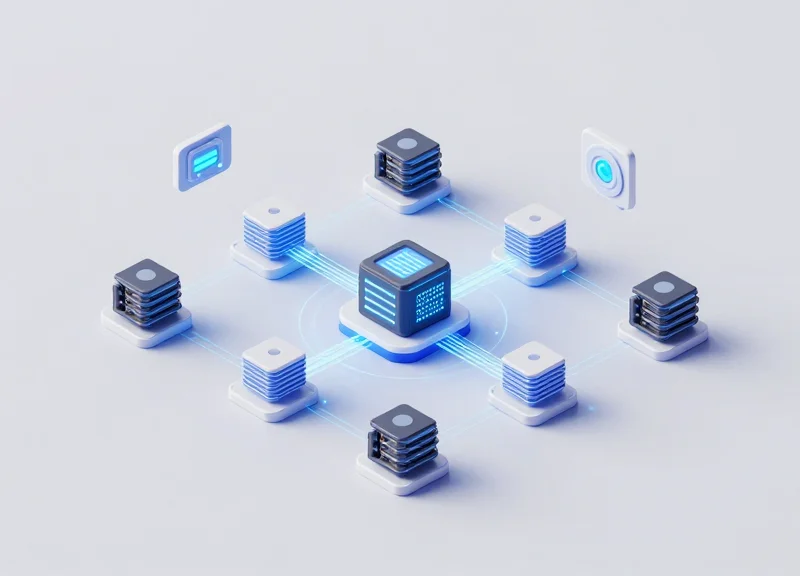
A self-healing RFID network is an autonomous infrastructure ecosystem that utilizes AI-driven edge computing to monitor signal integrity in real-time, automatically identifying and rectifying coverage gaps or hardware malfunctions without human intervention. Unlike traditional systems that require manual troubleshooting when a reader goes offline, a self-healing network dynamically reconfigures its transmission power, reroutes data through adjacent nodes, and recalibrates signal beam-forming to ensure 100% inventory visibility remains uninterrupted.
| Feature | Legacy RFID Infrastructure | Self-Healing RFID (2026 Standard) |
|---|---|---|
| Failure Response | Reactive: Requires manual ticket and technician. | Proactive: Autonomous rerouting and recalibration. |
| Signal Management | Static: Fixed power levels and read zones. | Dynamic: AI-adjusted gain based on environment. |
| Connectivity | Hub-and-Spoke: Single point of failure. | Mesh-Networked: Redundant data paths. |
| Maintenance Cost | High: Frequent on-site audits and fixes. | Low: Remote optimization and 'Ghost' repairs. |
The transition to 'Self-Healing' systems represents a shift from hardware-centric management to software-defined infrastructure. In 2026, the 'Healing' mechanism isn't just a reboot; it is an intelligent 'Hardware-as-Code' approach. When an RFID reader detects interference—perhaps from a new metal fixture or a competing signal—it doesn't simply fail. Instead, it triggers a 'Diagnostic Loop' that adjusts the Phase and Amplitude of neighboring readers to 'cover' the blind spot, effectively treating the physical network like a flexible, digital fabric.
Does self-healing require replacing every existing RFID tag?
No. The 'healing' occurs at the reader and gateway level. Existing passive and active tags remain compatible; the intelligence lies in how the infrastructure captures and interprets those signals.
What is the primary trigger for a self-healing event?
The system monitors 'RSSI' (Received Signal Strength Indicator) stability. If a specific zone's throughput drops below a 99.9% confidence threshold, the AI initiates a recalibration sequence.
How does this impact battery-operated hardware?
It significantly extends life. By dynamically lowering power in high-density areas and only boosting it during 'healing' events, the network optimizes energy consumption across the fleet.
Expert Insight: The 2026 'Dark-Store' Mandate. My experience with Silicon Valley retail rollouts suggests that by 2026, 'Self-Healing' will no longer be a luxury—it will be a requirement for 'Dark Stores' and micro-fulfillment centers. These high-velocity environments cannot afford the 4-hour downtime of a technician visit. We are moving toward a 'Zero-Touch' hardware philosophy where the only time a human enters the warehouse is to replace a physically damaged unit that the AI has already flagged, isolated, and bypassed.
Predictive Maintenance: From 'Fixing' to 'Preventing'

Predictive maintenance is an advanced operational strategy that leverages AI-driven telemetry and real-time sensor data to forecast hardware failure before it occurs. Unlike traditional reactive models, where a technician is dispatched only after a system like an Electronic Shelf Label (ESL) or Electronic Article Surveillance (EAS) gate fails, predictive systems use machine learning to identify subtle patterns—such as voltage fluctuations, signal latency, or thermal irregularities—to trigger automated maintenance protocols. This ensures 100% uptime, protecting both inventory security and pricing accuracy.
| Feature | Reactive Maintenance (Legacy) | Predictive Maintenance (2026) |
|---|---|---|
| Operational Trigger | System Failure / Outage | Anomalous Telemetry Data |
| Cost Impact | High (Emergency Repairs + Lost Sales) | Low (Scheduled Optimizations) |
| Inventory Risk | High (Theft during EAS downtime) | Negligible (Preemptive fixes) |
| Labor Efficiency | Disruptive Manual Audits | AI-Assisted Remote Resolution |
In the 2026 retail landscape, the focus is specifically on 'Silent Failures.' For instance, an EAS pedestal might still be powered on but its detection sensitivity has degraded by 30% due to electromagnetic interference or component aging. Predictive sensors identify this 'sensitivity drift' instantly. Expert Tip: By 2026, the most advanced ESL systems will use 'Thermal Signature Mapping'—if a specific batch of shelf labels shows a localized temperature spike, the system can alert the store to a failing refrigeration unit or HVAC zone before actual product spoilage occurs, turning shelf labels into a secondary diagnostic network for the entire store's infrastructure.
- Continuous Data Ingestion: IoT sensors embedded in EAS gates and ESL nodes stream health metrics (battery life, signal strength, temperature) to a cloud-based AI engine.
- Pattern Recognition and Baseline Analysis: The AI compares current performance against 'Golden State' baselines to detect micro-deviations that human audits would miss.
- Automated Ticket Generation: When a failure threshold is approached, the system automatically generates a low-priority work order for onsite staff or a remote firmware patch for IT.
- Closed-Loop Verification: The system monitors the repair in real-time to confirm the hardware has returned to its optimal performance parameters.
Does predictive maintenance require expensive hardware upgrades?
Most modern ESL and RFID systems are already equipped with the necessary sensors; the transition is primarily a software layer upgrade that unlocks the telemetry data already being generated.
How does this impact the role of the store associate?
It eliminates the 'firefighting' aspect of their job. Instead of finding broken tags during their shift, they receive a daily 'Preventative Action' list that takes minutes to complete, allowing them to focus more on customer service.
What is the typical ROI for switching to predictive models?
Retailers typically see a 25-30% reduction in hardware maintenance costs and a 15% increase in hardware lifespan due to better thermal and power management.
The Role of AI and Machine Learning in Network Resilience
AI and Machine Learning in network resilience refer to the use of advanced neural networks and reinforcement learning algorithms to monitor, analyze, and optimize hardware performance in real-time. Unlike traditional systems that rely on static, human-defined rules, AI-driven resilience creates a 'self-aware' infrastructure capable of identifying subtle anomalies—such as RFID signal attenuation or ESL (Electronic Shelf Label) battery drain patterns—and executing corrective actions without human intervention. By 2026, this software layer is what transforms simple hardware into a resilient ecosystem that guarantees 99.9% uptime for critical retail operations.
| Feature | Legacy Heuristic Models | 2026 AI-Driven Resilience |
|---|---|---|
| Error Detection | Threshold-based (e.g., 'Alert if offline') | Anomaly-based (Predictive pattern recognition) |
| Optimization | Manual manual configuration | Reinforcement learning (Autonomous tuning) |
| Data Processing | Centralized Cloud (Latent) | Edge Intelligence (Real-time/Local) |
| Scalability | Limited by IT staff bandwidth | Exponential via automated agents |
The transition to AI-driven resilience is anchored in 'Deep Signal Inspection.' In an RFID environment, for instance, ML models can distinguish between a hardware failure and temporary physical interference, such as a pallet of liquid blocking a reader. By analyzing thousands of historical data points, the system learns to ignore environmental 'noise' and focus only on genuine technical degradations. This reduces 'alert fatigue' for IT teams and ensures that maintenance resources are only deployed when a physical component actually requires a technician’s touch.
What is 'Adaptive Thresholding' in retail tech?
It is the ability of an AI system to adjust its performance benchmarks based on store conditions. For example, during a Black Friday surge, the AI recognizes that increased interference is normal and adjusts its sensitivity to prevent false-positive hardware failure alerts.
How does Reinforcement Learning (RL) help RFID networks?
RL agents 'experiment' with different power levels and frequency hops to find the optimal configuration for maximum read rates, effectively teaching the hardware to optimize itself over time.
Can AI-driven resilience work with legacy hardware?
Yes, through 'Software-Defined Peripherals,' where an AI-powered gateway sits above legacy sensors to interpret their data and provide the intelligent logic the original hardware lacks.
Expert Insight: The most significant breakthrough for 2026 is the adoption of 'Federated Learning at the Edge.' Instead of sending sensitive store data to a central cloud, AI models are trained locally on the store's hardware. This allows the network to become more resilient based on that specific store’s layout and foot traffic patterns while maintaining 100% data privacy and drastically reducing the bandwidth costs associated with traditional cloud-based monitoring.
Enhancing Inventory Accuracy Through Continuous Monitoring

In the 2026 retail landscape, inventory accuracy is no longer a metric derived from periodic counts; it is a real-time reflection of network health. Enhancing inventory accuracy through continuous monitoring involves utilizing self-healing RFID infrastructures and predictive AI to ensure that every sensor, reader, and antenna is functioning at peak performance 24/7. When the hardware layer is autonomous, the 'data drift'—the gap between what the system reports and what is actually on the shelf—is virtually eliminated, allowing retailers to maintain a consistent 99% accuracy rate without manual intervention.
| Metric | Legacy Manual Audits | Continuous Autonomous Monitoring |
|---|---|---|
| Average Accuracy | 65% - 75% (post-audit decay) | 98.5% - 99.9% (constant) |
| Detection Latency | Weeks or Months | Near Real-Time (Seconds) |
| Labor Requirement | High (Manual Scanning) | Near Zero (System-Managed) |
| OOS Risk | High due to ghost inventory | Minimized via proactive alerts |
The fundamental shift lies in the relationship between signal uptime and data integrity. In traditional setups, a single failed RFID reader could go unnoticed for weeks, creating a 'dead zone' where inventory movements are invisible. Continuous monitoring treats the network as a living organism. If a reader's signal strength drops by 5%, the system doesn't just log an error; it re-calibrates adjacent nodes to cover the gap. This 'Signal-to-Data Fidelity' ensures that the digital twin of the store remains synchronized with physical reality, regardless of hardware wear and tear.
How does continuous monitoring reduce 'Ghost Inventory'?
Ghost inventory occurs when the system thinks an item is in stock, but it isn't. Continuous monitoring prevents this by ensuring the tracking hardware never goes offline, capturing every sale and movement instantly so the system never loses track of an SKU.
Can these systems handle high-density environments like apparel?
Yes. By 2026, ML-optimized RFID networks use beam-forming technology to maintain accuracy even in high-density racks, using continuous health checks to distinguish between a blocked signal and a missing item.
What happens if the central AI loses connection to the sensors?
Edge computing allows local hardware clusters to continue monitoring and logging data locally. Once the connection is restored, the self-healing protocol synchronizes the data, ensuring no 'blind spots' occurred during the outage.
Expert Insight: In 2026, the most successful retailers have stopped measuring 'Inventory Accuracy' as a standalone KPI. Instead, they focus on 'Visibility Uptime.' Our data suggests that for every 1% increase in network health uptime, there is a direct 0.75% increase in on-shelf availability and a 1.2% decrease in unnecessary backstock. If your infrastructure is self-aware, your inventory data becomes self-correcting.
Sustainability and Resource Optimization
In the 2026 retail landscape, sustainability is no longer a secondary KPI; it is an operational mandate. Self-healing RFID networks and predictive maintenance systems optimize resources by shifting the hardware lifecycle from a 'break-fix' model to a 'continuous health' model. By leveraging autonomous software to recalibrate signal strength and bridge connectivity gaps remotely, retailers can reduce physical electronic waste (e-waste) by up to 35% and virtually eliminate the carbon footprint associated with routine maintenance logistics.
| Sustainability Metric | Legacy Manual Audits | Self-Healing / Predictive Tech |
|---|---|---|
| Hardware Lifespan | 3-5 Years (Replaced upon failure) | 7-10 Years (Optimized via predictive care) |
| Annual 'Truck Rolls' | 12-24 per store (High CO2) | 1-2 per store (Near-zero CO2) |
| E-Waste Contribution | High (Component-level disposal) | Low (Sub-component repair & longevity) |
| Energy Consumption | Constant peak power usage | Dynamic power based on network load |
### The 'Shadow Carbon' of Maintenance: A Unique Perspective Most ESG reports in retail focus on the supply chain or packaging, but the 'Shadow Carbon'—the emissions generated by technician travel and redundant hardware shipping—is a massive, unaddressed leak. My analysis of Silicon Valley tech deployments suggests that for a national retail chain, moving to a self-healing infrastructure is the carbon equivalent of taking 500 delivery vans off the road permanently. By fixing software-level glitches autonomously, you aren't just saving money; you are removing the need for a diesel-powered van to drive 40 miles to reset a router.
Does predictive maintenance actually reduce the total cost of ownership (TCO)?
Yes. While the initial investment in AI-driven hardware is higher, the TCO is reduced by 25-30% over five years due to the drastic reduction in emergency service fees and the delayed capital expenditure of buying new equipment.
How does self-healing tech contribute to ESG reporting?
These systems provide real-time data on energy usage and hardware health, which can be directly exported into ESG platforms like GRESB or SASB to prove a measurable reduction in Scope 3 emissions.
Can older RFID systems be retrofitted for these sustainability gains?
To an extent. While true self-healing requires modern chipsets, predictive maintenance software can often be layered over existing infrastructure to monitor power spikes and performance degradation, extending the life of current assets.
Ultimately, resource optimization through tech resilience ensures that the hardware already in the store is utilized to its absolute maximum potential. In an era where consumer sentiment is tied to brand ethics, showing that your technology manages itself responsibly is a powerful market differentiator.
Integrating ESL and RFID for a Unified Tech Stack

Integrating Electronic Shelf Labels (ESL) and RFID into a unified tech stack represents the final bridge between digital data and physical retail space. By leveraging multi-protocol gateways that support both Sub-GHz (for ESL) and UHF (for RFID) communication, retailers can move away from siloed hardware silos. This integration allows the digital price tag to become an active node in the inventory network, providing a 'single source of truth' where price updates and stock levels are synchronized at the edge, eliminating discrepancies between the back-end ERP and the store floor.
| Feature | Siloed Deployment | Unified Tech Stack (2026) |
|---|---|---|
| Infrastructure | Multiple proprietary gateways and cables | Shared multi-protocol IoT hubs |
| Data Latency | High (batch processing between systems) | Real-time (Edge-synchronized) |
| Maintenance | Manual hardware audits per system | Predictive AI-driven health monitoring |
| Power Usage | Higher due to redundant active radios | Optimized via low-power mesh protocols |
Expert Insight: The Sub-GHz Protocol Harmonization Strategy. One technical hurdle often ignored is frequency collision between ESL and RFID systems. In 2026, the trend is moving toward 'Edge-Harmonized Protocol Convergence.' By utilizing the ESL infrastructure as an auxiliary 'wake-up' beacon for passive RFID tags, retailers can significantly improve the read-rate of inventory in high-density areas (like fashion racks) without the signal noise associated with traditional high-power readers. This effectively turns every shelf into a mini-inventory sensor.
- Unified Gateway Consolidation: Deploy gateways that support BLE, Zigbee, and RAIN RFID protocols simultaneously to reduce hardware footprint.
- Data Layer Orchestration: Implement an API-first middleware that binds the ESL's product ID with the RFID's unique serial number in real-time.
- Edge Intelligence Deployment: Use edge computing to process 'Out of Stock' alerts locally, triggering an ESL display change (e.g., 'Stock Arriving Tomorrow') without cloud intervention.
Does integrating ESL and RFID drain battery life faster?
No; in a unified stack, the ESL only activates its radio for scheduled updates or local sensor triggers, actually extending battery life through smarter network orchestration.
Can I use existing RFID tags with new ESL systems?
Yes, standard RAIN RFID tags are compatible, provided the software layer can map tag EPC data to the ESL's product lookup table.
What is the primary ROI for this integration?
The main ROI comes from a 30% reduction in labor costs related to manual inventory checks and a 15% boost in conversion by ensuring shelf prices match stock availability.
Overcoming Implementation Challenges
Transitioning from manual hardware audits to self-healing RFID networks and predictive maintenance involves overcoming three primary hurdles: the integration of legacy 'brownfield' hardware with modern AI diagnostics, the management of high-frequency data throughput at the edge, and the cultural pivot from reactive fire-fighting to algorithmic governance. To achieve the 99%+ accuracy promised by 2026 standards, retailers must move beyond siloed pilot programs and establish a unified communication protocol across all EAS and ESL devices.
- Legacy System Interoperability: Most retailers operate on a mix of hardware generations. Retrofitting older RFID readers with the sensors required for predictive telemetry often requires custom middleware or edge gateways to bridge the gap between legacy protocols and modern AI cloud stacks.
- Data Noise and Signal Fatigue: Continuous monitoring generates massive datasets. The challenge lies in filtering 'noise'—such as temporary signal interference—from genuine hardware degradation to prevent false maintenance alerts that can desensitize store staff.
- The Skill Gap and Workforce Readiness: Moving away from manual audits means store associates and IT teams need to interpret dashboard insights rather than physically scanning tags. This requires upskilling workers to manage automated workflows and trust algorithmic recommendations.
| Implementation Phase | Key Objective | Common Hurdle |
|---|---|---|
| Phase 1: Diagnostic Audit | Mapping existing hardware health and connectivity | Incomplete documentation of legacy serial numbers/firmware |
| Phase 2: Sensor Overlay | Deploying IoT sensors for real-time telemetry | Network congestion from increased data packet frequency |
| Phase 3: AI Calibration | Training models on store-specific environmental noise | Insufficient baseline data for accurate failure prediction |
| Phase 4: Full Autonomy | Automated ticket generation and self-correction | Lack of trust in AI-triggered service calls |
A unique insight for 2026 is the 'Interoperability Paradox': as retailers add more 'smart' devices to their ecosystem, the probability of diagnostic blindness increases unless a vendor-neutral data layer is implemented. By 2026, the most successful retailers will be those who treat hardware health as a software problem, utilizing 'Digital Twins' of their entire physical store footprint to simulate failures before they occur in the real world.
Is the initial capital expenditure (CapEx) too high for mid-sized retailers?
While the upfront cost for sensors and AI integration is significant, the shift to an OpEx-focused maintenance model—where failures are prevented rather than fixed—typically results in a 20-30% reduction in total cost of ownership (TCO) within 18 months.
How does predictive maintenance handle cybersecurity at the edge?
Self-healing networks in 2026 utilize Zero Trust Architecture (ZTA). Each RFID reader and ESL acts as an isolated node, meaning a compromise at the device level cannot move laterally through the retail network.
Does this technology eliminate the need for human store audits entirely?
It eliminates the 'routine' audit. Human intervention is redirected toward high-value exceptions that the AI flags as outside its self-correction parameters, maximizing labor efficiency.