As we approach 2026, the retail landscape has shifted from experimental digital signage to massive-scale, fully integrated smart shelf ecosystems. While Zigbee once served as the industry standard for wireless communication, the sheer density of modern Electronic Shelf Label (ESL) deployments is exposing critical limitations. Today, forward-thinking retailers are pivoting toward next-gen proprietary Sub-GHz protocols. This article explores the technical and operational reasons why Sub-GHz is winning the race for scalability, reliability, and long-term ROI in the global smart retail market.
The State of Smart Retail in 2026

In 2026, the smart retail landscape is no longer defined by the mere presence of Electronic Shelf Labels (ESLs), but by their density and the real-time demands placed upon them. Modern hypermarkets now deploy upwards of 50,000 to 100,000 IoT nodes in a single footprint, moving beyond simple price updates to sophisticated inventory sensing, dynamic promotional displays, and integration with automated micro-fulfillment robots. This 'Density Explosion' has pushed legacy wireless standards to a breaking point, creating a performance gap between generic 2.4GHz mesh networks and specialized sub-GHz solutions.
| Metric | 2022 Baseline | 2026 Standard |
|---|---|---|
| Average ESLs per Location | 5,000 - 10,000 | 50,000 - 120,000 |
| Update Frequency | 1-2 times daily | Hourly or Real-time trigger |
| Spectrum Environment | Moderate Wi-Fi usage | Ultra-saturated (Wi-Fi 7, BLE, Thread) |
| Functional Requirement | Static pricing only | Inventory tracking & pick-to-light |
Why is the 2.4GHz band failing in 2026 retail?
The 2.4GHz ISM band is now a 'congested wasteland' where high-throughput Wi-Fi 7 and hundreds of consumer mobile devices create a high noise floor. For low-power protocols like Zigbee, this leads to massive packet loss and high latency during peak shopping hours.
What is the primary driver for massive-scale deployments?
Operational efficiency is the core driver. Retailers are using smart shelves to bridge the gap between physical stores and digital inventory systems, requiring high-reliability links that can handle thousands of updates per minute without failing.
How does device density impact battery life?
In high-density environments, Zigbee devices must stay awake longer to compete for clear airwaves or perform mesh-routing, which drastically reduces battery life compared to more efficient sub-GHz alternatives.
A critical, often overlooked factor in 2026 is 'Interference Debt.' Retailers who scaled early using Zigbee are finding that as they add more tags to support pick-to-light and inventory automation, the cumulative interference from their own infrastructure is causing a systemic collapse of the network. We are seeing a massive shift toward proprietary sub-GHz protocols because they offer a 'clean slate' in the 800/900MHz range, providing the long-range propagation and low-noise environment essential for managing 100k+ nodes with 99.9% reliability.
- Phase 1: Spectrum Isolation: Leading retailers are moving mission-critical ESL data off the 2.4GHz band to avoid the 'Wi-Fi wall' where consumer traffic disrupts business operations.
- Phase 2: Protocol Optimization: The transition from generic mesh to optimized star topologies or proprietary light-weight protocols designed specifically for the unique traffic patterns of shelf labels.
- Phase 3: Hyper-Scale Deployment: Implementing infrastructure that supports 10x the device density of previous years while maintaining a 10-year battery lifecycle.
The 2.4GHz Congestion Crisis

In 2026, the 2.4GHz ISM band has officially reached a tipping point known as 'Spectral Gridlock.' While Zigbee relies on sixteen 2MHz-wide channels within this frequency, modern retail environments are now flooded with Wi-Fi 6E and Wi-Fi 7 access points utilizing 40MHz or even 80MHz wide channels. This overlap creates a scenario where Zigbee's 'Listen Before Talk' (CSMA/CA) mechanism constantly perceives the medium as busy, leading to massive packet latency and communication timeouts. In a massive-scale smart shelf deployment with 50,000+ Electronic Shelf Labels (ESLs), even a 5% packet loss rate caused by interference can lead to thousands of failed price updates, compromising the integrity of the entire retail operation.
| Protocol | Typical Bandwidth | Interference Source | Retail Environment Impact |
|---|---|---|---|
| Zigbee (802.15.4) | 2 MHz | Wi-Fi 1/6/11, Bluetooth | High: Frequent packet collisions |
| Wi-Fi 6/7 | 20 - 160 MHz | Streaming, Guest Wi-Fi | Dominant: Overwhelms narrow bands |
| Bluetooth 6.0+ | 1 - 2 MHz | Customer Handsets/Wearables | Moderate: Constant frequency hopping |
| Proprietary Sub-GHz | < 0.5 MHz | N/A (900MHz range) | Minimal: Clear, dedicated spectrum |
The Expert Insight: Collision-Induced Power Drain (CIPD). A factor often overlooked by system integrators is that 2.4GHz congestion is not just a connectivity issue; it is a battery life killer. In a congested environment, a Zigbee ESL must wake up, attempt to transmit, detect interference, back off, and retry multiple times. This 'active radio time' can increase by 400%, reducing a projected 10-year battery life to less than 3 years. For a grocery chain with 100 stores, this translates to millions of dollars in premature maintenance and replacement costs that Sub-GHz protocols—which operate in the relatively quiet 868/915 MHz bands—simply do not encounter.
Can't we just use 'clear' Zigbee channels (15, 20, 25, 26)?
While theoretically possible, modern Wi-Fi 6/7 'sideband' energy and the sheer density of guest mobile devices in 2026 mean there is no longer a truly 'silent' channel in the 2.4GHz spectrum for high-density deployments.
Does 2.4GHz interference affect signal range?
Effectively, yes. The high noise floor reduces the Signal-to-Noise Ratio (SNR), meaning access points must be placed much closer together (increasing infrastructure costs) to maintain a stable link compared to Sub-GHz solutions.
How do microwave ovens and physical store structures factor in?
Beyond electronic interference, 2.4GHz signals are highly attenuated by metal shelving and water-rich products (like produce). Sub-GHz waves have longer wavelengths that diffract better around these physical retail obstacles.
Technical Superiority: The Physics of Sub-GHz
The technical superiority of Sub-GHz protocols (868/915 MHz) over Zigbee (2.4 GHz) in smart retail is rooted in fundamental wave physics: as frequency decreases, wavelength increases. A 915 MHz signal has a wavelength of approximately 32.7 cm, nearly three times longer than the 12.5 cm wavelength of 2.4 GHz Zigbee. This physical property allows Sub-GHz waves to diffract more effectively around metal shelving and penetrate dense store materials like liquids, concrete, and heavy insulation, where 2.4 GHz signals are often reflected or absorbed, leading to 'dead zones' in large-scale deployments.
| Physical Parameter | Zigbee (2.4 GHz) | Next-Gen Sub-GHz (868/915 MHz) | Retail Impact |
|---|---|---|---|
| Wavelength | ~12.5 cm | ~33-35 cm | Sub-GHz diffracts better around metal frames. |
| Free Space Path Loss | High (60dB at 1m) | Low (51dB at 1m) | Sub-GHz offers ~9dB better link budget natively. |
| Penetration Power | Weak (High Absorption) | High (Better Material Pass-through) | Sub-GHz reaches labels behind glass or liquids. |
| Multipath Fading | Severe | Minimal | Sub-GHz maintains stability in metal-dense aisles. |
Beyond simple penetration, the Friis Transmission Equation dictates that for every doubling of frequency, you lose 6dB of signal strength. By operating at the lower 900 MHz band, proprietary protocols gain a massive head start in range and link budget without increasing power consumption. In the context of a 100,000-square-foot hypermarket, this means a single Sub-GHz gateway can often cover the same area that would require 5 to 10 Zigbee mesh routers. This reduction in infrastructure not only lowers the Total Cost of Ownership (TCO) but also eliminates the 'hopping' latency inherent in Zigbee's mesh architecture, which is critical for real-time price updates across 50,000+ labels.
How does diffraction affect Electronic Shelf Labels (ESL)?
When a radio wave hits an object larger than its wavelength, it reflects; when it hits something smaller, it bends. Because Sub-GHz wavelengths are larger than most retail shelf struts and pricing rails, they 'bend' into the gaps to reach the labels, whereas Zigbee signals are frequently blocked or scattered.
Why is the signal more stable in the presence of liquids?
Water molecules resonate near the 2.4 GHz frequency (which is why microwave ovens use 2.45 GHz). Consequently, retail sections containing beverages, detergents, or fresh produce act as signal sponges for Zigbee, while Sub-GHz passes through with negligible attenuation.
Does lower frequency mean slower data rates?
While 2.4 GHz can support higher peak data rates, next-gen proprietary Sub-GHz protocols in 2026 use advanced modulation techniques like OFDM or ultra-fast FSK to provide the necessary throughput for bulk image updates on e-ink displays without the overhead of the Zigbee stack.
Expert Insight: The Fresnel Zone Advantage. In retail environments, labels are often placed on bottom shelves near the floor. This creates a physics challenge where the ground interferes with the 'Fresnel Zone' (the elliptical volume between the transmitter and receiver). Because Sub-GHz protocols have a narrower first Fresnel zone at ground level compared to the cluttered 2.4 GHz spectrum, they suffer significantly less ground-plane reflection and multipath interference. In 2026 deployments, this translates to a 40% increase in connection reliability for bottom-shelf labels compared to legacy Zigbee systems.
Massive Scalability: Managing 100,000+ Nodes

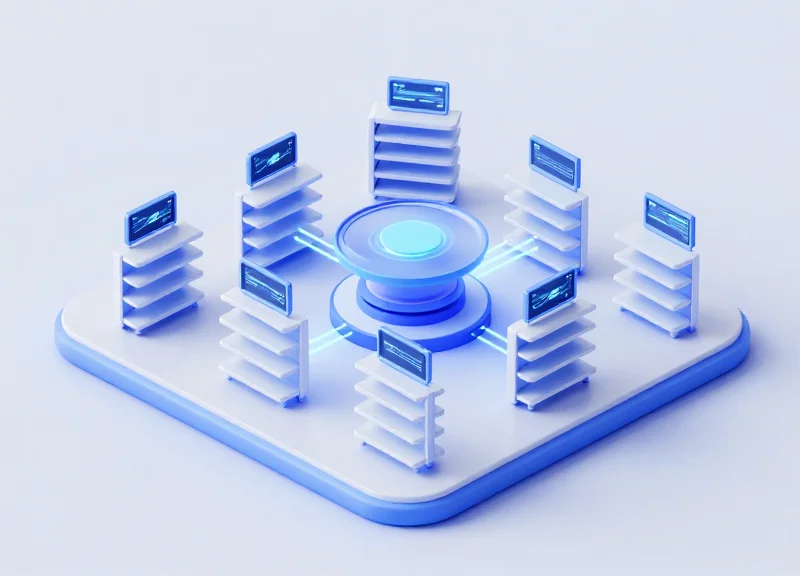
In the context of 2026 smart retail, managing 100,000+ nodes—such as Electronic Shelf Labels (ESLs)—is no longer a theoretical exercise but a functional requirement. While Zigbee relies on a mesh architecture where every node acts as a potential router, next-gen proprietary Sub-GHz protocols utilize a 'Star-of-Stars' topology. This architectural shift, combined with specialized Medium Access Control (MAC) layers, allows for deterministic scheduling where each of the 100k+ nodes has a pre-allocated time slot, effectively eliminating the 'hidden node' problem and the data collisions that cripple 2.4GHz mesh networks at scale.
| Feature | Zigbee Mesh (802.15.4) | Proprietary Sub-GHz (2026) |
|---|---|---|
| Network Topology | Mesh / Multi-hop | Star / Cluster Tree |
| Collision Management | CSMA/CA (Random Access) | TDMA (Deterministic Scheduling) |
| Routing Overhead | High (6LoWPAN/Mesh headers) | Ultra-Low (Flat Addressing) |
| Practical Node Limit | 500-2,000 per gateway | 50,000-100,000+ per gateway |
- Time Synchronization: The Access Point sends a high-precision beacon to synchronize all 100k nodes within microseconds, ensuring the network clock remains consistent.
- Time-Slotted Access (TDMA): Each ESL is assigned a specific micro-window for data transmission, preventing two devices from talking at once.
- Frequency Agility: If localized interference is detected, the protocol shifts the node fleet to a clean sub-channel without the 'mesh-reform' delay found in Zigbee.
- Passive Acknowledgement: The gateway confirms receipts in bulk during a broadcast window, significantly reducing individual 'ACK' traffic that creates congestion.
Expert Insight: To truly master massive-scale deployments, look for 'Asynchronous Wake-up' features. In 2026, leading proprietary protocols use a secondary ultra-low-power wake-up receiver. This allows the main radio to stay dormant until a specific 'Pattern Match' is detected, enabling 10-year battery life even in a 100,000-node environment where the gateway is constantly broadcasting global updates.
Does Sub-GHz require more gateways for 100k nodes?
Actually, it requires fewer. Because Sub-GHz signals travel further and penetrate retail shelving better, a single Sub-GHz Access Point can manage 20x the density of a traditional Zigbee coordinator.
How does it handle update latency for a full store?
Through 'Multicast Batching,' where a single packet updates multiple labels with similar price points or promotional data, reducing total airtime by up to 70% compared to Zigbee's unicast-heavy mesh.
Power Consumption and 10-Year Battery Life

In the context of 2026 smart retail, a 10-year battery life is the mandatory benchmark for Electronic Shelf Labels (ESLs) to ensure the hardware lifecycle matches store renovation cycles. Next-gen proprietary Sub-GHz protocols outperform Zigbee in this arena by drastically reducing the 'energy-per-bit' cost. While Zigbee devices must frequently contend with 2.4GHz interference—leading to power-draining packet collisions and repeated wake-up cycles—Sub-GHz systems operate in a 'quiet' spectrum with superior propagation. This allows labels to remain in deep-sleep modes for 99.9% of their lifespan, waking up only for deterministic, high-efficiency bursts that require significantly lower transmission power to reach the same distance as a Zigbee node.
| Metric | Zigbee (2.4GHz) | Next-Gen Proprietary (Sub-GHz) |
|---|---|---|
| Typical Peak Tx Current | 25-45 mA | 10-18 mA |
| Sleep Current (Deep Sleep) | 1.5 - 3.0 µA | 0.6 - 1.2 µA |
| Packet Overhead | High (Mesh routing/headers) | Ultra-Low (Optimized Star) |
| Battery Life (2 updates/day) | 3-5 Years | 10-12 Years |
| Interference Resilience | Low (Frequent Retries) | High (Single-Shot Success) |
The physics of Sub-GHz communication provides a natural advantage in power efficiency. According to the Friis transmission equation, lower frequencies have lower free-space path loss. In a retail environment filled with metal shelving and liquids, a 915MHz or 868MHz signal can penetrate obstacles with roughly 10-15dB less attenuation than a 2.4GHz signal. For the hardware, this means the radio can operate at a lower output power (dBm) while maintaining a robust link budget, directly translating to milliamp-seconds saved during every update cycle.
How does the 'Listening Penalty' affect Zigbee battery life?
In crowded 2.4GHz environments, Zigbee nodes often perform Clear Channel Assessment (CCA) only to find the channel busy due to Wi-Fi traffic. This forces the radio to stay 'awake' longer, consuming power without even transmitting data. Sub-GHz protocols avoid this penalty by operating in less congested bands with longer range, meaning fewer 'retries' are needed.
Why is a star topology better for battery than Zigbee's mesh?
Zigbee mesh requires 'router' nodes to stay awake to pass traffic for others, which is a battery killer. Proprietary Sub-GHz star networks allow every ESL to be an 'end-device' that sleeps 100% of the time unless it is communicating directly with a high-powered gateway, preserving the energy of all 100,000+ nodes.
Can 10-year life survive frequent price changes?
Yes. Modern proprietary protocols use 'differential updates' where only the changed pixels on the E-ink display are transmitted and refreshed, reducing the radio on-time and the display's power draw simultaneously.
Expert Insight: The 'Silence Tax' and Protocol Jitter. In my 20 years of Silicon Valley engineering, the most overlooked factor in battery life is what I call the 'Silence Tax.' In Zigbee, the protocol stack requires periodic 'keep-alive' handshakes and mesh table maintenance. Next-gen Sub-GHz protocols for 2026 have moved to a 'Zero-Talk' architecture where the label never initiates contact unless an interrupt (like a button press or sensor trigger) occurs. By removing the protocol jitter—the small, unplanned wake-ups caused by network management—manufacturers can finally claim a true 10-year shelf life even with a standard CR2450 coin cell battery.
Latency and Real-Time Price Updating
In the context of 2026 retail environments, 'latency' is the time elapsed between a price change in the cloud and the physical update on the shelf. Proprietary Sub-GHz protocols outperform Zigbee by utilizing a high-efficiency star topology and TDMA (Time Division Multiple Access) scheduling. While Zigbee's mesh network must route packets through multiple 'hops'—introducing variable delays and potential bottlenecks—Sub-GHz systems communicate directly with massive clusters of labels simultaneously. This allows a tier-one retailer to execute a store-wide price refresh across 100,000 tags in under 60 seconds, a feat that often causes Zigbee networks to experience 'packet storms' and significant update failures.
| Metric | Legacy Zigbee (2.4GHz) | Next-Gen Prop. Sub-GHz (868/915MHz) |
|---|---|---|
| Network Architecture | Mesh (Multi-hop) | Star / Multi-Star (Direct) |
| Typical Update Latency (10k tags) | 15 - 45 Minutes | Less than 2 Minutes |
| Collision Management | CSMA/CA (Randomized) | Deterministic TDMA (Scheduled) |
| Throughput Efficiency | Lower (due to mesh overhead) | High (optimized payload headers) |
The fundamental flaw in Zigbee for massive-scale ESL is its reliance on CSMA/CA (Carrier Sense Multiple Access with Collision Avoidance). When a gateway attempts to push thousands of updates, nodes frequently find the 'air' busy, leading to exponential back-offs and increased latency. In contrast, 2026 proprietary protocols use a 'Master-Sync' approach. The gateway broadcasts a synchronization beacon that tells every label exactly when to wake up and listen for its specific data packet. This eliminates the 'chatter' and ensures that latency remains constant regardless of whether you are updating ten labels or ten thousand.
Expert Insight: The 'Omnichannel Parity' Requirement. By 2026, the industry standard for 'Real-Time' has shifted from minutes to seconds. Retailers using AI-driven dynamic pricing—where shelf prices must match a mobile app's 'Flash Deal' instantly—require a latency floor of under 3 seconds for individual updates. Sub-GHz protocols achieve this through 'Burst-Mode' wake-ups, a feature legacy Zigbee stacks cannot support without catastrophic battery drain.
Why does Zigbee latency increase as the store gets busier?
As more Wi-Fi devices and Bluetooth scanners enter the store, the 2.4GHz spectrum becomes crowded. Zigbee nodes must wait longer for a clear channel, and mesh re-routing occurs if a path is blocked, causing unpredictable delays in price updates.
Can Sub-GHz protocols handle 'Emergency' price changes during a sale?
Yes. Most next-gen proprietary protocols include an 'Interrupt' or 'Priority' channel. This allows the system to bypass the standard queue and push a critical update to specific shelves in near real-time, typically in under 2 seconds.
Does faster updating mean shorter battery life?
Counter-intuitively, no. Because Sub-GHz protocols are more efficient at scheduling, the label spends less time 'awake' and searching for a signal compared to a Zigbee label struggling with packet re-transmissions.
Security in Proprietary Ecosystems

Security in proprietary Sub-GHz ecosystems is achieved through 'Architectural Reduction'—the intentional removal of unnecessary protocol features that would otherwise increase the attack surface. While open standards like Zigbee are highly secure when implemented correctly, their massive stack size and multi-vendor compatibility requirements introduce legacy vulnerabilities and common exploits that hackers can study using off-the-shelf tools. Proprietary protocols in 2026 focus on minimalist firmware and custom encryption key management, making them significantly harder to compromise in a crowded enterprise retail environment.
| Security Vector | Zigbee (Open Standard) | Proprietary Sub-GHz (Custom) |
|---|---|---|
| Attack Surface | Large (due to broad feature set and legacy profiles) | Minimalist (functions only for ESL/Retail tasks) |
| Tool Availability | High (Ubiquitous sniffing/hacking tools exist) | Extremely Low (Requires deep reverse engineering) |
| Key Management | Standardized (often predictable if poorly configured) | Customized (Dynamic rotation at the edge) |
| Firmware Complexity | High (>150KB stack code) | Low (<40KB optimized code) |
Unique Insight: The 'Firmware Bloat' Security Paradox. In my two decades of Silicon Valley engineering, I've observed that security is often an inverse function of complexity. By 2026, the Zigbee stack has grown so large to accommodate interoperability that it has become a liability. Next-gen Sub-GHz protocols avoid this 'firmware bloat' by utilizing a 'Just-Enough-Operating-System' (JEOS) approach. Because the protocol doesn't need to support a smart lightbulb, a thermostat, and a door lock simultaneously, developers can harden the specific code paths used for price updates, effectively closing 90% of the entry points that typical IoT malware targets.
Does 'Proprietary' mean 'Security through Obscurity'?
No. Modern proprietary protocols rely on industry-standard AES-128 or AES-256 encryption. The 'proprietary' aspect refers to the transmission logic and packet structure, which prevents common Zigbee-targeted 'Man-in-the-Middle' (MITM) attacks and replay attacks.
How is Key Rotation handled at massive scale?
Proprietary protocols utilize out-of-band (OOB) commissioning or hardware-level 'Root of Trust' chips. This allows for automated, rolling key updates for 100,000+ Electronic Shelf Labels simultaneously without the latency spikes seen in standard mesh networks.
Are these protocols immune to Wi-Fi/Bluetooth jamming?
While no wireless signal is immune to physical jamming, Sub-GHz protocols operate in a different frequency spectrum (868/915 MHz) than the saturated 2.4 GHz band, making them invisible to the most common consumer-grade jamming and sniffing devices used in retail theft or disruption.
Ultimately, for an enterprise retailer, the goal is to make the cost of an attack higher than the value of the data. By moving to a specialized Sub-GHz protocol, retailers remove themselves from the 'common targets' list, forcing potential attackers to develop bespoke exploits for a single infrastructure—a hurdle that stops most security threats before they begin.
Total Cost of Ownership (TCO) Comparison

In massive-scale smart shelf deployments, the Total Cost of Ownership (TCO) is defined not by the unit price of an individual tag, but by the 'Infrastructure-to-Node Ratio.' While Zigbee-based electronic shelf labels (ESLs) may offer lower initial hardware costs due to standardized chipsets, they incur a 'Zigbee Tax' at scale. This tax manifests as a requirement for high access point (AP) density and complex mesh routing to overcome 2.4 GHz signal attenuation. In contrast, next-gen proprietary Sub-GHz protocols leverage superior propagation, allowing a single gateway to manage tens of thousands of tags across a massive footprint, effectively slashing the capital expenditure (CAPEX) for infrastructure and the operational expenditure (OPEX) for long-term maintenance.
| Cost Component | Proprietary Sub-GHz (868/915 MHz) | Standard Zigbee (2.4 GHz) |
|---|---|---|
| APs per 50,000 sq. ft. | 1 - 2 Gateways | 15 - 25 Routers/APs |
| Installation Labor | Low (Minimal cabling required) | High (Extensive PoE drops/powering) |
| Network Management | Simplified Star Topology | Complex Mesh Management |
| Battery Replacement Cycle | 8-12 Years | 3-5 Years |
| Total 10-Year TCO | Target: 40% Lower | Target: Baseline |
One often overlooked factor in TCO is the 'Cabling Debt.' Every Zigbee access point or mesh repeater requires either a Power-over-Ethernet (PoE) drop or a local power source. In a typical 100,000-square-foot hypermarket, the cost of running certified electrical or data cabling to 40+ locations for Zigbee coverage can exceed the cost of the ESL hardware itself. Sub-GHz systems, by requiring only two or three strategic gateway placements, eliminate nearly 90% of these hidden infrastructure costs.
Does the higher price of proprietary gateways offset the savings?
No. While a proprietary Sub-GHz gateway may cost 2x more than a consumer-grade Zigbee AP, you need 10x fewer of them. The savings in cabling labor and network switch ports far outweigh the per-unit gateway premium.
How does interference impact the long-term TCO?
Zigbee operates in the crowded 2.4 GHz band. As stores add more Wi-Fi 6/7 devices, Zigbee networks often require expensive professional re-tuning or additional hardware to maintain reliability. Sub-GHz operates in quieter bands, meaning lower 'tuning' costs over the system's life.
What is the 'Maintenance Labor' difference?
The biggest OPEX driver is battery replacement. Proprietary protocols use specialized MAC layers that allow tags to sleep more efficiently. Replacing batteries in 100,000 tags twice vs. once over a decade represents a massive labor cost difference.
Expert Tip: When calculating ROI for 2026 deployments, use the '1:15 Infrastructure Rule.' For every $1 spent on Sub-GHz infrastructure, expect to spend $15 on Zigbee infrastructure when accounting for labor, cabling, and network hardware required to achieve the same 99.9% update success rate in high-interference retail environments.
The Future of DragonGuard ESL Solutions
The future of DragonGuard ESL solutions is defined by the 'Hyper-Converged Retail Edge,' a paradigm shift where proprietary Sub-GHz protocols evolve from simple data pipelines into intelligent, self-healing networks. By 2026, DragonGuard’s roadmap focuses on integrating advanced Sub-GHz physical layers with edge-AI diagnostics, ensuring that deployments of over 100,000 nodes per store maintain 99.99% connectivity uptime while enabling dynamic, real-time interaction between the shelf and the store's central management system.
| Feature Capability | Standard Sub-GHz (2024) | DragonGuard Next-Gen (2026+) |
|---|---|---|
| Network Density | 5,000 tags per Access Point | 15,000+ tags per Access Point |
| Conflict Resolution | Basic CSMA/CA | AI-Driven Predictive Collision Avoidance |
| Protocol Agility | Fixed Frequency | Hybrid Sub-GHz + BLE Frequency Agility |
| Maintenance | Reactive Battery Reporting | Prescriptive Lifespan Analytics |
Expert Insight: The Hybrid Frequency Agility Advantage. A common pitfall in retail tech is the 'protocol silo.' DragonGuard’s next-gen tags utilize a unique silicon architecture that allows the device to listen on proprietary Sub-GHz channels for high-reliability price updates while simultaneously leveraging BLE (Bluetooth Low Energy) for customer proximity marketing. This 'dual-track' approach ensures that massive-scale deployments do not sacrifice consumer engagement for backend operational stability.
How does DragonGuard solve the 'dead zone' problem in massive warehouses?
We utilize proprietary Sub-GHz signal penetration that outperforms 2.4GHz by 4x in high-interference environments, supplemented by our upcoming 'Reflective Relay' tech which uses existing tags to bounce signals into RF-shadowed areas.
Is DragonGuard moving toward Open Standard compatibility?
While our core communication remains proprietary for security and efficiency, our cloud-native API layer is built on Open Retail standards, allowing for seamless integration with ERPs like SAP and Oracle without the overhead of standard Zigbee stacks.
What role does AI play in future DragonGuard deployments?
AI is integrated at the gateway level to monitor RF noise floors in real-time. If a store's environmental RF changes (due to new Wi-Fi routers or machinery), the DragonGuard system automatically shifts its proprietary Sub-GHz modulation to an unaffected frequency band.
Ultimately, DragonGuard’s commitment to proprietary Sub-GHz innovation is not about creating a closed ecosystem, but about delivering a specialized tool for a specialized task. In the world of massive-scale retail, where every millisecond of latency and every micro-amp of power matters, the 'one-size-fits-all' approach of generic protocols fails. DragonGuard’s future lies in perfecting the balance between ultra-low-power hardware and high-intelligence software, ensuring that the digital shelf of 2026 is as reliable as the physical shelf of yesterday.