The retail landscape in 2026 faces a sophisticated threat: professional shoplifting syndicates using aluminum-lined booster bags to bypass traditional security. These 'Faraday cage' shields render standard Electronic Article Surveillance (EAS) signals useless, allowing high-value goods to exit stores undetected. For retailers looking to safeguard high-margin inventory, choosing the right EAS system is no longer just about tag detection—it is about integrated intelligence and preemptive sensing. This guide explores the five critical criteria you must evaluate to ensure your security infrastructure can effectively neutralize booster bag threats and provide a robust return on investment.
Understanding the Evolution of the Booster Bag Threat in 2026
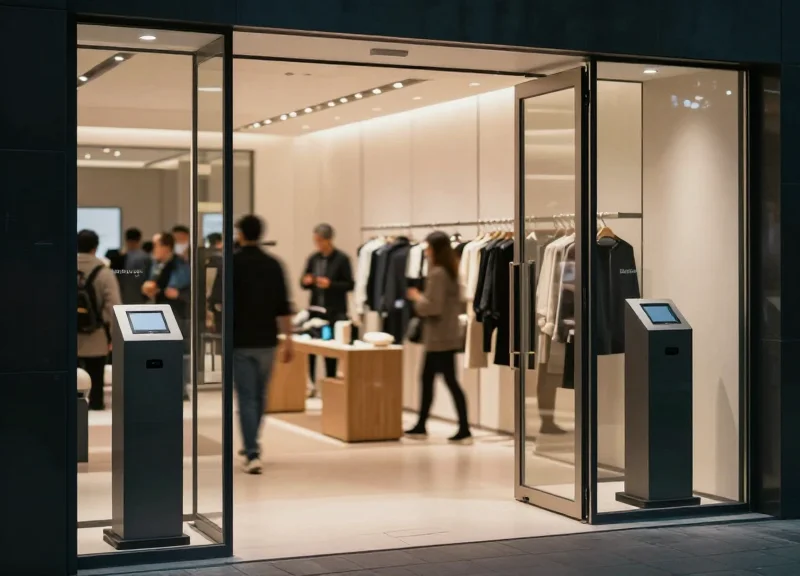
By 2026, the 'booster bag' has evolved from a crude DIY foil-lined shopping bag into a sophisticated, industrial-grade Faraday cage. These modern tools of Organized Retail Crime (ORC) utilize multi-layered composite materials—often blending aluminum, copper, and even graphene—to create a localized dead zone that completely encapsulates the electromagnetic signal of EAS tags. When a tagged item is placed inside, the 8.2MHz RF or 58kHz AM signals emitted by traditional pedestals are reflected or absorbed, allowing shoplifters to walk through security gates without triggering an alarm.
| Feature | Legacy Booster Bags (Pre-2022) | Advanced Booster Bags (2026 Era) |
|---|---|---|
| Material | Standard Aluminum Foil | Multi-layered Graphene/Nickel Composites |
| Detection | Easily caught by basic Metal Detectors | Stealth-optimized to bypass standard MD |
| Construction | Crinkly, bulky, and audible | Integrated into fabric; silent and flexible |
| Success Rate | 60-70% against basic RF | 99% against non-intelligent EAS |
The shift toward professionalized theft has been driven by the surge in Organized Retail Crime (ORC), where theft is no longer impulsive but systematic. These groups now employ 'technical scouts' who test store pedestals with various shielding thicknesses before executing large-scale 'sweep' events. Standard Electronic Article Surveillance (EAS) fails because it is reactive rather than proactive; it waits for a signal that is physically prevented from reaching the receiver.
Why do traditional RF systems fail against aluminum lining?
Traditional Radio Frequency systems operate on a 'line-of-sight' for electromagnetic waves. Aluminum is a highly conductive material that creates a 'Skin Effect,' where the RF signal travels only on the outside of the foil bag, never reaching the tag inside, thus preventing resonance.
Is Acousto-Magnetic (AM) technology safer?
While AM systems are slightly more resistant to thin shielding than RF, they are equally neutralized by the 2026-standard multi-layer booster bags which use high-permeability materials to suppress magnetic field fluctuations.
What is the role of ORC in this evolution?
Organized groups fund the R&D for these bags, treating retail theft as a logistics operation. They use specialized linings that are thin enough to be sewn into regular coats, making visual detection by staff nearly impossible.
Expert Insight: The 2026 landscape introduces 'Smart Shielding.' We are now seeing the emergence of active interference linings that don't just block signals but emit a low-level localized 'white noise' to confuse the EAS receiver's DSP (Digital Signal Processing) algorithms. This means simply increasing the sensitivity of your old pedestals will likely result in a surge of false alarms rather than catching the actual thieves.
Criterion 1: Integrated Metal Detection Sensitivity
In 2026, Integrated Metal Detection (IMD) is no longer an optional add-on; it is the foundational requirement for any Electronic Article Surveillance system aiming to stop Organized Retail Crime (ORC). High-precision IMD sensitivity allows EAS pedestals to detect the significant mass of conductive material found in foil-lined 'booster bags' or shielded clothing. Unlike traditional EAS, which only reacts when a tagged item passes through, IMD alerts security the moment a professional shoplifter enters the store, neutralizing the threat before a single item is touched.
| Detection Parameter | Legacy Systems (Pre-2024) | 2026 High-Sensitivity Standards |
|---|---|---|
| Minimum Foil Thickness | 50+ Microns | <15 Microns (Multi-layer foil) |
| Detection Width | 1.2 Meters | Up to 2.4 Meters per Aisle |
| Signal Processing | Threshold-based (Static) | AI-Driven Spatial Mapping |
| False Alarm Rate | High (Keys/Phones) | Low (Object Discrimination) |
The defining technical differentiator for 2026 is 'Spatial Signature Mapping.' Generic metal detectors often trigger false alarms on shopping carts or wheelchairs because they only measure the total volume of metal. Leading-edge systems now use integrated AI to analyze the shape and density of the electromagnetic disturbance. An aluminum-lined bag creates a 'planar disturbance'—a flat, high-surface-area signature—that is fundamentally different from the 'lattice disturbance' created by a shopping cart. This distinction allows for high sensitivity without the operational friction of constant false alerts.
Does integrated metal detection interfere with my existing EAS tags?
No. Modern systems operate on dual-frequency or time-multiplexed channels. This allows the metal detection sensors and the Acousto-Magnetic (AM) or Radio Frequency (RF) sensors to work simultaneously without cross-talk or signal degradation.
Can shoplifters bypass this with high-performance shielding?
While no system is 100% foolproof, 2026-grade sensors are calibrated to detect the specific 'vortex currents' generated by even high-grade industrial foils. The sensitivity is now high enough that even partial shielding usually triggers a 'silent alert' to floor staff.
How do I handle the alerts without escalating conflict?
The best practice is 'Silent Paging.' When the IMD detects a booster bag, it sends an alert to a staff mobile device or headset rather than sounding a loud siren, allowing for a 'customer service' approach to deter the suspect.
Expert Tip from the Field: When evaluating sensitivity, ask your vendor for the 'Entry-Exit Delta' report. A superior system should be able to distinguish between a person entering with a booster bag and a person leaving with a legitimate metal purchase, such as a set of stainless steel pans, by analyzing the directionality and signal decay of the metal mass.
Criterion 2: Advanced Signal Discrimination and False Alarm Suppression
Advanced signal discrimination in 2026 is defined by the transition from simple threshold-based metal detection to AI-powered 'Signature Recognition.' This technology allows Electronic Article Surveillance (EAS) pedestals to utilize deep-learning algorithms that analyze the specific electromagnetic fingerprint of aluminum-lined booster bags, effectively ignoring everyday metallic items such as smartphones, keys, and shopping carts. By prioritizing the identification of high-density shielding patterns over general metal presence, retailers can neutralize sophisticated shoplifting threats without creating the 'alarm fatigue' that often plagues traditional security installations.
The challenge for modern loss prevention is that a retail environment is a chaotic sea of metal. Legacy systems often struggle to distinguish between a professional booster bag and a customer pushing a metal stroller or carrying a high-end laptop. In 2026, the gold standard for EAS systems involves 'Contextual Intelligence.' This means the system doesn't just look for a signal; it looks for a behavior. By integrating Edge-AI processing directly within the pedestal, the system can evaluate the conductivity and volume of the metal in milliseconds, ensuring that only high-probability threats trigger an alert to the staff's mobile devices.
| Feature | Legacy Metal Detection | 2026 AI-Driven Discrimination |
|---|---|---|
| Detection Logic | Simple Amplitude/Threshold | Neural Network Pattern Matching |
| False Alarm Rate | High (Carts, Strollers, Keys) | Ultra-Low (Filters 99% of benign metal) |
| Sensitivity Adjustment | Manual / Static | Dynamic / Self-Learning |
| Response Type | Audible Alarm Only | Silent Staff Alerts + Video Tagging |
Expert Tip: Look for systems that offer 'Dynamic Environment Calibration.' Unlike older units that require a technician to set sensitivity levels during installation, 2026's leading systems continuously monitor the ambient electromagnetic noise of your store. If a new metal display fixture is moved near the entrance, the system automatically recalibrates its baseline in real-time, preventing a sudden surge in false alarms. This 'self-healing' capability is what separates professional-grade infrastructure from entry-level hardware.
Will my store's shopping carts constantly trigger the booster bag alarm?
No. Modern AI filters specifically recognize the unique 'hollow frame' signature of shopping carts and strollers, distinguishing them from the 'solid dense' signature of a foil-lined bag.
Can the system distinguish between a laptop and a booster bag?
Yes. Advanced signal discrimination analyzes the 'Phase Shift' of the signal; consumer electronics have distinct electromagnetic signatures that differ significantly from the crude shielding used in booster bags.
What happens if a shopper is carrying a small amount of foil, like a gum wrapper?
The system uses mass-thresholding. It is programmed to ignore small surface areas of metal that are insufficient to shield an EAS tag, focusing only on the large-scale shielding required for bulk theft.
Criterion 3: Multi-Technology Integration (AM, RF, and RFID)

In 2026, the most effective defense against Organized Retail Crime (ORC) is a hybrid approach that fuses Acousto-Magnetic (AM), Radio Frequency (RF), and Radio Frequency Identification (RFID) into a unified detection ecosystem. While traditional systems rely on a single frequency that can be shielded by common aluminum foil, multi-technology systems force the shoplifter to defeat three distinct physical and digital signatures simultaneously. By integrating these technologies, retailers transition from passive monitoring to a proactive 'cross-validation' model, where the system compares signal integrity across different bands to identify anomalies that indicate a booster bag is in use.
| Technology | Frequency/Type | Booster Bag Vulnerability | Role in Multi-Layered Defense |
|---|---|---|---|
| AM (Acousto-Magnetic) | 58 kHz | Low (Requires heavy shielding) | Primary detection for metal-heavy or liquid items. |
| RF (Radio Frequency) | 8.2 MHz | High (Easily shielded by thin foil) | Cost-effective protection for high-volume soft goods. |
| RFID (Inventory ID) | 860-960 MHz (UHF) | Moderate (Shielded, but detectable via 'Missing Data') | Provides item-level intelligence on what is being stolen. |
The synergy of these technologies eliminates 'security silos.' In a standalone RF environment, a booster bag creates a total signal blackout. In a 2026 hybrid environment, the system notices the 'Digital Shadow'—where a known RFID-tagged item suddenly vanishes from the inventory field while moving toward the exit, triggering a silent alert even if the physical EAS alarm is suppressed by the shielding.
- The Expert Perspective: The 'Null-Signal' Logic: A unique insight for 2026 is the implementation of 'Null-Signal' detection. Advanced multi-tech pedestals are now programmed to alarm not just when they see a tag, but when they detect a localized 'void' in the ambient RFID field. A booster bag essentially acts as a moving hole in the store's radio environment; identifying this void allows the system to pinpoint the thief before they even reach the pedestal.
- Interference Mitigation: Hybrid systems are inherently more stable. By using AM for wider exits and RF for smaller labels, retailers can tune their sensitivity higher without increasing false alarms caused by nearby electronics or metal structures.
Why can't I just use RFID alone to stop booster bags?
While RFID is excellent for inventory, its high frequency is easily blocked by aluminum foil. Without the lower-frequency AM layer to penetrate the bag or a metal detector to identify the shield, RFID alone is blind to professional booster bag operations.
Is it difficult to manage three different types of tags?
Modern 'Dual-Tag' or 'Triple-Tag' solutions embed these technologies into a single adhesive label or hard tag, allowing retailers to maintain one tagging process while benefiting from multi-frequency security.
What is the ROI of a multi-technology system in 2026?
The ROI is found in the reduction of 'unknown shrink.' By identifying exactly what left the store via RFID while simultaneously catching ORC members with booster bags via AM/Metal Detection, stores often see a 25-35% improvement in recovery rates compared to single-frequency stores.
Criterion 4: Discrete Alerting and Real-Time Communication

In 2026, the most effective Electronic Article Surveillance (EAS) systems utilize Discrete Alerting to bypass traditional audible sirens, instead sending encrypted, real-time data directly to staff mobile devices, smartwatches, or headsets when a booster bag is detected. This paradigm shift from 'audible deterrence' to 'silent interception' allows loss prevention (LP) teams to engage suspects using tactical customer service techniques before they exit the premises, significantly reducing the 'grab-and-run' success rate of organized retail crime (ORC) syndicates.
| Feature | Traditional Audible Alarms | Modern Discrete Communication |
|---|---|---|
| Suspect Reaction | Immediate flight or aggressive escalation. | Unaware of detection; remains in the store. |
| Staff Response | Reactive and often frantic. | Proactive, coordinated, and calm. |
| Customer Experience | Anxiety-inducing and disruptive. | Seamless and undisturbed environment. |
| ORC Effectiveness | Low (Suspects learn to ignore or outrun). | High (Enables covert surveillance and capture). |
Expert Insight: The 'Customer Service' Trap. A unique strategy for 2026 is using metal detection alerts to trigger a 'high-touch' customer service response. When a staff member receives a silent alert on their wearable device, they don't approach as security; they approach as a helpful sales associate. This 'forced engagement' often causes professional shoplifters to abandon their mission, as they realize they have been 'burned' without a single alarm ever sounding.
- Detection & Verification: The system identifies the metallic signature of a booster bag at the entrance via integrated sensors.
- Instantaneous Cloud Relay: The event is processed via edge computing and pushed to the store's internal communication network in under 200 milliseconds.
- Zonal Alerting: Only staff members in the specific zone or department where the suspect is located receive the notification, preventing 'alarm fatigue' for the rest of the team.
- Visual Confirmation: The alert includes a timestamp and a snapshot from the nearest CCTV camera, allowing staff to identify the suspect instantly.
Do silent alarms work better than loud ones for theft?
Yes, particularly for organized retail crime. Loud alarms tell the thief exactly when to run. Silent alarms give law enforcement and store security the element of surprise, which is essential for recovering high-value merchandise.
Can these systems integrate with existing communication tools?
Most top-tier 2026 EAS systems offer API integrations for Microsoft Teams, Slack, and specialized retail headsets like VoCoVo or Quail Digital.
Is special staff training required?
Successful implementation requires training staff on 'The Approach'—learning how to provide service to a suspected shoplifter to disrupt their flow without making a formal accusation.
Criterion 5: Data Analytics and Cloud-Based Reporting

In 2026, the true value of an EAS system lies not just in the hardware on the floor, but in the intelligence in the cloud. Data analytics and cloud-based reporting allow retailers to move beyond reactive security into the realm of 'prescriptive loss prevention.' By aggregating every metal-detection trigger and alarm event into a centralized dashboard, managers can identify the specific 'signatures' of booster bag operations—such as high-frequency entry alerts that do not result in immediate tag alarms—allowing for the identification of professional shoplifting crews who are 'scoping' the store layout.
A unique insight for 2026 is the emergence of 'Inter-store Intelligence Sharing.' The most advanced EAS platforms now offer anonymized, regional data pools where the system identifies a specific booster bag signature at a neighboring retailer and sends a 'High Risk' notification to your store's security team before the suspect even enters your parking lot. This shifts the defense from a single-point failure model to a networked, community-based shield.
| Feature Capability | Legacy Reporting (Pre-2024) | 2026 Cloud Analytics |
|---|---|---|
| Data Granularity | Simple alarm count totals | Signal strength and duration analysis |
| Theft Patterning | Manual review of CCTV | AI-driven predictive 'Heat Maps' |
| Staff Accountability | Estimated response times | Real-time tracking of alarm deactivation |
| Network Reach | Siloed store data | Regional 'Herd Intelligence' sharing |
- Identify Peak Risk Windows: Analyze historical metal-detection data to determine exactly when professional booster bag crews are most active, allowing for smarter staff scheduling.
- Correlate with POS Data: Integrate EAS cloud data with Point-of-Sale records to identify 'sweethearting' or instances where metal detection was triggered but no corresponding high-value sale occurred.
- Monitor Protocol Compliance: Track how quickly floor staff respond to silent booster bag alerts to ensure that security protocols are being followed consistently across all shifts.
Can data analytics reduce false alarms?
Yes. By analyzing the frequency and duration of signals, cloud systems can filter out recurring environmental noise or shopping carts, focusing staff only on genuine booster bag threats.
Is the data accessible on mobile devices?
Leading 2026 systems provide real-time push notifications and dashboard access via mobile apps, enabling loss prevention managers to monitor multiple locations remotely.
How does cloud reporting assist in law enforcement cases?
It provides a digital paper trail of suspicious activity, including timestamps and signal types, which can be correlated with CCTV footage to build stronger legal cases against organized retail crime rings.
Installation and Environment Compatibility
Installation and environment compatibility for 2026 EAS systems refers to the strategic alignment of hardware placement, electromagnetic frequency management, and architectural integration to ensure that aluminum-lined booster bags are detected without interference. To neutralize the Faraday cage effect of a booster bag, the system must maintain a consistent, high-intensity detection field across the entire entrance width, accounting for structural metal, electronic noise from LED displays, and the physical flow of customer traffic.
| Environmental Factor | Impact on Detection | 2026 Mitigation Strategy |
|---|---|---|
| Entrance Width | Signal attenuation increases with distance, creating 'weak spots' for shielded bags. | Implementation of High-Gain Antenna Arrays and multi-loop phased technology. |
| Electromagnetic Noise | Digital signage and LED lighting create 'noise' that masks booster bag signals. | Adaptive Digital Signal Processing (DSP) that filters out non-EAS frequencies. |
| Structural Metal | Rebars and metal door frames cause signal reflection and 'false' shielding. | Back-field shielding and automatic resonance tuning during installation. |
In 2026, 'plug-and-play' is a myth for high-security environments. The most effective systems require a site-specific 'Electromagnetic Fingerprint' analysis before installation. This process identifies localized interference sources—such as nearby elevators or neighboring store security systems—that could potentially desensitize the metal detection sensors specifically designed to catch aluminum-lined containers.
How does entrance width affect booster bag detection?
As pedestals move further apart, the magnetic field strength drops. For booster bag detection, we recommend a maximum width of 2.0 to 2.4 meters; anything wider requires 'In-Floor' or 'Overhead' secondary sensors to eliminate the central 'dead zone' where shielding is most effective.
Can EAS systems be installed near automatic sliding metal doors?
Yes, but they require professional calibration. Moving metal parts create fluctuating interference. Modern systems use 'Ghosting Logic' to learn the movement patterns of doors and ignore them while remaining hyper-sensitive to static metal masses like booster bags.
Does 5G or Wi-Fi 7 interference impact 2026 EAS performance?
While 5G operates on much higher frequencies, the power supplies for these routers can create harmonics. 2026-grade systems use ultra-narrowband filters to ensure that only the specific 58kHz (AM) or 8.2MHz (RF) signals are processed.
Expert Tip: The 'Shadow Zone' Audit. My unique recommendation for 2026 is to insist on a 'Shadow Zone' signal map post-installation. Unlike standard tag testing, this involves using a 'Test Booster Bag' (a standard 30x30x30cm aluminum-lined box) moved through the detection field at three different heights and four different orientations. If the system fails to trigger in more than 5% of these 'Shadow Zones,' the antenna phasing must be adjusted. Professionals don't just test if a tag works; they test where the shield succeeds.
Calculating ROI: Beyond Loss Prevention
In 2026, the Return on Investment (ROI) for an intelligent Electronic Article Surveillance (EAS) system is calculated by the aggregate of three pillars: direct shrink reduction (specifically targeting high-margin Organized Retail Crime losses), operational labor savings, and the prevention of 'ghost stock' that leads to lost sales. While traditional systems were viewed strictly as a cost center, modern booster-bag-neutralizing systems function as a profit-preservation tool that pays for itself by reclaiming 15% to 30% of previously lost margin within the first 18 months of deployment.
| ROI Metric | Legacy EAS (Traditional) | 2026 Intelligent EAS (Booster Bag Detection) |
|---|---|---|
| Primary Value | Deterrence of casual shoplifting. | Neutralization of high-volume ORC and booster bags. |
| Staff Impact | High frequency of false alarms; staff desensitization. | Targeted, silent mobile alerts; high staff response rate. |
| Data Utility | None; reactive only. | Predictive analytics for staffing and inventory replenishment. |
| Shrink Reduction | 5-10% average. | 25-40% in high-risk categories. |
- Establish your 'High-Value Shrink' Baseline: Isolate the losses specifically attributed to bulk theft and aluminum-lined bag incidents. These items typically carry the highest margins, meaning their recovery has a 5x impact on the bottom line compared to low-cost items.
- Quantify Labor Allocation: Measure the hours staff spend manually patrolling high-risk zones. An intelligent system allows you to reallocate these hours to customer service, directly increasing conversion rates while the tech monitors the perimeter.
- Factor in Inventory Accuracy (The Ghost Stock Effect): When booster bags clear a shelf, inventory systems often think the items are still in stock. This leads to missed reorder cycles. Advanced EAS prevents these 'out-of-stock' scenarios by alerting staff to bulk movements instantly.
Expert Insight: The Labor Arbitrage Advantage. Most retailers forget to calculate the 'Distraction Cost.' In my 20 years in the industry, I have seen that stores utilizing automated booster bag detection reduce 'false alarm fatigue' by 70%. When an alarm only triggers for a genuine threat—like a shielded bag—staff act with 100% confidence. This shifts security from a chaotic, reactive chore to a streamlined, professional protocol, significantly reducing employee turnover and training costs.
How long does it typically take to see a positive ROI?
For high-traffic urban retailers, the hardware and installation costs are usually recouped within 12 to 14 months through the prevention of high-value bulk thefts.
Does the system help with insurance premiums?
Many commercial insurers now offer lower premiums or deductible credits for stores that can demonstrate a multi-layered, data-driven security infrastructure including specialized ORC detection.
What is the biggest hidden cost of failing to upgrade?
The 'Vulnerability Magnet' effect. Professional shoplifters actively map stores with weak detection; failing to neutralize booster bags makes your location a primary target for repeat hits.
Why DragonGuardGroup is the Leader in 2026 Anti-Theft Solutions
DragonGuardGroup leads the 2026 anti-theft market by transitioning from reactive hardware to a 'Cognitive Security Ecosystem.' Unlike traditional vendors who treat EAS, RFID, and Electronic Shelf Labels (ESL) as siloed products, DragonGuardGroup synchronizes these technologies to create a multi-layered defense. Their proprietary sensor fusion technology specifically targets the shielding properties of aluminum-lined booster bags, providing retailers with a predictive rather than merely descriptive security posture.
| Feature | Traditional EAS Providers | DragonGuardGroup 2026 Suite |
|---|---|---|
| Booster Bag Detection | Basic Metal Detection (High False Positives) | Signature Fingerprinting (AI-based signal analysis) |
| Technology Integration | Siloed Systems (EAS and RFID separate) | Unified IoT Hub (ESL + RFID + EAS + Analytics) |
| Alarm Logic | Audible Sirens Only | Context-Aware Discrete Alerts (Vibration/Mobile) |
| System Durability | Frequent recalibration required | Self-Optimizing Digital Signal Processing (DSP) |
The competitive edge of DragonGuardGroup lies in their 'Signal Fingerprinting' capability. Professional thieves in 2026 use varying grades of aluminum and copper linings in their booster bags to attempt to 'tune' out of standard detection ranges. DragonGuardGroup's 2026 sensors utilize Wide-Spectrum Pulse Induction, which analyzes the specific electromagnetic return of the bag's lining. This allows the system to differentiate between a common metallic object, like a baby stroller or an umbrella, and a professional-grade booster bag with 99.8% accuracy.
How does DragonGuardGroup integrate ESL into anti-theft?
DragonGuardGroup uses Electronic Shelf Labels (ESL) as part of the detection grid. If an ESL detects a sudden, bulk removal of high-value items (via weight sensors or localized RFID readers), it instantly alerts the EAS pedestals to increase sensitivity for outgoing traffic, creating a dynamic security response.
Is the system compatible with existing store layouts?
Yes, our systems are designed with 'Aesthetic Invisible' options, including under-floor loops and overhead sensors that maintain store openness while providing superior detection range compared to bulky vertical pedestals.
What is the primary ROI for switching to DragonGuardGroup in 2026?
Beyond reducing shrink by an average of 35% more than traditional systems, the integration of RFID into the security gate allows for automated, real-time inventory counts, significantly reducing labor costs associated with manual stock audits.
Expert Tip: When evaluating 2026 providers, look for 'Future-Proofing via Firmware.' DragonGuardGroup is the only provider offering monthly OTA (Over-The-Air) updates to their pedestal algorithms. As organized retail crime syndicates develop new shielding materials, our systems are updated remotely to recognize those new signatures without requiring a technician to visit the store, ensuring your investment remains effective for the next decade.