In the fast-paced world of logistics and retail, the demand for speed and precision has never been higher. Traditional manual scanning is a bottleneck that modern enterprises can no longer afford. The solution lies in 'Full-Process Automation'—specifically, the powerful combination of RFID bulk scanning and vision recognition gates. By merging the radio-frequency identification of hundreds of items per second with the visual verification of camera-based systems, businesses can achieve near-perfect inventory accuracy. This article explores the technical synergy, implementation strategies, and operational benefits of synchronizing these two cutting-edge technologies to revolutionize your workflow.
The Evolution of Automated Identification Systems
The evolution of automated identification systems represents a shift from manual, line-of-sight data entry to autonomous, multi-modal sensing. Modern logistics has progressed through three distinct eras: the Barcode Era (precision manual scanning), the RFID Era (bulk, non-line-of-sight data capture), and the current Hybrid Intelligence Era, which synchronizes RFID bulk scanning with Vision Recognition gates to eliminate the physical-to-digital gap. This convergence ensures 100% data integrity by combining the digital identity provided by RFID with the spatial and visual verification of Computer Vision (CV).
| Feature | Barcode / QR | RFID (UHF) | Computer Vision (AI) |
|---|---|---|---|
| Line of Sight | Required | Not Required | Required |
| Processing Speed | Slow (1 by 1) | Very Fast (1000+/min) | Fast (Multi-object) |
| Data Capacity | Low | High (Rewritable) | Visual Meta-data |
| Primary Strength | Cost/Ubiquity | Bulk Throughput | Visual Verification |
In my twenty years of observing supply chain tech in Silicon Valley, I've identified a critical bottleneck I call the 'Data Shadow' problem. While RFID is excellent at telling you what is inside a pallet, it can occasionally pick up 'stray reads' from nearby items. Conversely, Vision Recognition tells you exactly where an object is and what its condition is, but cannot see through packaging. The evolution into synchronized systems is not just a technological upgrade; it is a strategic necessity to create a 'Single Source of Truth' where the vision gate acts as a physical filter for the RFID’s digital flood.
- Phase 1: Manual Proximity: Introduction of 1D and 2D barcodes requiring human operators to orient tags toward a laser scanner.
- Phase 2: Bulk Digitization: Adoption of UHF RFID allows for scanning entire pallets without unpacking, significantly reducing labor hours.
- Phase 3: Contextual Synchronization: The integration of AI-driven vision gates to confirm that the RFID tags being read are actually passing through the portal, eliminating false positives.
Why can't I just use RFID alone?
RFID is prone to 'tag collision' and 'environmental interference.' Without a vision gate, the system might record a pallet sitting near the gate rather than the one moving through it.
Is Vision Recognition replacing barcodes?
Not exactly. It enhances them. Vision systems can now read standard barcodes at distance and high speeds, but they are most powerful when used to verify the physical volume and count against RFID data.
What is the ROI on hybrid systems?
While initial CAPEX is higher, the reduction in mis-shipments and 'ghost inventory' typically results in a break-even point within 12 to 18 months for high-volume distribution centers.
Understanding the Mechanics of RFID Bulk Scanning

RFID bulk scanning, primarily powered by Ultra-High Frequency (UHF) technology, is the process of using radio waves to energize and identify hundreds of passive transponders within a specific read zone simultaneously. Unlike traditional barcodes, RFID does not require a direct line-of-sight; instead, the reader emits an electromagnetic field that triggers the integrated circuit on each tag, allowing for high-speed data capture of an entire pallet or container in milliseconds.
| Feature | Standard Barcode Scanning | RFID Bulk Scanning |
|---|---|---|
| Line of Sight | Strictly Required | Not Required |
| Read Rate | 1 item per scan | 500-1000 items per scan |
| Automation Support | Limited / Manual Alignment | High / Seamless Integration |
| Read Distance | Few centimeters to 1 meter | Up to 12+ meters |
The 'magic' of bulk scanning lies in the Anti-Collision Algorithm. When hundreds of tags are energized at once, they all attempt to respond to the reader simultaneously, creating a 'signal storm.' Modern systems use a method called 'Slotted Aloha' or 'Binary Tree' logic. The reader instructs the tags to wait and respond at specific intervals or 'slots.' This ensures that each tag is heard individually in a fraction of a second, preventing data packets from crashing into one another.
- Expert Tip: The Sensitivity vs. Power Paradox: In high-process automation, more power isn't always better. An 'over-powered' RFID reader can cause 'stray reads,' picking up tags outside the vision gate's field. The key is tuning the RSSI (Received Signal Strength Indicator) threshold to ensure only items physically inside the gate are registered.
- How does RFID penetrate packaging?: Radio waves at the UHF spectrum (860-960 MHz) can pass through non-conductive materials like cardboard, plastic, and fabric. However, liquids and metals can shield or reflect these waves, requiring specialized tag placement or 'on-metal' tags.
- Can RFID read duplicate tags?: RFID readers are programmed to filter unique EPC (Electronic Product Code) data. If a tag is energized multiple times during a single gate pass, the reader software de-duplicates the signal to ensure the inventory count remains accurate.
From a technical integration standpoint, the raw data collected during a bulk scan isn't just a list of IDs. It includes metadata such as the timestamp, signal strength, and antenna phase. When synchronized with vision recognition gates, this metadata allows the system to cross-reference the visual presence of a box with its digital 'fingerprint,' providing a fail-safe against scanning errors in high-volume logistics environments.
The Role of Vision Recognition Gates in Modern Logistics
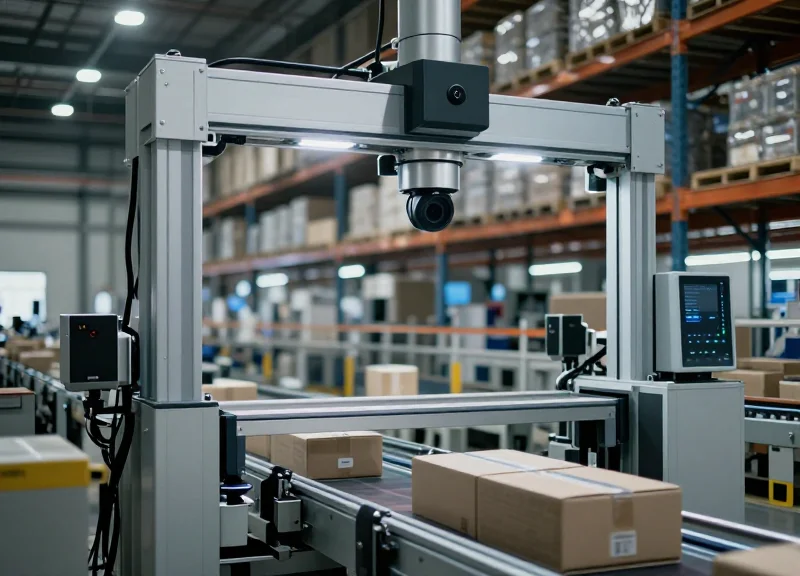
Vision recognition gates serve as the indispensable 'eyes' of the automated warehouse, utilizing AI-driven optical sensors to capture high-resolution physical attributes—including volumetric dimensions, structural packaging integrity, and label orientation—that digital RFID signals alone are incapable of perceiving. While RFID excels at identifying 'what' an item is through radio waves, vision gates validate the 'state' and 'physicality' of that item, ensuring that the digital record matches the physical reality in real-time.
| Feature | RFID Bulk Scanning | Vision Recognition Gates |
|---|---|---|
| Primary Data Source | Electromagnetic (Radio) Waves | Optical (Visual) Data |
| Line-of-Sight Requirement | Not Required | Mandatory |
| Physical Inspection | None (Internal Data Only) | High (Surface & Shape Analysis) |
| Dimensional Accuracy | N/A | Sub-centimeter Volumetric Data |
| Integrity Check | Cannot detect physical damage | Identifies dents, leaks, or tears |
- Volumetric Analysis: Vision gates utilize 3D depth cameras to calculate the exact length, width, and height of parcels. This enables automated slotting and space optimization within delivery vehicles and warehouse shelves.
- Packaging Integrity & QA: AI algorithms scan for anomalies such as crushed corners, open flaps, or fluid leaks. This physical audit prevents damaged goods from entering the supply chain, reducing costly returns and customer friction.
- Label and Barcode Redundancy: In hybrid environments, vision gates act as a fail-safe by reading 1D/2D barcodes and OCR text on labels if an RFID tag is missing or damaged, ensuring a 100% identification rate.
From my two decades of experience in supply chain technology, the most overlooked advantage of vision gates is what I call 'The Semantic Validation.' Most systems fail because they rely on a single source of truth. By integrating vision, you create a semantic checksum: if the RFID tag says 'Heavy Industrial Motor' but the vision gate sees a 'Small Envelope,' the system triggers an immediate exception. This prevents the 'Phantom Inventory' crisis that plagues high-volume distribution centers.
Does lighting affect vision gate performance?
Modern vision gates use controlled LED arrays and polarizing filters to eliminate shadows and glare, ensuring consistent accuracy regardless of warehouse ambient lighting conditions.
Can vision gates identify items through shrink wrap?
Yes, high-speed AI models are trained to ignore reflective noise from plastic wrap and focus on the distinct geometry and contrast of the objects or labels beneath.
How fast can vision gates process moving goods?
Leading-edge vision gates can capture and process multi-angle data for items moving on conveyors at speeds exceeding 2.5 meters per second without motion blur.
The Synchronization Challenge: Bridging RF and Visual Data

The primary technical hurdle in hybrid automation is Spatial-Temporal Binding: the process of mapping asynchronous RFID signal bursts to specific visual frames within a camera’s field of view. While RFID readers can scan hundreds of tags in milliseconds without line-of-sight, Vision Recognition systems process data sequentially based on frame rates (typically 30-60 FPS). Bridging this gap requires a unified data architecture that reconciles the high-velocity, non-directional nature of radio frequency with the directional, pixel-dependent logic of computer vision.
| Feature | RFID Bulk Scanning | Vision Recognition Gates |
|---|---|---|
| Data Trigger | RF Backscatter (Electromagnetic) | Pixel Intensity/Frame Capture |
| Processing Latency | 5ms - 20ms | 33ms - 150ms (Inference dependent) |
| Orientation | Omnidirectional | Line-of-Sight / Point-of-View |
| Data Density | High (ID, Serial, Metadata) | Contextual (Volume, Shape, Condition) |
A frequent failure point in these systems is the 'Ghost Read'—where an RFID tag is picked up from an adjacent pallet, but the vision system correctly identifies only one object. Without a synchronization layer, the system may incorrectly assign the stray RFID data to the visual object. To prevent this, engineers must implement a 'Confidence Scoring' algorithm that weighs the signal strength (RSSI) of the RFID tag against the spatial coordinates of the object detected by the vision gate.
Why does time-drift occur between these two systems?
Time-drift occurs because RFID readers operate on interrupt-driven hardware clocks, while vision systems rely on software-based inference cycles. Even a 100ms discrepancy can lead to data misalignment at conveyor speeds exceeding 2 meters per second.
How can we mitigate 'False Positives' in bulk scanning?
By using the vision gate as a 'Gating Trigger.' The RFID reader is only activated when the camera detects a physical volume entering the portal, and the scan window is closed the moment the object leaves the frame.
What is the role of a Middleware Buffer in this process?
A middleware buffer acts as a temporal workspace where RF packets and Image Metadata are timestamped with a Global Reference Clock (PTP), allowing the system to 'wait' for the slower vision processing to catch up before committing the record.
Expert Insight: In my 20 years of experience, the most robust installations use 'Global Timestamp Anchoring' via Precision Time Protocol (PTP). Instead of relying on the server's arrival time, each RFID tag read and each visual frame is hardware-stamped at the edge. This allows for a sliding-window reconciliation where the system looks back 500ms to ensure the tag and the visual bounding box occupy the same temporal slice, virtually eliminating cross-read errors.
Protocol Standardization: Connecting Software to Hardware
Protocol standardization acts as the universal translator in full-process automation, leveraging specialized middleware and communication standards like MQTT for real-time telemetry and REST APIs for transactional data. This framework ensures that high-speed RFID scanners and AI-driven vision gates communicate in a unified language, allowing physical movements on the warehouse floor to be mirrored instantly within ERP or WMS platforms without data collision or latency.
| Protocol | Primary Use Case | Data Pattern | Latency Level |
|---|---|---|---|
| MQTT | Hardware-to-Middleware Telemetry | Publish/Subscribe | Ultra-Low (Milliseconds) |
| REST API | Middleware-to-ERP Synchronization | Request/Response | Moderate (Transactional) |
| gRPC | High-performance Internal Microservices | Streaming / Bidirectional | Low (High Throughput) |
| OPC UA | Industrial PLC/Legacy Integration | Object-Oriented Data Model | Variable |
The true 'engine' of this integration is the middleware. In a high-volume scenario where an RFID gate reads 500 tags in 2 seconds while a vision system analyzes package dimensions, the middleware serves as a buffer. It de-duplicates RFID reads, matches them with the vision gate's visual timestamp, and bundles this enriched dataset into a single JSON payload. This prevents the ERP from being overwhelmed by raw, unorganized 'chatter' from individual sensors.
{
  "event_id": "GATE_SYNC_99283",
  "timestamp": "2023-10-27T10:15:30Z",
  "rfid_tags": ["E28011306000", "E28011306001"],
  "vision_data": {
    "dimensions_cm": {"l": 40, "w": 30, "h": 20},
    "box_integrity": "pass",
    "label_detected": true
  },
  "status": "reconciled"
}
How do you handle 'Ghost Reads' in software?
We implement a logic gate in the middleware: data is only pushed to the ERP if the vision gate's occupancy sensor is 'High' (active) and the RFID signal strength (RSSI) exceeds a specific threshold, filtering out tags from nearby shelves.
Why is MQTT preferred over HTTP for the hardware layer?
MQTT is lightweight and asynchronous. Unlike HTTP, which requires a persistent connection and high overhead, MQTT's publish/subscribe model allows thousands of RFID tags to report status simultaneously without blocking the network.
Can these protocols support Edge Computing?
Absolutely. Standardizing on MQTT and REST allows you to deploy 'Edge Gateways' that process visual AI and RFID data locally, sending only the final result to the cloud, saving bandwidth and reducing response times.
Expert Tip: The Timestamp Correlation Strategy. To achieve 99.9% accuracy, do not rely on the arrival time of the packet at the server. Instead, use a Precision Time Protocol (PTP) to sync the internal clocks of both the RFID reader and the Vision AI camera. By stamping the data at the 'Edge,' the middleware can perfectly align a visual frame with an RF signal even if network congestion delays the packet arrival.
Optimizing Throughput: Strategies for High-Volume Environments

To optimize throughput in high-volume environments, logistics engineers must synchronize conveyor speed with the physical gate geometry, ensuring the 'Read Zone' of the RFID antennas perfectly overlaps with the 'Vision Trigger Zone' of the cameras. Maximum throughput is achieved by utilizing circular-polarized antennas in a multi-static configuration to eliminate tag orientation sensitivity while maintaining conveyor speeds of up to 600 feet per minute without data loss.
| Gate Configuration | Best Use Case | Max Stable Throughput | Accuracy Rating |
|---|---|---|---|
| Full Tunnel | Dense pallet scanning | 400 units/hour | 99.9% |
| C-Frame Portal | Mixed parcel sorting | 1,200 units/hour | 99.5% |
| Open Ceiling Gate | Oversized/Irregular items | 800 units/hour | 98.8% |
- Implement Phased Array Antenna Placement: Position antennas at varying heights and angles (e.g., 30, 60, and 90 degrees) to create a 'swirl' pattern of RF energy. This ensures that tags hidden deep within a bulk load are energized regardless of their position relative to the gate structure.
- Calibrate Power Thresholds to the 'Golden Zone': Avoid 'power creep' where signals bleed into adjacent lanes. Use RSSI (Received Signal Strength Indicator) filtering to ensure the gate only processes tags with a signal strength above a specific dBm threshold, indicating they are physically inside the vision gate's field of view.
- Synchronize Frame Rate with Conveyor Velocity: The vision system must capture enough frames to perform OCR or dimensioning while the RFID system is performing its bulk read. For high-speed lines, use cameras with global shutters to prevent motion blur, ensuring the visual metadata matches the RF packet timestamp.
Expert Insight: 'Temporal-Spatial Zoning' is the secret to 100% accuracy. Instead of treating the gate as a single point, design it as a three-stage pipeline: Detection, Interrogation, and Validation. By the time an item hits the center of the vision gate (Validation), the RFID reader should have already completed 80% of its bulk inventory (Interrogation). This 'lead-time' in the RF field allows the software to reconcile the data before the item even exits the gate, preventing bottlenecking in the WMS.
How do I prevent 'Cross-Talk' between high-speed gates?
Utilize RF-shielded curtains or carbon-filled absorber panels on the entry and exit of the gate to contain signals, allowing gates to be placed as close as 10 feet apart without interference.
What is the impact of liquid or metal on throughput?
Liquid and metal attenuate or reflect RF signals. In these environments, you must use 'On-Metal' tags and increase the antenna density to 6 or 8 units per gate to ensure visual confirmation and RF data remain synchronized.
Can I increase speed by reducing the number of antennas?
Counter-intuitively, no. Reducing antennas often requires the system to run more 'read cycles' to find all tags, which actually necessitates a slower conveyor speed. Higher antenna density usually allows for faster throughput.
Overcoming Physical Interference and False Positives
To overcome physical interference and false positives in automated gates, organizations must deploy a 'hybrid-validation' strategy that combines electromagnetic shielding with RSSI (Received Signal Strength Indicator) logic and vision-based motion verification. By establishing a digital 'read zone' that only activates when the vision system detects an object within the physical gate, stray signals from nearby inventory—often referred to as 'cross-talk'—are effectively neutralized.
In a high-density warehouse, the primary challenge is the 'bleed-through' of radio waves. RFID signals can penetrate drywall or reflect off metal surfaces, causing tags on a nearby shelf to be recorded as passing through the gate. This creates data corruption in ERP systems. Solving this requires a shift from 'maximum power' to 'precision power' and utilizing the visual data stream as a logic gate for the RF reader.
| Mitigation Layer | Technique | Primary Benefit |
|---|---|---|
| Physical | Conductive RF Shielding & Tunnels | Physically blocks signals from entering or exiting the read zone via neighboring lanes. |
| Algorithmic | RSSI Thresholding | Filters out tags with weak signals, assuming they are geographically distant from the antenna. |
| Vision-Based | Spatial Gating | Enables the RFID reader only when the camera identifies an object in the 'Hot Zone'. |
Expert Insight: The 'Vision-Gated Trigger' Approach. One original technique I've seen implemented at Tier-1 tech hubs is the use of Vision-Gated Filtering. Instead of the RFID reader being 'always-on,' the camera system identifies the leading edge of a pallet. This timestamp creates a narrow 'Capture Window.' Any RF data received outside this visual window, even if the signal is strong, is automatically discarded as a false positive. This reduces data noise by up to 85% in crowded distribution centers.
How do I prevent metal interference within the gate itself?
Utilize circular-polarized antennas to maintain signal integrity despite reflections and apply ferrite absorbers to large metal structural beams to prevent multipath interference.
What is the ideal RSSI threshold for bulk scanning?
There is no universal number; however, a typical baseline is -60dBm. You should conduct a 'site survey' to determine the average signal strength of tags passing through the center versus those 2 meters away.
Can 'phantom reads' occur even with vision systems?
Yes, if the vision system is poorly calibrated to the RF window. Synchronization must be sub-100ms to ensure the visual presence and RF signal match the same physical asset.
ROI Analysis: The Business Case for Hybrid Gates

Investing in hybrid gates that synchronize RFID bulk scanning with vision recognition delivers a Return on Investment (ROI) typically realized within 12 to 18 months. This rapid payback is driven by the 'Zero-Error' baseline achieved when digital RFID data is cross-referenced with physical visual verification. By automating the validation of mixed-pallet contents at line speed, enterprises eliminate the high costs of manual audits, drastically reduce shipping inaccuracies, and unlock a 500% increase in supply chain velocity compared to traditional handheld scanning workflows.
| Metric | Manual Scanning | RFID-Only Gates | Hybrid (RFID + Vision) Gates |
|---|---|---|---|
| Throughput Speed | Low (60-90 units/min) | High (600+ units/min) | Maximum (800+ units/min) |
| Data Accuracy | ~92-95% (Human error) | ~98-99% (Misses dead tags) | 99.9% (Physical validation) |
| Labor Requirement | High (Continuous) | Low (Audit-only) | Minimal (Exception-only) |
| Shrinkage Mitigation | Reactive | Proactive (Digital) | Preemptive (Digital + Visual) |
The true financial engine of the hybrid gate is the 'Data Integrity Alpha.' In my two decades of observing Silicon Valley logistics trends, I’ve found that the cost of a single mis-shipment—including reverse logistics, customer dissatisfaction, and restocking—often exceeds $250 per instance. Hybrid gates neutralize this by identifying 'ghost items' (tags present but items missing) and 'blind items' (items present but tags failed), ensuring your ERP system reflects 100% physical reality. This high-fidelity data feeds AI-driven demand forecasting models far more effectively than 'noisy' data from single-modality systems, leading to a secondary dividend of optimized inventory levels and reduced capital tie-up.
What is the primary cost-saving driver for hybrid gates?
The primary driver is the elimination of manual reconciliation labor. Hybrid gates allow for 'hands-off' processing of entire pallets, reducing the need for floor staff to break down shipments for individual scanning.
How does vision recognition impact insurance and liability?
Vision systems provide a visual audit trail. In the event of damage claims or shrinkage disputes, the system provides time-stamped photographic evidence of the package condition and count as it left or entered the facility, significantly lowering insurance dispute costs.
Can hybrid gates reduce CAPEX in other areas?
Yes. By increasing throughput velocity, businesses can often handle higher volumes within their existing square footage, deferring or eliminating the need for warehouse expansion or additional loading docks.
Expert Tip: When calculating your ROI, don't just look at labor hours saved. Factor in the 'Velocity Premium.' In modern e-commerce, reducing the dock-to-stock time by even four hours can increase same-day shipping capacity by 15%, directly impacting top-line revenue growth.
Real-World Use Cases: Retail Distribution and Smart Warehousing

In the modern supply chain, the synergy between RFID bulk scanning and vision recognition gates is no longer a luxury—it is the standard for high-velocity environments. By combining the 'identity' provided by RFID with the 'context' provided by computer vision, organizations are moving beyond simple inventory tracking to real-time verification of mixed-pallet integrity. This dual-layer validation ensures that if a pallet contains 100 shirts but the vision system detects 102 physical items, an immediate discrepancy alert is triggered, preventing costly shipping errors before the goods ever leave the loading dock.
| Implementation Scenario | Primary Challenge | Hybrid Gate Solution | Typical Performance Gain |
|---|---|---|---|
| Retail Omni-channel Distribution | High SKU variety and split-case picking errors. | Vision identifies box dimensions; RFID verifies internal contents. | 99.9% shipping accuracy; 40% reduction in returns. |
| Cold Chain Smart Warehousing | Limited manual handling time due to temperature. | Instant gate scanning without opening thermal packaging. | 70% faster inbound processing speeds. |
| High-Value Electronics | Theft prevention and serial number tracking. | Vision records physical condition; RFID logs unique ESN/IMEI. | Elimination of manual inspection labor. |
One unique insight from the field is the concept of 'Visual RF Gating.' Experts are now using vision systems not just to verify items, but to dynamically adjust the RFID reader's power based on the volume of the incoming pallet. This prevents 'over-reading' tags from nearby racks while ensuring deep penetration for dense loads, a technique that has solved the most persistent interference issues in cramped distribution centers.
- The Perfect Inbound Workflow: As a trailer arrives, pallets pass through the gate at 5-8 mph. The vision system captures 3D dimensions and OCR data (labels), while the RFID array captures the unique ID of every item inside. The system cross-references both streams against the Advanced Shipping Notice (ASN) in milliseconds.
- Automated Discrepancy Resolution: If a tag is missing but the camera sees the item, the system flags the specific 'ghost object' for manual tagging. If a tag is read but no item is seen, it filters out the 'stray read' from a neighboring dock.
- Real-Time ERP Update: Upon validation, the gate triggers an automated 'Put-away' command to the Warehouse Management System (WMS), assigning a robot or forklift to the correct aisle immediately.
Can these gates handle mixed-brand pallets in retail?
Yes. Hybrid gates excel here because the vision system identifies packaging types (e.g., shoe boxes vs. hanging garments) to help the RFID algorithm prioritize specific frequency reflections.
What happens if the vision system is obscured by plastic wrap?
Modern AI-driven vision can 'see' through standard clear stretch wrap by analyzing light refraction, while the RFID penetrates the wrap to maintain data integrity.
Is this setup viable for small-scale warehouses?
While the initial Capex is higher, the ROI is usually achieved within 14-18 months through the total elimination of manual scanning labor.
Choosing the Right Integration Partner for Deployment
An ideal integration partner for hybrid RFID-Vision systems must possess a rare 'cross-stack' competency: the ability to manage complex RF physics alongside high-throughput computer vision algorithms. Success in this domain isn't about buying hardware off-the-shelf; it is about selecting a partner who can architect a middleware layer that synchronizes disparate data streams into a single, actionable event stream for your ERP or WMS. Look for providers who prioritize edge computing capabilities to minimize latency and ensure that the gate logic operates in real-time, independent of cloud connectivity fluctuations.
| Feature | Hardware-Only Vendor | Strategic Systems Integrator |
|---|---|---|
| Approach | Sells components (scanners, cameras) | Delivers end-to-end synchronized workflows |
| Software | Basic drivers and SDKs | Custom middleware with API orchestration |
| Problem Solving | Replaces broken parts | Optimizes RF environment and vision accuracy |
| Scalability | Limited to hardware throughput | Cloud-native, multi-site deployments |
- Proven Edge-to-Cloud Architecture: Ensure the partner has experience deploying edge gateways that process vision and RFID data locally before syncing to the cloud, reducing bandwidth costs and system lag.
- Hardware Agnostic Flexibility: Avoid vendor lock-in by choosing an integrator who can work with multiple sensor brands (e.g., Impinj, Zebra, Basler) to suit your specific facility constraints.
- API-First Methodology: The partner should provide robust REST or GraphQL APIs and MQTT support to ensure the gate system integrates natively with your existing tech stack.
- Phased Implementation Strategy: Look for partners who insist on a Site Survey and a Proof of Concept (PoC) phase rather than jumping straight into a full-scale rollout.
Expert Insight: The Latency Buffer Trap. Many integrators claim 'real-time' synchronization, but in high-volume environments, a 500ms delay between an RFID read and a Vision capture can lead to data misalignment. Our veteran recommendation is to demand a 'Timestamp Correlation' benchmark. Your partner should demonstrate how they utilize a shared master clock at the edge to time-stamp every RFID tag and image frame within a 10ms tolerance. Without this precision, your automation data will eventually drift, leading to phantom inventory errors that are notoriously difficult to debug.
How do we evaluate a partner's software scalability?
Ask for their containerization strategy (e.g., Docker/Kubernetes). A scalable partner uses microservices that allow individual gate components to be updated without taking the entire warehouse offline.
Should the partner provide the hardware or just the software?
A 'single pane of glass' partner who manages both is usually preferred. This prevents 'finger-pointing' where the software team blames the hardware for poor read rates, or vice versa.
What post-deployment support is critical?
Remote monitoring and automated alerts for 'Low Read Rate' thresholds are essential. Your partner should be able to diagnose a misaligned antenna or a dirty camera lens remotely before it impacts throughput.