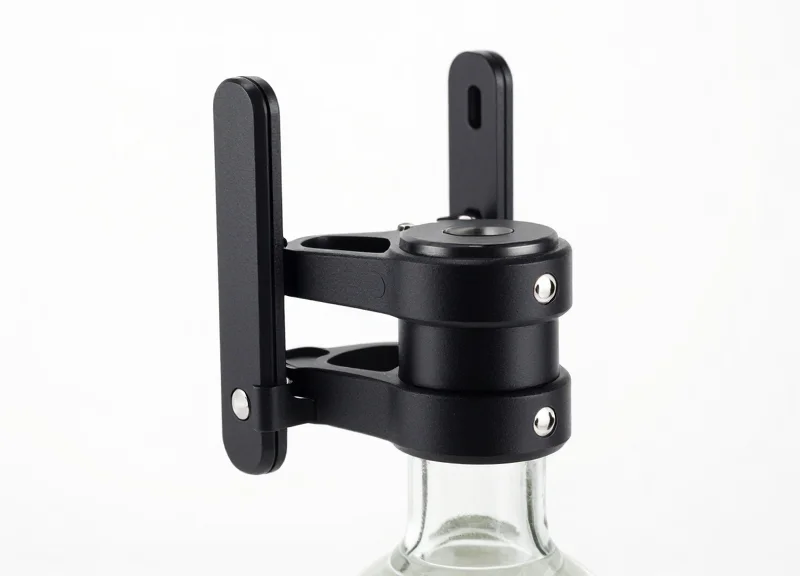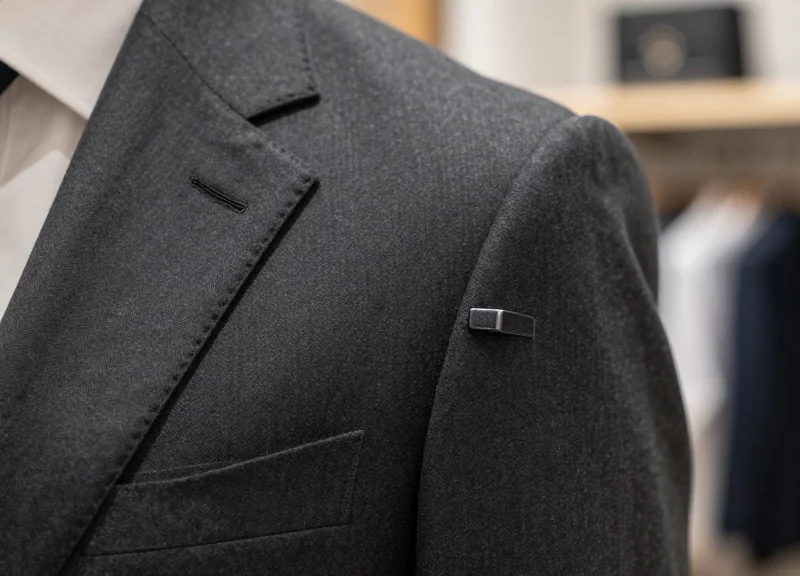
For luxury retailers, the challenge is paradoxical: inventory must be protected from theft, yet the security hardware itself can be a threat to the integrity of delicate, high-value fabrics. Tailored suits and structured garments—crafted from fine wool, silk, and intricate blends—require a specialized approach to loss prevention. This guide explores the technical evolution of non-damaging tagging, ensuring your most expensive assets remain pristine while staying secure from the sales floor to the stockroom.
The Vulnerability of Structured Apparel to Standard Tagging
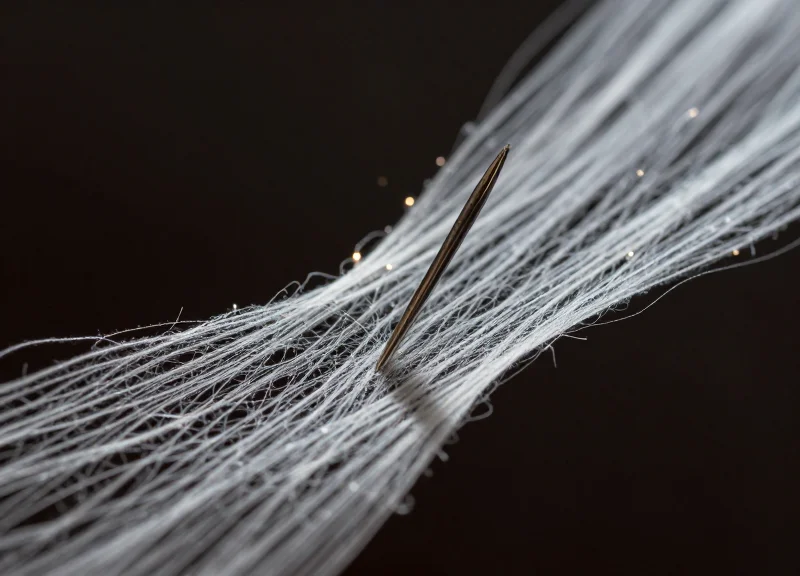
Standard tagging pins, typically ranging from 1.2mm to 1.5mm in gauge, cause permanent fiber displacement in structured apparel by severing high-twist yarns and distorting the internal horsehair canvas or synthetic interfacing. Unlike casual wear, tailored garments utilize multi-layered construction where a single puncture can create 'bruising'—a visible, non-recoverable indentation or localized 'shine' on the fabric surface caused by the compression of the tag’s clutch mechanism against delicate wool fibers.
When a standard Electronic Article Surveillance (EAS) pin is forced through a tailored suit, it doesn't just pass between threads; in high-density weaves like Super 150s or 180s wool, it often splits the filaments. This damage is exacerbated in 'structured' areas—such as shoulder pads and lapels—where the pin must penetrate multiple layers of fabric, padding, and chest pieces. This creates a structural weak point that can lead to 'dimpling' once the tag is removed, effectively devaluing the inventory before it even reaches the customer's closet.
| Component | Tagging Impact | Structural Consequence |
|---|---|---|
| Floating Canvas | Fiber Severance | Loss of chest piece 'roll' and shape retention. |
| Shoulder Padding | Compression Set | Visible 'dents' or bruising on the shoulder silhouette. |
| Super Wool Shell | Filament Splitting | Permanent holes that do not 'heal' with steam or brushing. |
| Fusible Interfacing | Adhesive Delamination | Bubbling around the puncture site after dry cleaning. |
Expert Insight: The Torsional Stress Factor. A unique vulnerability often overlooked is 'torsional stress.' In a retail environment, customers frequently move or shift tagged garments on the rack. Standard heavy-head tags act as a lever; the weight of the tag creates torque on the pin. In structured apparel, this torque pulls against the rigid internal interfacing, causing the puncture hole to elongate into a tear—a phenomenon known in the textile industry as 'yaw distortion' that is impossible to repair invisibly.
Why doesn't steaming fix tag holes in suits?
Steaming helps fibers relax, but it cannot repair severed filaments or compressed synthetic interfacings that have reached their plastic deformation limit.
What is 'bruising' in luxury retail?
Bruising refers to the permanent crushing of fabric nap or the creation of a 'shiny' spot where the hard plastic surface of a security tag has been clamped too tightly against the wool.
How does needle gauge affect damage?
Every 0.1mm increase in pin diameter exponentially increases the number of broken warp and weft threads in high-thread-count fabrics.
Fine-Gauge Pin Technology: The Technical Difference
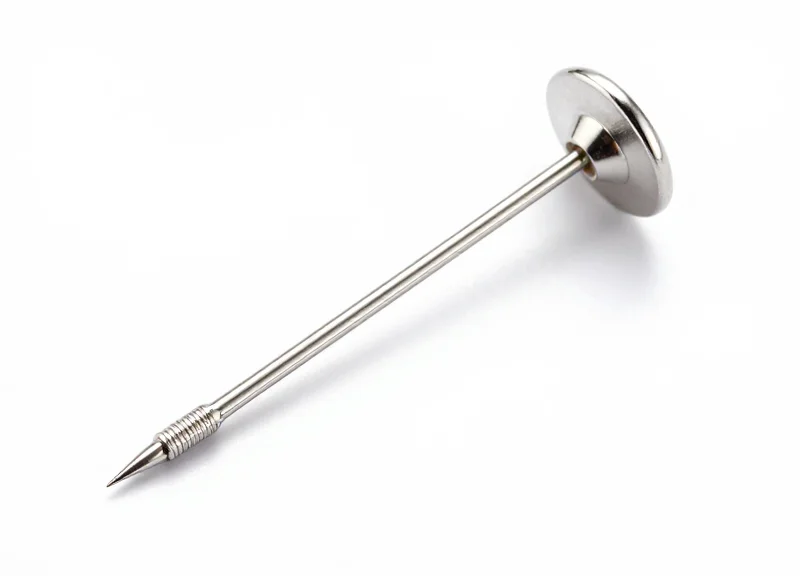
Fine-gauge pin technology refers to high-precision security fasteners engineered with a significantly reduced diameter—typically between 0.45mm and 0.55mm—and a micro-tapered conical tip. Unlike standard security pins that rely on sheer force to penetrate materials, fine-gauge pins are designed to achieve 'fiber displacement' rather than 'fiber severance.' By sliding between the microscopic gaps in the warp and weft of luxury textiles like Super 150s wool or silk-blends, these pins preserve the weave density and eliminate the permanent 'entry wounds' common in retail environments.
| Technical Specification | Standard EAS Pin | Precision Fine-Gauge Pin |
|---|---|---|
| Shaft Diameter | 0.80mm - 1.20mm | 0.45mm - 0.55mm |
| Tip Geometry | Blunt or Chiseled | Ultra-Smooth Conical |
| Fiber Interaction | Severance (Cutting) | Displacement (Nudging) |
| Surface Finish | Nickel Plated | Electropolished Stainless |
| Fabric Suitability | Denim, Heavy Knits | Tailored Wool, Silk, Microfiber |
The engineering secret lies in the 'Apex Radius.' Standard pins often have microscopic burrs or a blunt tip that acts like a punch tool, forcing its way through threads. A fine-gauge pin undergoes an electropolishing process to ensure a friction-coefficient near zero. This allows the pin to find the path of least resistance within a fabric's structure. For structured apparel like tailored suits, this is critical because it prevents the 'memory effect' where the fabric cannot return to its original shape after the pin is removed.
Does the reduced diameter compromise security strength?
No. By using hardened stainless steel alloys, fine-gauge pins maintain high tensile strength and resistance to bending, ensuring they cannot be easily snapped or manipulated by shoplifters.
How does 'Smooth-Finish' technology prevent snagging?
The pins are subjected to a chemical-mechanical polishing (CMP) process that removes microscopic irregularities. This prevents the pin from catching on individual silk or wool filaments during extraction.
Are these pins compatible with existing EAS hard tags?
Most fine-gauge pins are designed with universal grooves, making them backwards-compatible with standard AM (Acousto-Magnetic) and RF (Radio Frequency) hard tags.
Expert Insight: In my two decades observing retail loss prevention, the most overlooked factor isn't the pin's width, but its 'Lubricity.' Premium fine-gauge pins often feature a proprietary dry-film lubricant coating. This microscopic layer reduces the heat generated by friction during rapid tagging, which prevents the synthetic binders often found in modern 'stretch' tailored fabrics from melting or fusing to the pin—a common cause of those mysterious 'white spots' seen on dark garments after tag removal.
Strategic Tag Placement for Tailored Jackets and Blazers
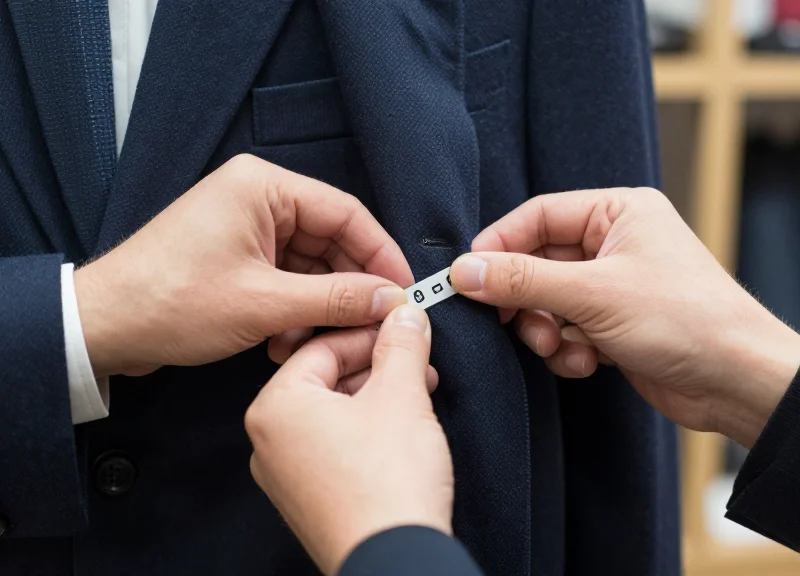
Strategic tag placement for tailored jackets involves identifying 'structural nexuses'—specific points where the garment's internal construction (such as hair canvas, shoulder pads, or seam tape) can support the weight of a security tag without distorting the silhouette. To maintain the 'roll' of the lapel and the 'pitch' of the sleeve, tags must be placed through reinforced seam intersections rather than the primary face fabric. The goal is to leverage existing structural reinforcement to distribute the shear force exerted by the tag's weight, preventing the common 'dimpling' effect seen on high-twist wools and silks.
| Placement Zone | Technical Advantage | Risk Level to Silhouette |
|---|---|---|
| Underarm Armscye Seam | High structural density; hidden from view; minimal fabric movement. | Low |
| Functional Sleeve Vent | Reinforced by mitered corners and facing; easy access for removal. | Medium |
| Lower Lapel Gorge | Directly pierces internal canvas; maintains lapel roll integrity. | Low |
| Center Back Lining Pleat | Attaches to 'ease' fabric; avoids the shell fabric entirely. | High (if not reinforced) |
Expert Tip: The 'Seam Sandwich' Technique. Never pierce the face fabric in isolation. Always ensure the pin passes through the seam allowance where at least four layers of material meet (shell, interfacing, stay tape, and lining). This creates a 'sandwich' that prevents the weight of the tag from stretching the delicate weave of high-Super wools (Super 150s+), which lack the elasticity to recover from localized tension.
- Identify the Armscye Intersection: Locate the point where the sleeve seam meets the side seam under the arm. This is the strongest point of the jacket.
- Partial Lining Entry: If the jacket is half-lined, insert the pin through the interior seam allowance of the shell fabric, keeping the tag body tucked within the lining cavity.
- Gravity Calibration: Check the hang of the jacket on a hanger after tagging. If the shoulder drops or the chest buckles, move the tag 1cm closer to the rigid armhole seam.
Will tagging a buttonhole damage the shape?
Tagging through a functional buttonhole is safe only if the tag pin is thinner than the buttonhole's internal diameter. However, the weight can cause 'gaping' over time; use a lanyard attachment to the button shank instead.
How do I avoid 'bruising' on light-colored linens?
For light or porous fabrics, use a plastic-coated fine-gauge pin. The friction of metal against dry linen fibers can cause 'burnishing' or grey marks that are nearly impossible to remove without professional laundering.
Is the interior pocket a viable tagging location?
While discreet, the interior 'besom' pocket is often only held by the lining. Heavy tags can tear the delicate silk or cupro lining. Only use this if the pocket is reinforced with a bartack.
Lanyard and Loop Solutions: Security Without Piercing
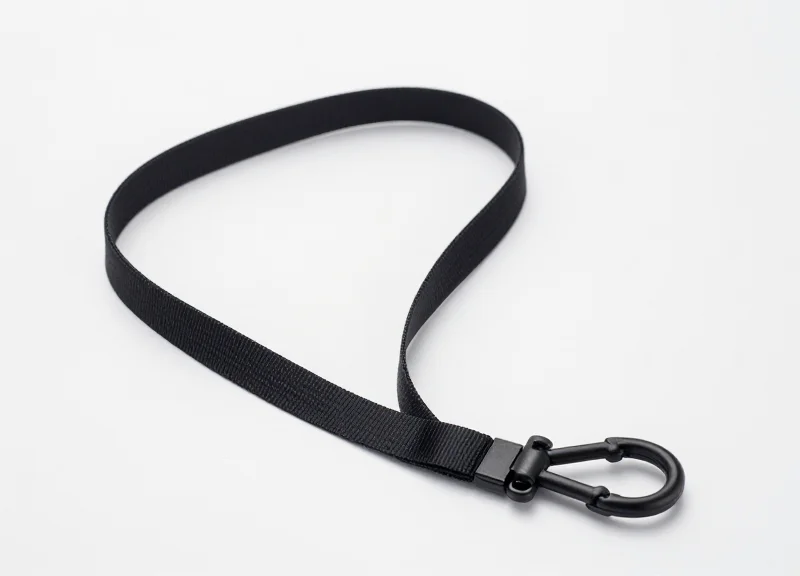
Lanyard and loop solutions represent the gold standard for 'zero-pierce' security in high-end retail. Unlike traditional EAS pins that must penetrate the weave, these systems utilize a flexible, high-tensile cable to tether a hard tag to a garment's existing structural features—such as buttonholes, zipper pulls, or woven brand labels. This method is essential for garments with silk linings, leather accents, or micro-denier fabrics where any puncture, however small, risks permanent fiber snagging or 'run' damage. By bypassing the fabric entirely, retailers can protect inventory without compromising the material integrity of bespoke items.
| Lanyard Material | Tensile Strength | Best Use Case | Aesthetic Impact |
|---|---|---|---|
| Stainless Steel (PVC Coated) | Extremely High | Heavy Outerwear & Leather | High Visibility/Deterrent |
| Braided Nylon Cord | Moderate | Silk-Lined Suits & Lingerie | Low Visibility/Soft Touch |
| Reinforced Polypropylene | High | Structured Blazers | Standard Commercial Look |
Expert Insight: The Neck Bridge Strategy. For bespoke tailoring, avoid looping lanyards through shoulder pads or sleeve vents. Instead, anchor the lanyard through the internal 'locker loop' or the seam junction at the neck bridge. This technical placement transfers the physical weight of the security tag to the garment's strongest structural point, preventing the 'hang-dip' distortion that occurs when heavy tags pull on delicate shoulder constructions over time.
- Identify the Structural Anchor: Locate a reinforced point such as a functional buttonhole, a securely sewn interior label, or a zipper slider.
- Loop Insertion: Pass the lanyard through the anchor point, ensuring the cable does not create a pinch point or friction zone on the fabric.
- Tag Engagement: Insert the lanyard tip into the EAS hard tag locking mechanism until a physical click confirms the deadbolt is engaged.
- Tension Calibration: Ensure the lanyard length allows the garment to hang naturally on a mannequin while remaining short enough to prevent the tag from being slipped over the hanger.
Are lanyards easier for shoplifters to cut than pins?
No. Modern lanyards utilize multi-strand aircraft-grade steel cores that require specialized heavy-duty cutters, often making them more secure than plastic-headed pins.
Will the lanyard cable leave a pressure mark on silk?
Only if the cable is raw metal. Utilizing PVC-coated or fabric-sleeved lanyards provides a buffer that prevents friction burns and 'shining' on delicate linings.
Can lanyards be used with RFID technology?
Yes, lanyard-style tags are fully compatible with both AM/RF EAS systems and RFID inventory tracking chips, providing dual-layer protection.
Integrating RFID for Luxury Inventory Management

Integrating Radio Frequency Identification (RFID) into luxury inventory management involves embedding passive UHF (Ultra-High Frequency) chips into existing garment components—such as care labels, brand tags, or hangtags—to enable contactless, bulk scanning of high-value inventory. Unlike traditional EAS hard tags that require piercing fabric, RFID provides a non-invasive, 'invisible' tracking layer that maintains the structural integrity of tailored suits while offering near-100% stock accuracy and real-time provenance verification.
| Feature | RFID-Embedded Care Labels | RFID-Integrated Hangtags |
|---|---|---|
| Installation | Sewn-in during manufacturing | Attached via lanyard/string |
| Permanence | Permanent (lifecycle tracking) | Temporary (point-of-sale removal) |
| Visual Impact | Zero (completely hidden) | Low (replaces standard hangtag) |
| Best Use Case | Anti-counterfeiting & Returns | Showroom Floor Management |
- Source Tagging Selection: Partner with manufacturers to embed 'Inlay-on-Fabric' RFID chips directly into the silk or satin brand labels during the production phase to ensure zero post-production handling.
- Frequency Calibration: Calibrate readers for UHF Gen2 signals, which allow for dense-reading environments where suits are packed closely on high-capacity rolling racks.
- Software Synchronization: Link the unique Electronic Product Code (EPC) of each tag to your ERP system, capturing specific attributes like fabric mill, tailor ID, and seasonal batch.
Expert Silicon Valley Insight: The 'Dual-Stack' Advantage. While most retailers settle for UHF RFID for logistics, the elite tier is moving toward 'Dual-Stack' tags that combine UHF (for long-range inventory) and NFC (for short-range customer interaction). This allows a client to tap their smartphone against a suit sleeve to verify its authenticity and view its 'digital birth certificate,' turning a security feature into a premium brand-building asset.
Will RFID tags interfere with the drape of a lightweight suit?
Modern 'flexible' inlays are thinner than a human hair and encapsulated in soft PET or fabric carriers, making them imperceptible to the wearer and neutral to the garment's silhouette.
Can RFID be used alongside traditional EAS security?
Yes, many luxury brands use 'Dual-Tech' tags that house both an RFID chip for data and an acousto-magnetic (AM) element for theft deterrence within a single non-damaging housing.
Does metallic threading in suits block the RFID signal?
While high concentrations of metallic thread can cause 'detuning,' strategic tag placement 2-3cm away from heavy metallic embellishments ensures consistent read rates.
The Role of Soft Tags and Adhesive Safety
Soft tags, or adhesive-backed Electronic Article Surveillance (EAS) labels, provide a non-piercing security solution for high-value tailored garments where even fine-gauge pins might cause irreversible weave distortion. The safety of these tags hinges on the chemical composition of their adhesives; specifically, the use of pH-neutral, acrylic-based compounds that ensure no chemical transfer, staining, or 'ghosting' occurs on delicate internal linings like silk, cupro, or acetate. When selected correctly, these tags offer a low-profile security layer that adheres firmly during display but peels away cleanly without leaving a tacky residue or pulling the fabric fibers.
| Adhesive Type | Fabric Compatibility | Risk Profile | Best Use Case |
|---|---|---|---|
| Acrylic-Based (pH Neutral) | Silk, Cupro, High-Twist Wool | Low: Resists yellowing and heat | Luxury suit linings & designer silk |
| Rubber-Based | Synthetics, Heavy Canvas | High: Can leave oily residue | Outerwear and heavy denim only |
| Removable High-Tack | Polyester, Viscose | Medium: May pull delicate fibers | Mid-range structured blazers |
The Science of Plasticizer Migration: Many standard adhesive tags contain plasticizers—chemicals used to keep the adhesive flexible. Over time, or when exposed to the heat of a dressing room or warehouse, these chemicals can 'migrate' into the garment’s fibers, causing permanent discoloration known as 'yellowing.' For tailored suits, this is catastrophic as it typically occurs on the light-colored sleeve linings or the brand’s silk-screened interior labels. To mitigate this, luxury retailers must specify 'non-migratory' adhesive certifications from their suppliers. This technical distinction ensures that the bond remains surface-level and does not interact with the molecular structure of the textile.
Expert Tip: The 48-Hour Thermal Stress Test. Before committing to a bulk order of soft tags for a new seasonal collection, perform a stress test. Apply a sample tag to the lining of a production-grade sample and place it in a high-humidity environment (or near a mild heat source) for 48 hours. If the label peels off without leaving a 'shadow' (a faint change in fabric luster) and the adhesive remains on the tag rather than the fabric, it is safe for high-end inventory. This proactive step prevents the 'inventory rot' that occurs when tags are left on garments during long-term storage.
Can soft tags be used on suede or leather linings?
No. Adhesives can strip the top-grain finish or nap from leather and suede. For these materials, lanyard-based security or seam-pinned tags are always preferred over adhesives.
Does 'clean-peel' mean it won't damage any fabric?
Not necessarily. While it won't leave residue, the mechanical action of peeling can still cause 'pilling' on loosely woven wools. Always apply soft tags to the smoothest part of the interior lining, never the exterior face fabric.
How does humidity affect adhesive safety?
High humidity can soften certain adhesives, making them more likely to seep into the weave. In humid climates, it is vital to use moisture-resistant, synthetic-faced soft tags rather than paper-faced ones.
Staff Training: The Human Element in Fabric Preservation

Staff training in fabric preservation is the systematic implementation of Standard Operating Procedures (SOPs) designed to eliminate human error during the security tagging lifecycle. By focusing on precision handling, employees move beyond simple loss prevention to become stewards of garment quality, ensuring that the mechanical application and removal of security hardware never results in thread displacement, needle scarring, or structural distortion of high-value tailored apparel.
- The 'Seam-First' Inspection: Before applying any tag, staff must identify the strongest structural point, typically a seam allowance or reinforced interior gusset, to ensure the weight of the tag does not pull on delicate face fabrics.
- Zero-Force Application: Train staff to never force a pin through resistance. If a needle does not glide through the weave, it is hitting a structural thread; the entry point must be shifted slightly to maintain fabric integrity.
- The Two-Handed Detachment: During checkout, staff should use one hand to stabilize the garment and the other to operate the detacher. This prevents the 'tug-and-release' snap that often causes micro-tears in silk linings.
- Post-Removal Grooming: After a tag is removed, use a specialized fabric bone folder or a clean fingernail to gently massage the fibers back into place, closing any temporary gaps in the weave.
| Action | Common Mistake (High Risk) | Professional Standard (Zero Damage) |
|---|---|---|
| Tag Placement | Piercing the lapel face | Utilizing hidden interior seam allowances |
| Handling Speed | Rapid, forceful 'clicking' of tags | Slow, deliberate alignment of pin and lock |
| Removal Process | Pulling the garment away from the detacher | Lifting the tag vertically while the garment rests flat |
| Staff Audit | Occasional spot checks | Weekly 'Tactile Audits' of floor inventory |
Expert Tip: Implement the 'Light Pass' technique. Before a garment is returned to the rack after a fitting or at the point of sale, staff should hold the tagged area against a backlit surface. This allows for immediate detection of 'pin-light'—tiny holes where the weave hasn't snapped back—allowing for instant remediation before the customer ever sees the defect.
How do we handle staff who struggle with dexterity?
Transition these team members to lanyard-based security solutions which require less fine motor precision than needle-and-clutch tags.
What is the best way to train for different fabric densities?
Provide 'practice swatches' of varied materials—from heavy wool flannel to 150s silk-blend—so staff can feel the different levels of resistance before touching live inventory.
Should tags be removed before or after the final garment steam?
Tags should be removed before the final press or steam to allow the heat to naturally reset the fibers where the pin was previously seated.
Future-Proofing Your Boutique with Hybrid Security Solutions
Hybrid security solutions represent the convergence of Electronic Article Surveillance (EAS) for loss prevention and Radio Frequency Identification (RFID) for inventory intelligence into a single, streamlined hardware form factor. For the luxury boutique, this 'dual-tech' approach eliminates the need to clutter a delicate tailored suit with multiple pins and sensors, effectively halving the physical stress placed on high-value fabrics while providing real-time data on stock levels and theft patterns.
The technical challenge in structured apparel has always been the weight-to-security ratio. Traditional setups often require an EAS hard tag for the door and an RFID hangtag for the stockroom. By consolidating these into a single hybrid tag, retailers reduce 'tag fatigue'—the phenomenon where heavy security hardware pulls at the shoulder pads or distorts the lapels of a structured garment over time. Furthermore, these systems allow for 'frictionless' luxury experiences, where items can be tracked from the fitting room to the point of sale without intrusive manual scanning.
| Feature | Legacy Multi-Tag Approach | Hybrid Single-Tag Solution |
|---|---|---|
| Fabric Impact | High: Two puncture points or heavy weight. | Minimal: Single puncture point, optimized weight. |
| Inventory Speed | Manual scanning of barcodes or separate RFID. | Instant: Bulk-reading via integrated RFID. |
| Theft Analytics | Basic: Alarm sounds at door. | Advanced: Identifies exactly *which* item left. |
| Aesthetic Clutter | High: Multiple visible plastic components. | Low: Single, often branded, sleek enclosure. |
Expert Insight: The 'Hidden' ROI of Granular Shrinkage Data While most retailers focus on the aesthetic benefits, the true power of hybrid tagging is 'Item-Level Attribution.' When a hybrid tag passes through an EAS gate, it doesn't just trigger an alarm; it identifies the specific SKU, size, and color being removed. This allows luxury managers to differentiate between opportunistic shoplifting and professional organized retail crime (ORC) patterns, enabling more targeted security deployments without turning your boutique into a fortress.
Can hybrid tags be reused on different fabric types?
Yes, high-quality hybrid tags are designed for multi-year lifecycles. However, for tailored suits, you must ensure the pin gauge is 'fine' (less than 1.2mm) to prevent permanent thread displacement in high-twist wools.
Does the RFID frequency interfere with the EAS signal?
Modern hybrid solutions use 'Spectral Separation,' where the AM or RF EAS signal operates on a different frequency band than the UHF RFID, ensuring zero interference and preventing false alarms at the storefront.
Is the transition to hybrid tagging cost-prohibitive?
While the initial per-tag cost is higher, the ROI is realized through reduced labor hours during inventory counts (up to 90% faster) and the elimination of double-tagging labor costs.