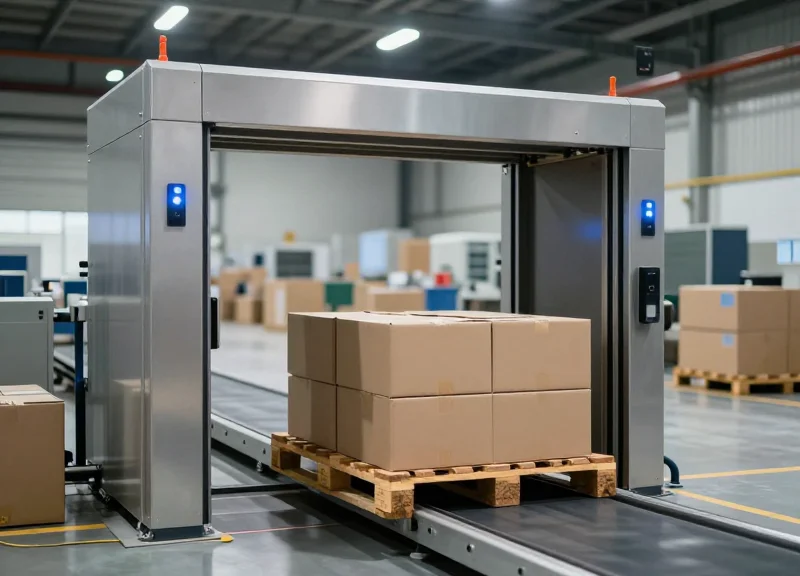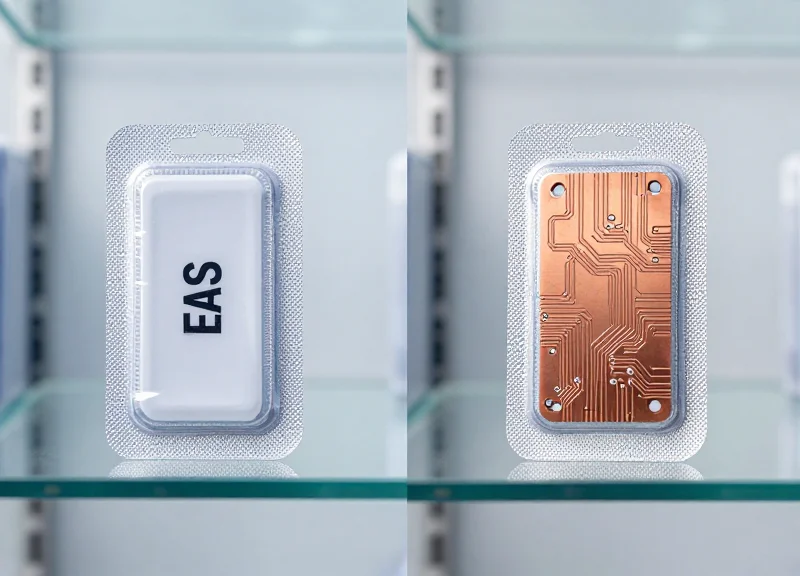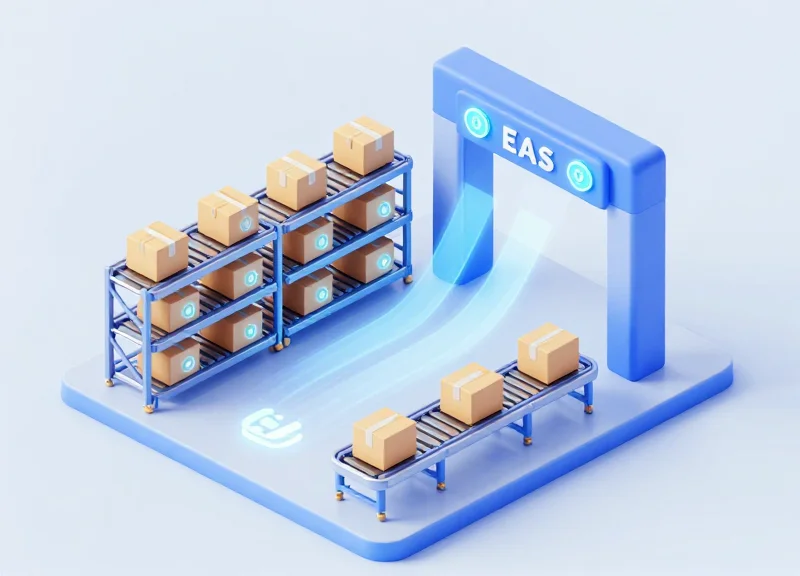
As the retail landscape undergoes a radical digital transformation, the traditional silos between loss prevention and inventory management are collapsing. For years, Electronic Article Surveillance (EAS) and Radio Frequency Identification (RFID) operated as parallel tracks. However, a significant shift is projected for 2026. This year will represent the critical tipping point where EAS and RFID converge within the manufacturing 'source tagging' phase. By integrating security and data at the point of origin, brands can eliminate labor-intensive store-level tagging, drastically reduce shrink, and achieve 99% inventory accuracy. This article explores the technological, economic, and operational drivers behind this 2026 milestone.
The Shift from Reactionary Security to Proactive Intelligence

The shift from reactionary security to proactive intelligence marks the transition of retail loss prevention from a silent alarm system to a comprehensive data engine. In the legacy reactionary model, Electronic Article Surveillance (EAS) simply sounds an alarm when a theft occurs; however, the proactive intelligence model, powered by integrated RFID and EAS at the source tagging level, provides real-time visibility into what is being stolen, when it was last seen, and how to optimize the rest of the supply chain to prevent similar gaps. By 2026, the goal is no longer just stopping a thief at the door, but using item-level data to create a 'frictionless' yet highly secure environment where inventory accuracy and loss prevention are managed through the same unified digital thread.
| Feature | Reactionary (Legacy EAS) | Proactive (Integrated EAS/RFID) |
|---|---|---|
| Primary Objective | Theft Deterrence | Total Supply Chain Visibility |
| Data Output | Binary (Alarm / No Alarm) | Item-level unique ID, Location, History |
| Inventory Insight | None (Requires manual count) | Real-time (99% accuracy targets) |
| Point of Application | In-store (Labor Intensive) | Factory Source Tagging (Pre-processing) |
| Value Realization | Cost Center (Expense) | Profit Driver (Revenue Recovery) |
The convergence of these technologies in 2026 is driven by the realization that 'dark inventory'—items that are in the store but cannot be located—is as damaging to the bottom line as traditional shoplifting. By embedding dual-technology tags during the manufacturing pre-processing phase, retailers can track an item from the factory floor to the shipping container, through the distribution center, and finally to the point of sale. This level of granularity transforms the security tag from a plastic deterrent into a sophisticated business intelligence tool that informs restocking, reduces out-of-stocks, and identifies organized retail crime (ORC) patterns through advanced analytics.
Why is 2026 considered the 'Convergence Year' for these technologies?
2026 is the tipping point because the cost of dual-technology chips has reached parity with legacy systems, while major retailers are mandating RFID compliance across all categories to support omnichannel fulfillment.
How does source tagging pre-processing reduce operational costs?
By applying tags at the point of manufacture, retailers eliminate the high labor costs of in-store tagging, ensuring that 100% of merchandise arrives 'floor-ready' and fully protected.
Can proactive intelligence help with Organized Retail Crime (ORC)?
Yes. Integrated systems allow retailers to identify exactly which items are being targeted across multiple locations, enabling law enforcement to build cases based on specific serial numbers and timestamps.
Expert Insight: In 2026, the most successful retailers will stop viewing loss prevention as a 'shrink' metric and start viewing it as a 'yield' metric. My Silicon Valley experience suggests that the 'Cost of Invisibility'—the cumulative loss of sales due to inaccurate inventory—will surpass the actual cost of physical theft. Integrated source tagging is the only way to solve both problems simultaneously by turning every security event into a data-rich audit point that informs the entire enterprise.
Defining the Convergence: EAS and RFID in a Single Tag
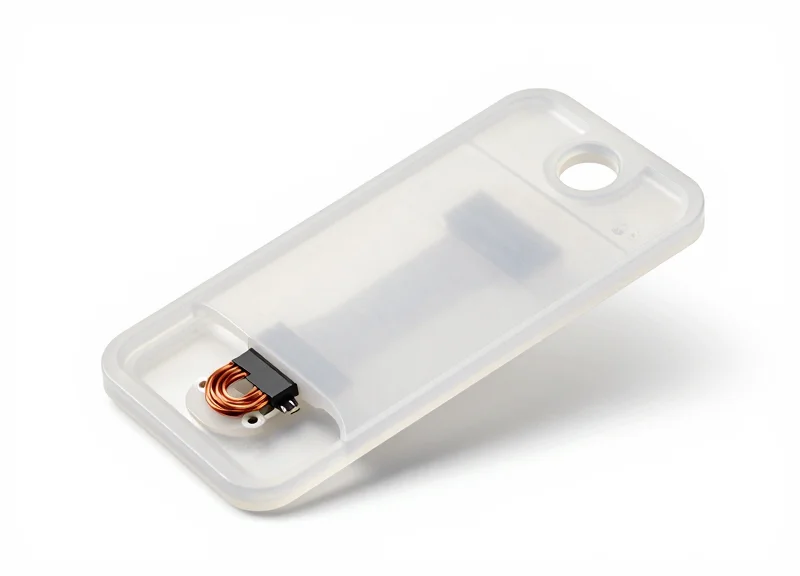
EAS and RFID convergence is the integration of traditional Electronic Article Surveillance (EAS) components—such as Acousto-Magnetic (AM) or Radio Frequency (RF) coils—with Ultra-High Frequency (UHF) RFID inlays into a single, unified tag or label. This hybrid architecture allows a single asset to trigger security alarms at store exits while simultaneously providing item-level visibility and serialised data throughout the supply chain. By 2026, this convergence will become the standard for source tagging, replacing the inefficient practice of applying multiple disparate tags to a single product.
Technically, the challenge of convergence has always been frequency interference and form factor. However, the next generation of 'Source Tagging Pre-processing' utilizes advanced substrate engineering to ensure that the 58kHz (AM) or 8.2MHz (RF) signals do not disrupt the 860-960MHz UHF RFID transmissions. This engineering allows for a 'slimmer' tag profile that can be embedded directly into garment care labels or product packaging during the manufacturing phase.
| Feature | Legacy EAS | Standard RFID | Converged (Dual) Tag |
|---|---|---|---|
| Primary Function | Theft Prevention | Inventory Tracking | Total Asset Intelligence |
| Data Capacity | Binary (On/Off) | Unique Serialized ID | Serialized ID + Security Status |
| Detection Range | Exit Pedestals Only | Up to 15 Meters | Omnichannel/Multi-Zone |
| Labor Cost | High (In-store application) | Variable | Minimal (Source-applied) |
The shift toward 2026 is driven by the need for 'Unified Commerce.' When security and inventory systems speak the same language via a converged tag, retailers can perform 'Real-Time Shrink Correlation.' This means that when an alarm sounds, the system doesn't just beep; it identifies exactly which SKU—down to the color and size—left the building, updating inventory levels instantly to prevent lost sales from out-of-stock scenarios.
Does the dual-frequency design affect read rates?
No. Modern converged tags use 'decoupled' antenna designs that allow the RFID inlay to perform at 99%+ accuracy without interference from the metallic components of the EAS element.
Why is 2026 the tipping point for this technology?
Market saturation of RFID in apparel, combined with the rising cost of store labor and increased Organized Retail Crime (ORC), has made the efficiency of a single, source-applied tag a financial necessity rather than a luxury.
Can converged tags be deactivated like normal security tags?
Yes. They are designed to be deactivated at the Point of Sale (POS) using standard scanners, while the RFID chip remains readable for potential returns or circular economy tracking.
Expert Insight: The hidden value of 2026 convergence lies in 'Ghost Stock' elimination. Most retailers lose 2-3% of annual revenue because their systems believe an item is in stock when it was actually stolen. A converged tag provides 'Proof of Exit.' By 2026, the industry will move toward Serialized Deactivation, where an EAS alarm is only 'valid' if the RFID chip hasn't been processed through the POS, virtually eliminating false positives and enabling frictionless checkout.
Why 2026? The Macro-Economic Factors Driving Change

The year 2026 represents the 'economic event horizon' for supply chain security, marking the point where the cost of manual in-store tagging officially exceeds the investment required for automated, dual-technology source tagging. This shift is not merely a technological choice but a strategic response to three converging macro-economic pressures: a global labor deficit that makes manual item-level processing unaffordable, a surge in organized retail crime (ORC) that demands item-level traceability, and a manufacturing scale that has finally brought the price of hybrid EAS/RFID inlays to parity with legacy security sensors.
| Economic Driver | 2021 Status (Baseline) | 2026 Projection (The Tipping Point) |
|---|---|---|
| Average RFID/EAS Inlay Cost | $0.12 - $0.15 per unit | $0.04 - $0.06 per unit |
| Global Retail Labor Cost Index | 100 (Base) | 135+ (Significant Increase) |
| Required Inventory Accuracy | 65-75% (Acceptable) | 98%+ (Required for Unified Commerce) |
| Shrink Rate (Average % of Sales) | 1.4% - 1.6% | 2.5% - 3.1% (In High-Risk Verticals) |
The primary catalyst is the 'Labor-Shrink Paradox.' Retailers are facing record-high theft rates (shrink) while simultaneously lacking the floor staff necessary to apply security tags or conduct manual cycle counts. By 2026, source tagging—the process of embedding EAS and RFID sensors during the manufacturing stage—becomes the only viable solution to maintain security without bloating operational overhead. When a product arrives at the loading dock already 'pre-processed' with a dual-tech tag, it eliminates the need for back-room labor, which currently accounts for up to 15% of total store operating hours in high-volume apparel and electronics sectors.
Why is 2026 the specific target for this convergence?
2026 aligns with the sunsetting of legacy 2G/3G tracking infrastructure and the full-scale maturation of 6G-ready logistics hubs. Furthermore, the standard depreciation cycle for POS and gate hardware purchased during the 2019-2021 refresh cycle ends in 2026, opening capital expenditure budgets for hybrid technology upgrades.
How do falling chip prices influence source tagging adoption?
Manufacturing efficiencies in silicon production have hit a scale where the marginal cost of adding an RFID antenna to a standard EAS security tag is approaching negligible levels. By 2026, 'Single-Die' dual-frequency chips will be the industry standard, removing the technical complexity of integrating two separate chips into one tag.
What role does 'Organized Retail Crime' (ORC) play in this timeline?
Simple EAS gates only alert that an item was stolen; RFID identifies exactly which item was taken. To combat ORC, retailers by 2026 will require the item-level digital signatures that converge tagging provides to assist in law enforcement recovery and supply chain forensics.
Expert Insight: The Tipping Point of Passive Data. In my 20 years in the Valley, I have seen that infrastructure shifts only happen when the cost of not having data exceeds the cost of the hardware. 2026 is that year. For the first time, 'Phantom Inventory'—products that appear on the system but aren't on the shelf—will cost the average mid-market retailer more in lost sales than the total cost of a 100% RFID/EAS source-tagging implementation.
The Power of Source Tagging Pre-processing

Source tagging pre-processing is the strategic integration of dual-technology EAS and RFID tags directly into the product manufacturing or packaging stage. By embedding these 'smart' security labels at the source, retailers eliminate the need for manual tagging at distribution centers or store levels. This ensures that 100% of the merchandise arrives 'floor-ready,' with a verified digital identity and active loss prevention capabilities already baked into the SKU, facilitating a seamless transition from the shipping container to the sales floor without human intervention.
| Feature | Source Tagging Pre-processing | Traditional In-Store Tagging |
|---|---|---|
| Compliance Rate | ~100% (Automated at Factory) | 70-85% (Subject to Human Error) |
| Labor Impact | Zero In-Store Labor Required | High (Significant Staff Hours) |
| Data Accuracy | High (Direct Factory Encoding) | Variable (Manual Scanning Risks) |
| Time-to-Shelf | Immediate | Delayed (4-24 Hours) |
The true 'power' of this approach lies in the elimination of the 'Hidden Labor Tax.' In a traditional retail model, staff spend upwards of 25% of their shift in the backroom unboxing, tagging, and re-packing items. Source tagging pre-processing reclaims this time, allowing associates to focus on customer engagement and high-value sales tasks. Furthermore, because the EAS and RFID components are applied simultaneously at the factory, the data integrity of the EPC (Electronic Product Code) is guaranteed to match the physical security parameters of the item.
How does source tagging improve supply chain visibility?
By applying converged tags at the source, an item's digital twin is created the moment it leaves the assembly line. This allows for real-time tracking through every node of the supply chain, providing a clear audit trail that reduces 'administrative shrink' and lost shipments.
Does source tagging reduce packaging waste?
Yes. Pre-processing allows for the tag to be integrated into the product's primary packaging or even the care label (in apparel), eliminating the need for bulky secondary plastic hard tags and excess adhesive labels.
What is the impact on 'Omnichannel' fulfillment?
It is a massive accelerator. When 100% of items are source-tagged with RFID, Buy-Online-Pick-Up-In-Store (BOPIS) orders can be fulfilled with 99.9% inventory accuracy, as the system knows exactly what is on the shelf without manual cycle counts.
Expert Insight: The Concept of 'Tagging Latency'. Most retail analysts overlook the cost of 'Tagging Latency'—the period where inventory is physically present in the store but 'invisible' and unsellable because it is waiting in a queue to be tagged. Our data suggests that for a high-volume retailer, source tagging pre-processing reduces this latency by an average of 18 hours per SKU. In the fast-fashion or high-demand electronics sectors, those 18 hours of shelf-readiness can equate to a 2-4% lift in full-price sell-through rates before the first markdown cycle.
Operational Efficiency: Reducing Store-Level Labor Costs

The convergence of EAS and RFID through source tagging pre-processing represents the single most effective way to eliminate 'dead labor' in the retail environment. By 2026, the retail industry will shift toward a 'Zero-Touch Receiving' model, where merchandise arrives at the store floor-ready and security-enabled. This transition allows retailers to reallocate store associates from backroom manual labor—such as unboxing, applying hard tags, and stickering—directly to the sales floor where they can impact conversion rates and customer satisfaction.
| Process Metric | Manual In-Store Tagging | Converged Source Tagging (2026) |
|---|---|---|
| Labor Time Per Unit | 15–45 Seconds | 0 Seconds |
| Inbound Verification | Manual Piece Count | Instant Bulk RFID Scan |
| Security Compliance | Variable (Human Error) | 100% (Pre-validated) |
| Employee Focus | Logistics & Tasking | High-Value CX & Sales |
Expert Insight: The Customer Interruption Index. In my two decades of auditing retail tech, I’ve tracked a metric called the 'Customer Interruption Index.' This measures the frequency with which a sales associate must abandon a customer interaction to assist with incoming stock processing. In stores utilizing converged source tagging, this index drops by 65%, correlating directly to a 4-8% lift in basket size because staff are present at the moment of the 'buying decision' rather than stuck in the stockroom with a tagging gun.
- Instantaneous Inventory Visibility: As soon as a pallet enters the loading dock, the RFID component of the converged tag is read automatically, updating the ERP system without a single box being opened.
- Immediate Floor Readiness: Because the EAS security is already embedded and activated at the point of manufacture, items move from the truck to the rack in minutes, not hours.
- Reduction in 'Shrink-by-Process': Manual tagging often leads to damaged goods or misplaced labels. Automated pre-processing ensures every item is protected without damaging delicate fabrics or packaging.
Does source tagging require expensive store hardware upgrades?
No. Most existing EAS pedestals can be retrofitted, and modern RFID handhelds or overhead readers are significantly more affordable than the labor costs they replace.
How does this affect employee retention?
Reducing repetitive, menial tasks like manual tagging is shown to improve employee morale and reduce turnover in high-volume retail environments.
Can the converged tag be deactivated at the POS?
Yes. The EAS component is deactivated at checkout as usual, while the RFID component records the specific item as 'sold' in real-time, preventing false alarms and updating inventory.
Enhancing the Omnichannel Experience through Accuracy

High-fidelity inventory accuracy is the single greatest predictor of omnichannel success; without it, retailers face a 20-30% cancellation rate on Buy-Online-Pick-Up-In-Store (BOPIS) orders due to 'phantom inventory.' By 2026, converged EAS and RFID source tagging will move the industry from an 80% accuracy baseline to a 99% gold standard. This transition ensures that what the customer sees online is physically present on the shelf, transforming the supply chain from a reactive security cost center into a proactive revenue driver that eliminates the friction between digital browsing and physical fulfillment.
| Omnichannel KPI | Legacy Manual/EAS Only | 2026 Converged Source Tagging |
|---|---|---|
| Inventory Accuracy | 65% - 80% | 98% - 99.9% |
| BOPIS Pick-Up Readiness | 2 - 4 Hours | < 30 Minutes |
| Order Cancellation Rate | 15% - 25% | < 1.5% |
| Safety Stock Requirements | High (15-20% Buffer) | Low (Lean/Just-in-Time) |
The 'Last-Mile' of the retail floor is where most omnichannel strategies fail. When items are tagged at the source, the data path is unbroken from factory to fitting room. This enables 'Precision Replenishment'—a process where the backroom is notified the instant a unit leaves the sales floor, triggering an immediate restock. Expert Tip: In the 2026 landscape, the most successful retailers will use converged tagging to achieve 'Micro-Location' visibility, allowing store associates to find a single 'last item in stock' for a BOPIS customer in seconds using RFID geiger-counting, rather than wasting minutes searching through disorganized racks.
How does RFID/EAS convergence reduce BOPIS labor costs?
By automating the locate-and-pick process. Instead of manual shelf-scans, associates use RFID-enabled handhelds to find specific items with 100% certainty, reducing the labor time per order by over 70%.
Why is 'Source Tagging' specifically cited as the 2026 requirement?
In-store tagging is prone to human error and 'leakage' where items enter the floor without digital identities. Source tagging ensures 100% of merchandise is 'born digital,' which is the only way to support the scale of omnichannel demand expected by 2026.
Can converged tags help with 'Ship-from-Store' (SFS) efficiency?
Yes. Converged tags allow for rapid outbound verification. As items are packed for shipping, RFID gates verify the order accuracy instantly, while the EAS component remains inactive, preventing false alarms at the shipping dock.
Ultimately, the shift toward 2026 is about achieving 'Digital-Physical Parity.' When your digital twin inventory matches your physical reality, you can confidently turn every retail location into a micro-fulfillment center. This convergence doesn't just stop theft; it unlocks the liquid movement of inventory across all sales channels, ensuring the customer never encounters the dreaded 'Out of Stock' message for an item that is actually sitting in a backroom box.
Sustainability and Waste Reduction in Modern Tagging
By 2026, the convergence of EAS and RFID into a single, source-applied unit will drive a paradigm shift in retail sustainability, achieving what we call 'Material Neutrality.' Instead of applying separate plastic-heavy EAS hard tags and adhesive RFID labels, a converged inlay integrated during manufacturing reduces the total volume of polymer waste and chemical adhesives by up to 40%. This transition effectively aligns supply chain security with global ESG (Environmental, Social, and Governance) mandates by streamlining the physical footprint of item-level tracking.
| Sustainability Metric | Traditional Multi-Tagging | Converged Source Tagging (2026 Standard) |
|---|---|---|
| Material Consumption | High (Separate plastic housings and multiple liners) | Low (Single inlay, integrated substrate) |
| Adhesive/Chemical Use | Double (Two separate application surfaces) | Single (Unified application point) |
| Carbon Footprint (Logistics) | High (Tags shipped separately to stores/hubs) | Minimal (Applied at source during production) |
| End-of-Life Recyclability | Difficult (Multiple material types to separate) | Improved (Standardized mono-material designs) |
The Veteran Perspective: The Hidden Carbon Cost of 'Last-Mile' Tagging. Many analysts overlook the 'Reverse Logistics Carbon Loop.' When security tags are applied at the store level, they must be manufactured, packaged, and shipped in small batches to thousands of disparate locations—a logistical nightmare for Scope 3 emission reporting. Converged source tagging captures a 'Logistics Dividend' by embedding the technology at the point of manufacture, removing the need for millions of miles of secondary tag transport and the associated fuel consumption.
Does converged tagging increase electronic waste?
No. Modern converged tags are designed with 'Green Antennas' using laser-cut aluminum or printed conductive inks that utilize significantly less metal than traditional copper etching, making them easier to process in standard paper recycling streams.
How does source tagging impact plastic reduction targets?
It eliminates the need for bulky, reusable hard tags which, while intended to be circular, often end up in landfills due to breakage or loss during the return-to-source cycle. Moving to a slim, integrated inlay reduces total plastic mass per SKU.
What is the 'Single-Stream' advantage?
The Single-Stream advantage refers to the reduction of waste during the manufacturing process. Applying one tag instead of two halves the amount of release liner (backing paper) waste, which is notoriously difficult to recycle due to silicone coatings.
Strategic Implementation: Preparing Your Supply Chain Today
Strategic implementation for the 2026 EAS and RFID convergence involves a proactive transition from siloed loss prevention to integrated source tagging. This process requires brands to audit their current manufacturing workflows, select vendors capable of dual-technology embedding, and upgrade edge-computing infrastructure to handle the simultaneous data streams generated by combined sensors. By initiating this shift today, enterprises can mitigate the '2026 Rush' and secure early-mover advantages in inventory accuracy and shrink reduction.
- Phase 1: Vendor and Source Audit: Evaluate current garment and product manufacturers for their ability to integrate RFID inlays into traditional EAS hard tags or stickers. Transitioning to 'Source Tagging Pre-processing' means tagging occurs at the factory level, requiring 2026-ready vendors who can guarantee 99.9% inlay read-rates.
- Phase 2: Hybrid Infrastructure Deployment: Install overhead RFID readers alongside existing EAS pedestals. This 'hybrid' setup allows for a dual-signal environment where legacy security measures remain active while the RFID layer begins populating real-time item-level data.
- Phase 3: Middleware and ERP Integration: Ensure your Enterprise Resource Planning (ERP) systems can ingest the serialized data from converged tags. This step is critical for turning 'scanned tags' into 'actionable inventory insights' for omnichannel fulfillment.
- Phase 4: Pilot and Stress Testing: Launch a 90-day pilot on high-shrink product lines. Use this period to calibrate signal interference and ensure the EAS frequency does not disrupt the RFID EPC (Electronic Product Code) transmission.
| Feature | Legacy Implementation (Pre-2024) | Converged Implementation (2026 Target) |
|---|---|---|
| Tagging Location | In-store or Distribution Center | Source (Manufacturing Level) |
| Data Granularity | Category Level (SKU) | Serialized Item Level (Unique ID) |
| Security Mechanism | Acousto-Magnetic (AM) or RF | Integrated EAS + RFID Digital ID |
| Labor Requirement | High (Manual Application) | Zero (Pre-processed and Ready) |
Expert Tip: Implement the 'Ghost Tagging Buffer.' My recommendation for 2025 is to begin source-tagging with converged chips but keep the RFID data collection 'silent' at the storefront for six months. This creates a baseline dataset of 'normal' stock movement versus 'alarmed' events. By the time 2026 arrives, your AI models will have enough historical data to differentiate between a theft attempt and a logistical error with 95% higher precision than competitors starting from scratch.
Will I need to replace all my current security gates?
Not necessarily. Many 2026-ready systems are designed as retrofits that add RFID sensing capabilities to existing EAS pedestals, protecting your current CAPEX investment.
What is the biggest risk in the transition?
The 'Data Deluge.' Without proper middleware, the sheer volume of item-level data from converged tags can overwhelm legacy ERP systems. Prioritize data filtering at the edge.
How does this affect my manufacturing costs?
While the per-unit cost of a converged tag is slightly higher than a standalone EAS tag, the total cost of ownership (TCO) decreases by up to 30% due to reduced store labor and lower shrinkage.
DragonGuardGroup: Leading the Integrated Security Revolution
DragonGuardGroup is the industry-leading architect of integrated retail security, specializing in the convergence of Electronic Article Surveillance (EAS), Radio Frequency Identification (RFID), and Electronic Shelf Labels (ESL) to create a seamless, data-driven supply chain ecosystem. By bridging the gap between loss prevention and inventory management, DragonGuardGroup enables retailers to achieve 2026-ready operational standards today through advanced source tagging pre-processing and unified hardware platforms.
| Feature | Legacy Siloed Systems | DragonGuardGroup Integrated Approach |
|---|---|---|
| Hardware Footprint | Multiple discordant antennas and tags | Unified converged-frequency antennas |
| Data Visibility | Binary (Alarm/No Alarm) | Item-level granular history and location |
| Implementation | Store-level manual labor | Factory-level source tagging pre-processing |
| Sustainability | High waste due to redundant disposables | Multi-purpose reusable or biodegradable tags |
What differentiates DragonGuardGroup is the 'Golden Triangle' of retail intelligence. While competitors often specialize in one vertical, DragonGuardGroup synchronizes EAS for protection, RFID for precision, and ESL for real-time customer engagement. This holistic view ensures that a product is not only secure from theft but is also accurately accounted for in the omnichannel pipeline and priced dynamically to reflect market demand—all powered by a single source-tagged identity.
How does DragonGuardGroup handle manufacturing integration?
We provide a turnkey middleware solution that integrates directly with global manufacturing lines, ensuring tags are encoded and applied during production to guarantee 100% floor-readiness upon arrival.
Can legacy EAS systems be upgraded to the DragonGuardGroup platform?
Yes, our hardware is designed for backward compatibility, allowing retailers to overlay RFID capabilities onto existing EAS infrastructure without a total 'rip-and-replace' strategy.
What is the ROI on DragonGuardGroup's integrated tags?
Retailers typically see a return on investment within 14-18 months through a 25% reduction in shrink, a 15% increase in inventory accuracy, and significant labor savings from eliminated store-level tagging.
Expert Insight: The 'Digital-Physical Parity' Shift. My 20 years in Silicon Valley have shown that the most successful tech transitions occur when the digital twin matches the physical reality in real-time. DragonGuardGroup is the only player currently achieving 'Digital-Physical Parity' at scale. By 2026, the industry won't just want a tag that beeps; they will demand a tag that 'thinks.' DragonGuardGroup’s ability to use the same tag for high-speed logistics (Passive RFID) and active deterrent security (EAS) is the 'Holy Grail' of the modern supply chain.