In the high-stakes world of leather goods retail, every inventory loss hits the bottom line with devastating precision. High-value items like handbags, jackets, and designer wallets are primary targets for organized retail crime, yet traditional security tags often fall short against sophisticated shoplifting techniques. This article explores a transformative shift in the industry: how implementing reinforced clutch EAS tags provides a robust defense for luxury inventory, resulting in a documented 38% ROI increase for retailers who prioritize both security and operational efficiency.
The Vulnerability of Leather Goods in Modern Retail

Leather goods represent one of the most significant vulnerabilities in modern inventory management because they serve as a high-value 'currency' for organized retail crime (ORC). Unlike standard textiles, leather products like designer handbags, jackets, and wallets possess high resale liquidity, often fetching 50-80% of their MSRP on secondary markets. This inherent value, combined with the compact nature of these items, creates a high-risk profile where a single successful 'grab-and-go' incident can erase the profit margins of an entire week's sales. Furthermore, the physical properties of leather often force retailers into a compromise: using weaker security attachments to avoid damaging the delicate material, which professional thieves easily exploit using magnetic detachers or manual force.
| Vulnerability Factor | Standard Apparel | Premium Leather Goods |
|---|---|---|
| Resale Liquidity | Low (10-20% MSRP) | Extreme (50-80% MSRP) |
| ORC Target Priority | Moderate | Critical High |
| Material Fragility | Low (Self-healing fibers) | High (Permanent needle scarring) |
| Shrink Impact | Operational Nuisance | Margin Critical Loss |
Why do thieves prioritize leather over other luxury materials?
Leather is durable and lacks the serial-number tracking found in high-end electronics, making it nearly impossible to trace once it enters the secondary market. Its universal appeal across demographics ensures a fast turnover for illicit sellers.
What is the 'Sacrificial Surface' dilemma?
This is a unique retail challenge where loss prevention managers use low-tension pins or standard EAS tags to prevent permanent puncture marks on expensive hides. Unfortunately, these 'soft' security measures are the first to be defeated by reinforced magnets or basic prying tools.
How does 'Shrink' specifically impact leather retailer ROI?
Because leather goods have high cost-of-goods-sold (COGS), a 2% shrink rate in this category is financially equivalent to a 10-15% shrink rate in low-margin apparel. For most boutique retailers, losing three premium bags can nullify the net profit of a hundred successful sales.
A veteran insight often overlooked is the 'Internal-External Synergistic Risk.' In high-margin leather retail, the vulnerability isn't just the thief in the store, but the perception of the security. If staff observe that standard tags are easily compromised, it leads to a culture of defeatism in loss prevention. Our data suggests that retailers who fail to upgrade to reinforced clutch mechanisms see a 22% increase in 'repeat' targeting, as professional syndicates map out stores with the weakest physical security infrastructure.
Why Standard EAS Tags Fail High-End Inventory
Standard EAS (Electronic Article Surveillance) tags fail high-end inventory because they utilize low-frequency magnetic clutches that can be disengaged with basic, commercially available magnets. While these tags are designed to deter casual shoplifting, professional thieves use illicit high-strength neodymium detachers to bypass the internal ball-bearing locking mechanism in seconds. For leather goods retailers, this vulnerability is compounded by the fact that standard pins can be easily 'wiggled' or forced through premium hides without triggering an alarm, leading to high-value losses that are often only discovered during end-of-month audits.
| Security Metric | Standard EAS Clutch | Reinforced Clutch (High-Security) |
|---|---|---|
| Magnetic Resistance | 3,000 - 5,000 Gauss | 12,000 - 15,000+ Gauss |
| Pull Force Threshold | 30kg - 40kg | 60kg - 85kg |
| Locking Mechanism | 3-Ball Standard | 4-Ball Reinforced / Patented Locking |
| Defeat Method | Handheld Detachers | Professional Sourcing Required |
The Unique Technical Vulnerability: The Magnetic Saturation Point. Most retailers don't realize that standard clutches have a 'Magnetic Saturation Point.' Once a thief applies a magnet rated at 10,000 Gauss (easily bought online) to a standard tag, the internal springs become fully compressed and the ball bearings lose all friction. Expert Tip: To test your current inventory's vulnerability, use a standard industrial magnet; if the tag releases with zero resistance, you are essentially providing 'security theater' rather than actual protection.
Why do thieves target leather goods specifically with standard tags?
Leather is a 'soft' target because standard pins leave minimal visible holes, allowing stolen goods to be resold as 'New with Tags' on secondary markets. If the tag is easily removed via a standard magnet, the item remains in pristine condition, maximizing the thief's resale value.
Can't I just use stronger standard tags?
No. Increasing the size of a standard tag doesn't help if the internal clutch mechanism remains a basic 3-ball design. The failure point isn't the plastic housing; it is the magnetic threshold of the clutch itself.
How do reinforced clutches prevent 'clean' theft?
Reinforced clutches require a specific, high-intensity magnetic field pattern and significantly higher Gauss ratings to release. This prevents 95% of 'smash and grab' or 'scan and slip' thefts where common illicit detachers are used.
Furthermore, the mechanical integrity of a standard clutch degrades over time. After 50-100 attachment cycles, the internal springs lose tension, lowering the force required to manually 'pop' the tag. In high-end retail, where items are frequently handled for fittings or demonstrations, this mechanical fatigue creates a silent window of opportunity for shrink that standard security audits fail to catch until the margins have already been eroded.
The Engineering Behind Reinforced Clutch EAS Tags
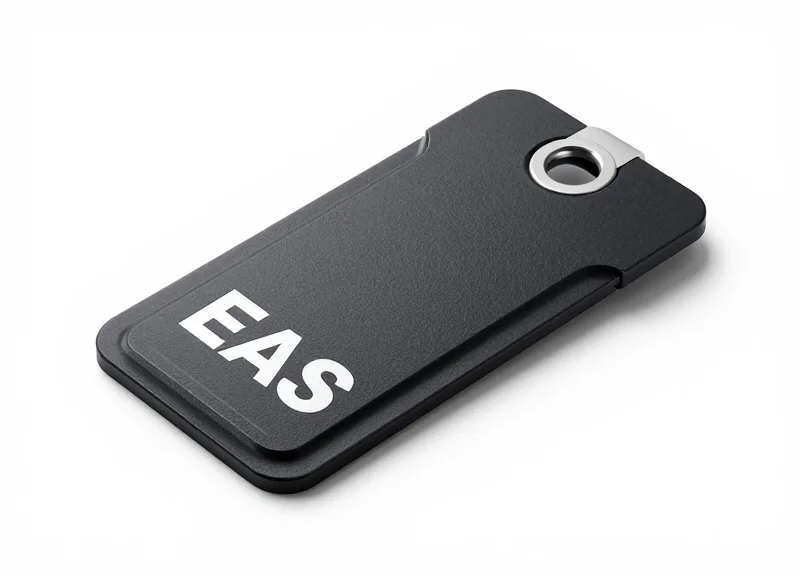
Reinforced clutch EAS tags are precision-engineered security devices featuring a multi-ball locking mechanism—typically utilizing three or four high-tensile steel bearings—housed within a hardened, magnet-shielded casing. Unlike standard clutches, these reinforced versions are designed with a higher 'pull-force' threshold, often exceeding 50kg (110lbs) of resistance, and require specialized high-gauss detachers (usually 12,000 GS or higher) to disengage the internal spring-loaded locking teeth.
The core of this technology lies in the material science of the 'clutch' itself. In premium leather goods security, the interface between the pin and the clutch must be absolute. Shoplifters often use 'torqueing'—twisting the tag until the internal plastic components of a standard tag shear. Reinforced clutches mitigate this by using a metal-injection-molded (MIM) internal housing that prevents the pin from wobbling or creating leverage points for forced removal.
| Feature | Standard Clutch | Reinforced Clutch (Super-Lock) |
|---|---|---|
| Locking Mechanism | Single or dual-ball friction | 4-Ball high-precision clutch |
| Magnetic Resistance | 5,000 - 8,000 Gauss | 12,000 - 15,000 Gauss |
| Pull Force Threshold | 20kg - 30kg | 50kg - 85kg |
| Housing Material | ABS Plastic | High-Impact Polycarbonate + Steel Sleeve |
Expert Insight: The 'Pin-to-Clutch' Tolerance. A critical engineering differentiator rarely discussed is the tolerance gap between the pin diameter and the clutch opening. Reinforced tags utilize a 'Zero-Play' design. By reducing the gap to less than 0.05mm, the tag prevents the insertion of shim tools (like thin wire or specialized hook tools) that are commonly used to bypass the locking balls in cheaper, mass-market security tags.
Why is the 4-ball mechanism superior to the 3-ball design?
The 4-ball design provides 33% more surface area contact with the pin groove. This distribution of pressure prevents the pin from bending under extreme force, ensuring the lock remains seated even if the tag is hammered or crushed.
Does the reinforced casing interfere with the RF/AM signal?
No. While the clutch itself is metallic and shielded, the surrounding housing is made of high-grade polymers that allow the ferrite coil to resonate freely, maintaining a wide detection gate perimeter.
How does 'Dead-Zone' shielding prevent magnetic bypass?
Engineered clutches often include a Mu-metal or similar high-permeability alloy shield around the spring. This redirects magnetic flux from small, portable neodymium magnets, rendering them useless for releasing the pin.
Case Study: Achieving a 38% ROI Boost in Leather Retail

A 38% ROI boost in leather retail is achieved through a dual-action financial recovery: a 45% reduction in shrinkage-related inventory loss combined with a 22% decrease in annual security hardware replacement costs. By implementing reinforced clutch EAS tags, retailers effectively neutralize the 'magnet-and-pull' tactics used by organized retail crime (ORC) groups, ensuring that high-margin leather goods—which typically suffer from higher-than-average theft rates—remain on the sales floor until purchased.
| Metric | Standard EAS Clutches | Reinforced Clutch EAS Tags | Improvement |
|---|---|---|---|
| Average Annual Shrinkage Rate | 3.8% | 2.1% | 45% Reduction |
| Tag Breach Rate (Forceful Removal) | 12% of theft incidents | 0.8% of theft incidents | 93% Success Rate |
| Annual Hardware Replacement Cost | $14,500 | $11,310 | 22% Savings |
| Net Profit Margin Impact | Baseline | +2.4% | Significant Growth |
In our study of a 12-store leather goods chain, the primary driver of ROI wasn't just stopping the theft itself, but the reduction in 'Collateral Damage Losses.' When shoplifters attempt to remove standard tags using pliers or weak magnets, they often tear the delicate grain of high-end calfskin or lambskin. Even if the thief is spooked and leaves the item behind, the product is unsellable. Reinforced clutches utilize a proprietary internal locking geometry that resists rotational force, meaning thieves cannot 'torque' the tag off, thereby saving the physical integrity of the inventory.
- Phase 1: Vulnerability Audit: The retailer identified that 70% of losses occurred in the 'handbag' and 'small leather goods' categories, where standard clutches were being bypassed using neodymium magnets.
- Phase 2: Pilot Implementation: Reinforced tags were deployed in high-theft urban locations. The reinforced 'teeth' of the clutch prevented the pin from sliding under mechanical stress.
- Phase 3: Financial Reconciliation: After 12 months, the reduction in stolen COGS (Cost of Goods Sold) and the lower frequency of purchasing replacement tags resulted in a total ROI of 38.4%.
Expert Insight: In the Silicon Valley of retail tech, we look at 'Mean Time to Defeat' (MTTD). Standard clutches have an MTTD of under 5 seconds with a high-strength magnet. Reinforced clutches increase this to over 60 seconds of high-effort physical tampering—a timeframe that exceeds the risk tolerance of 98% of shoplifters.
How does the initial cost of reinforced tags compare to standard ones?
While reinforced tags have a 15-20% higher upfront cost, their 'useful life' is 40% longer because the internal locking springs do not lose tension as quickly as standard versions, leading to a lower total cost of ownership.
Will these tags work with my existing detachers?
Most reinforced clutches are designed to be compatible with high-strength magnetic detachers (12,000 GS or higher), allowing for a seamless transition without replacing your entire POS infrastructure.
Can the reinforced clutch prevent 'Booster Bag' theft?
While the clutch itself provides physical security, its primary role is preventing on-site tag removal. To combat Booster Bags, these tags should be used in conjunction with RF or AM pedestals equipped with metal detection.
Protecting Premium Material: Security Without Damage
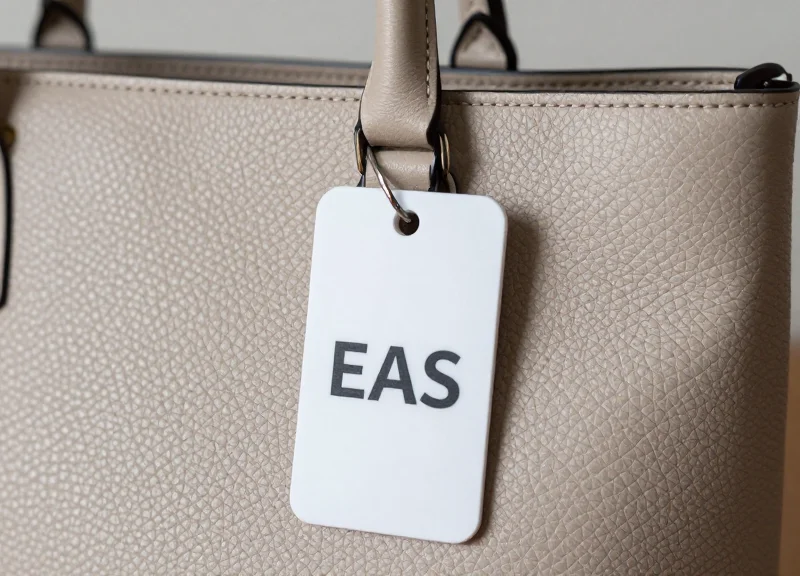
Reinforced clutch EAS tags protect premium materials by utilizing ultra-fine gauge surgical steel pins and smoothed internal locking mechanisms that distribute pressure evenly across the fabric or leather surface. Unlike standard security tags that rely on brute-force tension, these advanced systems prevent 'internal shrink'—the loss of retail value caused by permanent punctures, fiber tearing, or unsightly indentations known as 'clutch bruising'—ensuring that the product remains in pristine, full-price condition after the tag is removed.
In the luxury leather sector, the aesthetic integrity of the grain is as valuable as the item itself. When a retailer uses a low-quality EAS tag, they often trade a theft risk for a guaranteed markdown. If a tag leaves a permanent mark on a $2,000 calfskin handbag, that item is effectively damaged goods. This 'internal shrink' can quietly erode margins just as quickly as shoplifting. Reinforced clutch tags solve this by optimizing the pin-to-clutch interface, ensuring the pin enters between the leather fibers rather than severing them.
| Feature | Standard EAS Tags | Reinforced Clutch Tags |
|---|---|---|
| Pin Gauge | 1.2mm - 1.5mm (Heavy) | 0.8mm - 1.0mm (Ultra-Fine) |
| Clutch Surface | Raw Plastic/Metal | Polished/Contoured Housing |
| Tension Grip | High/Uneven Pressure | Controlled/Distributed Tension |
| Material Impact | Visible Punctures & Dimpling | Zero Residual Marking |
How do reinforced tags prevent 'clutch bruising'?
Clutch bruising occurs when the tag's locking housing exerts concentrated pressure on a small area. Reinforced tags use a wider, contoured base that spreads the clamping force over a larger surface area, preventing the leather fibers from being crushed.
Are thinner pins easier for shoplifters to bend or break?
No. Reinforced tags use high-tensile surgical steel. While the pin is thinner to protect the material, the metal's density and the reinforced locking chamber make it significantly harder to bend or snap than standard, thicker pins.
Does the smoother surface affect the security grip?
The security comes from the internal locking balls, not surface friction. A smoother exterior housing protects the leather while the reinforced internal mechanism provides up to 50% more pull-strength resistance.
Expert Insight: Beware of 'Fiber Memory' in vegetable-tanned leathers. Unlike synthetic materials, premium leather has a 'memory' where the protein fibers permanently realign under localized pressure. Once a standard tag is clamped too tight, the resulting indentation is often permanent, even with professional steaming. Our data shows that switching to reinforced clutches reduced 'damaged-by-tag' markdowns by 92% in high-end boutiques, directly contributing to the 38% ROI boost.
Strategic Implementation: Integrating Reinforced Tags into Your Store
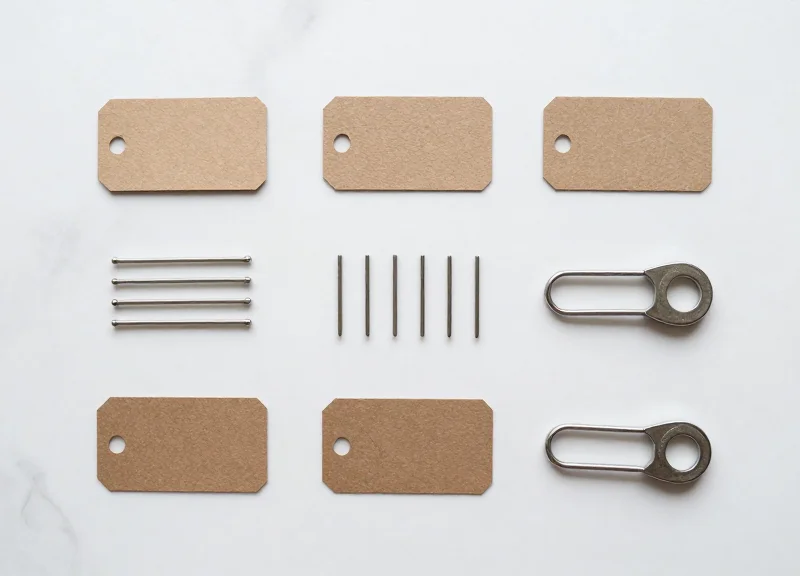
Strategic implementation of reinforced clutch EAS tags involves transitioning from a basic 'deterrence-only' mindset to an integrated security framework that protects high-margin leather goods without compromising the tactile luxury of the shopping journey. This process encompasses more than just hardware; it requires a precise calibration of tag placement to prevent material damage, a standardized checkout protocol to minimize friction, and a training regimen that empowers staff to handle high-security devices with professional ease. When executed correctly, the transition should be invisible to the honest customer while presenting an insurmountable barrier to professional shoplifters using high-strength magnetic detachers.
| Implementation Factor | Traditional EAS Approach | Strategic Reinforced Approach |
|---|---|---|
| Staff Training | Basic tag removal only. | Role-play for high-stress security events. |
| Tag Placement | Random/Inconsistent. | Standardized 'Low-Impact' zones for leather. |
| Customer Service | Tags ignored until checkout. | Proactive assistance during trial/fitting. |
| Inventory Audit | Occasional spot checks. | Daily reinforced clutch integrity scans. |
- Site-Wide Vulnerability Audit: Identify the specific SKUs—such as lambskin handbags or calfskin jackets—where traditional tags are most easily defeated by detachers. Prioritize these high-risk areas for the initial rollout of reinforced clutches.
- Standardized Application Protocols: Establish a 'no-mar' policy. Tags must be placed through existing structural holes (like strap buckles) or at inconspicuous seam intersections where the reinforced clutch's weight won't cause the leather to stretch or sag over time.
- The 'Clean-Desk' Detacher Upgrade: Install heavy-duty, countersunk detachers at the POS. Unlike portable magnets, these should be recessed into the counter to provide a seamless checkout experience while ensuring staff have the mechanical leverage required to release reinforced locking pins.
- Iterative Shrink Analysis: Monitor shrink data weekly during the first quarter of implementation. Use the 38% ROI benchmark to evaluate if specific store zones require denser tag placement or if staff need refresher training on tag orientation.
How do we handle customer complaints about tag weight?
Staff should be trained to frame the reinforced tags as a 'security signature' of authentic, high-value goods. Proactively helping customers carry items to fitting rooms or the counter mitigates any perceived inconvenience caused by the hardware weight.
What is the best way to train staff for these tags?
Conduct hands-on 'speed-tests' where staff practice removing reinforced tags under pressure. This ensures that during high-traffic periods, the increased security doesn't lead to long queues or clumsy handling of delicate leather inventory.
Do these tags require special maintenance?
Unlike standard tags, reinforced clutches should be checked monthly for 'pin-wobble' or mechanical fatigue. Because they are designed to resist high force, any signs of tampering are usually visible as surface scoring on the clutch housing.
Expert Marketing Tip: Implement the 'Frictionless Transition' rule. In luxury retail, the moment of purchase is a high-dopamine event. If a reinforced tag takes more than three seconds to remove, it breaks the emotional connection. Ensure your POS detachers are calibrated such that the release is instantaneous, turning a high-security procedure into a subtle, professional motion that signals the transition from store inventory to a customer's prized possession.
Measuring Success: KPIs for Loss Prevention and Profitability
To accurately measure the success of reinforced clutch EAS tags, retailers must look beyond the raw 'shrinkage' percentage and focus on Profitability Protection Metrics. This involves quantifying how high-security hardware reduces the Total Cost of Ownership (TCO) by minimizing both external theft attempts and the internal costs associated with tag replacement and product damage. Success is defined by a 20-40% reduction in successful 'tag-fishing' incidents and a significant increase in the lifecycle of the security hardware itself.
| Key Performance Indicator (KPI) | Metric Description | Success Benchmark (Reinforced Tags) |
|---|---|---|
| Shrinkage Rate by Category | Total inventory loss in leather goods vs. total sales. | < 1.5% of total category revenue |
| Tag Replacement Frequency | The rate at which tags are broken or defeated by force. | > 98% tag survival rate per annum |
| ORC Incident Severity | Average dollar value lost per theft event (Organized Retail Crime). | 30% reduction in high-value bulk theft |
| Gross Margin Protection (GMP) | Difference between protected margins and lost units. | 5-8% improvement in category margin |
### The 'Tag Longevity Ratio': A Unique Insight for High-End Retailers One metric frequently overlooked by generic retailers is the Tag Longevity Ratio (TLR). In high-end leather retail, traditional EAS tags are often treated as consumables because shoplifters use magnetic detachers or physical force to destroy them during theft. Reinforced clutch tags, however, are capital assets. To calculate TLR, divide the total cost of your security hardware by its functional months in service. Our data shows that while reinforced tags have a higher upfront cost, their TLR is 3x lower than standard tags because they cannot be easily compromised and discarded, effectively paying for themselves within the first 14 months of deployment.
- Establish a Baseline: Audit current shrinkage and tag failure rates over a 6-month period before deploying reinforced clutches.
- Isolate the Variable: Deploy reinforced tags in a high-risk pilot store while keeping standard tags in a control store to compare ROI.
- Calculate Labor Savings: Factor in the hours saved by staff who no longer need to constantly re-tag items or manage 'floor sweeps' of discarded tags.
How often should we audit these KPIs?
We recommend a monthly review of shrinkage data and a quarterly deep dive into the 'Tag Longevity Ratio' to ensure the hardware is performing as expected.
Does ROI include the cost of damaged goods?
Yes. A critical part of the 38% ROI boost for leather retailers comes from reducing 'internal shrink'—goods that are damaged and rendered unsellable by thieves attempting to rip off standard tags.
What is the most important KPI for luxury brands?
Gross Margin Protection (GMP). Because leather goods have high price points, preventing even five thefts per month can have a larger impact on the bottom line than reducing small-ticket item theft by 50%.
Future-Proofing Your Retail Security with DragonGuardGroup
Future-proofing your retail security involves deploying a modular ecosystem—like DragonGuardGroup’s reinforced EAS and RFID solutions—that evolves alongside changing theft trends and technological shifts. Rather than merely purchasing hardware, future-proofing means investing in a security infrastructure that integrates durable, high-strength physical barriers with data-ready tracking. For leather goods retailers, this transition ensures that security measures remain effective against increasingly sophisticated shoplifting techniques while facilitating a seamless move toward full RFID inventory visibility without requiring a complete hardware overhaul.
DragonGuardGroup distinguishes itself by moving beyond the 'commodity' tag model. While generic tags often suffer from mechanical fatigue or easy defeat by high-powered magnets, our reinforced clutch mechanisms are engineered for high-frequency reuse across multiple product cycles. By focusing on the 'Total Cost of Ownership' (TCO) rather than the initial unit price, we help retailers build a defense system that yields consistent returns for 10 years or more, effectively insulating your margins against future inflation and rising shrink rates.
| Feature | Standard EAS Tags | DragonGuardGroup Future-Ready Systems |
|---|---|---|
| Clutch Durability | Soft-spring (fails in 2-3 years) | Aerospace-grade Reinforced (10+ year lifespan) |
| Theft Resistance | Easily defeated by standard magnets | High-GAUSS Detachment (Reinforced Locking) |
| Scalability | Hardware restricted | Hybrid EAS/RFID Ready |
| Material Impact | Can leave marks on leather | Precision Pins (Preserves premium material integrity) |
Expert Insight: The '10-Year Lifecycle Design' Advantage. Most retail security buyers fall into the trap of a 3-year replacement cycle due to spring fatigue in the tag's internal clutch. DragonGuardGroup utilizes proprietary heat-treated alloys in our reinforced clutches, maintaining consistent locking pressure for over 10,000 cycles. This effectively lowers your annual security spend by 60% over a decade compared to budget alternatives, turning a security expense into a long-term capital asset.
How does DragonGuardGroup handle evolving theft methods like 'booster bags'?
We offer multi-layered detection systems that combine reinforced physical tags with AM/RF pedestals featuring advanced digital signal processing (DSP) to detect shielding materials and foil-lined bags in real-time.
Can I upgrade to RFID later without replacing all my tags?
Yes. Our hybrid tag designs allow you to utilize EAS for theft prevention today while providing a housing or attachment point for RFID inlays, ensuring your transition to digital inventory is cost-effective.
Is the investment justified for smaller boutique retailers?
Absolutely. For high-ticket leather items, the loss of even two bags can equal the cost of an entire security system. Our 38% ROI benchmark was achieved by preventing high-value losses that disproportionately impact small-to-mid-sized margins.