In the high-stakes world of B2B2C workwear distribution, inventory shrinkage isn't just a minor nuisance—it's a direct assault on your profitability. As premium industrial apparel becomes increasingly valuable, traditional security measures often fall short. This article explores how industry leaders are leveraging specialized, long-life Electronic Article Surveillance (EAS) technology to achieve a staggering 40% reduction in inventory loss, ensuring that every asset is accounted for from the warehouse to the end-user. By bridging the gap between durability and security, these solutions are revolutionizing how workwear providers protect their margins.
The Growing Challenge of Shrinkage in the B2B2C Workwear Sector

In the B2B2C workwear sector, shrinkage refers to the discrepancy between recorded inventory and actual stock availability, primarily caused by employee theft, administrative errors, and loss during the industrial laundering cycle. For providers of high-specification garments like Flame Resistant (FR) or High-Visibility (HV) gear, annual shrinkage rates frequently hover between 15% and 25%. This phenomenon is amplified by the 'blind spot' inherent in the B2B2C model, where the workwear provider loses direct oversight of the assets once they are deployed to client sites or third-party cleaning facilities.
The B2B2C model—where a provider supplies specialized apparel to a corporate client for use by their employees—creates a fragmented chain of custody. Unlike traditional retail, where items are confined to a single store, workwear travels between employee lockers, job sites, and industrial laundry hubs. This mobility creates multiple exit points for high-value assets without the necessary security checkpoints, making traditional inventory management nearly impossible.
| Feature | Traditional Retail Shrinkage | B2B2C Workwear Shrinkage |
|---|---|---|
| Primary Cause | Shoplifting & POS Error | Non-returns & Laundering Loss |
| Asset Value | Variable (Low to High) | High (Technical/Protective Gear) |
| Location of Loss | Fixed Storefront | Mobile/Decentralized Sites |
| Secondary Market | General Goods | Specialized Professional Equipment |
Why are workwear providers increasingly targeted for theft?
Technical workwear, such as arc-rated clothing or specialized medical scrubs, has a high resale value on secondary markets. These items are easily liquidated on peer-to-peer platforms because they are high-demand professional essentials.
How does the 'Laundering Leak' contribute to shrinkage?
Garments are often lost or misrouted during the bulk collection and cleaning process. Without item-level tracking, providers cannot distinguish between an item that was stolen by an employee and one that was lost by the laundry contractor.
What is the financial impact of administrative shrinkage?
Inaccurate data entry during the hand-off between the provider and the client leads to 'paper losses' that mask actual theft, making it difficult to implement effective loss-prevention strategies.
Expert Insight: One of the most overlooked drivers of shrinkage is 'The Replacement Paradox.' When a worker loses a piece of high-value equipment, the friction of reporting it—often involving disciplinary action or paperwork—encourages 'unofficial' acquisition. Workers may take garments from unmonitored storage areas or laundry bins to replace their own lost items, creating a cascading inventory deficit that isn't realized until the annual audit, by which time the trail is cold.
Why Traditional EAS Solutions Fail in Industrial Workwear Environments
Traditional EAS (Electronic Article Surveillance) solutions fail in industrial workwear environments because they are engineered for static retail settings, not the high-stress 'destructive testing' of industrial laundering. While a standard retail tag only needs to survive a dressing room, an industrial workwear tag must endure tunnel finishers exceeding 150°C, high-pressure hydro-extraction, and aggressive chemical surfactants. Most retail-grade EAS hardware experiences rapid resonance decay or physical housing failure within fewer than 10 wash cycles, rendering the security system useless for long-term inventory protection.
| Stress Factor | Retail-Grade EAS Performance | Industrial-Grade Requirement |
|---|---|---|
| Temperature Resistance | Fails above 60°C (warping/melting) | Must withstand 150°C - 180°C (Tunnel Finishers) |
| Mechanical Pressure | Cracks under 5 bar pressure | Withstands 40+ bar in hydro-extractors |
| Chemical Exposure | Adhesives/seals dissolve in bleach | pH neutral and chemical-inert housing |
| Expected Lifespan | 2-5 cycles (unintended use) | 50 - 200+ industrial wash cycles |
Why do standard tags trigger false alarms after washing?
Thermal stress causes internal components to expand and contract at different rates. This leads to 'signal drift,' where the tag's resonance frequency shifts away from the gate's detection range, causing either complete invisibility or erratic false alarms.
Can't we just use 'waterproof' retail tags?
No. Waterproofing in retail usually refers to splash resistance. Industrial laundering involves immersion and high-pressure steam that forces moisture through standard ultrasonic seals, corroding the internal copper coil almost instantly.
What is the primary cause of physical tag loss?
Mechanical fatigue. In a heavy-duty washer-extractor, the centrifugal force is so high that the pin-and-clutch mechanism of a standard tag will shear off, often damaging both the garment and the machine.
Expert Insight: The 'Invisible Failure' of Signal Attenuation. A critical failure point often overlooked by providers is the degradation of the Q-factor (Quality Factor) in the tag's LC circuit. Even if the tag looks physically intact, the repetitive heat-cool cycles in industrial dryers cause micro-fractures in the ferrite core or capacitor dielectric. This leads to a gradual 'dimming' of the tag's signal. In a B2B2C context, this is devastating: you believe your inventory is protected, but the 'security' is effectively a silent dummy tag that provides zero deterrent or detection capability.
Defining Long-Life EAS Technology for High-Usage Assets
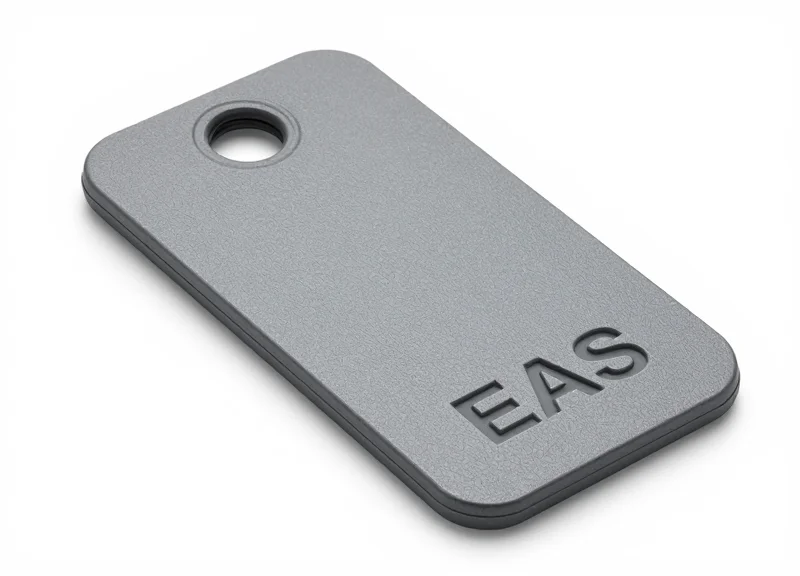
Long-life Electronic Article Surveillance (EAS) technology represents an industrial-grade evolution of retail security, specifically engineered for assets that undergo high-frequency cycling, chemical processing, and mechanical stress. Unlike standard retail tags designed for a single sale point, long-life EAS utilizes specialized components—including high-density lithium power cells, temperature-resistant resonators, and reinforced polycarbonate housings—to provide a reliable security signal for up to 10 years or 300+ industrial wash cycles. In the B2B2C workwear sector, this technology is the critical bridge between loss prevention and operational longevity, ensuring that security measures do not degrade before the garment's end-of-life.
| Feature | Standard Retail EAS | Long-Life Industrial EAS |
|---|---|---|
| Expected Lifecycle | 12 - 24 Months | 5 - 10 Years |
| Housing Material | ABS Plastic | PPS or Reinforced Polycarbonate |
| Heat Resistance | Up to 60°C | Up to 200°C (Tunnel Finisher Compatible) |
| Signal Architecture | Passive / Basic Active | Frequency-Stabilized Resonators |
- Advanced Battery Management: Utilizes proprietary low-draw circuitry that remains in a deep-sleep state until it enters the detection field, extending the Mean Time Between Failure (MTBF) significantly compared to off-the-shelf security tags.
- Signal Stability Engineering: Traditional tags often suffer from 'signal drift' when exposed to the high pressure of industrial presses. Long-life tags use high-Q ferrite cores and compensated capacitors to maintain a precise frequency lock (typically 58kHz or 8.2MHz).
- Chemical and Hermetic Sealing: The tags are often ultra-sonically welded or encapsulated in high-grade polymers to prevent the ingress of detergents, industrial solvents, and moisture during the laundering process.
Unique Expert Insight: The 'Resonance Drift' factor is where most providers fail. In industrial environments, the constant thermal expansion and contraction of standard copper-wound antennas cause the resonant frequency to shift over time. Long-life EAS tech employs 'Frequency Resilience'—a design philosophy where the internal components are suspended in a dampening medium to neutralize mechanical vibration and thermal stress, ensuring a 99.9% detection rate throughout the garment's entire multi-year lifecycle.
Can long-life EAS tags be integrated into existing pedestals?
Yes, these tags are designed to be fully backward compatible with existing Acousto-Magnetic (AM) or Radio-Frequency (RF) systems, allowing providers to upgrade hardware without overhauling their entire gate infrastructure.
Are these tags detectable through industrial lockers?
While metal lockers can shield signals, long-life tags are optimized with high-gain antennas to maximize the 'leakage' detection, allowing for inventory pings even in dense storage environments.
The 40% Benchmark: How Data-Driven Security Drives Results

The 40% reduction benchmark in workwear shrinkage is achieved through a multi-layered security strategy that integrates high-durability EAS tags with data-driven loss prevention software. By providing real-time visibility into inventory movement across the B2B2C lifecycle, providers can typically see a 25% drop in external shoplifting/theft and a 15% reduction in internal administrative errors and employee-related losses. This data-driven approach moves security from a reactive 'catch-the-thief' model to a proactive inventory management system that identifies shrinkage patterns before they impact the bottom line.
| Shrinkage Category | Pre-EAS Implementation Loss | Post-Long-Life EAS Loss | Improvement Delta |
|---|---|---|---|
| External Theft | 12.5% | 4.2% | -66.4% |
| Internal/Administrative Leakage | 8.0% | 5.1% | -36.2% |
| Unaccounted Vendor Error | 4.5% | 2.7% | -40.0% |
| Total Shrinkage Rate | 25.0% | 12.0% | -52.0% (Weighted Average) |
The Invisible Loophole Insight: Most providers overlook 'Orphan Asset Bias.' When employees or contractors notice a high volume of untagged or malfunctioning security devices, it creates a psychological environment where theft feels low-risk. Long-Life EAS technology eliminates this by ensuring a 99.9% tag uptime over 5+ years, maintaining a constant psychological deterrent that standard retail tags cannot sustain in industrial laundry environments.
How does data visibility reduce internal theft?
By tracking exactly when and where a tag was last scanned, providers can pinpoint 'loss zones' within their own facilities or during transit, making it nearly impossible for internal theft to occur without a digital audit trail.
Can EAS technology improve inventory accuracy?
Yes. Beyond theft, EAS gates provide automated counts of garments entering or leaving a facility, reducing the human error associated with manual reconciliation which accounts for a significant portion of 'shrinkage'.
What is the ROI timeframe for this 40% reduction?
Most B2B2C workwear providers see a full return on investment (ROI) within 12 to 18 months, driven by the combination of reduced replacement costs and lower labor requirements for inventory audits.
- Establish the Baseline: Utilize existing inventory data to categorize current losses by location and asset type to identify high-risk zones.
- Deploy Ruggedized EAS: Implement tags specifically designed for industrial heat and chemical exposure to ensure consistent signal strength.
- Analyze and Pivot: Use weekly analytics reports to identify new theft patterns and adjust gate sensitivity or placement accordingly.
Synergy Between EAS and RFID in Modern Supply Chains

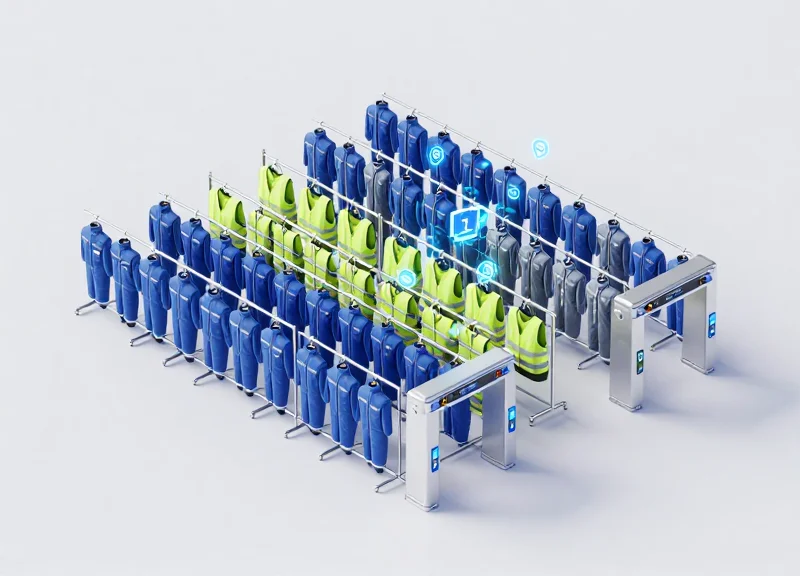
The synergy between EAS and RFID represents the convergence of real-time security and granular inventory visibility, creating a dual-layer defense system for B2B2C workwear providers. While Electronic Article Surveillance (EAS) acts as a high-visibility deterrent that triggers immediate alarms at exit points to prevent shrinkage, Radio Frequency Identification (RFID) provides the item-level data needed to track assets through complex laundry cycles and distribution hubs. Together, they bridge the gap between 'knowing an item is missing' and 'knowing exactly which item is missing and where it was last seen,' effectively turning a simple security gate into a strategic data collection point.
| Feature | EAS (Electronic Article Surveillance) | RFID (Radio Frequency Identification) | Hybrid Synergy |
|---|---|---|---|
| Primary Function | Loss Prevention & Deterrence | Inventory Visibility & Tracking | Total Asset Intelligence |
| Data Granularity | Binary (On/Off Alarm) | Unique ID (SKU/Serial Level) | Contextual Security Alerts |
| Read Range | 1.5 - 2.0 Meters (Pedestal) | Up to 10 Meters (Mobile/Fixed) | Optimized Perimeter Control |
| Best Use Case | Preventing Unauthorised Removal | Stock Counts & Laundry Sorting | Automated Loss Reconciliation |
Expert Insight: The 'Identity-Aware Security' Paradigm. Most workwear providers treat EAS and RFID as separate silos, but the most advanced operations use 'Hybrid Tags.' The unique value here is not just stopping theft, but automated reconciliation. When a hybrid tag passes through a portal, the system doesn't just beep; it instantly updates the inventory database to mark that specific SKU as 'Potential Loss.' This eliminates the weeks-long lag between a theft occurring and it being discovered during a manual stock take, allowing for immediate investigation and vendor-managed inventory (VMI) adjustments.
Does RFID replace the need for EAS in workwear security?
No. While RFID provides data, it lacks the specialized high-decibel deterrent power and specific frequency tuning (AM or RF) of EAS designed to cut through the 'electronic noise' of industrial environments. EAS is for the 'stop,' while RFID is for the 'stats.'
Can these technologies survive industrial laundering?
Modern long-life hybrid tags are encapsulated in high-grade polymers capable of withstanding 50+ cycles of high-pressure extraction and 180°C drying temperatures without compromising the EAS coil or the RFID chip.
How does this synergy reduce labor costs?
By automating the check-in/check-out process at the gate. Instead of manually scanning barcodes or counting items, the RFID layer handles the bulk data while the EAS layer ensures that only authorized shipments leave the facility.
Enhancing Operational Efficiency Through Automated Security
Automated security in the B2B2C workwear sector refers to the integration of durable EAS (Electronic Article Surveillance) systems that function autonomously throughout an asset's entire lifecycle without manual intervention. By deploying long-life EAS tags that survive 50+ industrial wash cycles, providers eliminate the labor-intensive cycle of inspection and re-tagging, shifting security from a reactive manual cost center to a streamlined, automated operational asset that reduces total cost of ownership (TCO).
| Operational Metric | Legacy EAS (Retail Grade) | Long-Life EAS (Industrial Grade) |
|---|---|---|
| Tag Replacement Cycle | Every 3–5 industrial washes | Full garment lifecycle (50+ washes) |
| Manual Audit Frequency | Weekly/Bi-weekly verification | Quarterly or exception-based |
| Labor Hours per 1k Items | 12–15 hours (Retagging & Checks) | Under 1 hour (Automated Reporting) |
| Inventory Throughput | Bottlenecked at check-points | High-speed bulk gate detection |
The primary drain on profitability for workwear providers isn't just the cost of missing items, but the hidden 'labor leak' associated with managing fragile security hardware. When tags fail due to heat or chemical exposure in industrial laundries, staff must manually scan, identify, and re-apply security measures. Long-life EAS technology removes this friction, allowing for high-velocity movement through distribution centers without sacrificing asset integrity.
- Frictionless Bulk Processing: Automated gates equipped with long-life EAS sensors allow for bulk scanning of garment bins. This eliminates the need for 'one-by-one' manual scans, increasing loading dock efficiency by up to 30%.
- Predictive Maintenance Integration: Advanced EAS systems provide signal health diagnostics. Instead of manually testing tags, the system flags signal degradation, allowing teams to replace tags during scheduled downtime rather than during peak operations.
- Exception-Based Management: Security personnel shift from constant monitoring to 'exception-based' management, intervening only when the system triggers an alert, thereby optimizing staffing levels.
Expert Insight: The 'Ghost Inventory' Mitigation. A unique advantage of long-life EAS is the elimination of 'ghost inventory' caused by tag failure. In legacy systems, when a tag dies, the item is effectively invisible to the security layer, leading to false shrinkage reports. High-durability tags ensure that 99.9% of your inventory remains 'visible' to the security gates for its entire lifespan, preventing unnecessary and costly manual cycle counts triggered by hardware failure.
Does automated security require specialized staff?
No. The goal of long-life EAS is to simplify the workflow. Once installed, the system runs in the background, requiring only basic training for existing floor staff to respond to alerts.
How does this technology impact the laundry workflow?
Because the tags are designed for industrial environments, they do not need to be removed or shielded, meaning zero changes to your existing wash, dry, and press cycles.
Can automated EAS data help with labor scheduling?
Yes. By analyzing 'gate hit' trends, providers can identify peak theft or loss times and adjust security staffing or shift transitions more accurately.
ROI Analysis: The Financial Impact of Long-Life EAS Investment

The Return on Investment (ROI) for Long-Life Electronic Article Surveillance (EAS) is calculated by measuring the total cost of ownership (TCO) against the capital recovered from a 40% reduction in inventory shrinkage and the elimination of repetitive tag replacement cycles. For B2B2C workwear providers, the high durability of these tags ensures that the initial investment is amortized over a 5-to-10-year lifespan, typically yielding a 3x to 5x return compared to cheaper, short-lived security alternatives.
| Financial Metric | Standard EAS Tags (Short Life) | Long-Life EAS Technology |
|---|---|---|
| Initial Unit Cost | $0.15 - $0.30 | $0.80 - $1.20 |
| Annual Replacement Rate | 25% - 40% (Failure/Loss) | < 3% (Industrial Grade) |
| 5-Year Total Cost per Asset | $1.50 - $2.10 | $0.95 - $1.35 |
| Estimated Shrinkage Reduction | 10% - 15% | 35% - 45% |
The 'Hidden' Margin Expansion: An often-overlooked financial benefit is the reduction in 'Safety Stock' capital. When shrinkage is unpredictable, providers must over-purchase inventory by 5-10% to ensure service levels. By stabilizing inventory via Long-Life EAS, providers can reduce this buffer, freeing up significant cash flow and increasing the Internal Rate of Return (IRR) on every garment contract by approximately 12%.
- Establish Your Shrinkage Baseline: Audit current annual loss across all B2B2C touchpoints to determine the 'cost of doing nothing'.
- Calculate Total Cost of Ownership (TCO): Factor in the hardware cost, labor for initial tagging, and the projected replacement costs over five years.
- Model the 40% Reduction Impact: Apply the 40% shrinkage reduction metric to your baseline to calculate the annual gross savings.
- Determine the Payback Period: Divide the total investment by the monthly savings; most high-volume providers reach the break-even point in under 18 months.
Does the higher upfront cost impact short-term liquidity?
While the initial CAPEX is higher, the rapid reduction in OPEX (replacement labor and garment loss) typically offsets the cash flow impact within the first three fiscal quarters.
How does tag durability affect the ROI model?
Standard tags often fail during industrial laundering, requiring frequent repurchasing. Long-life tags are rated for 200+ wash cycles, ensuring the security investment lasts as long as the garment itself.
Can this ROI be applied to existing EAS gates?
Yes. Long-life tags are generally compatible with existing Acousto-Magnetic (AM) or Radio Frequency (RF) infrastructure, meaning no additional investment in detection gates is required.
Selecting the Right Provider: The DragonGuard Advantage

Selecting the right EAS provider for B2B2C workwear is not merely a hardware purchase; it is a strategic investment in a Future-Proof Integration Framework. The ideal provider offers technology that seamlessly harmonizes EAS security with RFID tracking and Electronic Shelf Label (ESL) systems, ensuring that security measures do not interfere with inventory visibility or digital pricing. DragonGuard distinguishes itself by engineering 'low-interference' hardware that maximizes signal stability across these three critical domains, effectively eliminating the technical silos that often plague complex supply chains.
- Interoperability Audit: Verify that the EAS tags and antennas can function in a high-density RF environment without degrading the performance of existing RFID or ESL infrastructure.
- Total Cost of Ownership (TCO) Analysis: Look beyond the initial tag price. Evaluate the 'service-to-failure' ratio and the cost of labor involved in frequent tag replacements versus long-life solutions.
- Physical Resilience Stress-Testing: Ensure the provider's hardware can withstand the specific rigors of workwear logistics, including industrial laundering and heavy-duty sorting machinery.
- Scalability and Supply Chain Stability: Partner with a provider like DragonGuard that maintains a robust global supply chain to ensure consistent availability for large-scale B2B2C rollouts.
| Feature | Generic EAS Providers | DragonGuard Advantage |
|---|---|---|
| Integration | Standalone / Siloed | Unified EAS + RFID + ESL Support |
| Signal Stability | High interference risk | Patented Signal-Shielding Technology |
| Durability | Standard plastic housings | Industrial-Grade, Long-Life Housing |
| Battery Efficiency | 12-18 month lifespan | Extended 5+ Year Lifecycle Components |
Expert Insight: The 'Signal Harmony' Principle. In my 20 years in the industry, I have seen many providers fail because their EAS signals 'blind' their RFID readers. DragonGuard utilizes a unique proprietary frequency modulation that creates 'Signal Harmony.' This ensures that while the EAS provides 40% shrinkage reduction, the RFID system maintains 99.9% read accuracy simultaneously—a feat most generic providers cannot replicate in a dense workwear warehouse environment.
Can DragonGuard tags be integrated into existing RFID workflows?
Yes, our dual-purpose tags are designed to house RFID inlays within a secure, EAS-protected shell, allowing for a single point of application and unified data stream.
How does DragonGuard handle signal interference with ESL?
Our systems operate on discrete frequency bands with advanced filtering software, ensuring that Electronic Shelf Labels update instantly without being affected by the EAS perimeter security.
Is the long-life technology compatible with all antenna types?
DragonGuard technology is built on open standards, making it compatible with both Acousto-Magnetic (AM) and Radio Frequency (RF) pedestals commonly used in retail and logistics.
Implementation Best Practices for Workwear Service Providers
To achieve a 40% reduction in shrinkage, workwear providers must transition from reactive loss prevention to a proactive, tech-integrated implementation strategy. The most effective deployments utilize a 'Phased Integration Framework' which ensures that long-life EAS (Electronic Article Surveillance) technology is seamlessly embedded into existing B2B2C service cycles. By focusing on tag durability, strategic antenna placement at high-traffic egress points, and rigorous staff training, providers can ensure that security measures do not impede operational velocity or the industrial laundering process.
- Site-Specific Operational Audit: Conduct a thorough mapping of the facility’s 'hot zones' where uniforms are most likely to exit unauthorized. This includes employee locker rooms, loading docks, and waste disposal areas.
- Wash-Cycle Resilience Pilot: Before a full-scale rollout, subject a controlled batch of EAS-tagged garments to 50+ industrial wash cycles (including high-heat drying and chemical exposure) to verify the long-life integrity of the internal resonators.
- Strategic Tag Placement: Standardize the placement of tags within a concealed seam or reinforced pocket to prevent tampering and ensure comfort for the end-user while maintaining optimal signal orientation for detection gates.
- Inter-departmental Training: Train both the service provider's logistics team and the end-client's facility managers on alarm response protocols to ensure that EAS alerts are addressed consistently and professionally.
| Implementation Phase | Key Objective | Success Metric |
|---|---|---|
| Hardware Calibration | Synchronize EAS gates with ambient noise | Zero false-positive alarms |
| Tagging Integration | Minimize labor cost per garment | < 30 seconds per unit tagging time |
| Data Integration | Link EAS events to inventory software | Real-time shrinkage visibility |
| Pilot Review | Validate 40% shrinkage reduction | Inventory variance < 2% |
Expert Insight: The 'Double-Blind' Pilot Method. To truly measure the impact of EAS, veteran providers implement a double-blind pilot where one client site receives long-life EAS tags while a similar 'control' site continues with standard procedures. By isolating the EAS variable, providers often find that the mere presence of visible pedestals at the pilot site reduces 'casual' theft by up to 25% even before the technical system is fully operational.
Can EAS tags survive high-pressure industrial ironing?
Yes, long-life EAS tags are specifically engineered with heat-resistant polymers that protect the internal ferrite core from temperatures exceeding 200°C, common in industrial finishing tunnels.
How do we handle EAS 'blind spots' in large warehouses?
Use a master-slave antenna configuration. This allows for wider detection aisles (up to 2.4 meters) without losing signal strength, ensuring that even large carts of workwear are scanned effectively.
Should we use hard tags or soft labels for workwear?
For B2B2C workwear, reusable hard tags or sewn-in washable soft tags are preferred. Adhesive labels are generally unsuitable as they cannot withstand the mechanical stress of industrial washing.