As we approach 2026, the tech rental industry is undergoing a radical transformation. Traditional Electronic Article Surveillance (EAS) systems, which have served as the industry standard for decades, are no longer sufficient to meet the demands of a high-velocity, high-value asset economy. The need for simple theft prevention has evolved into a requirement for 'Intelligent Asset Visibility'—knowing not just that an item left the building, but exactly which item it was, its maintenance history, and its real-time availability. This article explores why hybrid RFID-EAS systems are becoming the cornerstone of modern rental operations, providing the bridge between security and data-driven logistics.
The Evolution of the Tech Rental Landscape into 2026

The evolution of the tech rental landscape into 2026 is defined by a shift from simple equipment lending to 'Intelligent Asset Management.' While traditional Electronic Article Surveillance (EAS) was designed solely to prevent theft at exits, the modern rental market requires continuous, real-time data on asset location, health, and utilization rates. This transition is driven by the rise of the Circular Tech Economy, where high-value electronics—from AI-capable laptops to enterprise-grade VR headsets—are treated as liquid assets that must be tracked with surgical precision throughout their entire lifecycle.
| Feature | Legacy Rental Model (Pre-2023) | Modern Rental Outlook (2026+) |
|---|---|---|
| Primary Security | Passive EAS (Alarms at doors) | Hybrid RFID-EAS (Granular tracking) |
| Data Visibility | Binary (Present vs. Absent) | Telemetry (Location, Status, History) |
| Asset Velocity | Slow (Manual check-in/out) | High (Automated batch processing) |
| Loss Prevention | Reactive (Recover after theft) | Proactive (Predictive risk modeling) |
In this new era, 'Intelligent Asset Visibility' is no longer a luxury for large-scale enterprise providers; it is a baseline requirement. As rental durations shorten and the variety of high-end hardware increases, the friction of manual inventory audits becomes a significant drain on profitability. The 2026 outlook suggests that companies failing to integrate intelligent tracking will face unsustainable overhead costs and higher asset shrinkage rates.
Why are traditional EAS systems failing in the 2026 rental market?
Traditional EAS systems are 'blind' to specific item data; they can trigger an alarm but cannot tell you which laptop or camera is leaving the building. In a rental environment handling diverse SKU sets, this lack of item-level intelligence leads to inventory discrepancies and slower operational throughput.
How does the rise of 'Asset-as-a-Service' (AaaS) impact security needs?
AaaS models involve frequent asset rotation and multiple custody transfers. This requires a security system that integrates with ERP software to update asset status automatically as items pass through RFID-enabled portals, rather than relying on manual barcode scans.
What role does real-time telemetry play in the 2026 landscape?
Beyond security, hybrid systems provide telemetry data that helps rental firms understand hardware utilization. If an asset is rarely moved or rented, the data identifies it as a candidate for liquidation, optimizing the capital expenditure of the rental fleet.
Expert Tip: The most significant 'hidden' cost in 2026 will be 'Ghost Assets'—items that appear in your inventory software but do not exist in the warehouse. While competitors struggle with 5-10% inventory variance, early adopters of Hybrid RFID-EAS systems are achieving 99.9% inventory accuracy. In the high-margin world of tech rentals, this accuracy directly translates to a 15% increase in fleet utilization efficiency by eliminating 'false out-of-stock' scenarios.
The Limitations of Traditional EAS in a Modern Context
Traditional EAS systems operate on a binary 'alarm/no-alarm' logic that is blind to asset identity, providing only a reactive security measure rather than proactive data intelligence. In a 2026 tech rental environment characterized by high-volume throughput and high-value hardware, this lack of item-level granularity results in 'ghost inventory' and operational blind spots. While these systems can detect that something is crossing a threshold, they cannot distinguish between a low-value peripheral and a $5,000 server, rendering them insufficient for the complex audit trails required in modern logistics.
| Feature | Traditional EAS (Legacy) | Modern Rental Requirements |
|---|---|---|
| Data Granularity | Binary (On/Off Alarm) | Item-level (Serial/SKU Identification) |
| Inventory Integration | None (Manual Update Needed) | Real-time Automated Database Sync |
| Shrinkage Context | Unknown Item Loss | Specific Asset Recovery Data |
| Directional Logic | Proximity Based | Inbound/Outbound Discrimination |
The Signal-to-Noise Deficit: As an SEO engineer looking at the underlying data architecture, the primary failure of legacy EAS in 2026 is what I call the 'Signal-to-Noise Deficit.' In a high-speed warehouse or rental hub, a security alert without an associated metadata tag is effectively noise. Traditional EAS creates a security event that requires human intervention to diagnose. In contrast, modern operations require 'Secured Data Flows,' where the act of an item moving through a portal automatically resolves its status in the ERP. Legacy EAS is a silo; modern tech rental demands a bridge.
Why can't I just upgrade to higher-frequency EAS tags?
Higher frequency or 'stronger' tags only increase the detection range or reliability of the alarm. They do not solve the fundamental lack of data. You might hear the beep more reliably, but you still won't know which specific laptop triggered it.
Does traditional EAS contribute to 'Ghost Inventory'?
Yes. Because EAS doesn't update your inventory management system, items that are stolen or misplaced are still shown as 'available' in your software. This leads to overbooking and client dissatisfaction when the asset cannot be found for a rental contract.
Are traditional EAS systems vulnerable to modern shielding?
Legacy AM and RF systems are increasingly susceptible to 'booster bags' and basic electromagnetic shielding. Without the encrypted digital handshake found in RFID-hybrid systems, security remains superficial.
Defining the Hybrid RFID-EAS Solution
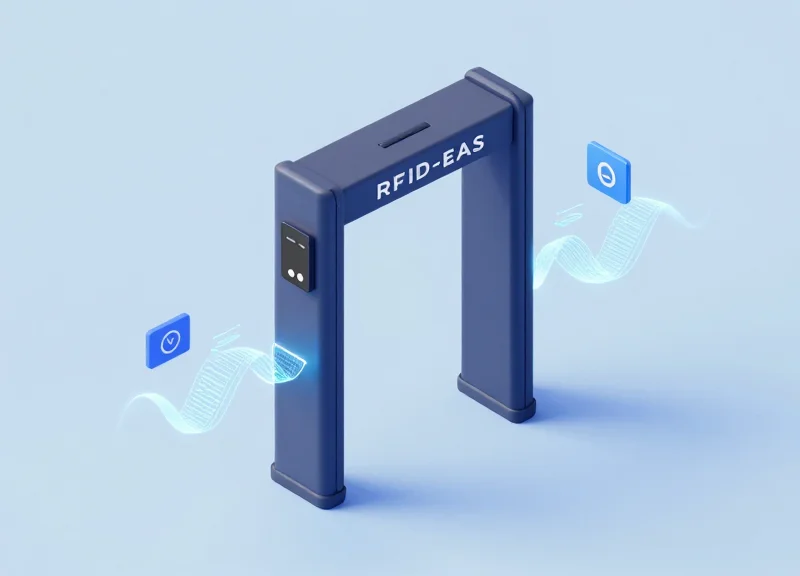
A Hybrid RFID-EAS solution is a unified security and inventory management architecture that integrates the immediate, audible deterrent of Electronic Article Surveillance (EAS) with the unique identification capabilities of Radio Frequency Identification (RFID). Unlike traditional systems that merely trigger an alarm when any tag passes a sensor, hybrid systems utilize dual-technology tags and multi-protocol readers to provide 'item-level intelligence.' This allows the system to distinguish between a laptop that has been properly checked out and a high-value asset being removed without authorization, effectively turning a 'dumb' alarm into a data-rich event notification.
| Feature | Traditional EAS | Passive RFID | Hybrid RFID-EAS |
|---|---|---|---|
| Primary Function | Loss Prevention (Deterrence) | Inventory Management | Loss Prevention + Intelligence |
| Detection Granularity | Binary (Yes/No) | Individual Serial Number | Individual Serial Number + Status |
| Alarm Context | Anonymous Alarm | Silent Data Capture | Identified Alarm (Who/What/When) |
| Bulk Scanning | No | Yes | Yes |
- Dual-Technology Tags: A single physical tag containing both an EAS resonator (AM or RF) for gate detection and an RFID chip (UHF) for serialized data storage.
- Converged Pedestals: Entrance and exit gates equipped with both EAS antennas for broad detection and RFID readers for high-speed item identification.
- Cloud-Integrated Middleware: Software that correlates alarm triggers with rental status in real-time, preventing 'false positives' for items already marked as 'checked out' in the database.
Expert Insight: The '2026 Edge' in hybrid systems lies in the shift toward Software-Defined Perimeters (SDP). In this model, the physical 'beeping' gate is secondary to the system's ability to create a digital twin of the rental floor. By 2026, we expect hybrid systems to use 'Contextual Exclusion' logic—where the system ignores tags within a three-foot 'gray zone' of the exit unless the motion sensors detect a specific trajectory, virtually eliminating the proximity alarms that plague older EAS setups.
Can I reuse my existing EAS gates?
In many cases, yes. Leading 2026 providers offer 'RFID-Overlay' kits that mount onto existing AM or RF pedestals, allowing firms to upgrade to hybrid visibility without a total hardware rip-and-replace.
Does the RFID interference affect EAS performance?
No. Modern hybrid systems operate on vastly different frequencies (e.g., 58kHz for AM EAS and 860-960MHz for UHF RFID), ensuring that the theft-deterrent signal remains robust while the data signal is captured.
How does this handle metal tech assets like MacBooks?
Hybrid solutions now utilize 'On-Metal' RFID spacers and shielded EAS components to ensure 99.9% read rates even when applied directly to aluminum or magnesium alloy chassis.
Achieving Intelligent Asset Visibility: The Data Advantage

Intelligent Asset Visibility refers to the real-time, granular tracking of physical inventory using data-rich tags that communicate unique serial numbers, usage history, and location status to a centralized management system. Unlike traditional security systems that merely alert staff when an item is unauthorized for removal, hybrid RFID-EAS systems provide a continuous data stream. This allows rental managers to shift from reactive loss prevention to proactive business intelligence, enabling automated check-ins, instant inventory counts, and detailed lifecycle analytics for every individual unit in the fleet.
| Data Point | Traditional EAS (Legacy) | Hybrid RFID-EAS (2026 Standard) |
|---|---|---|
| Identification Level | Generic (SKU/Group only) | Unique (Individual Serial Number) |
| Workflow Integration | Manual barcodes + Beepers | Automated gate-read & API sync |
| Visibility Range | Proximity only (Entry/Exit) | Zone-based (Room/Warehouse level) |
| Analytics Capabilities | Theft counts only | Usage cycles, turn-rates, and aging |
One original insight for 2026 is the emergence of 'Asset Velocity' metrics. In the high-frequency tech rental market, profitability is determined by how quickly an asset can be processed from return to re-deployment. Hybrid systems eliminate the 'dark period' where returned assets sit in a staging area. By utilizing RFID-enabled bulk check-ins, rental houses can process 50+ items in seconds, instantly updating their web storefront to show availability. This visibility effectively increases inventory capacity without purchasing a single new unit of hardware.
- Bulk Automated Check-In/Out: Scan entire pallets or cases of equipment simultaneously as they pass through loading dock portals, automatically updating rental status in the ERP.
- Serialized Lifecycle Tracking: Monitor the number of rental days and historical maintenance events for specific units to determine optimal resale windows.
- Dynamic Inventory Balancing: Use real-time location data to move assets between warehouse branches based on regional demand signals and current stock levels.
Can hybrid systems track usage intensity?
Yes. By logging the duration an asset is 'checked out' versus 'in storage,' managers can identify underutilized equipment and adjust procurement strategies.
Does this data integrate with existing CRM/ERP systems?
Most modern hybrid systems utilize REST APIs to push real-time asset movements directly into platforms like Salesforce, SAP, or custom rental software.
How does intelligent visibility improve customer service?
It eliminates 'ghost inventory' errors, ensuring that when a customer books a specific high-end camera or laptop online, the item is physically verified and ready for pickup.
Reducing Shrinkage Through Granular Loss Analysis
Granular loss analysis is the transition from reactive security to proactive asset intelligence. Unlike traditional EAS systems that merely trigger a generic alarm, hybrid RFID-EAS systems provide immediate, serialized data regarding which specific item triggered the gate. This allows rental operations to move beyond 'binary security'—knowing an alarm happened—to 'forensic security,' which identifies the exact model, serial number, and timestamp of the incident, effectively eliminating the mystery of missing inventory.
| Feature | Traditional EAS (Reactive) | Hybrid RFID-EAS (Granular) |
|---|---|---|
| Detection Detail | Generic alarm (something passed) | Specific item ID (serial number 4029 passed) |
| Shrinkage Reporting | Manual audit required to find missing items | Real-time digital update of missing assets |
| Employee Response | Often ignored due to false positives | Actionable data sent to mobile devices |
| Theft Patterning | Impossible to track trends by SKU | Heat-mapping of high-risk assets and times |
In the tech rental sector, 'shrinkage' isn't always theft; it's often a result of misfiled items or unlogged returns. Traditional systems cannot distinguish between a high-value MacBook Pro and a low-cost peripheral. Hybrid systems solve this by creating a digital paper trail. When an item passes through a sensor, the system cross-references the item's unique RFID tag against the current rental database. If the item is not flagged as 'checked out,' the system logs a 'leakage event.' This granular visibility allows managers to differentiate between operational friction (misfiled items) and actual external theft, significantly reducing 'ghost inventory'—items that appear in the system but aren't physically present.
How does granular analysis reduce 'alarm fatigue' among staff?
By identifying the specific item, staff can immediately verify if the alert is a technical error (e.g., a tag not deactivated during check-out) or a genuine security breach, leading to faster and more confident interventions.
Can granular data identify internal shrinkage?
Yes. By tracking timestamps and specific item movements during non-operational hours, managers can identify patterns that suggest internal loss, which accounts for a significant portion of rental shrinkage.
How does this improve the annual audit process?
Instead of manual year-end counts, hybrid systems provide a perpetual inventory. Any discrepancy is flagged the moment it leaves the designated zone, meaning the 'audit' is happening 24/7.
Expert Insight: The 'False Positive Audit' Strategy. One of the most overlooked advantages of granular loss analysis is the ability to audit the security system itself. In high-volume rental hubs, 15-20% of EAS alarms are often 'phantom alarms' caused by interference. By comparing RFID detection logs against EAS alarm logs, we can identify hardware blind spots and recalibrate sensors, ensuring that when an alarm does sound, it is treated with 100% urgency. This data-backed reliability is what separates 2026-ready rental operations from legacy providers.
Operational Efficiency and the ROI of Modernization

Modernizing to hybrid RFID-EAS systems represents a fundamental shift from defensive security to offensive operational efficiency, allowing tech rental firms to replace labor-intensive manual barcode scanning with automated, bulk-capture data flows. By integrating item-level intelligence with gate-level security, organizations typically realize a full Return on Investment (ROI) within 12 to 18 months, primarily driven by an 80% to 90% reduction in the labor hours previously dedicated to inventory audits and shipping/receiving verification.
| Operational Activity | Traditional EAS + Manual Scanning | Hybrid RFID-EAS Automation | Estimated Efficiency Gain |
|---|---|---|---|
| Inbound/Outbound Audit | 1-2 mins per item (Line-of-sight scan) | Bulk capture (300+ items per second) | 95% Faster |
| Quarterly Inventory Cycle | 48-72 labor hours per warehouse | 4-6 labor hours per warehouse | 90% Reduction |
| False Alarm Investigation | Manual bag checks & log entries | Automated ID logs with timestamp | 75% Reduction |
| Stock Discrepancy Resolution | Hours of manual 'shelf hunting' | Real-time location lookup | 85% Faster |
In the high-velocity tech rental world, the 'Shadow Cost' of traditional EAS is often overlooked. When a standard EAS alarm sounds, it creates operational friction: staff must stop their current task, manually verify the item, and cross-reference a paper or digital manifest. This creates a bottleneck that slows down the deployment of high-value assets. Hybrid systems eliminate this friction by identifying the specific serial number of the asset triggering the gate. If the item is marked as 'checked out' in the database, the system remains silent, allowing authorized shipments to pass without interruption while only alerting on actual unauthorized removals.
Expert Insight: The Tipping Point of Zero-Touch Logistics. The true ROI of 2026-era hybrid systems isn't just in stopping theft—it's in the enablement of 'Zero-Touch' logistics. By utilizing the RFID component for automated gate-read triggers, tech rental firms can initiate automated billing the moment a pallet passes through the loading dock, effectively removing the human element from the revenue recognition cycle. This reduces the 'DSO' (Days Sales Outstanding) by ensuring invoicing happens in real-time with 100% accuracy.
How does the labor cost reduction specifically impact the bottom line?
Labor costs are the largest variable expense in rental operations. By automating inventory capture, companies can reallocate staff from 'counting boxes' to 'servicing clients,' effectively increasing their scaling capacity without increasing headcount.
Is the initial hardware investment justifiable for mid-sized rental firms?
Yes. When factoring in the cost of 'ghost assets' (items lost due to data errors) and the speed of throughput, even mid-sized firms see a break-even point within the first 14 months of deployment.
What is the primary driver of ROI beyond loss prevention?
Inventory accuracy is the primary driver. Increasing accuracy from the industry average of 70% to 99%+ prevents over-purchasing of redundant stock and ensures that every piece of gear is available for rental at all times.
Future-Proofing with ESL and IoT Integration

By 2026, the tech rental industry will move beyond simple security toward 'ambient intelligence,' where Hybrid RFID-EAS systems function as the central nervous system for a wider IoT mesh. In this architecture, the hybrid gate is no longer just a loss prevention tool; it is a data gateway that synchronizes with Electronic Shelf Labels (ESL) and environmental sensors. This integration allows for a 'Living Warehouse' where the digital twin of every asset is updated instantly—not just when it passes a gate, but as its location, battery health, or environmental conditions change on the shelf.
| Feature | Legacy EAS Approach | IoT-Integrated Hybrid RFID Ecosystem |
|---|---|---|
| Price/Status Updates | Manual paper labeling | Real-time ESL updates via RFID sync |
| Asset Location | Zone-level (Gate only) | Shelf-level (Triangulated IoT/ESL) |
| Maintenance | Reactive after failure | Predictive via usage cycle telemetry |
| Inventory Audits | Scheduled downtime | Continuous 'Perpetual' inventory |
Expert Insight: The Edge-to-Label Sync. A unique competitive advantage in 2026 will be the use of 'pick-to-light' functionality enabled by ESL. When a rental order is initiated, the Hybrid RFID system can trigger the specific ESL attached to an item's shelf to flash or change color. This reduces human searching error and pick-time by up to 40%, effectively turning your storage facility into a high-velocity fulfillment center without increasing headcount.
Does ESL integration require a separate network infrastructure?
Modern ESL systems typically operate on sub-GHz or Bluetooth Low Energy (BLE) frequencies that can be managed through the same IoT access points used by your Hybrid RFID-EAS controllers, minimizing hardware clutter.
Can IoT sensors protect tech assets from environmental damage?
Yes. By integrating temperature and humidity sensors into the same dashboard as your RFID data, the system can alert managers if high-value servers or delicate optics are being stored in sub-optimal conditions.
How does ESL help with the rental 'Churn' rate?
ESLs can display 'Days since last service' or 'Rental Ready' status dynamically. When an item returns and is scanned by the Hybrid RFID gate, the ESL automatically updates from 'Out' to 'Processing' or 'Ready,' eliminating the 'lost in transit' lag in the warehouse.
To truly future-proof, businesses must adopt an API-first approach. The value of a Hybrid RFID-EAS system triples when its data feeds directly into your ERP and CRM. By 2026, the companies leading the rental market will be those that view their hardware not as separate units, but as a unified data stream that optimizes everything from procurement to the final customer hand-off.
Implementation Strategies: Moving from Traditional to Hybrid
Transitioning from traditional Electronic Article Surveillance (EAS) to hybrid RFID-EAS is a strategic shift from simple theft deterrence to total asset intelligence. The core implementation strategy involves retrofitting legacy inventory with dual-frequency tags that satisfy existing 58kHz or 8.2MHz gates while simultaneously enabling UHF RFID tracking. This 'dual-track' approach allows rental operations to maintain security protocols while building a granular data layer, effectively preventing capital expenditure spikes and ensuring the transition does not disrupt high-velocity rental workflows.
| Implementation Phase | Key Action Item | Operational Impact |
|---|---|---|
| Infrastructure Audit | Map RF interference and gate dead zones | Low - Internal review |
| Tag Retrofitting | Swap single-tech tags for dual-tech RFID-EAS labels | Medium - Labeling during returns |
| Middleware Sync | Connect RFID readers to existing Rental Management Systems (RMS) | Low - Backend development |
| Portal Deployment | Install hybrid pedestals at primary egress points | High - Weekend installation |
- RF Mapping and Site Survey: Conduct a comprehensive assessment of the rental facility to identify 'multipath' interference from metal racking or high-density electronics that could affect RFID read rates.
- The 'Ghost Tagging' Phase: Begin applying hybrid tags to all new and returning inventory months before the hardware swap. This ensures that when the hybrid readers go live, 100% of your fleet is already discoverable.
- Middleware and API Integration: Develop the bridge between the RFID data stream and your ERP. The system must recognize that an item passing through the gate isn't just 'present' but is 'checked out' or 'flagged for maintenance'.
- Phased Pedestal Replacement: Replace traditional gates one zone at a time. This minimizes downtime and allows staff to adjust to the new alert protocols in a controlled environment.
Expert Insight: The Ghost Tagging Maneuver. In my two decades of Silicon Valley tech deployments, the biggest failure point is the 'blind spot' during the hardware cutover. By implementing 'Ghost Tagging'—applying dual-frequency tags six months before the reader infrastructure is installed—you create a data reservoir. The moment the hybrid gates are powered on, your inventory visibility jumps from 0% to 100% instantly, providing an immediate ROI that justifies the project to stakeholders.
Will hybrid tags trigger my old EAS gates?
Yes, dual-frequency tags are designed to be backward compatible. They contain both the EAS resonator for your legacy gates and the RFID chip for the new system.
Do I need to replace my entire IT infrastructure?
No. Modern hybrid systems use edge computing to process data locally before sending consolidated summaries to your existing cloud-based RMS via APIs.
How do I handle 'shielded' assets like metal flight cases?
Specialized 'on-metal' hybrid tags or 'flag tags' are used to create the necessary air gap, ensuring the signal is not absorbed by the metal casing.
DragonGuardGroup: Your Partner in Next-Gen Asset Security
DragonGuardGroup is a leading innovator in the convergence of physical loss prevention and digital asset intelligence, offering a specialized ecosystem of Hybrid RFID-EAS hardware and cloud-integrated software specifically engineered for the high-velocity tech rental industry. By focusing on the 'Intelligent Perimeter,' DragonGuardGroup enables businesses to transition from reactive security to proactive asset visibility, ensuring every laptop, tablet, and server is accounted for in real-time throughout its entire rental lifecycle.
- Vertical-Specific R&D: Unlike generic security vendors, DragonGuardGroup invests heavily in engineering tags and sensors that perform optimally on metallic surfaces and high-density electronics, common in tech rental inventories.
- End-to-End Integration Support: We provide more than just hardware; our team offers full-stack integration services to ensure your RFID-EAS data flows seamlessly into existing ERP and inventory management systems.
- Scalable Infrastructure: Our solutions are designed to scale from boutique rental houses to global enterprise depots, utilizing modular architecture that adapts to changing 2026 compliance standards.
| Feature | Traditional Security Vendors | DragonGuardGroup Hybrid Solutions |
|---|---|---|
| Primary Function | Simple Alarm Triggering | Granular Data Capture & Loss Prevention |
| Asset Tracking | Bulk Detection Only | Serial-Number Level Visibility |
| Environmental Tolerance | High Interference in Tech Hubs | Patented Shielding for Electronic Density |
| Data Synergy | Siloed Systems | API-First IoT Integration |
Expert Insight: The 'Signal-to-Shelf' Continuity Advantage. A common pitfall in the 2026 outlook is the 'blind spot' between the warehouse shelf and the exit gate. DragonGuardGroup introduces a unique proprietary protocol called 'Edge-First Signal Processing.' This technology analyzes signal strength and directionality at the antenna level, virtually eliminating the false positives caused by internal movement of tech assets near the exits—a massive pain point for rental warehouses with limited square footage.
How does DragonGuardGroup assist with the transition from legacy EAS?
We offer a phased migration path that allows you to keep existing EAS gates functional while layering in RFID capabilities, minimizing upfront capital expenditure and operational downtime.
What is the typical ROI for a tech rental firm?
Most clients see a full return on investment within 14–18 months through a 40% reduction in manual inventory labor and a 25% decrease in unrecovered asset write-offs.
Are DragonGuardGroup tags compatible with third-party readers?
Yes, our hardware adheres to global Gen2 UHF RFID standards, ensuring interoperability while providing enhanced security features when used with our proprietary readers.