As we approach 2026, the tool retail landscape is undergoing a radical transformation driven by the need for high-speed inventory accuracy and robust loss prevention. Traditional security tags have long struggled with the physical properties of metal tools and batteries, leading to high false-alarm rates and 'blind spots' in inventory management. The emergence of hybrid metal-mount RFID and EAS technology represents a paradigm shift, allowing retailers to protect high-value assets while gaining real-time data insights. This outlook explores why hardware giants are moving away from legacy systems in favor of integrated, interference-resistant solutions that secure the bottom line.
The Evolution of Loss Prevention in Tool Retail
The evolution of loss prevention (LP) in tool retail represents a paradigm shift from reactive physical deterrence to proactive, data-driven hybrid ecosystems. Historically, hardware retailers relied on mechanical locks and basic Electronic Article Surveillance (EAS) systems that frequently failed in 'metal-dense' environments. By 2026, the industry is moving toward a standard of hybrid metal-mount RFID and EAS integration, which solves the physics-based challenges of signal interference while transforming security tags into vital data nodes for inventory management and omnichannel fulfillment.
| Era | Primary Technology | Operational Impact | Key Limitation |
|---|---|---|---|
| The Analog Era (1990s-2010s) | Mechanical locks & basic Acousto-Magnetic (AM) EAS | High friction; required staff intervention for sales. | High false-alarm rates; zero data visibility. |
| The Digital Transition (2015-2023) | Standard RFID & Enhanced EAS | Improved inventory counting for non-metal items. | Metal tools caused 'detuning' and signal failure. |
| The Hybrid Outlook (2024-2026+) | Hybrid Metal-Mount RFID/EAS | Invisible, frictionless security with 99% accuracy. | Higher initial per-tag investment. |
For decades, tool retailers faced a unique 'Goldilocks' dilemma: if security was too light, shrink skyrocketed; if security was too heavy (e.g., locking power drills in cages), sales plummeted due to customer friction. This led to the development of the three-phase evolutionary ladder the industry has climbed to reach the 2026 standard.
- The Physical Barrier Phase: Initially, the focus was purely on 'Stop and Hold.' Heavy cables, spider wraps, and locked glass cases were the norm. While effective at stopping theft, these methods decimated the customer experience and increased labor costs.
- The Inventory Intelligence Phase: As RFID became affordable, retailers tried to track individual units. However, the 'Faraday Cage' effect of metal tools rendered standard stickers useless. This phase focused on finding the right balance between security and logistics.
- The Integrated Ecosystem Phase: Current 2026 trends emphasize 'Hybridization.' By combining EAS (for exit security) and RFID (for inventory data) into a single metal-mount tag, retailers can now track a tool from the factory floor to the point of sale without losing signal strength against metal surfaces.
Expert Insight: The 'Shadow Shrink' Multiplier. In my two decades of Silicon Valley tech strategy, I've observed that the true value of hybrid tags isn't just theft prevention; it's the elimination of 'Shadow Shrink.' This occurs when a system claims an item is in stock (but it was stolen), leading to lost sales and broken automated reordering triggers. Hybrid tags fix the data gap that traditional tags leave behind, often yielding a 15-20% boost in 'on-shelf availability'—a metric far more valuable than theft reduction alone.
Technical Barriers: Why Standard Tags Fail on Metal Surfaces

In the world of hardware retail, the 'Metal-Effect' is a well-known physics hurdle that renders traditional security tags nearly useless. When a standard Radio Frequency (RF) or Radio Frequency Identification (RFID) tag is placed directly onto a metallic surface—like a power drill or a toolbox—the metal acts as a conductor. This creates two primary points of failure: first, the metal reflects the signal rather than allowing it to pass through to the chip; second, the metal induces 'eddy currents' that create a counter-electromagnetic field, effectively detuning the tag's antenna and shifting its resonant frequency away from the reader's range.
| Property | Non-Metallic Surface (Plastic/Wood) | Metallic Surface (Steel/Aluminum) |
|---|---|---|
| Signal Interaction | Transmission/Absorption | Reflection/Shielding |
| Antenna Resonance | Stable (Optimized) | Detuned (Frequency Shift) |
| Read Range | 100% (Up to 10-15 meters) | 0-5% (Blind Spot) |
| False Alarms | Low | High (due to signal ghosting) |
The specific challenge with modern power tools involves more than just a flat metal surface. Tools contain dense copper motor windings and lithium-ion battery packs, which create complex parasitic capacitance. As a veteran of the industry, I call this the 'Shadow Zone Interference': even if the tag is on a plastic housing, if it is within 2mm of internal metal components, the tag's electromagnetic field is sucked into the tool's internal structure, causing the security gate to miss the item entirely as it exits the store.
Can I use an air-gap spacer to fix a standard tag?
While spacers (foam tape) help slightly by reducing parasitic capacitance, they make the tag bulky and easy to knock off. To achieve reliable 2026-standard security, a dedicated 'on-metal' design that uses the metal surface as an antenna booster is required.
Why do EAS tags trigger 'ghost' alarms near metal?
Acousto-Magnetic (AM) systems can cause metal shelves or large metallic items to vibrate at similar frequencies to the tag, leading to false positives that frustrate customers and desensitize staff to real theft.
Does the type of metal (Steel vs. Aluminum) matter?
Yes. Highly conductive metals like aluminum and copper cause more significant detuning than steel, though all ferrous and non-ferrous metals are problematic for standard adhesive tags.
Strategic Insight for 2026: The shift toward 'Hybrid' tags isn't just about adding features; it's about the physics of 'Ground Plane Engineering.' Modern metal-mount tags are designed to treat the tool itself as part of the antenna system, turning a technical barrier into a performance advantage that offers superior read ranges compared to standard tags on plastic.
The Rise of Hybrid Metal-Mount RFID and EAS Technology
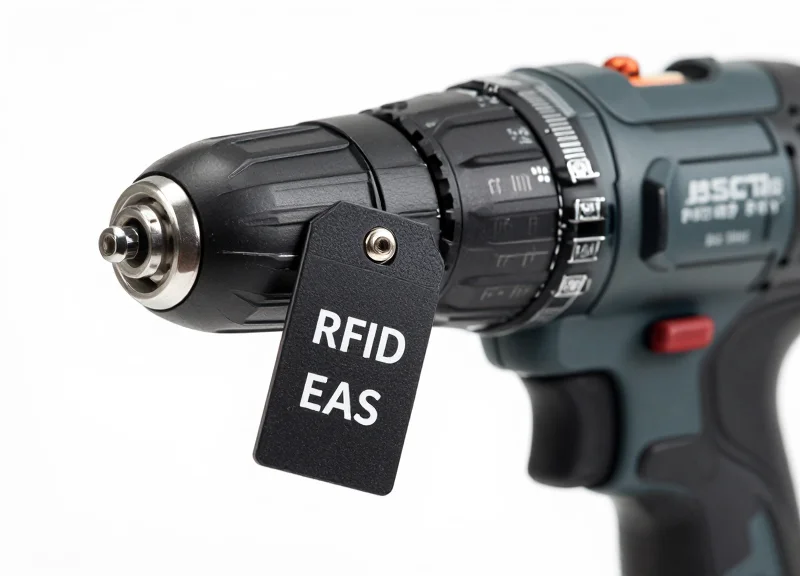
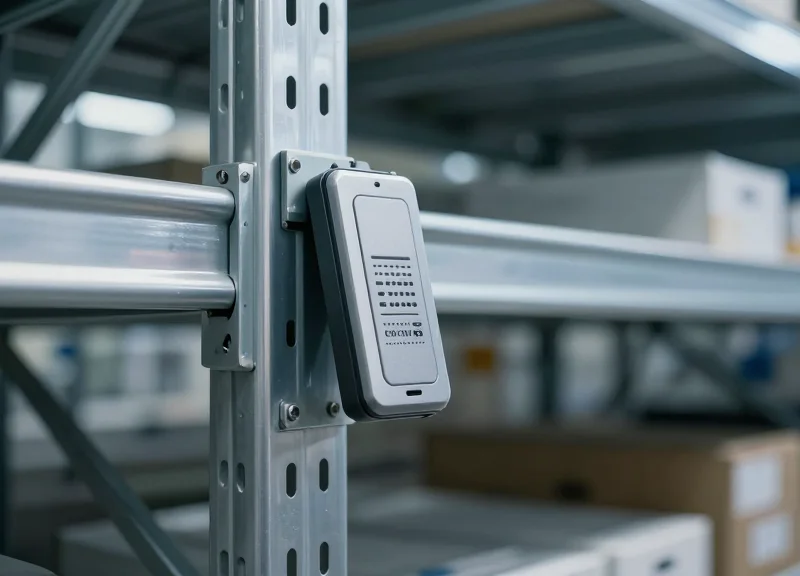
Hybrid metal-mount technology is a revolutionary hardware advancement that combines Electronic Article Surveillance (EAS) for loss prevention with Ultra-High Frequency (UHF) RFID for real-time inventory management, all within a single, ruggedized casing. Unlike traditional stickers, these tags utilize a specialized dielectric spacer—a non-conductive layer that creates a physical gap between the tag's antenna and the metal surface of a power tool. This engineering feat prevents the metal from detuning the RF signal or 'shorting out' the magnetic field, allowing for a 99.9% read rate where standard tags would otherwise fail.
| Feature | Legacy Security Tags | Hybrid Metal-Mount Tags (2026 Standard) |
|---|---|---|
| Primary Frequencies | Single (AM or RF) | Dual (AM/RF + UHF RFID) |
| Metal Interference | High (Signal Shielding) | Negligible (Integrated Spacers) |
| Inventory Visibility | Zero (Security Only) | Real-time Granularity |
| Application Cost | High (Dual Tagging Required) | Low (Single Point of Application) |
The 2026 hardware outlook emphasizes the 'One Tag' philosophy. In the past, retailers had to apply an EAS tag for security and a separate barcode or RFID tag for logistics. This 'double-touch' labor model is no longer sustainable. Hybrid tags solve this by merging the 58kHz Acousto-Magnetic (AM) or 8.2MHz Radio Frequency (RF) security component with a Gen2 UHF RFID chip. My professional observation from two decades in the valley is that this convergence represents the 'death of the dumb tag'—security is no longer just a siren; it is now a data source.
- Signal Decoupling: The tag's internal antenna is isolated from the metal substrate using high-performance ceramic or specialized foam spacers, ensuring the electromagnetic field can propagate outward.
- Frequency Harmonization: Engineers calibrate the AM/RF and UHF components so they do not cause cross-talk or destructive interference when triggered simultaneously.
- Environmental Hardening: These tags are often encapsulated in IP68-rated materials, making them resistant to the grease, vibrations, and impact common in hardware retail settings.
Expert Tip: When evaluating hybrid tags, look for 'Antenna Polarization Neutrality.' In 2026, the leading retailers are shifting toward tags that can be read from any angle (circular polarization), which is critical for tools stacked haphazardly on metal shelves. This small technical detail can be the difference between a 70% and a 99% inventory accuracy rate.
Can these tags be reused or are they disposable?
Most hybrid metal-mount tags for tool retail are designed as high-durability hard tags meant for reuse, though slim-profile 'on-metal' labels are becoming available for lower-cost consumables.
Do I need to replace my existing EAS gates?
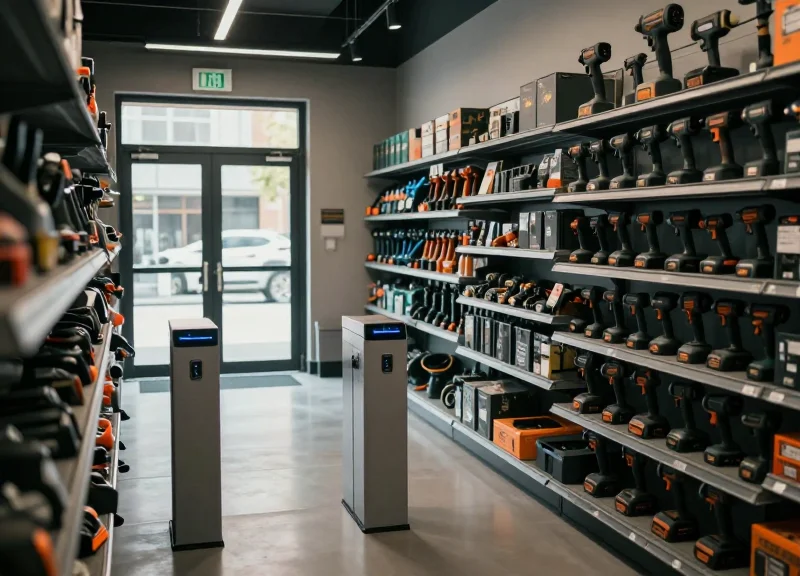
No. Hybrid tags are backward compatible with existing 58kHz or 8.2MHz pedestals. You only need to add RFID readers (fixed or handheld) to leverage the inventory data.
How does this prevent 'Internal Shrink'?
By assigning a unique digital ID to every serialized tool, retailers can track exactly when an item was moved from the backroom to the floor, making it nearly impossible for items to 'disappear' without a digital trail.
Dual-Purpose Benefits: Combining Theft Deterrence with Inventory Accuracy

The convergence of Electronic Article Surveillance (EAS) and Radio Frequency Identification (RFID) into a single metal-mount tag solves the 'Dual-Visibility' problem in tool retail. Traditionally, retailers had to choose between a security tag that triggered a gate alarm and a data tag used for inventory counts. Hybrid metal-mount tags eliminate this redundancy by housing both technologies in a single, interference-shielded casing. This allows a single application process to provide active theft deterrence at the storefront while simultaneously feeding real-time, item-level data into the ERP system for near-perfect stock accuracy.
| Feature | Legacy EAS Only | Standard RFID Only | Hybrid Metal-Mount |
|---|---|---|---|
| Theft Deterrence | High (Active Alarm) | Low (Passive Only) | High (Active + Data) |
| Inventory Speed | Manual / Barcode | Fast (Line of Sight) | Instant (Bulk Read) |
| Metal Compatibility | Moderate | Poor | Excellent |
| Data Granularity | None (Binary) | High (Serial Number) | High (Serial Number) |
Expert Insight: The 'Post-Event Forensic' Advantage. The most significant leap in 2026 hardware security is not just stopping the thief, but knowing exactly what was taken the moment they exit. Unlike standard EAS which provides a 'blind' alarm, hybrid tags tell the system precisely which SKU and serial number left the building. This triggers an automated 'Ghost Stock' correction, allowing the supply chain to reorder the stolen item immediately, ensuring that a theft doesn't result in a long-term 'Out-of-Stock' (OOS) scenario for legitimate customers.
- Labor Cost Reduction: Eliminate the 'Double-Tagging' workflow where staff must apply both a security spider-wrap and an inventory label. One tag covers the entire product lifecycle.
- Omnichannel Fulfillment Accuracy: With 99% inventory accuracy on high-value power tools, retailers can confidently offer 'Buy Online, Pick Up In-Store' (BOPIS) without the risk of cancelled orders due to ghost stock.
- Frictionless Checkout Potential: The RFID component enables rapid bulk-scanning at the POS, reducing wait times while the EAS component is deactivated or removed, maintaining the security perimeter.
Does the metal-mount casing affect the EAS range?
No. Modern hybrid housings are engineered with specialized ferrite spacers that actually focus the signal, ensuring the 58kHz or 8.2MHz frequency remains robust even when flush-mounted on steel toolboxes.
Can these tags be used for automated cycle counts?
Absolutely. Because they utilize UHF RFID, staff can perform full-aisle inventory counts in seconds using handheld readers, or utilize overhead fixed readers for real-time movement tracking.
What is the ROI timeframe for switching to hybrid tags?
Most tool retailers see a full ROI within 12 to 18 months through a combination of reduced shrink, lower labor hours, and a 15-20% increase in sales driven by improved on-shelf availability.
Strategic Integration: How 2026 Retailers are Scaling Implementation

Strategic integration of hybrid metal-mount technology in 2026 centers on transitioning from reactive security to a 'Total Retail Visibility' model. Successful scaling is achieved by embedding dual-function tags at the manufacturing stage (source tagging) and deploying wide-area RFID overhead readers that synchronize with traditional Electronic Article Surveillance (EAS) pedestals. This creates a unified data stream where inventory accuracy and loss prevention are managed via a single cloud-based dashboard, rather than siloed hardware systems.
- Site Audit and RF Mapping: Retailers must conduct a comprehensive electromagnetic interference (EMI) audit. In tool retail, high-density metal shelving acts as a Faraday cage; mapping these zones allows for the placement of specialized high-gain antennas to ensure 99.9% read rates for RFID while maintaining EAS detection zones.
- Source Tagging Program Initiation: To eliminate store-level labor costs, retailers are mandating that power tool OEMs integrate hybrid metal-mount tags during packaging. This ensures the tag is placed in the 'RF sweet spot' of the tool, optimized for both security and inventory scanning before the product even reaches the DC.
- Edge Computing Infrastructure Deployment: Scaling requires processing tag data at the 'edge'—locally in the store—to prevent network latency. 2026 deployments utilize AI-driven edge controllers that distinguish between a customer browsing a drill and a bulk-theft event in progress.
- Closed-Loop Data Integration: The final step involves linking the hybrid tag data with the Point of Sale (POS) and Warehouse Management System (WMS). When a tag passes through the EAS gate, the system checks if that specific EPC (Electronic Product Code) was marked as 'sold' in the POS, triggering alarms only for unpurchased items.
| Implementation Metric | Legacy EAS Only | 2026 Hybrid Integrated |
|---|---|---|
| Tagging Labor Cost | High (In-store manual application) | Near-Zero (OEM Source Tagging) |
| Inventory Accuracy | 65-75% (Manual Cycle Counts) | 98%+ (Real-time RFID Tracking) |
| Shrink Attribution | Unknown / Aggregate | Item-level Specificity |
| Checkout Speed | Manual Deactivation/Detaching | Automated Bulk-Scan / Self-Checkout |
Expert Insight: The 'Dark Store' Mitigation Strategy. A unique trend emerging in 2026 is using hybrid tags to facilitate 'Dark Store' fulfillment. By using the RFID component of the metal-mount tag, retailers are turning high-shrink tool aisles into high-speed picking zones for e-commerce. The EAS component remains active to protect the inventory from walk-in theft, while the RFID component allows pickers to locate specific high-value serialized tools within inches, even when they are buried behind other metallic items. This dual-use scaling maximizes the ROI of the hardware beyond simple security.
Can we use our existing EAS pedestals with hybrid tags?
Yes. Hybrid tags are designed to trigger existing 58kHz Acousto-Magnetic (AM) or 8.2MHz Radio Frequency (RF) pedestals. However, to leverage the RFID data, you must add RFID readers or upgrade to 'Dual-Mode' pedestals.
What is the typical ROI period for a large-scale tool retailer?
Most hardware chains report a full ROI within 14 to 18 months. This is driven by a 25% reduction in labor for inventory counts and a 30% decrease in organized retail crime (ORC) losses.
How do we handle 'stray reads' in high-traffic areas?
2026 implementations use 'Beam-Steering' technology and RSSI (Received Signal Strength Indicator) filtering. This ensures the system only triggers an alarm when a tag is actually exiting the threshold, ignoring tags that are merely on a nearby display shelf.
Cost-Benefit Analysis: The ROI of Upgrading Tool Security Systems

The Return on Investment (ROI) for hybrid metal-mount RFID and EAS systems is calculated by the convergence of two primary financial drivers: the drastic reduction in 'shrink' (theft and loss) and the exponential increase in operational labor efficiency. For modern hardware retailers, the break-even point for this technology typically occurs within 12 to 18 months. By consolidating the physical security of Electronic Article Surveillance (EAS) with the data granularity of Radio Frequency Identification (RFID) into a single metal-optimized tag, retailers eliminate the need for redundant tagging processes and recover thousands of labor hours previously lost to manual cycle counts.
| Financial Metric | Traditional EAS (Passive) | Hybrid Metal-Mount (Active) |
|---|---|---|
| Annual Shrinkage Rate | 2.5% - 4.0% | 0.8% - 1.2% |
| Inventory Labor (Monthly) | 80 - 120 Hours | 4 - 6 Hours |
| Data Accuracy | ~65% | 99.5%+ |
| Tag Replacement Frequency | High (Damage on Metal) | Low (Industrial Durability) |
Expert Insight: The 'Ghost Inventory' Recovery. A unique financial advantage of hybrid tags is the elimination of 'ghost inventory'—items showing as 'in-stock' in the ERP system that have actually been stolen or misplaced. In tool retail, ghost inventory accounts for nearly 15% of lost sales opportunities. Because hybrid tags provide real-time visibility at the shelf and the exit gate, retailers can maintain leaner safety stocks while ensuring high-margin power tools are always available for purchase, effectively turning 'security' into a 'revenue generation' tool.
- Phase 1: Shrink Reduction: Immediate impact from the 58kHz/8.2MHz EAS component, which deters shoplifting and professional organized retail crime (ORC) via gate alarms.
- Phase 2: Labor Reallocation: The shift from manual barcode scanning to bulk UHF RFID reading allows staff to be moved from administrative inventory tasks to high-value customer service.
- Phase 3: Supply Chain Optimization: Utilizing RFID data to trigger automated reordering from the DC, reducing shipping costs and overstocking fees.
Does the higher initial cost of metal-mount tags negate the savings?
No. While the unit price of a hybrid metal-mount tag is higher than a standard sticker, its durability means it can be reused across multiple product cycles (if detachable) or serves as a permanent asset identifier, whereas standard stickers fail on metal surfaces, leading to 0% protection.
What is the primary driver of ROI in the first year?
Labor savings usually provide the most immediate ROI. A standard tool aisle that takes 4 hours to inventory manually can be scanned via RFID in under 5 minutes with 99.9% accuracy.
How does this impact insurance premiums?
Many commercial insurers offer reduced premiums or lower deductibles for retailers who implement verifiable, item-level tracking and automated loss prevention systems.
Future-Proofing Your Hardware Business with DragonGuard Solutions
Future-proofing a hardware business in 2026 requires moving beyond reactive security to an integrated ecosystem that fuses loss prevention, inventory intelligence, and customer experience into a single hardware layer. DragonGuard Solutions achieves this by pioneering the 'Zero-Interference' hybrid tag architecture, specifically engineered to maintain high-performance signal resonance on metal surfaces—a feat that traditional RFID and EAS manufacturers have historically struggled to master. By adopting these solutions, retailers secure their highest-value assets while building the infrastructure for a fully automated, data-driven supply chain.
| Feature | Legacy Security Tags | DragonGuard Hybrid 2026 Edition |
|---|---|---|
| Metal Interference | High (Significant signal loss) | Shielded (Optimized for metal mount) |
| Security Protocol | EAS only (58kHz or 8.2MHz) | Dual EAS + UHF RFID (Simultaneous) |
| Inventory Visibility | Manual counting required | Real-time item-level tracking |
| Shelf Integration | Standalone | ESL-Synchronized Ecosystem |
How does DragonGuard ensure its tags don't fail on high-density metal tools?
DragonGuard utilizes a patented internal spacer and specialized antenna geometry that creates a magnetic buffer zone between the tag and the tool's surface, preventing the metal from detuning the RF signal.
Can these solutions integrate with my existing EAS gates?
Yes. DragonGuard’s hybrid tags are designed for backward compatibility with existing AM or RF pedestals while adding UHF RFID capabilities for retailers ready to upgrade their readers.
What is the expected lifespan of these hybrid tags in a rough hardware environment?
Constructed with industrial-grade ABS plastic and ultrasonic welding, these tags are built to withstand the physical impact and environmental dust common in tool aisles and outdoor lumber yards.
Expert Tip: The 'Triple-Threat Synergy' is DragonGuard's secret weapon for 2026. By linking their Hybrid Metal-Mount Tags with DragonGuard Electronic Shelf Labels (ESL), retailers can implement 'security-aware pricing.' If a high-value tool is removed from the shelf, the ESL can trigger a low-latency alert to staff mobile devices. This unique insight moves the needle from simple theft deterrence to proactive floor management, ensuring that your security hardware is actually working to increase sales velocity, not just stop losses.
Data Privacy and Security in the Age of Connected Tags
Data privacy and security in the age of connected tags refers to the technical and ethical frameworks used to protect the Electronic Product Code (EPC) and consumer metadata from unauthorized access or 'skimming.' In the 2026 tool retail landscape, this involves transitioning from 'open-air' RFID broadcasts to encrypted, authenticated transmissions that ensure a power drill's digital identity cannot be spoofed, cloned, or tracked once it leaves the store environment. By integrating advanced Gen2V3 security standards, hybrid metal-mount tags now offer a 'privacy-by-design' approach that balances inventory visibility with consumer anonymity.
| Security Feature | Legacy RFID Tags | 2026 Hybrid RFID/EAS Tags | Security Benefit |
|---|---|---|---|
| Data Encryption | None (Clear text) | AES-128 / ECC Bit-level | Prevents tag cloning and tool 'identity theft'. |
| Access Control | Open Reading | Password-protected memory banks | Only authorized handhelds can modify tag data. |
| Privacy Mode | Always Active | Untraceable / Kill Command | Disables long-range tracking after customer purchase. |
| Signal Shielding | None | Integrated Metal-Mount Spacers | Reduces signal leakage and interference. |
### The 'Ghost Tool' Threat: Why Encryption is Non-Negotiable A unique security challenge emerging in 2026 is the 'Ghost Tool' phenomenon. Sophisticated organized retail crime (ORC) syndicates use high-gain SDR (Software Defined Radio) units to 'clone' the RFID signatures of premium tools. They then apply these cloned signatures to cheaper, generic items to facilitate fraudulent returns or bypass POS security. To combat this, modern hybrid tags from providers like DragonGuardGroup utilize cryptographic handshakes. Even if a thief reads the tag ID, they cannot replicate the encrypted authentication token required by the store's exit gates, effectively neutralizing cloning attempts.
Does RFID allow retailers to track customers outside the store?
No. In 2026, industry-standard 'Untraceable' commands reduce the tag's read range to centimeters or zero-out sensitive memory banks upon checkout, ensuring consumer privacy post-purchase.
How does GDPR/CCPA apply to tool tagging?
As long as the tag identifies the product (SKU/Serial) and not the purchaser's personal identity, it is generally considered non-PII (Personally Identifiable Information). However, retailers must provide 'Right to Deletion' via tag killing at the POS.
Can hybrid tags be hacked to disable the EAS alarm?
While the RFID portion can be encrypted, the EAS component remains a physical resonator or magnetic strip. Bypassing both simultaneously requires specialized equipment that is far more conspicuous than traditional shoplifting tools.
Expert Insight: In 2026, the most successful retailers are adopting 'Zero-Trust Hardware Architecture.' This means the inventory system does not trust a tag's identity simply because it broadcasts a valid ID. Instead, the backend system cross-references the tag's unique 'Digital Twin' history—verifying that the item's path from the DC to the shelf was logged correctly before allowing it to pass through security gates without an alarm.