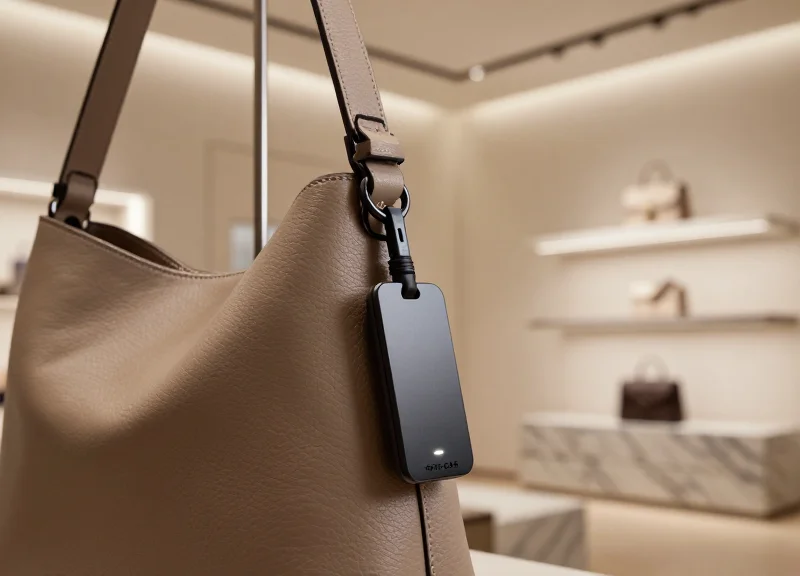
The global retail landscape for premium leather goods is undergoing a radical transformation. As we approach 2026, the traditional silos between loss prevention and inventory management are collapsing. High-end retailers are no longer satisfied with simple anti-theft buzzers; they require granular data and seamless protection that respects the material integrity of luxury items. Enter the RFID-EAS hybrid lanyard—a dual-purpose powerhouse designed to safeguard high-margin leather goods while providing the real-time stock visibility required for modern omnichannel commerce. This article explores why this technology is set to become the industry benchmark for smart retailing within the next two years.
The Evolution of Retail Security: Moving Beyond Basic EAS

The evolution of retail security represents a fundamental shift from reactive loss prevention to proactive data intelligence. While traditional Electronic Article Surveillance (EAS) has served as the industry's 'silent sentry' for decades by triggering alarms at exits, it is no longer sufficient for the 2026 retail landscape. Modern smart retailing demands a hybrid approach where EAS technology is merged with Radio Frequency Identification (RFID), transforming a basic security tag into a multifaceted data node that prevents shrink while simultaneously providing 99% inventory accuracy across the supply chain.
For leather goods retailers, the stakes are uniquely high. High-value items like designer handbags and premium jackets are prime targets for organized retail crime (ORC). However, legacy EAS systems provide zero visibility into which specific item was stolen or when it was last seen on the shelf. This 'data blindness' is the primary catalyst driving the industry toward hybrid lanyards that offer the physical protection of EAS with the digital identity of RFID.
| Feature | Legacy EAS (Acoustic/Magnetic) | Next-Gen RFID-EAS Hybrid |
|---|---|---|
| Primary Function | Theft Deterrence | Theft Deterrence + Inventory Intelligence |
| Data Granularity | None (Binary alarm) | Unique ID (SKU, Color, Size, Origin) |
| Omnichannel Support | Non-existent | Enables Buy Online Pick Up In Store (BOPIS) |
| Shrink Analysis | Manual/Estimated | Automated real-time loss reporting |
Why is EAS alone failing modern retailers?
Traditional EAS is a 'dumb' technology; it alerts you that something is leaving, but doesn't tell you what. In a high-velocity retail environment, this leads to 'ghost stock' where the system thinks an item is available for a customer, but it was actually stolen or misplaced, resulting in lost sales.
What role do lanyards play in leather goods security?
Lanyards are critical for leather goods because they allow for secure attachment without piercing the material. A hybrid RFID-EAS lanyard protects the integrity of the premium leather while housing the sensitive electronics required for dual-mode tracking.
How does this technology improve the customer experience?
By automating inventory counts via RFID, staff spend less time in the backroom and more time on the floor. Furthermore, accurate stock levels ensure that when a customer sees a '1 in stock' notification online, the item is actually there.
Expert Insight: The 'Invisible Shrink' Threshold. Based on my two decades in the valley, we are seeing a shift where 'Invisible Shrink'—losses due to administrative errors and stock-outages—is actually becoming more costly than physical theft for leather retailers. The hybrid lanyard's true ROI isn't just in stopping a thief at the door; it is in the 15-20% revenue lift seen when retailers finally have a real-time, 100% accurate view of their high-margin leather inventory. In 2026, if your security tag isn't also a data point, it's a liability.
The Hybrid Synergy: How RFID and EAS Work Together

The hybrid synergy in retail security is the architectural integration of two distinct wireless technologies—Electronic Article Surveillance (EAS) and Ultra-High Frequency (UHF) RFID—into a single hardware form factor like a lanyard tag. While EAS provides a 'binary' signal (present or not present) to trigger alarms at exits using 8.2MHz (RF) or 58KHz (AM) frequencies, the RFID component operates between 860-960MHz to transmit unique digital identifiers. This dual-frequency approach allows leather goods retailers to simultaneously prevent high-value theft and maintain 99%+ inventory accuracy without the need for multiple tags on a single handbag or jacket.
| Feature | EAS Component (AM/RF) | RFID Component (UHF) |
|---|---|---|
| Primary Purpose | Loss Prevention (Gate Alarms) | Inventory Intelligence & Logistics |
| Data Capacity | Zero (Simple On/Off signal) | High (EPC, Serial Number, SKU) |
| Read Range | 1.5 - 2.5 Meters (Gate width) | Up to 10+ Meters (Bulk scanning) |
| Frequency | 58KHz or 8.2MHz | 860MHz - 960MHz |
In a luxury leather retail environment, the 'synergy' manifests as a streamlined workflow. When a designer handbag is moved from the stockroom to the floor, the RFID chip updates the inventory management system in real-time. If that same item passes the exit pedestals without being deactivated or detached, the EAS element triggers the alarm. By 2026, the industry is moving toward 'intelligent alarming,' where the RFID data tells the security system exactly which item is leaving the store, allowing for more targeted loss prevention strategies and reducing 'false alarm fatigue' among staff.
Can RFID and EAS frequencies interfere with each other?
No. Because EAS operates at much lower frequencies (KHz or low MHz) compared to UHF RFID (900MHz range), they occupy different parts of the electromagnetic spectrum, allowing them to coexist in a single lanyard tag without signal degradation.
Why is a lanyard format better for leather goods?
Leather is easily damaged by pins. Hybrid lanyards use a high-strength cable that loops through handle eyelets or zippers, providing the same dual-tech security without puncturing the material.
Is the hybrid tag heavier than traditional tags?
Modern 2026-gen hybrid tags use miniaturized integrated circuits, making them nearly indistinguishable in weight and size from legacy EAS-only tags.
Expert Insight: The 'Ghost Inventory' Solution. A critical friction point in high-end leather retail is 'ghost inventory'—items that appear in the system but aren't on the shelf. The unique value of hybrid lanyards is the ability to perform 'Cycle Counting' via RFID while the item remains secured by EAS. By 2026, we expect to see 'Shielded Hybrid Architectures' that prevent the metal hardware often found on luxury leather (buckles, chains) from detuning the RFID antenna, a common failure point in older tagging solutions.
Protecting Luxury: Why Lanyards Surpass Pins for Leather Goods

In the luxury leather sector, the physical integrity of the material is inseparable from its market value. Traditional EAS pins secure items by puncturing the material, which causes irreversible 'scarring' or 'pocking' in premium hides. RFID-EAS hybrid lanyards have emerged as the next-gen standard because they utilize a non-invasive attachment method—looping through handles, D-rings, or hardware—which secures the asset without compromising the delicate collagen fiber structure of the leather. This shift from 'penetration' to 'attachment' ensures that high-ticket items like calfskin handbags or exotic skin wallets remain in pristine, mint condition from the warehouse to the point of sale.
| Feature | Traditional EAS Pins | RFID-EAS Hybrid Lanyards |
|---|---|---|
| Material Impact | Permanent fiber rupture (holes) | Zero contact damage |
| Attachment Point | Directly through leather/lining | Hardware, buckles, or handles |
| Customer Experience | Visible damage if tag is moved | Preserves aesthetic perfection |
| Security Level | High (but prone to 'rip-out') | High (cut-resistant steel cores) |
| Resale/Return Value | Decreased due to puncture marks | 100% value retention |
The 'Grain Migration' Insight: A critical factor often overlooked by standard retailers is the tension stress on leather fibers. When a pinned tag is attached to a vertical item like a hanging handbag, gravity exerts constant pressure on the needle site. Over time, this leads to 'Grain Migration,' where the hole elongates and the surrounding leather thins. Hybrid lanyards eliminate this 'gravity-wear' by distributing the weight of the tag across the bag's existing structural hardware, effectively future-proofing the inventory against shelf-wear degradation.
Can lanyards be used on small leather goods without hardware?
Yes, for items like slim cardholders, lanyards can be looped through internal zipper pulls or specialized adhesive 'tabs' that leave no residue, though hardware attachment remains the preferred method for maximum security.
Are lanyard cables easy to cut for shoplifters?
Modern RFID-EAS hybrid lanyards utilize multi-strand aircraft-grade steel cables coated in soft-touch plastic. These are nearly impossible to sever with standard pocket tools, requiring industrial-grade cutters that are easily detected by security personnel.
Does the lanyard interfere with the RFID signal?
No. The hybrid design ensures the RFID antenna is housed in the tag body, while the lanyard acts strictly as the mechanical fastener, ensuring 99.9% read accuracy during inventory cycles.
2026 Market Drivers: The Rise of Omnichannel Inventory Precision

By 2026, inventory precision is the primary catalyst for the adoption of RFID-EAS hybrid lanyards in high-end leather retailing. As the industry moves toward a 'Unified Commerce' model, the traditional 65-75% accuracy rates of barcode-based systems are no longer viable. Retailers now require a minimum of 99% SKU-level accuracy to fulfill 'Buy Online, Pick Up In-Store' (BOPIS) and 'Ship from Store' orders without the risk of 'cancel-and-disappoint' cycles. Hybrid lanyards solve this by merging theft deterrence with real-time digital visibility, ensuring that every leather goods item—from artisanal handbags to luxury luggage—is accounted for every second it is on the sales floor.
| Metric | Legacy EAS Pins | RFID-EAS Hybrid Lanyards (2026) |
|---|---|---|
| Inventory Accuracy | 65-70% (Manual Audits) | 99.5% (Real-time Digital Tracking) |
| Omnichannel Fulfillment | High Error/Cancellation Rate | Near-Zero Friction / High Reliability |
| Shrinkage Insight | Known loss only after audit | Real-time alerts on exact SKU lost |
| Cycle Counting | 8-12 Hours (Manual) | 15-30 Minutes (Handheld Scanning) |
A critical, often overlooked market driver for 2026 is the elimination of 'Phantom Inventory' in the luxury leather sector. When a premium leather item is stolen but remains listed as 'In Stock' in the system, it triggers a chain of failure: marketing dollars are wasted on items that don't exist, and omnichannel customers lose trust when their orders are canceled. Expert Tip: In 2026, the most successful leather goods retailers will treat their security lanyards as 'data nodes' rather than 'expense items,' using the RFID component to automate replenishment and maintain perfect shelf-availability, effectively turning loss prevention hardware into a revenue-generating asset.
How does inventory precision affect ROI in 2026?
Moving from 70% to 99% accuracy via RFID-EAS lanyards typically results in a 2-5% increase in top-line sales by reducing out-of-stock scenarios and improving the reliability of digital storefronts.
Why are lanyards better than adhesive RFID tags for leather?
Adhesive tags often fail due to the oils and textures of leather, leading to data loss. Lanyards provide a physically secure, non-invasive attachment that ensures the RFID chip stays with the product until the point of sale.
What is the 'Zero-Friction Mandate' for 2026?
It is the consumer expectation that any item seen online must be available in-store. Hybrid technology ensures that the system updates the moment a lanyard is detached at checkout, providing instantaneous inventory synchronization.
Reducing Shrinkage While Boosting Sales: The Dual-Impact ROI
In the 2026 retail landscape, the Return on Investment (ROI) of RFID-EAS hybrid lanyards is defined by a 'Double-Bottom-Line' effect: the simultaneous reduction of operational loss (shrinkage) and the proactive acceleration of top-line revenue. While traditional EAS tags are purely defensive—alerting staff to theft at the door—hybrid lanyards act as offensive sales tools. By integrating item-level intelligence with robust security, leather goods retailers can eliminate the 'blind spots' that lead to out-of-stock scenarios and ghost inventory, which currently cost the global retail industry over $1 trillion annually.
| Metric | Legacy EAS Lanyards | RFID-EAS Hybrid Lanyards |
|---|---|---|
| Shrinkage Visibility | Detection only at exit points | Real-time tracking from floor to exit |
| Inventory Accuracy | Manual counts (approx. 65-70%) | Digital counts (>99% accuracy) |
| Replenishment Trigger | Periodic manual reviews | Automated low-stock alerts |
| Annual Sales Lift | 0% (Cost Center) | 3% - 8% (Revenue Driver) |
- Deterrence Plus Data: Hybrid lanyards prevent external theft through physical deterrents while providing data on internal 'sweethearting' and stockroom mismanagement.
- Rapid Replenishment: When a high-value leather bag is sold, the RFID component instantly notifies the backroom, ensuring the shelf is never empty during peak hours.
- Omnichannel Fulfillment: Accurate store-level inventory allows for confident 'Buy Online, Pick Up In-Store' (BOPIS) services without the risk of canceled orders due to stock errors.
Expert Insight: The 'Smart Clearance' Strategy. A unique financial advantage of hybrid tags is the mitigation of unnecessary markdowns. In the leather goods sector, items often sit in the backroom or are misplaced, only to be discovered at the end of the season. Hybrid lanyards allow retailers to locate 'misplaced' assets instantly, ensuring that 100% of the inventory is available for sale at full price during its peak demand window, effectively reclaiming 15-20% of lost margin typically sacrificed to clearance sales.
How fast is the typical ROI realization for hybrid tags?
Most high-end leather retailers see a full return on investment within 12 to 18 months, driven by a 20% reduction in labor hours for inventory counting and a 15% reduction in total shrinkage.
Do hybrid lanyards reduce labor costs?
Yes. By automating inventory cycle counts that previously took hours of manual scanning, staff can be redirected toward high-value customer service and sales activities.
Can these tags help with insurance premiums?
By providing granular data on loss patterns and maintaining a lower shrinkage rate, some luxury retailers use hybrid deployment data to negotiate better terms on their commercial loss insurance.
Enhancing the Customer Experience through Invisible Security

Invisible security in high-end leather retail refers to the strategic deployment of RFID-EAS hybrid lanyards that merge inventory intelligence with loss prevention, effectively removing the physical and psychological barriers of traditional security. By 2026, the 'next-gen standard' will be defined by how little the customer notices the technology, allowing for bulk-scanning checkouts and rapid 'ship-from-store' fulfillment that eliminates the friction of manual item counting and individual tag detaching.
In the luxury leather sector, where the touch and feel of a product are paramount, the intrusive 'clunky' security tag has long been a deterrent. Hybrid lanyards solve this by being lightweight and non-invasive, but their true value lies in the data. When a customer brings a high-end handbag to the counter, the RFID component allows the entire transaction to be logged in milliseconds. This is not just about speed; it is about the transition from a 'policing' environment to a 'service' environment.
| Customer Touchpoint | Traditional EAS Experience | Hybrid RFID-EAS Experience |
|---|---|---|
| Checkout Speed | Manual scanning of barcodes; individual tag removal. | Instant bulk-scanning; automated inventory update. |
| Product Trial | Tags can be heavy or distort the leather's drape. | Lightweight lanyards maintain product integrity. |
| Stock Availability | High error rates; staff often 'search' the backroom. | 99% accuracy; real-time location for 'ship-from-store'. |
| Omnichannel Ease | Slow BOPIS fulfillment due to manual search. | Rapid 'Geiger-counter' style picking for online orders. |
Expert Insight: The 'Ghost Fulfillment' Advantage. One original perspective I have observed in the shift to 2026 standards is the rise of 'Ghost Fulfillment.' Hybrid lanyards allow store associates to fulfill online orders using RFID 'Sleds' that can locate a specific SKU even if it is tucked deep inside a storage bin or hidden behind other inventory. This means 'ship-from-store' orders can be processed 3x faster without disrupting the floor's aesthetic or the in-store customer's experience, effectively turning every boutique into a high-speed micro-fulfillment center.
How does invisible security reduce checkout wait times?
By utilizing the RFID element of the hybrid tag, Point of Sale (POS) systems can read all items in a shopping bag simultaneously without line-of-sight. This eliminates the need to find and scan individual barcodes, reducing transaction times by up to 75%.
Does this technology improve 'Buy Online, Pick Up In Store' (BOPIS)?
Yes. Because the hybrid lanyards provide real-time inventory accuracy, the system won't allow a customer to buy an item online that isn't physically in the store. Staff can then use RFID handhelds to find the item instantly, ensuring it is ready for the customer within minutes.
Is the customer's privacy protected with RFID lanyards?
Absolutely. Modern hybrid systems are designed with privacy-at-source. The RFID tags are typically deactivated or the data 'unlinked' upon purchase, ensuring that the technology is only used for inventory management and security within the store environment.
Technical Selection Criteria: Choosing the Right Hybrid Lanyard
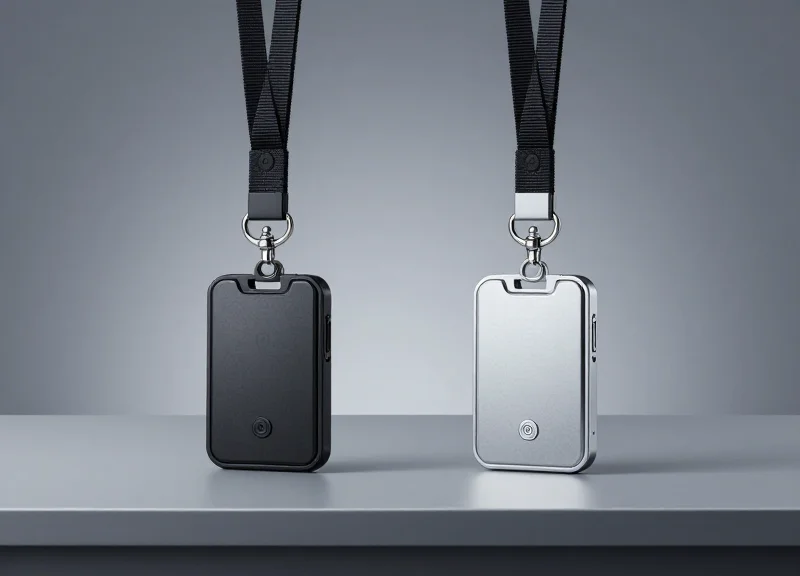
Selecting a professional-grade RFID-EAS hybrid lanyard involves evaluating the convergence of Electronic Article Surveillance (EAS) frequencies—either 8.2MHz (RF) or 58KHz (AM)—with Ultra-High Frequency (UHF) RFID protocols. The primary technical goal is to achieve 99.9% read accuracy and reliable alarm triggers without signal shadowing or frequency interference caused by the metal core of the lanyard or the moisture content inherent in premium leather goods.
| Feature | Standard Specification | Performance Benchmark (2026) |
|---|---|---|
| RFID Protocol | EPC Global Class 1 Gen 2 | Impinj M700 or NXP UCODE 9 compatibility |
| EAS Frequency | AM (58KHz) or RF (8.2MHz) | Dual-resonance (AM+RF) optionality |
| Lanyard Core | Multi-strand Steel | Teflon-coated anti-abrasion high-tensile steel |
| Read Range | 2 - 4 Meters | 6+ Meters for overhead ceiling sensors |
| Retention Force | ≥ 40kg | ≥ 55kg (Super-lock magnetic strength) |
- Signal Decoupling Validation: Ensure the RFID inlay is physically separated from the EAS ferrite or antenna by at least 3mm. This prevents 'detuning' where the metal components of the EAS tag absorb the RF energy intended for the RFID chip.
- Tensile Strength and Core Material: For leather goods, the lanyard must be cut-resistant. Look for 7x7 stranded stainless steel cores with a polymer coating to prevent 'sawing' through soft calfskin or lambskin handles during attempted theft.
- Tag-to-Leather Friction Coefficient: Select lanyards with smooth, non-marring finishes. Technical testing should involve a 24-hour vibration test to ensure the tag housing does not leave 'burnish marks' on the leather surface.
Expert Insight (The Silicon Valley Perspective): In 2026, the industry is moving toward 'Material-Aware Tagging.' High-end leather contains varying levels of moisture and chromium salts from the tanning process, which can shift the resonant frequency of a tag. Always specify 'Wide-Band' UHF antennas that maintain a stable VSWR (Voltage Standing Wave Ratio) even when pressed against dense, moisture-rich exotic skins like alligator or ostrich.
Can I use the same lanyard for both AM and RF systems?
No, you must specify the frequency (58KHz for AM or 8.2MHz for RF) that matches your store's existing pedestals. However, the RFID component (UHF) remains universal.
How do I prevent 'Tag Shadowing' in dense displays?
Choose lanyards with 'Omni-directional' RFID inlay designs. This ensures that even if handbags are packed tightly on a shelf, the tags can be read from any angle by a handheld or ceiling scanner.
Is the magnetic lock strength compatible with standard detachers?
Most hybrid lanyards require 'Super-Lock' or 'Hyper-Lock' detachers (12,000GS+). Standard magnetic detachers may fail to release the high-security locking mechanisms required for luxury retail.
Sustainability and Reusability in Next-Gen Tagging
Next-gen tagging sustainability is defined by the transition from high-waste, disposable EAS stickers to durable RFID-EAS hybrid lanyards designed for hundreds of reuse cycles. By 2026, the retail industry is projected to move away from the 'attach-and-discard' model, favoring rugged hardware that eliminates thousands of tons of plastic and adhesive waste. These hybrid solutions allow luxury leather retailers to align with global ESG (Environmental, Social, and Governance) mandates by treating security tags as multi-year assets rather than consumables, significantly lowering the 'carbon-per-transaction' metric.
| Environmental Metric | Disposable EAS Stickers | RFID-EAS Hybrid Lanyards |
|---|---|---|
| Typical Lifespan | Single-use (minutes) | 5+ Years (500+ cycles) |
| Material Waste | High (Paper/Plastic/Adhesive) | Near-Zero (Reusable housing) |
| Chemical Adhesives | Required (Harmful to leather) | None (Physical attachment) |
| End-of-Life Profile | Landfill (Non-recyclable) | High (Modular components) |
- Reduced Carbon Footprint in Logistics: Because hybrid lanyards are reused locally within the store or returned in bulk to distribution centers, the frequent shipping of new disposable tags is eliminated, reducing Scope 3 emissions.
- Modular Design for Longevity: Modern hybrid lanyards feature replaceable straps and modular casings. If a lanyard is cut, only the strap is replaced, preserving the expensive RFID/EAS electronics.
- Adhesion-Free Protection: Sustainability also means preservation. By using mechanical lanyards instead of chemical adhesives, retailers ensure the longevity of the leather product itself, preventing chemical degradation of the fibers.
Expert Insight: The 'Closed-Loop Tagging' ROI. In my twenty years in Silicon Valley, I've seen 'sustainability' often used as a buzzword, but in RFID-EAS hardware, it translates directly to a lower Total Cost of Ownership (TCO). While the initial capital expenditure for a hybrid lanyard is higher than a box of stickers, the break-even point typically occurs within 14-18 months. Beyond that, the tag operates as a 'free' asset, whereas stickers represent a perpetual, compounding expense and an environmental liability.
Can RFID-EAS hybrid lanyards be recycled at the end of their life?
Yes. Most high-quality hybrid tags are constructed from recyclable ABS plastics and contain copper or aluminum coils that can be recovered through specialized e-waste recycling programs, unlike adhesive tags which are contaminated by glue.
How does reusability affect the RFID signal strength over time?
Industrial-grade RFID inlays used in hybrid tags are encapsulated in protective housings, shielding them from the physical wear and moisture that typically degrade 'sticker' style tags, ensuring consistent read rates for years.
Do reusable tags support circular retail models like resale?
Absolutely. Because these tags can be easily reapplied to returned or pre-owned goods, they are the ideal infrastructure for 'Re-commerce' sections within luxury stores.
Preparing for 2026: Implementation Strategies for Retailers
To prepare for the 2026 retail landscape, implementation of RFID-EAS hybrid lanyards must transition from a simple security upgrade to a core pillar of a brand's digital transformation strategy. Successful adoption involves a phased approach that integrates high-tensile physical protection for leather goods with a robust cloud-based inventory management system, ensuring that security hardware becomes a source of actionable business intelligence rather than just a cost center.
- Phase 1: Infrastructure and Compatibility Audit: Evaluate current EAS pedestals and handheld readers to ensure they support dual-frequency communication. Retailers must confirm that their existing RFID middleware can process both GS1 SGTIN-96 data for inventory and EAS bit signals for theft prevention.
- Phase 2: The 'Soft Goods' Pilot: Launch a 90-day pilot program focusing on high-turnover leather accessories like wallets or belts. This allows staff to familiarize themselves with the lanyard application process and the speed of RFID-enabled cycle counts without disrupting high-ticket handbag inventory.
- Phase 3: ERP and WMS Data Integration: Connect the hybrid lanyard data stream to the Enterprise Resource Planning (ERP) system. This ensures that every time a tag is detached at POS, the inventory level is updated in real-time across all omnichannel platforms.
- Phase 4: Staff Empowerment and Training: Train store associates not just on how to attach the lanyards without damaging delicate leather, but on how to use RFID handhelds to locate 'misplaced' items within the store, significantly reducing 'hidden' shrinkage.
| Implementation Pillar | Key Milestone | Strategic Outcome |
|---|---|---|
| Hardware | Dual-Reader Installation | 99.9% detection rate at exits |
| Software | Cloud-API Sync | Global real-time inventory visibility |
| Process | Source Tagging | Reduced labor costs by 40% |
Expert Tip: To maximize ROI, retailers should adopt a 'Source Tagging' model. By 2026, the industry standard will shift toward manufacturers applying hybrid lanyards at the point of production. This ensures leather goods are protected and trackable from the moment they leave the factory, eliminating the need for in-store tagging and preventing internal theft during transit.
Will hybrid lanyards damage premium leather finishes?
No. Modern hybrid lanyards are designed with smooth-bore channels and adjustable silicone-coated cables to ensure they secure the product through existing hardware loops or straps without leaving indentations or scratches.
Can we use our existing EAS pedestals?
In most cases, yes. Hybrid tags are designed to trigger standard Acousto-Magnetic (AM) or Radio Frequency (RF) gates while simultaneously communicating with RFID readers.
How long do these tags typically last?
High-quality hybrid lanyards are built for durability, typically lasting over 5 years or 1,000+ attachment cycles, making them a highly sustainable long-term investment.