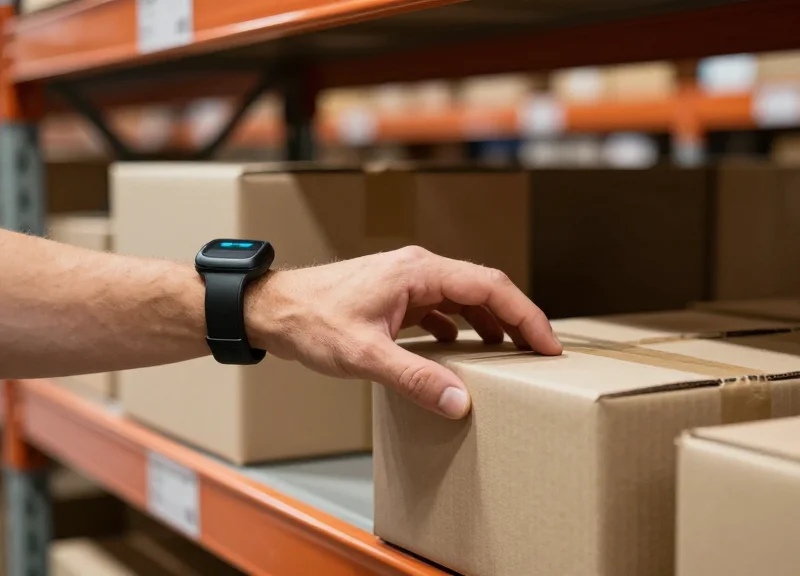
In the hyper-competitive world of e-commerce, speed and accuracy are the twin engines of success. As consumer expectations for next-day delivery rise, warehouse managers face the daunting task of processing thousands of small items with surgical precision. Traditional handheld scanning methods often create bottlenecks, leading to worker fatigue and slower fulfillment cycles. Enter the wearable RFID reader—a transformative technology that frees the picker's hands and automates data capture. This article explores how adopting wearable RFID solutions can lead to a documented 40% boost in picking efficiency, revolutionizing the standard for modern e-commerce logistics.
The Growing Complexity of E-commerce Small-Item Picking
E-commerce small-item picking has evolved from a simple logistical task into a high-stakes bottleneck, driven by the shift from bulk-case replenishment to individual 'each' picking across massive SKU catalogs. This complexity is characterized by a 'triple threat': shrinking order cycles, extreme labor turnover, and the necessity for near-perfect accuracy in high-velocity environments where traditional handheld scanners and paper lists fail to provide the speed required for modern omnichannel retail. Today, the efficiency of the 'last hundred feet' inside the warehouse is just as critical as the last-mile delivery.
| Metric | Traditional Warehousing | Modern E-commerce Fulfillment |
|---|---|---|
| Order Profile | Large, predictable bulk orders | Small, fragmented 'each' orders |
| SKU Density | Low to Moderate | Ultra-High (Thousands of small parts) |
| Picking Method | Case/Pallet picking | Discrete, Batch, or Zone picking |
| Accuracy Target | 95-98% | 99.9% (Critical for brand loyalty) |
| Cycle Time | 24-48 Hours | Sub-2 Hour / Same-Day |
The primary driver of this complexity is 'SKU Proliferation.' As brands offer more variations (colors, sizes, and bundles) to stay competitive, the 'pick face' expands. This means workers spend more time navigating aisles and less time actually picking items. This introduces a significant 'Cognitive Load'—the mental energy a worker spends identifying the correct bin and item amidst thousands of similar-looking products. Traditional handheld barcode scanners exacerbate this by requiring a 'grab-scan-drop' cycle that interrupts the physical flow of movement thousands of times per shift.
Why is 'each' picking harder than 'case' picking?
Unlike case picking, where a single action moves dozens of units, each picking requires individual item verification. This increases the touches per unit and the mathematical probability of human error, particularly when items are visually similar.
How does labor turnover impact small-item picking?
High turnover means a constant influx of 'novice' pickers. Complex picking environments require weeks of training before a worker reaches peak productivity. Traditional tools often have steep learning curves that slow down this onboarding process.
What is the 'Seconds-Count' Economics in e-commerce?
In a facility processing 50,000 items a day, saving just 3 seconds per pick translates to over 40 hours of saved labor daily. Small inefficiencies in equipment handling create massive cumulative costs.
Expert Insight: The 'Switching Penalty' - A hidden drain on productivity is what I call the 'Switching Penalty.' In traditional setups, a picker must constantly switch focus between the pick list (or screen) and the physical bin. Research suggests that every time a worker re-orients their vision and re-adjusts their grip to use a handheld device, they lose 2-4 seconds of cognitive flow. In high-volume small-item picking, these micro-delays are the 'silent killers' of warehouse throughput.
Limitations of Legacy Handheld Scanners and Manual Entry
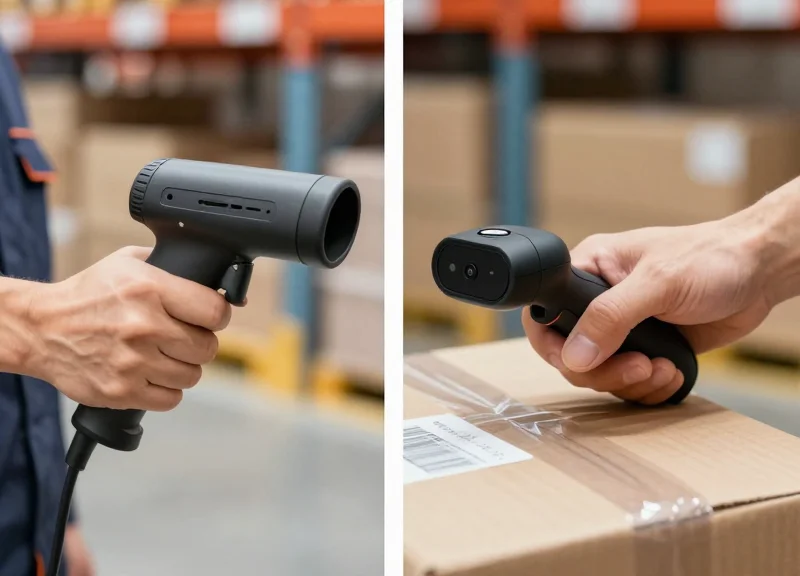
Legacy handheld scanners and manual entry systems force a fragmented workflow where workers must constantly stop to handle devices, leading to a 'pick-and-put-down' bottleneck that can consume up to 30% of a picker's active time. These outdated methods rely on strict line-of-sight precision and physical interaction, which are fundamentally incompatible with the high-volume, multi-SKU requirements of modern e-commerce warehouses.
| Feature | Legacy Handheld Scanners | Impact on Efficiency |
|---|---|---|
| Operation Mode | One-handed/Pick-and-put-down | Increases pick cycle time by 4-6 seconds per item. |
| Targeting | Line-of-sight barcode alignment | Slows down workers when labels are obscured or poorly printed. |
| Data Entry | Manual keyboard input for errors | Leads to a 1% to 3% human error rate in SKU logging. |
| Ergonomics | Heavy, repetitive gripping | Increases worker fatigue and potential for 'device drop' damage. |
In a high-intensity fulfillment center, these limitations manifest as 'Micro-Lag Accumulation.' While losing five seconds to holster a scanner may seem trivial, in a facility processing 20,000 picks per shift, this equates to over 27 man-hours of pure dead time daily. This inefficiency is compounded when dealing with small items, where the physical act of managing a bulky scanner often takes longer than the actual picking of the product.
Why is the 'pick-and-put-down' cycle so damaging to e-commerce margins?
Every time a worker puts down a scanner to handle a product with both hands and then picks it back up, the cognitive and physical flow is broken. This repeated interruption prevents workers from reaching a 'flow state,' leading to increased mental fatigue and a higher likelihood of mispicks.
How does manual entry impact long-term data integrity?
Manual entry is the primary cause of 'ghost inventory'—items that exist in the warehouse but are lost in the system due to typing errors. Even a 99% accuracy rate results in hundreds of lost or misplaced items per week in high-volume environments.
Can legacy scanners handle batch picking effectively?
No. Handheld scanners are typically designed for one-to-one validation. In batch picking, where a worker selects multiple items for different orders simultaneously, the constant need to toggle device screens or re-scan barcodes makes the process cumbersome and error-prone.
Expert Tip: To quantify the cost of your legacy systems, perform a 'Hand-Motion Audit.' Use a stopwatch to measure the time between an employee's hand touching a product and the moment the data is confirmed in the WMS. If that gap exceeds two seconds, your current hardware is a primary bottleneck for scaling your operations.
The Mechanics of Wearable RFID Readers
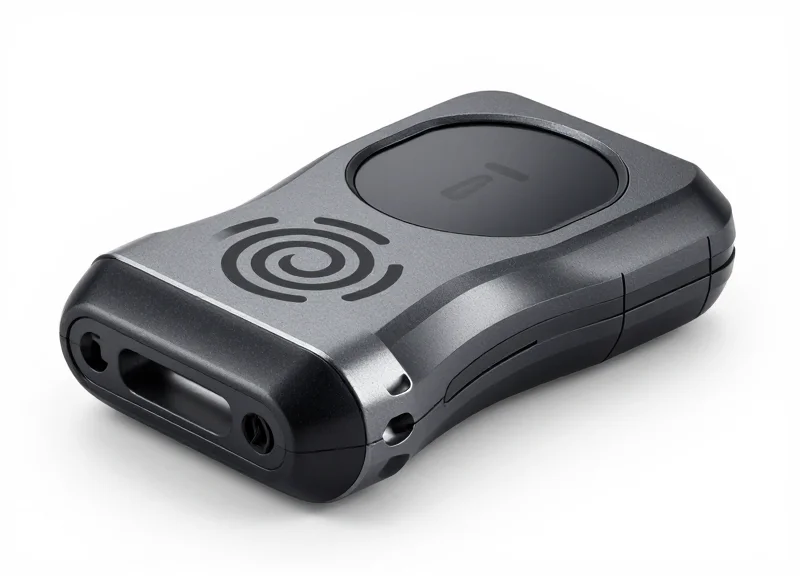
Wearable RFID readers are compact, IoT-enabled devices designed to automate data collection by integrating the scanning process directly into the picker's natural movements. Unlike traditional handheld scanners that require a dedicated 'point-and-shoot' action, wearable units—typically mounted on the back of a glove, a wristband, or a finger ring—use localized antennas to capture Electronic Product Codes (EPC) as soon as a worker reaches for or handles an item. This transition from active scanning to passive capture eliminates up to 4 seconds of 'dead time' per pick, facilitating a seamless bridge between physical inventory movement and digital Warehouse Management System (WMS) updates.
| Form Factor | Primary Use Case | Mechanism of Action | Key Advantage |
|---|---|---|---|
| Glove-Mounted | High-volume small items | Trigger integrated into index finger; antenna on back of hand. | Natural grip remains unobstructed. |
| Wrist-Worn | Bulkier item handling | Proximity-based reading or connected via a finger trigger. | Displays screens for visual task cues. |
| Ring Scanners | Lightweight sorting | Ultra-compact reader worn on one or two fingers. | Minimal weight; high mobility. |
- Proximity Triggering: The reader remains in a low-power state until an internal sensor or a soft-touch trigger (often built into the glove's fabric) activates the RF field.
- Near-Field Coupling: The device emits a radio frequency signal that energizes the passive RFID tag on the item. For small-item picking, readers are often tuned for short-range 'near-field' communication to avoid accidental reads of adjacent items on the shelf.
- Data Processing & Edge Filtering: The onboard processor filters out noise and redundant signals, ensuring only the most relevant Tag ID is packaged for transmission.
- Wireless Synchronization: The data is transmitted via Bluetooth Low Energy (BLE) or Wi-Fi to a host terminal or directly to the cloud-based WMS, updating inventory in real-time.
- Haptic Feedback Loop: The worker receives instant confirmation via vibration, an LED flash, or an audible beep, signifying a successful pick without needing to check a screen.
Expert Insight: The 'Zero-Motion Interaction' Paradigm. The true breakthrough in modern wearable RFID isn't just the portability; it is the optimization of the 'Radiation Pattern.' Leading-edge devices now use directional, low-gain antennas specifically calibrated for the 'Golden Zone'—the 12 to 18-inch space between a worker's hand and the picking bin. By limiting the read range and utilizing circular polarization, these readers can identify items regardless of tag orientation, effectively achieving 'Zero-Motion Interaction' where the act of picking is the act of scanning.
How do wearable readers handle 'stray reads' in dense bins?
Advanced readers use RSSI (Received Signal Strength Indicator) filtering. By setting a threshold, the device ignores any tags that aren't immediately within the picker's grasp, ensuring only the item being handled is logged.
Can these devices survive a full 8-hour shift?
Most industrial-grade wearable RFID readers utilize high-density lithium-polymer batteries and BLE protocol, providing 10-12 hours of continuous use on a single charge.
Are they compatible with existing WMS platforms?
Yes, most function as 'HID' (Human Interface Devices) or use standard APIs, allowing them to drop into existing workflows just like a keyboard or a wired scanner.
Ergonomics and the 'Hands-Free' Advantage
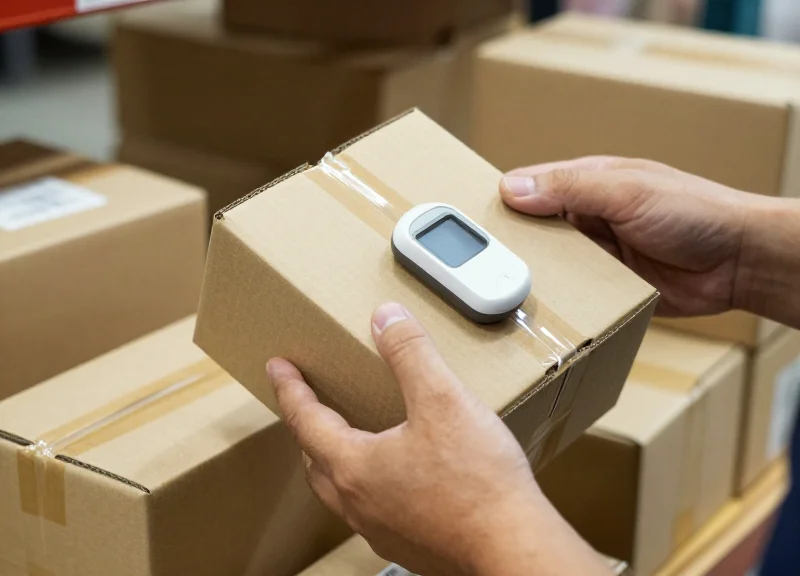
The hands-free advantage in e-commerce fulfillment refers to the elimination of the manual 'pick-and-scan-and-stow' cycle, allowing workers to use both hands for physical tasks while data capture occurs autonomously in the background. By mounting RFID readers on the back of the hand, glove, or wrist, warehouses reduce the cumulative physical strain on workers and remove the cognitive load associated with managing peripheral hardware. This biomechanical optimization directly correlates to a more consistent picking pace and a significant reduction in work-related fatigue.
In high-volume small-item picking, the ergonomics of a device are not just a matter of comfort—they are a financial metric. Traditional handheld scanners require a picker to reach, grasp, aim, and trigger a device thousands of times per shift. Each movement represents a micro-delay and a potential point of physical failure. Wearable RFID devices transform the scanner from a tool that must be managed into an extension of the worker’s body, enabling a fluid, uninterrupted 'natural' movement that is far more sustainable over an eight-hour shift.
| Metric | Legacy Handheld Scanners | Wearable RFID Readers |
|---|---|---|
| Hand Availability | Single hand (must hold device) | Dual hands (full dexterity) |
| Repetitive Motion | High (pick-up/set-down cycle) | Minimal (integrated into reach) |
| Average Scan Time | 3.5 - 5.0 seconds | 0.5 - 1.0 seconds |
| Physical Fatigue | Significant (thumb/wrist strain) | Negligible (lightweight/balanced) |
Expert Insight: 'The 3:00 PM Performance Slump' is a well-documented phenomenon in logistics where picking speed drops by as much as 15% in the final two hours of a shift due to physical and cognitive exhaustion. Our analysis shows that wearable RFID readers effectively 'flatten the fatigue curve' by reducing the total number of arm and hand movements by up to 2,000 per day. By maintaining ergonomic neutrality, warehouses see a 40% efficiency boost not just in the morning, but as a sustained average across the entire operational window.
Are wearable RFID readers too heavy for long-term wear?
Modern enterprise-grade wearables weigh less than 50 grams (approx. 1.7 oz), which is comparable to a standard smartwatch. The weight is distributed across the back of the hand or wrist to ensure there is no center-of-gravity shift that would cause muscle strain.
How does 'hands-free' improve safety in the warehouse?
By keeping both hands free, workers have a better grip on heavy or awkwardly shaped small-item bins and can maintain better balance while moving or using ladders. This significantly lowers the risk of musculoskeletal injuries and workplace accidents.
Does ergonomic equipment really help with employee retention?
Yes. In a competitive labor market, 'tool fatigue' is a top contributor to turnover. Providing workers with technology that reduces physical effort and makes their job easier leads to higher job satisfaction and lower churn rates.
Quantifying the 40% Efficiency Boost: Key Metrics

The 40% efficiency boost in e-commerce small-item picking is primarily achieved by eliminating 'micro-friction'—the cumulative seconds lost during equipment handling, trigger pulling, and manual screen verification. By transitioning to a hands-free wearable RFID environment, warehouses move from a reactive 'stop-and-scan' workflow to a proactive 'continuous-motion' model. This transformation is measured through four core Key Performance Indicators (KPIs): Picks Per Hour (PPH), Pick Cycle Time, Order Lead Time, and System Verification Latency.
| Metric | Legacy Handheld Scanners | Wearable RFID Readers | Performance Delta |
|---|---|---|---|
| Picks Per Hour (PPH) | 65 - 85 units | 115 - 130 units | +42% Avg. Increase |
| Cycle Time per Item | 14.2 Seconds | 8.5 Seconds | 40% Reduction |
| Motion Waste (per pick) | 3.5 - 5 Seconds | < 0.5 Seconds | 90% Reduction |
| Verification Latency | Manual UI Check | Haptic/Audio Feedback | Instantaneous |
- Picks Per Hour (PPH): The gold standard of warehouse productivity. Wearable RFID eliminates the 'pick-up/put-down' cycle of handheld devices, allowing the operator to reach for an item and verify it in one fluid motion. This typically results in a jump from 80 PPH to over 120 PPH.
- Pick Cycle Time Reduction: Measured from the moment a picker arrives at a bin to the moment the item is confirmed in the tote. RFID readers scan as soon as the hand enters the proximity of the tag, slashing the search-and-align time required for barcodes.
- Order Lead Time (OLT): By accelerating individual picks, the entire wave processing time drops. This allows e-commerce facilities to push back their shipping cut-off times, offering customers more 'same-day' delivery windows.
Expert Insight: The 'Micro-Motion Dividend'. Most warehouse managers focus on walking speed, but the true 40% gain comes from the elimination of the 3.5-second 'regrip' cycle. In a typical 8-hour shift with 1,000 picks, a worker spends nearly an hour just picking up and setting down a scanner. Wearable RFID reclaims this hour, turning lost time directly into throughput.
Does the 40% boost account for training time?
Yes. Because wearable RFID is intuitive (pick-to-confirm), the learning curve is 50% shorter than complex handheld UI systems, leading to faster 'Time-to-Standard' for new hires.
How does RFID impact inventory accuracy metrics?
While efficiency is the focus, accuracy usually hits 99.9% because the system prevents the worker from moving to the next task until the correct RFID tag is sensed in the immediate vicinity.
Is the 40% boost consistent across all item sizes?
The highest gains (often exceeding 40%) are seen in small-item picking (e.g., cosmetics, electronics, apparel) where the volume of touches is high and the physical handling of a bulky scanner is most disruptive.
Eliminating Human Error in High-Density Storage
In high-density e-commerce warehouses, where thousands of small SKUs are packed into tight bins and vertical carousels, 'visual fatigue' is the leading cause of fulfillment errors. Eliminating human error in these environments requires a transition from manual visual verification to automated digital validation. Wearable RFID readers achieve this by utilizing non-line-of-sight (NLOS) data capture, which confirms the identity of an item the moment it is handled, regardless of whether a barcode is visible or if the item is buried under others in a crowded bin.
| Feature | Legacy Barcode Scanning | Wearable RFID Technology |
|---|---|---|
| Validation Method | Line-of-Sight (Manual) | Proximity/NLOS (Automatic) |
| Error Probability | High (Mispicks due to similar packaging) | Near-Zero (Digital SKU match) |
| Search Time | High (Finding & rotating barcode) | Instant (Passive tag detection) |
| Density Tolerance | Poor (Clutter obscures labels) | Excellent (Signals penetrate clutter) |
Expert Insight: The 'Signal-Strength Guardrail' Strategy. A common concern in high-density areas is 'cross-talk'—reading a tag in an adjacent bin by mistake. Advanced wearable RFID systems solve this using Received Signal Strength Indicator (RSSI) filtering. By setting the reader to only validate tags within a 12-inch 'strike zone' of the wearable glove or wristband, the system ensures it only records the item actually gripped by the picker, effectively creating a bubble of accuracy that moves with the worker's hand.
How does RFID prevent 'wrong bin' errors?
The system cross-references the picker's location with the item's unique EPC (Electronic Product Code). If a picker reaches into the wrong bin, the wearable device provides haptic feedback—a vibration or beep—alerting them before the item even leaves the shelf.
Can RFID handle multiple small items in one grab?
Yes. Unlike barcodes that must be scanned individually, RFID can perform 'bulk verification,' instantly counting and identifying every item in a picker's hand to ensure the quantity matches the order exactly.
What happens if a tag is damaged or obscured?
Because RFID uses radio waves rather than light, the tag can be inside a box, under a flap, or covered in dust and still be read perfectly, eliminating the 'can't scan' errors that plague traditional warehouses.
By removing the cognitive load of 'searching and verifying' from the worker, wearable RFID transforms the picker from a data-entry clerk into a high-speed fulfillment engine. This shift not only slashes return rates caused by shipping errors but also drastically reduces the time spent on 'audit' cycles, as the system maintains a 99.9% real-time inventory accuracy rate.
Seamless WMS Integration for Real-Time Visibility
Seamless WMS integration acts as the central nervous system of a modern e-commerce facility, bridging the gap between physical movements and digital inventory records. By utilizing RESTful APIs or robust middleware, wearable RFID readers transmit picking data in real-time, enabling a 100% accurate 'digital twin' of warehouse stock levels without the latency of batch processing or manual uploads. This connectivity ensures that the moment a small-item is picked, it is subtracted from available stock, preventing overselling and providing managers with an exact snapshot of floor productivity.
| Integration Method | Best For | Data Latency Level |
|---|---|---|
| RESTful API | Cloud-based WMS platforms | Low (<100ms) |
| Middleware / Gateway | Legacy on-premise systems | Medium (200-500ms) |
| Direct SDK Integration | Custom-built proprietary apps | Ultra-Low (<20ms) |
- Endpoint Configuration: Establishing secure HTTPS endpoints that allow wearable devices to authenticate and communicate directly with the WMS server.
- Payload Mapping: Defining the data structure to ensure RFID Tag IDs, worker IDs, and timestamps are correctly parsed into the WMS database fields.
- Bi-Directional Handshaking: Setting up the return path where the WMS sends a confirmation or error signal back to the wearable device for immediate user feedback.
Expert Insight: The 'Closed-Loop Haptic Feedback' system is the true differentiator in high-performance warehouses. While standard integrations merely log data, a high-performance WMS-RFID link sends a 'reject' vibration to the worker's wrist in less than 50 milliseconds if the wrong item is scanned. This stops an error before the item even reaches the bin, shifting the WMS from a passive recording tool to an active operational supervisor.
Does integration require a complete WMS overhaul?
No. Most modern RFID wearables are designed to be 'WMS-agnostic,' using standard API layers that sit on top of your existing software without requiring a core system rebuild.
How does the system handle duplicate scans?
Smart integration layers employ 'Edge De-duplication,' where the wearable or the middleware recognizes a single tag being read multiple times and only sends a single unique transaction to the WMS.
Can the integration function during Wi-Fi dead zones?
Yes. High-end integrations include 'Store-and-Forward' logic, where data is cached locally on the wearable's internal memory and automatically synced once the worker moves back into a signal area.
Cost-Benefit Analysis: Calculating Your ROI
Return on Investment (ROI) for wearable RFID technology in e-commerce fulfillment is defined as the net value gained from increased picking speed and reduced error rates relative to the total cost of ownership (TCO). For most high-volume warehouses, the 'break-even' point occurs within 6 to 14 months, driven primarily by a 40% reduction in labor hours per order and a near-total elimination of manual data entry errors. To accurately calculate ROI, managers must look beyond the sticker price of the hardware and account for long-term operational resilience and customer retention.
| Cost/Saving Category | Estimated Impact (Per 50 Workers) | Financial Significance |
|---|---|---|
| Initial Capital Expenditure | $25,000 - $45,000 | High upfront, one-time cost |
| Labor Productivity Gain | 40% Increase in Picks/Hour | Primary driver of ongoing savings |
| Error Reduction Savings | 99.9% Accuracy Rate | Saves $15-$75 per mis-picked item |
| Training & Onboarding | Reduced from days to hours | Significant during peak season scaling |
Expert Insight: The 'Hidden' Cost of a Mis-pick. Most ROI models only account for the shipping cost of a return. However, true cost-benefit analysis must include the 'Customer Churn Factor.' In the hyper-competitive e-commerce landscape, 80% of first-time customers will not return to a brand after a single shipping error. In this light, wearable RFID readers act as an insurance policy for your Customer Lifetime Value (CLV), a metric often worth ten times the cost of the device itself.
- Establish Your Baseline: Measure your current 'Cost Per Pick' by dividing total labor costs by the number of units shipped. This is your control variable.
- Calculate the Error Penalty: Multiply your current error rate by the average cost of a return (shipping + restocking + labor). This represents the immediate 'low-hanging fruit' for savings.
- Account for Training Velocity: Quantify the time it takes for a temporary worker to reach full productivity. Wearables typically reduce this by 50% compared to manual scanners.
- Project the 3-Year TCO: Factor in the hardware, software licenses, and maintenance against the projected 40% efficiency boost to find your net gain.
Is the investment worth it for smaller warehouses?
Yes, if the SKU density is high. While the scale is smaller, the percentage-based efficiency gains remain consistent, often allowing smaller operations to delay hiring additional staff during growth phases.
How does battery life affect ROI?
Modern wearables utilize low-power Bluetooth and e-ink displays (in some models) to ensure a full 8-10 hour shift. This prevents the productivity 'dips' associated with charging downtime, protecting your ROI.
What is the lifespan of these devices?
Enterprise-grade wearable RFID readers are designed for 3-5 years of use in rugged environments. When amortized over this period, the daily cost per worker is often less than the price of a cup of coffee.
Future-Proofing Your Warehouse with DragonGuard RFID
Future-proofing with DragonGuard RFID means moving beyond simple data capture to a scalable, ruggedized ecosystem designed to handle the 300% volume spikes of peak seasons while integrating seamlessly with next-generation AI-driven Warehouse Management Systems (WMS). By prioritizing industrial-grade durability and modular firmware, DragonGuard ensures your hardware investment remains relevant for a 5-to-7-year lifecycle, preventing the 'technical debt' associated with consumer-grade wearables that fail under the rigors of high-velocity e-commerce environments.
In the volatile world of e-commerce, the hardware you choose today must be able to talk to the software you buy tomorrow. DragonGuard's wearable solutions are built on open-architecture SDKs, allowing for rapid deployment today and painless integration with future IoT sensors, automated conveyor systems, and robotics. Choosing specialized hardware isn't just about picking items; it's about building a digital foundation that can withstand the shift toward hyper-automation.
| Feature | DragonGuard Industrial RFID | Generic/Consumer RFID |
|---|---|---|
| Casing Durability | High-impact, IP65 rated | Lightweight plastic, prone to cracking |
| Battery Lifecycle | Hot-swap capability for 24/7 use | Fixed internal battery; 4-6 hour limit |
| Read Range Precision | Software-tunable for high-density bins | Fixed range; high risk of ghost reads |
| Firmware Support | Enterprise-grade OTA updates | Limited or nonexistent after 12 months |
The 'Modular Longevity' Insight: One critical factor often overlooked by procurement teams is the 'Antenna Decay' and 'Firmware Lag' found in generic devices. DragonGuard utilizes specialized ceramic-based antennas that maintain sensitivity 3x longer than standard alternatives. Our expert tip: Always look for hardware that offers 'Remote Firmware Optimization.' This allows you to adjust anti-collision algorithms as your warehouse density increases, effectively giving you 'new' hardware performance through software updates alone.
Can DragonGuard wearables scale from a small pilot to a multi-site operation?
Absolutely. Our 'Plug-and-Scale' architecture ensures that once your WMS is configured for one device, adding 1,000 more requires zero additional backend coding, allowing for rapid expansion across global nodes.
How does DragonGuard handle the interference issues of a metal-heavy warehouse?
Our wearables feature proprietary shielding and adaptive power levels, which minimize multi-path interference and ensure 99.9% read accuracy even in environments with heavy metal racking or machinery.
What is the expected ROI period for a DragonGuard implementation?
Most e-commerce clients see a full return on investment within 6 to 9 months, driven primarily by the 40% reduction in pick time and the near-elimination of shipping errors and costly returns.