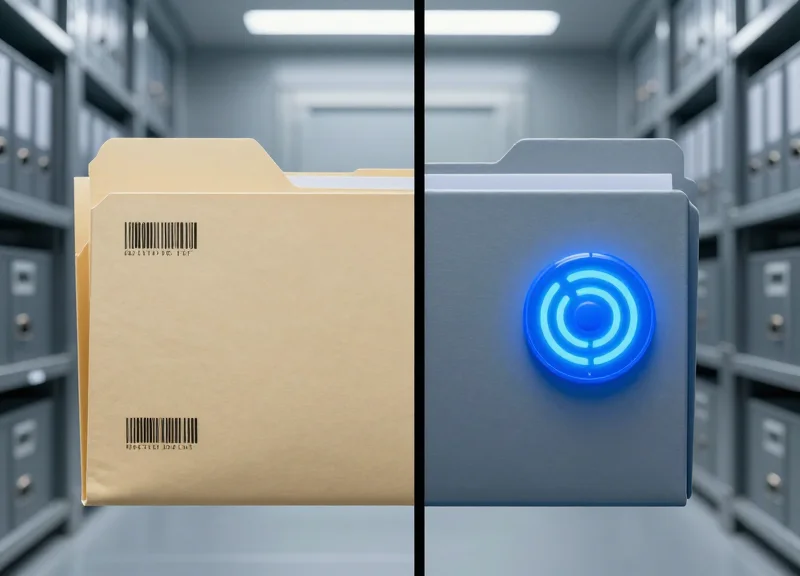
As we approach 2026, the financial sector is facing a critical transition in data management. While barcode technology has served as the backbone of record tracking for decades, its limitations in real-time visibility and manual labor intensity are becoming liabilities. For banks, where security and compliance are non-negotiable, the shift toward RFID-powered 'Smart Filing' is no longer a luxury—it is a mandatory upgrade. This article analyzes the fundamental differences between legacy barcode systems and next-generation RFID solutions, explaining why the latter is the only viable path for the high-stakes archiving environment of 2026.
The Evolution of Financial Archiving: From Barcodes to RFID
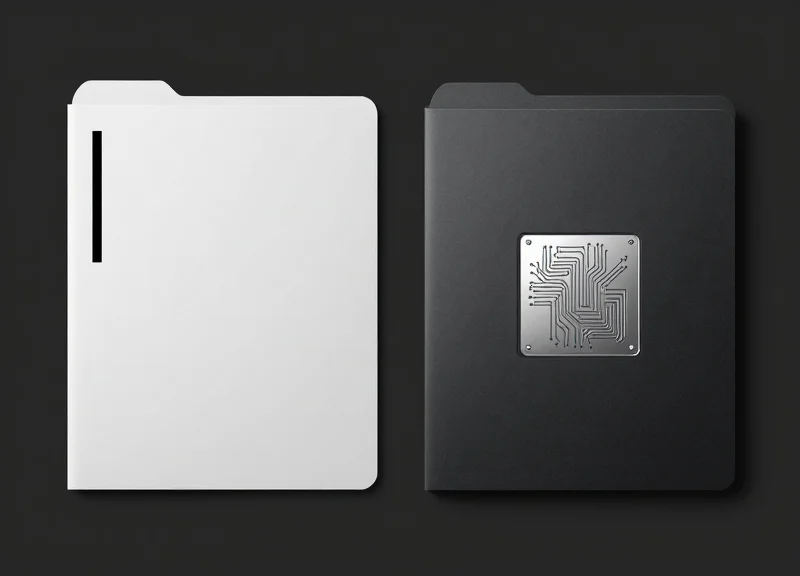
The evolution of financial archiving is characterized by a definitive shift from reactive, line-of-sight tracking using barcodes to proactive, automated data capture through Radio Frequency Identification (RFID). As we approach the 2026 compliance landscape, banks are moving away from manual filing systems toward 'Ambient Intelligence' environments where documents are tracked in real-time without human intervention. This transition is no longer a matter of convenience; it is a mandatory upgrade for institutions aiming to eliminate the 3-5% manual error rate inherent in legacy barcode systems.
| Feature | Legacy Barcodes | Next-Gen RFID (2026) | |||
|---|---|---|---|---|---|
| Scan Requirement | Line-of-sight required | No line-of-sight needed | |||
| Processing Speed | Individual (1-2 seconds per item) | Bulk (200+ items per second) | Data Integrity | Static; easily duplicated | Encrypted; unique chip ID |
| Automation Level | Manual labor dependent | Fully autonomous tracking | |||
| Audit Readiness | Point-in-time check | Real-time continuous audit |
Historically, barcodes served as the backbone of bank record management because of their low cost and simplicity. However, the '2026 Security Wall'—a term used by industry experts to describe the upcoming tightening of global financial data privacy regulations—exposes the barcode's fatal flaw: it requires a human to initiate a scan. In a high-security vault, if a document isn't scanned, it effectively doesn't exist to the digital system. RFID eliminates this 'dark data' by providing constant connectivity between the physical asset and the digital ledger.
Why is the shift happening specifically now?
New 2026 financial directives require 'Proof of Location' for physical sensitive data. Barcodes only show the last known location, whereas RFID provides live location status, satisfying stricter audit requirements.
Can RFID integrate with existing bank management software?
Yes. Modern RFID middleware acts as a bridge, translating tag data into standard formats that legacy ERP and document management systems (DMS) can process without a total software overhaul.
What is the 'Shadow Inventory' risk?
This is the unique insight for 2026: Barcode systems often suffer from 'Shadow Inventory,' where items are moved but not logged. RFID sensors at egress points trigger immediate alerts, preventing unauthorized document removal before it becomes a breach.
Unique Expert Insight: By 2026, the cost of a single misfiled document in the banking sector—including labor for manual searching and potential regulatory fines—is projected to exceed $1,200. RFID technology reduces the 'time-to-find' from hours to seconds, offering an ROI that typically offsets the initial hardware investment within the first 14 months of deployment.
Why 2026 is a Critical Deadline for Bank Compliance
2026 marks a regulatory tipping point where traditional barcode-based archiving fails to meet the strict Operational Resilience and Data Sovereignty requirements set by frameworks like DORA and updated Basel III protocols. To remain compliant, banks must transition to automated tracking systems like RFID that are capable of real-time inventory and instant audit verification without the manual scanning delays inherent in legacy systems. By 2026, the 'reasonable timeframe' for document retrieval during a high-stakes audit is expected to shrink from days to minutes, making manual barcode processes a significant liability.
The transition isn't just a technological upgrade; it is a response to the 'Digital-Physical Parity Gap.' For years, banks have fortified their digital perimeters while leaving physical archives managed by 1990s-era barcode technology. Regulators are now closing this loophole, demanding that physical document security mirrors the 'zero-trust' architecture used in IT departments. This means every file must have a persistent, trackable digital identity that can be queried remotely at any time.
| Compliance Metric | 2024 Legacy Standard (Barcode) | 2026 Modern Standard (RFID) |
|---|---|---|
| Audit Retrieval Speed | 24-48 Hours (Manual Search) | Sub-60 Seconds (Automated Query) |
| Inventory Accuracy | 85-92% (Human Error Risk) | 99.9% (Continuous Scanning) |
| Chain of Custody | Point-in-time (Last Scan) | Real-time (Active Presence) |
| Regulatory Focus | Storage Compliance | Operational Resilience |
How does DORA impact physical filing?
The Digital Operational Resilience Act (DORA) mandates that financial entities maintain high standards for all critical data. This includes physical documents that contain sensitive information, requiring banks to ensure these records are as resilient and retrievable as their digital backups.
Why are barcode systems considered a security risk in 2026?
Barcodes require manual line-of-sight interaction. This creates 'blind spots' between scans where files can be lost, stolen, or misplaced without an immediate alert. Next-gen RFID systems provide proactive monitoring, triggering alerts the moment a file moves without authorization.
What is the cost of non-compliance after 2026?
Beyond direct fines, banks face 'operational friction' costs. A failed audit due to slow document retrieval can trigger deeper investigations, reputational damage, and higher insurance premiums for professional liability.
Expert Insight: The 'Invisible Audit'—In the 2026 landscape, we anticipate the rise of remote regulatory queries. Regulators may soon request real-time snapshots of document inventory via secure APIs. RFID-enabled filing cabinets allow banks to provide this data instantly without sending a single staff member into the archive room. If your system requires a human to go 'find the file,' you are already behind the compliance curve.
Security Comparison: Line-of-Sight vs. Radio Frequency

The fundamental security gap between barcodes and RFID lies in the physical method of data capture: Barcodes require 'Line-of-Sight' (LoS) contact, meaning a human operator must physically align a scanner with a label. In contrast, RFID utilizes Radio Frequency (RF) waves to identify and track tags without direct visibility. For bank security in 2026, this shift represents the transition from manual, error-prone verification to automated, 'zero-touch' accountability where files are tracked even when hidden inside folders or locked boxes.
| Security Metric | Barcode (Line-of-Sight) | RFID (Radio Frequency) |
|---|---|---|
| Scanning Requirement | Direct visual alignment per item | No line-of-sight; proximity-based |
| Human Error Factor | High: Scanning can be skipped or missed | Minimal: Automated bulk scanning |
| Verification Speed | 1 item every 2-3 seconds | Up to 1,000 items per second |
| Audit Integrity | Reactive: Relies on manual logs | Proactive: Real-time location tracking |
| Security Barriers | Label must be clean and visible | Reads through paper, plastic, and dust |
In a high-stakes banking environment, the 'Line-of-Sight' requirement of barcodes is a structural vulnerability. If a sensitive loan document is misfiled behind another folder, a barcode scanner will never find it without a human manually searching every shelf. This leads to the 'Shadow File' problem—documents that exist in your database but are physically missing from their assigned location. RFID eliminates this by allowing auditors to wave a handheld scanner across a room to detect every single RF tag, identifying 'lost' files in seconds through thick archival boxes.
How does RFID prevent 'Ghost Files' in bank audits?
Ghost files occur when a barcode is scanned into a location, but the file is later moved without a scan. RFID's radio frequency allows for 'Zone Monitoring,' where fixed overhead readers detect the movement of tags in real-time, updating the audit trail without human intervention.
Is radio frequency safe for sensitive magnetic media?
Yes, modern Passive RFID tags operate at frequencies (UHF) that do not interfere with magnetic stripes on credit cards or older backup tapes, making them safe for comprehensive bank archival use.
Can RFID tags be replicated as easily as barcodes?
No. While barcodes can be photocopied and spoofed, RFID tags contain unique serialized chips with encrypted IDs and 'kill' features, making them significantly harder to counterfeit for unauthorized document access.
Unique Expert Insight: The 2026 security mandate is moving toward 'Continuous Custody.' Traditional barcodes only provide a 'Snapshot Audit'—you only know where the file was the last time someone bothered to scan it. RFID enables a 'Live Ledger' approach. By installing RF portals at archive exits, a bank can trigger immediate alarms if a high-security document leaves the room, a feat impossible with passive line-of-sight technology. This transition effectively moves security from a reactive discovery process to a proactive prevention model.
Operational Efficiency: Transforming Days into Minutes
Operational efficiency in 2026 banking isn't just about speed; it's about the radical elimination of manual labor in the archival process. While barcode systems require a line-of-sight, one-by-one scan for every box and folder, RFID (Radio Frequency Identification) enables 'bulk scanning' where thousands of records are captured simultaneously without ever opening a filing cabinet. This shift transforms a multi-day audit into a task that takes less time than a coffee break, effectively reducing labor costs by up to 90% while ensuring 99.9% data accuracy.
| Metric | Legacy Barcode Systems | Next-Gen RFID Systems |
|---|---|---|
| Inventory Speed | 50-100 items per hour | 15,000+ items per hour |
| Line of Sight | Required (Manual) | Not Required (Automated) |
| Search Time | Average 15-30 mins/file | Real-time (Geiger-counter mode) |
| Labor Requirement | 2-4 Full-time Employees | 1 Employee (Part-time) |
Expert Insight: The End of 'Shadow Inventory'. Traditional banking archives often suffer from 'shadow inventory'—files that are technically in the system but physically misplaced. In a barcode environment, these files remain 'lost' until a manual audit happens, which might be yearly. With RFID, banks can perform 'Weekly Virtual Audits.' By walking through the vault with a handheld reader, an employee can verify every single asset in the room without touching a shelf, ensuring that missing documents are flagged within days, not months.
- Proximity-Based Bulk Capture: The RFID reader emits a signal that wakes up all tags within range (up to 30 feet), allowing for the instantaneous identification of entire archive rows.
- Automated Delta Reporting: Software immediately compares the 'live scan' against the database, highlighting missing items or those stored in the wrong sub-section.
- Geiger-Counter Search: To retrieve a specific file, the system uses signal strength to guide the user directly to the folder's physical location, even if it is buried deep within a stack.
Does RFID interfere with other bank security systems?
No. Modern passive RFID systems operate on regulated UHF bands (860-960 MHz) that are specifically designed to coexist with Wi-Fi, cellular, and standard bank security frequencies without interference.
How much training is required for staff to operate smart filing?
Minimal. Because the system removes the need for precision scanning, a typical warehouse or vault clerk can be trained in less than two hours to operate the handheld and mobile software.
Can RFID read files through metal cabinets?
High-density banking cabinets can dampen signals, but specialized 'On-Metal' tags and strategically placed gateway readers ensure that signals penetrate or diffract sufficiently for 100% read rates.
Real-Time Tracking and Unauthorized Removal Alerts

Real-time tracking in bank archives refers to the continuous, automated monitoring of physical document locations using RFID (Radio Frequency Identification) sensors and portals. Unlike legacy barcode systems that depend on manual 'point-in-time' scans, RFID-enabled filing creates a 'Digital Perimeter' around sensitive records. This system utilizes fixed readers at exits, entryways, and key zones to establish a persistent digital handshake with every folder, ensuring that if a document moves without authorization, the system triggers an immediate alert via email, SMS, or integrated security dashboards.
For banking institutions facing the 2026 compliance landscape, the ability to prevent a data breach before it concludes is the ultimate security goal. Barcodes are 'reactive'—you only know a file is missing when you fail to find it during a manual audit. RFID is 'proactive,' identifying a potential breach at the exact moment a file crosses a threshold. This 'Geofencing' of physical assets ensures that document custody is never a mystery, providing a level of forensic auditability that manual systems simply cannot match.
| Security Metric | Barcode System (Manual) | Next-Gen RFID (Automated) |
|---|---|---|
| Detection Timeline | Weeks/Months (During next audit) | Milliseconds (Instant alert) |
| Theft Deterrence | Low (Passive labels only) | High (Alarmed portals and sirens) |
| Movement Logging | Incomplete (Relies on human scan) | 100% (Auto-logs every zone transition) |
| Personnel Required | High (Dedicated audit teams) | Zero (System is autonomous) |
What happens when a 'Restricted' file leaves the vault?
The RFID portal detects the tag ID, checks its status against the central database, and if unauthorized, triggers a lockdown or notifies security personnel instantly with the file name and the identity of the badge holder moving it.
Can RFID track files within specific rooms?
Yes. By installing overhead 'Zonal' readers, banks can see which desk or shelf a folder is currently located on in real-time, reducing 'lost' file searches to seconds.
Is the system compatible with existing bank security software?
Most modern RFID middleware uses standard APIs (REST/JSON) to feed location data directly into existing ERP or Security Management Systems (SMS).
Unique Expert Insight: The 'Silent Breach' Gap. In my two decades of infrastructure security, the most dangerous vulnerability I’ve seen is the 'Silent Breach'—where a physical document is removed and replaced with a blank folder or simply left missing for months. RFID eliminates this gap by moving from a 'periodic inventory' model to a 'state-change' model. In 2026, regulators will likely view any delay in identifying a missing physical record as a failure in internal controls; RFID is the only technology that offers a zero-latency response to document movement.
Integration and Interoperability with Modern Bank ERPs

Next-gen smart filing integration is the process of synchronizing physical document tracking data with core banking Enterprise Resource Planning (ERP) systems and Document Management Systems (DMS) through automated middleware. By utilizing RESTful APIs and Webhooks, RFID-enabled systems ensure that any physical interaction—such as a file being checked out or moved—is reflected instantly within the bank's digital 'Single Source of Truth.' This interoperability eliminates the data silos that previously existed between the physical archive and the digital record-keeping platform, creating a cohesive security ecosystem essential for 2026 compliance standards.
| Feature | Legacy Barcode Integration | Next-Gen RFID Interoperability |
|---|---|---|
| Data Update Trigger | Manual scan at a fixed workstation | Automatic detection via overhead/portal sensors |
| Sync Frequency | Batch processing (Daily/Weekly) | Real-time (Sub-millisecond latency) |
| ERP Connection | Custom flat-file exports | Native REST/SOAP API integration |
| Human Intervention | High (Requires manual data entry) | Zero (Automated background syncing) |
Expert Insight: To avoid 'Shadow Archives'—where your digital ledger says a file is in Storage A but it is physically in Office B—modern banks must adopt a 'Physical-to-Digital Twin' strategy. By 2026, the industry standard will shift from reactive logging to proactive synchronization. The unique advantage of RFID is its ability to perform 'Automatic Reconciliation Cycles.' Instead of yearly audits, the system can ping thousands of files every hour and cross-reference them with the ERP database, flagging discrepancies before they become compliance liabilities.
Will smart filing work with our existing legacy ERP?
Yes. Most next-gen systems use middleware layers that translate RFID tag data into standard formats compatible with legacy systems like COBOL-based kernels or older versions of Oracle, ensuring you don't need a total system overhaul.
How is data security maintained during the sync process?
Integration is typically handled via encrypted TLS 1.3 channels. Data payloads are signed and often tokenized, ensuring that sensitive document metadata is never exposed during the transit between the RFID reader and the ERP.
Does this require high bandwidth from the bank's network?
No. The data packets for individual file movements are extremely small (kilobytes). Even for high-volume archives, the bandwidth impact is negligible compared to standard banking transactions.
POST /api/v1/archive/sync
{
  "event_id": "RFID_99283",
  "asset_id": "DOC_2026_XYZ_001",
  "action": "CHECK_OUT",
  "location": "Vault_B_Gate_4",
  "authorized_by": "Employee_7782",
  "timestamp": "2026-10-12T14:30:05Z",
  "erp_sync_status": "PENDING"
}
The Hidden Costs of Sticking with Barcode Systems
The hidden costs of barcode systems refer to the cumulative financial burden of manual labor, regulatory non-compliance fines, and operational delays that arise from the 'line-of-sight' requirement of legacy tracking. While barcode labels are inexpensive at the point of purchase, their Total Cost of Ownership (TCO) in a high-security banking environment often exceeds RFID alternatives within 18 months due to the 'Human Error Factor' and the inability to conduct real-time, touchless audits.
| Cost Driver | Legacy Barcode Systems | Next-Gen RFID Systems |
|---|---|---|
| Audit Labor Cost | High: Requires manual scanning of every individual file folder. | Minimal: Automated bulk scanning of entire rooms in minutes. |
| Compliance Risk | High: Significant gaps between manual inventory checks. | Low: Continuous real-time monitoring and instant alerts. |
| Data Accuracy | 80-92%: Frequent misses due to human fatigue. | 99.9%+: Cryptographic verification of every tag. |
| Search Time | Hours/Days: Manual 'hide and seek' for misfiled documents. | Seconds: Geiger-counter style proximity locating. |
A critical, often overlooked cost is what I call 'Shadow Labor'—the thousands of hours bank employees spend performing redundant checks because the underlying barcode database is untrusted. In 2026, as data privacy regulations like GDPR and CCPA evolve into stricter financial archival mandates, the cost of a single 'lost' file can reach five figures in legal discovery fees and regulatory penalties. Sticking with barcodes is essentially paying a high-interest 'inefficiency tax' that erodes bank margins every quarter.
How do barcode systems impact audit-readiness in 2026?
Barcode systems leave banks in a state of 'reactive readiness,' where hundreds of man-hours are burned just before an audit to verify records. This creates a massive spike in operational expense and increases the risk of 'finding' errors when it is too late to fix them.
What is the financial impact of misfiled bank records?
Beyond the labor to find them, misfiled records lead to 'regulatory friction.' If a bank cannot produce a document during a 24-hour compliance window, fines can be levied per day of delay. RFID eliminates this by providing an 'impossible-to-hide' digital twin of the physical archive.
Why is the 2026 labor market a risk for barcode-heavy banks?
As the workforce shifts toward tech-native roles, finding staff willing to perform repetitive, manual scanning is becoming harder and more expensive. Barcode systems represent a 'talent tax,' where skilled employees are wasted on low-value data entry.
Expert Insight: By 2026, the 'Ghost of Compliance Past' will haunt legacy systems. Because barcodes lack a unique, time-stamped history of every movement without a manual scan, they cannot provide the 'Immutable Chain of Custody' required for modern forensic accounting. The cost of failing one major forensic audit can easily fund an entire bank-wide RFID rollout three times over.
ROI Analysis: The Financial Case for RFID Upgrades

The return on investment (ROI) for RFID implementation in bank archives is primarily driven by the massive reduction in labor-intensive manual processes and the mitigation of catastrophic compliance risks. Most financial institutions realize a full capital recovery within 18 to 24 months, as RFID technology allows for a 95% reduction in audit time and virtually eliminates the 'hidden tax' of lost employee productivity during document retrieval. By shifting from a reactive barcode search model to a proactive RFID visibility model, banks transform their archives from a cost center into a high-efficiency security asset.
| Expense Category | Legacy Barcode System (5-Year TCO) | RFID Smart Filing (5-Year TCO) | Projected Savings |
|---|---|---|---|
| Annual Audit Labor | $150,000 | $7,500 | 95% Reduction |
| Lost/Misplaced File Recovery | $45,000 | $2,000 | 96% Reduction |
| Regulatory Fine Risk (Est.) | $250,000+ | $0 | 100% Avoidance |
| Hardware/Tagging Costs | $10,000 | $65,000 | -$55,000 (Investment) |
| Total Five-Year Cost | $455,000 | $74,500 | 83.6% TCO Savings |
To calculate the specific financial impact on your institution, it is essential to look beyond the initial hardware expenditure. My unique 'Discovery Agility Factor' analysis suggests that the true value of RFID lies in the speed of legal discovery. In a banking environment, the ability to produce a document in 30 seconds versus 3 days can be the difference between a dismissed case and a multi-million dollar settlement. This 'velocity of compliance' is a critical, yet often overlooked, component of the financial case for 2026 mandates.
- Baseline Manual Audit Hours: Calculate the total staff hours spent annually on inventorying archives and searching for misplaced documents using traditional barcode scanners.
- Quantify Search Friction: Apply a labor rate to the 'friction time'—the gap between a request for a document and its delivery—to find the hidden cost of manual retrieval.
- Assess Non-Compliance Premiums: Factor in the historical cost of fines, legal penalties, or insurance premiums related to document mismanagement or chain-of-custody failures.
- Calculate Net Present Value (NPV): Discount the future labor savings and risk mitigation gains against the initial RFID infrastructure investment to determine the long-term project value.
Does RFID technology increase the lifespan of physical archives?
Yes. By reducing physical handling and the 'man-handling' of files during search-and-find missions, the physical integrity of sensitive documents is preserved for significantly longer periods.
What is the primary driver of immediate ROI?
Labor reallocation. Instead of high-value employees spending days scanning barcodes one-by-one, RFID allows for bulk inventorying, freeing staff for more complex analytical tasks.
Is the cost of RFID tags still a barrier?
No. In 2026, the cost of high-memory RFID tags has reached a scale where the per-file cost is negligible compared to the labor cost of a single manual barcode scan.
Future-Proofing Your Archive Infrastructure
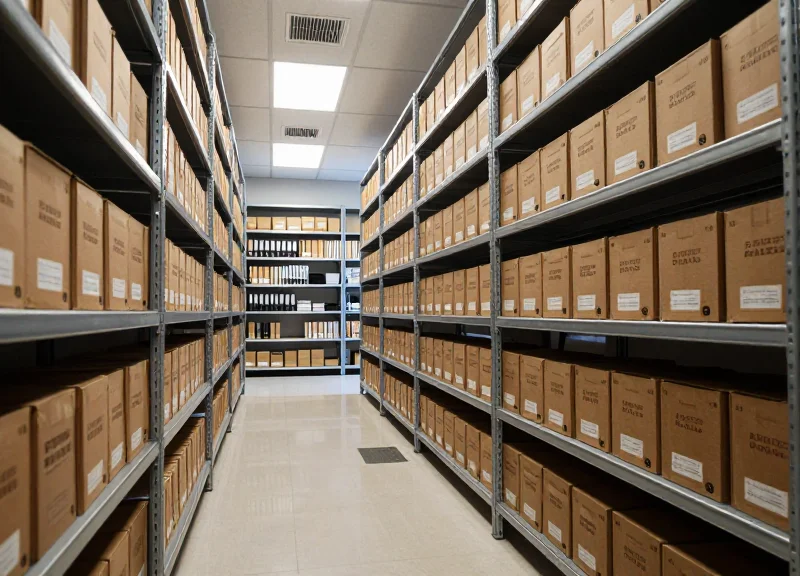
Future-proofing your archive infrastructure is the strategic implementation of modular RFID hardware and open-standard software architectures designed to outlast current hardware cycles and integrate seamlessly with future AI-driven compliance tools. Rather than simply replacing barcodes with tags, a future-proofed system creates a 'data-agnostic' layer that ensures your physical filing assets remain visible and secure regardless of changes to your bank's core ERP or cloud provider over the next decade.
- Adopt Global Open Standards: Ensure all hardware and tags comply with ISO/IEC 18000-63 (EPC Gen2v2). This prevents vendor lock-in and ensures that your 2026 infrastructure can communicate with third-party logistics and regulatory hardware worldwide.
- Deploy API-First Middleware: Select an RFID management platform that prioritizes RESTful APIs. This allows your archive data to feed into future AI auditing tools or automated 'smart vault' robotic systems without needing to replace the underlying tag infrastructure.
- Invest in 'Over-The-Air' (OTA) Capable Hardware: Use RFID readers and gateways that support remote firmware updates. As security protocols evolve to counter new cyber threats, your physical hardware must be capable of receiving security patches without a technician visiting the vault.
- Prioritize Sub-Centimeter Accuracy: While basic proximity is enough for 2026, future-proofing requires Phase-Based Ranging capability. This allows for precise 3D location tracking within a shelf, essential for upcoming robotic retrieval systems.
A unique insight for 2026 planning is the shift toward 'Silicon-Free' RFID or eco-friendly substrate tags. As ESG (Environmental, Social, and Governance) mandates become as strictly enforced as financial security in the banking sector, future-proofing means selecting tags that are recyclable or have a minimal carbon footprint. Traditional plastic-inlay tags may face 'electronic waste' surcharges by 2030; transitioning to paper-based or degradable RFID antennas now can save millions in future compliance costs.
| Feature | Legacy Barcode Systems | Standard RFID (2024) | Future-Proof Smart Filing (2026+) |
|---|---|---|---|
| Scalability | Low - Manual intensive | Medium - Batch processing | High - Continuous real-time mesh |
| Interoperability | Proprietary / Siloed | Standardized Data | API-Driven / Cloud-Native |
| Security | Visual only | Encrypted IDs | Post-Quantum Cryptography Tags |
| Maintenance | High (Relabeling) | Low (Passive tags) | Zero (Self-healing mesh networks) |
Will I need to replace my tags when 6G arrives?
No. Passive RFID operates on specific UHF bands (860-960 MHz) that are internationally protected. Future-proofing ensures your readers are compatible with new backhaul networks (like 6G or Wi-Fi 8), but the tags themselves remain functional.
How do we handle the massive influx of data?
Future-proof systems use 'Edge Computing' where the RFID reader filters noise and only sends relevant movement events to the cloud, preventing your network from being overwhelmed by millions of redundant pings.
Can RFID tags survive 50-year retention periods?
Yes, high-quality passive tags have no internal battery to fail. When paired with acid-free adhesives, they are designed to remain readable for the entire lifecycle of a legal or financial document.