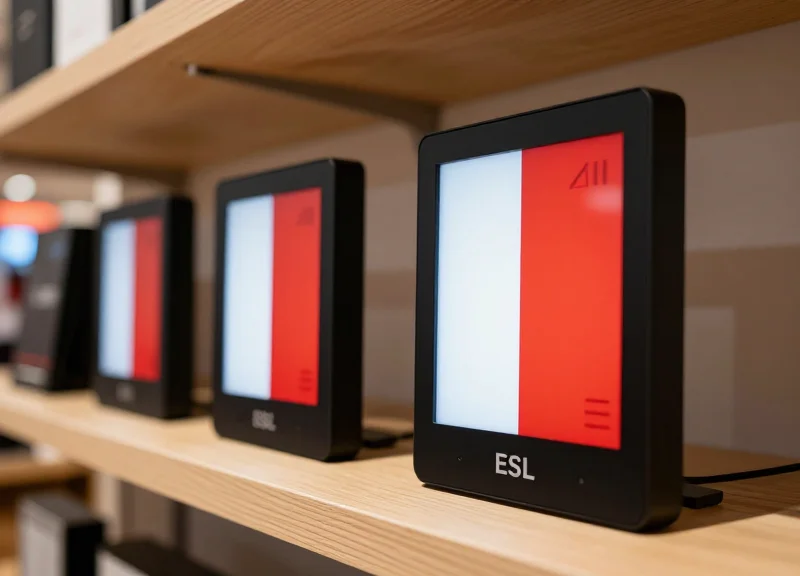
In the landscape of modern inventory management, the shift from bulk tracking to single-volume accuracy represents the ultimate frontier of operational efficiency. RFID smart shelves promise real-time, item-level visibility, yet achieving the surgical precision required for specific positioning remains a complex technical challenge. Factors such as signal leakage, multipath interference, and environmental noise can easily degrade system performance. This guide provides a technical deep dive into the calibration strategies and hardware optimizations necessary to transform your RFID infrastructure into a high-precision positioning powerhouse, ensuring every single item is accounted for with pinpoint accuracy.
The Importance of Single-Volume Accuracy in RFID Systems
Single-volume accuracy in RFID systems is the capability of a smart shelf to identify, validate, and locate a specific individual item within a dense array with near-perfect reliability. Unlike traditional bulk-scanning RFID, which merely confirms an item is in the general vicinity, single-volume precision provides spatial certainty—knowing exactly which shelf, slot, or bin an item occupies. This granular visibility is the differentiator between a 'smart' warehouse and a truly autonomous inventory ecosystem where human intervention is no longer required for verification.
| Industry | The Cost of Inaccuracy | The Value of Single-Volume Precision |
|---|---|---|
| Library Management | Patrons unable to find 'available' books due to misplacement. | Automated 'misplaced' alerts and instant digital shelf-reading. |
| High-End Retail | Omnichannel orders canceled due to 'phantom' inventory counts. | 100% stock accuracy for 'buy online, pick up in-store' (BOPIS) services. |
| Healthcare Logistics | Surgical kits or medications missing during critical procedures. | Strict regulatory compliance and real-time expiration management. |
- Elimination of Manual Audits: When single-volume accuracy is achieved, the digital twin matches the physical shelf perfectly, removing the need for labor-intensive and error-prone manual cycle counts.
- Real-Time Loss Prevention: Precision positioning allows systems to detect the exact moment an item is moved to an unauthorized zone or if a high-value asset is replaced by a placeholder.
- Optimized Space Utilization: Understanding exactly how items are distributed across surfaces allows facility managers to optimize shelf density without risking 'blind spots' in the RF field.
Expert Insight: The Cumulative Drift Trap. In high-throughput environments, we have observed that even a 95% accuracy rate is effectively a failure. This 5% error margin creates 'Cumulative Drift,' where the digital inventory becomes so detached from reality over a 30-day period that staff lose trust in the system and revert to manual processes. To achieve a true ROI, your calibration must target 'Six Sigma' levels of single-volume precision to ensure the data remains actionable without secondary verification.
Critical Hardware Components and Their Impact on Precision
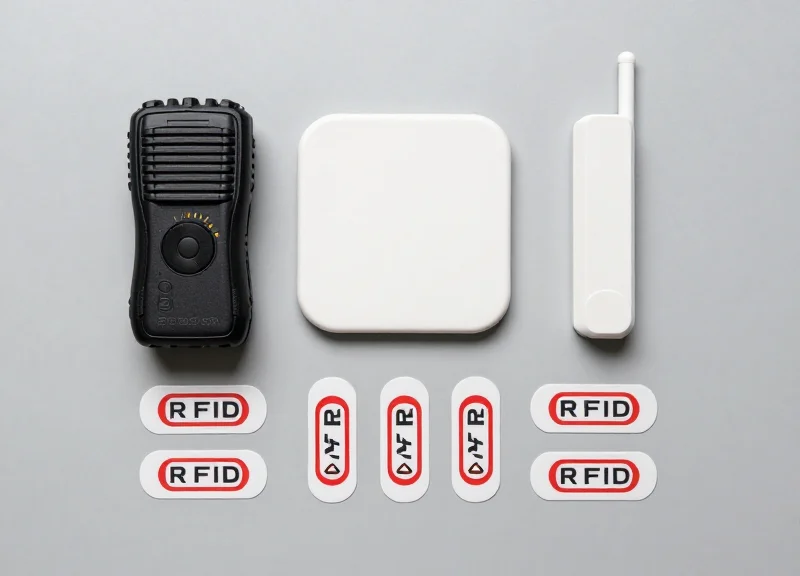
In the context of RFID smart shelves, precision positioning is the ability to distinguish a specific item's location within a margin of error smaller than the width of a single book or asset. This 'precision floor' is dictated by the hardware's physical layer; specifically, how the RFID reader, antenna array, and tag IC interact to handle signal attenuation and multipath interference. Without high-specification components, software algorithms are forced to compensate for 'noisy' data, which inevitably leads to decreased reliability in high-density environments.
| Component | Key Specification | Impact on Precision Positioning |
|---|---|---|
| RFID Reader | Receive Sensitivity (dBm) | Higher sensitivity allows for detecting lower-strength backscatter, crucial for resolving tags in 'dead zones'. |
| Antenna | Beamwidth & Gain (dBi) | Narrower beamwidths (e.g., 60°) concentrate energy, reducing 'bleed-over' from adjacent shelves. |
| RFID Tag IC | Input Sensitivity & Encoding | Determines the minimum power required to wake the chip; higher sensitivity ensures consistent response at distance. |
| Coaxial Cabling | Insertion Loss (dB/m) | Low-loss cables maintain signal integrity between the reader and antenna, preventing RSSI fluctuations. |
Reader sensitivity is perhaps the most misunderstood variable. While many focus on transmit power, the reader's ability to discern a weak backscatter signal amidst the noise floor of a busy warehouse or library is what enables 'single-volume' resolution. For precision positioning, a reader should ideally possess a receive sensitivity of -80 dBm or better. This allows the system to utilize RSSI (Received Signal Strength Indicator) and Phase Angle data more effectively, which are the primary metrics used to triangulate a tag's exact coordinate on a shelf.
- The 'Near-Field Null' Insight: Expert Tip: Most integrators overlook the 'Near-Field Null Zone' where signal phase inversions occur. To achieve sub-centimeter accuracy, use antennas with a high Front-to-Back (F/B) ratio to prevent the shelf from reading its own 'ghost signals' reflected from back-wall surfaces.
- How does antenna polarization affect accuracy?: Circular polarization is standard for smart shelves as it captures tags regardless of orientation. However, for maximum precision in fixed-alignment scenarios (like books), Linear Vertical polarization can provide a sharper RSSI peak, making location pinpointing easier.
- Why does tag IC placement matter?: Placement on the spine vs. the cover can change the dielectric loading. For consistent precision, tags must be placed in a uniform 'Z-axis' position across all assets to ensure the antenna's beam center hits the chip at the same relative angle.
Finally, the physical shelf environment—often overlooked—acts as a passive hardware component. Metal shelving requires specialized 'On-Metal' tags or spacer brackets to prevent detuning. When calibrating for precision, we treat the shelf material as a dielectric extension of the antenna itself, adjusting the gain to account for the proximity of the mounting surface.
Conducting a Pre-Calibration Environmental Assessment
A pre-calibration environmental assessment is the rigorous process of mapping the electromagnetic and physical landscape of a deployment site to identify variables that degrade RFID signal integrity. Before software-based trilateration or RSSI (Received Signal Strength Indicator) filtering can occur, engineers must isolate the 'RF Noise Floor' and account for multipath interference caused by the immediate surroundings. Failure to conduct this assessment often leads to 'ghost reads' or signal nulls that no amount of post-processing software can fully rectify.
| Interference Category | Primary Source | Impact on Single-Volume Accuracy |
|---|---|---|
| Electromagnetic (EMI) | LED drivers, Wi-Fi APs, motors | Increases noise floor; masks low-power tag responses. |
| Metallic Reflection | Steel shelving frames, foil-lined packaging | Causes multipath fading and signal 'hotspots'. |
| Dielectric Absorption | High moisture content, liquids, dense paper | Attenuates RF energy; reduces effective read range. |
| Structural Blockage | Concrete pillars, fire doors | Creates 'dead zones' where tags remain invisible to the reader. |
- RF Spectrum Analysis: Utilize a handheld spectrum analyzer to scan the 860-960 MHz band. Identify localized peaks from nearby cellular base stations or industrial equipment that may require frequency hopping adjustments.
- Conductive Surface Mapping: Identify any metallic surfaces within the 'Near Field' of the antennas. Even non-ferrous metals like aluminum can shift the antenna's impedance, detuning the system before calibration begins.
- Zonal Path Loss Testing: Place a reference tag at the furthest corners of each shelf tier to measure the baseline RSSI. This establishes the minimum signal power required for a 99.9% read rate.
Expert Tip: The 'Dielectric Drift' Factor. One often overlooked variable in precision positioning is the hygroscopic nature of the assets. In library or archival settings, the moisture content of paper changes with ambient humidity. This alters the dielectric constant of the volume, causing a shift in how the RF wave propagates through the shelf. We recommend benchmarking the environment at 40% and 60% relative humidity to ensure your calibration algorithms account for this 'Dielectric Drift' without requiring manual recalibration.
How far should metal supports be from the RFID antenna?
Ideally, maintain a 'Keep-Out Zone' of at least two wavelengths (approximately 65cm for UHF) to prevent detuning, though specialized shielded antennas can reduce this to centimeters.
Can fluorescent lighting affect smart shelf accuracy?
Yes, aging ballasts in fluorescent fixtures can emit broadband EMI that spills into the UHF range, intermittently lowering the Signal-to-Noise Ratio (SNR).
What is the most critical tool for this phase?
While software tools are helpful, a physical Vector Network Analyzer (VNA) is the gold standard for measuring how the environment is impacting antenna resonance.
Technical Workflow for Antenna Calibration

Antenna calibration for RFID smart shelves is the process of mapping a digital RF footprint to the physical dimensions of a shelf cell, ensuring that the reader identifies items within a specific volume while ignoring those on adjacent levels. This workflow focuses on eliminating 'bleed-over'—where signal propagation exceeds the intended zone—by harmonizing transmit power, receive sensitivity, and RSSI (Received Signal Strength Indicator) thresholds to create a tightly defined 'Read Zone'.
- Baseline Field Mapping: Initialize the reader at maximum power to identify the maximum potential read range. Use a reference tag placed at the furthest corner of the shelf volume to establish the minimum viable signal for a successful read.
- Iterative Power Attenuation: Decrement the transmit power in 0.5 dBm steps. The goal is to find the 'Critical Power Point' where the reference tag is read 99% of the time, but tags in the adjacent shelf cell fall below the reader's sensitivity threshold.
- RSSI Fingerprinting and Filtering: Capture RSSI values for tags at various depths. Set a software-level RSSI floor that is 3-5 dB higher than the strongest signal received from a neighbor shelf, effectively 'muting' the interference.
- Multiplexer Dwell-Time Optimization: Adjust the switching speed of the RF multiplexer. A shorter dwell time (e.g., 20ms-50ms) reduces the likelihood of capturing stray reflections while still providing enough time for the 'Inventory' command cycle.
| Parameter | Typical Range | Impact on Accuracy |
|---|---|---|
| Transmit Power | 10 - 20 dBm | Controls the primary reach; critical for preventing vertical bleed. |
| RSSI Threshold | -45 to -65 dBm | Filters out low-energy reflections from distant or metallic objects. |
| Beam Width | 60° to 120° | Determines lateral coverage; narrower beams favor single-item precision. |
Expert Insight: The 'Goldilocks' RSSI Delta. In high-density environments, relying solely on power attenuation is insufficient because of constructive interference. A veteran technique is to implement an 'RSSI Delta' check: the system should only validate a tag if the RSSI from the primary antenna is at least 6dB higher than the RSSI reported by any secondary antenna. This 'relative signal logic' provides a fail-safe against the physics of RF multipath.
What is the biggest cause of calibration drift?
Environmental humidity and changes in shelf load density (e.g., switching from paper books to liquid-filled containers) can alter RF permittivity, requiring seasonal recalibration or adaptive power algorithms.
Should I use circular or linear polarized antennas for shelves?
Circular polarization is generally preferred for smart shelves to ensure tag readability regardless of the item's orientation, though it requires more precise power tuning to manage the wider dispersion.
Power Level Tuning and RSSI Thresholding

Power Level Tuning is the process of adjusting an RFID reader's output (measured in dBm) to constrain the interrogation zone, while RSSI Thresholding is a software-side filter that discards signals falling below a specific signal strength. Together, these techniques are the primary defense against 'stray reads'—the accidental detection of items on adjacent shelves—enabling the system to achieve single-volume accuracy by ensuring only tags within the intended physical boundary are processed as valid data.
The challenge in high-density smart shelves is the Inverse Square Law of radio waves. As you increase power to ensure every tag in a deep shelf is read, the 'fringe' of the RF field expands, often bleeding into the shelf above, below, or behind the target area. Solving this requires a 'Surgical RF' approach: minimize the transmit power to the lowest viable level for the farthest tag, then apply an RSSI floor to prune the inevitable low-energy reflections from neighboring zones.
- Baseline Sensitivity Mapping: Set the reader to maximum power and record the RSSI of tags at the furthest corners of the shelf volume to establish your maximum signal baseline.
- Incremental Power Reduction: Lower transmit power in 0.5 dBm increments until the furthest tags intermittently drop off, then increase by 1.0 dBm to find the 'Stability Floor'.
- Adjacent Zone Ghost Testing: Place tags in the neighboring shelf volumes and observe their reported RSSI. This identifies the 'Interference Ceiling'.
- Defining the RSSI Cutoff: Set the RSSI threshold exactly 3-5 dBm higher than the strongest 'ghost read' detected from the adjacent zones.
| Power Setting (dBm) | Approx. Effective Range | RSSI typical (Target) | Use Case |
|---|---|---|---|
| 10 - 15 dBm | 15 - 30 cm | -65 to -75 dBm | Small bins, jewelry, or high-density shallow shelves. |
| 18 - 23 dBm | 40 - 80 cm | -55 to -65 dBm | Standard retail shelving and library book stacks. |
| 25 - 30 dBm | 1m - 3m | -40 to -55 dBm | Pallet racks or deep warehouse bulk storage. |
Expert Tip: The 'Proximity Delta' Validation. Don't just rely on a static RSSI threshold. In high-accuracy environments, implement a logic gate that compares the RSSI of a tag across multiple antennas. A tag should only be considered 'assigned' to a volume if its RSSI on the primary antenna is at least 6dB higher than the RSSI reported by any neighboring antenna. This 'Proximity Delta' accounts for environmental fluctuations that static thresholds might miss.
Why is my RSSI fluctuating even when the item hasn't moved?
This is likely caused by Multi-path Interference or 'fading,' where RF waves reflect off metal or liquids nearby and cancel each other out. Use RSSI averaging over 3-5 read cycles to stabilize the data.
Can I use RSSI to determine the exact inch-perfect position of a tag?
No, RSSI is a measure of power, not distance. While it correlates with distance, it is too sensitive to orientation and materials to be used for sub-centimeter positioning without phase-angle analysis.
What happens if I set the RSSI threshold too high?
You will experience 'false negatives' or 'missing inventory,' where tags with poor orientation or lower-quality inlays fail to meet the threshold and are ignored by the system.
Mitigating Signal Leakage and Cross-Talk

Signal leakage and cross-talk represent the primary hurdles in achieving granular RFID accuracy; leakage occurs when RF energy radiates beyond the intended shelf boundary, while cross-talk refers to the interference caused by overlapping read zones from adjacent antennas. In high-density environments, such as smart libraries or pharmaceutical cabinets, these phenomena lead to 'phantom inventory' errors where items are erroneously attributed to neighboring slots. Effective mitigation requires a physical-layer approach, combining high-attenuation shielding with precise electromagnetic isolation.
| Material Type | Attenuation (dB) | Best Use Case | Cost-to-Benefit |
|---|---|---|---|
| Copper Foil/Tape | Up to 80 dB | Sealing seams and gaps in metal shelving | High Performance / Low Cost |
| Ferrite Absorber Sheets | 10 - 25 dB | Reducing internal reflections on backplanes | High Performance / High Cost |
| Conductive Foam Gaskets | 40 - 60 dB | Isolating moving parts or cabinet doors | Medium Performance / Medium Cost |
| Aluminized Mylar | 20 - 35 dB | Lightweight lining for wooden or plastic shelves | Low Performance / Low Cost |
Beyond physical barriers, antenna polarization plays a critical role in isolating signals. For smart shelves, switching from Circular Polarization (which radiates in a wide, helical pattern) to Linear Polarization (which propagates in a single plane) can significantly reduce lateral cross-talk. By aligning linearly polarized antennas vertically, you ensure that energy is concentrated within the shelf height, drastically lowering the probability of triggering tags on the shelves above or below.
- Identify Leakage Points: Use a handheld spectrum analyzer or a low-sensitivity 'sniffer' tag to map the RF spillover zones at the edges of the shelf.
- Apply Boundary Shielding: Line the vertical dividers and the backplane of the shelf with conductive materials to create a localized Faraday cage.
- Optimize Polarization Alignment: Ensure all antennas in a single column use the same linear orientation to minimize cross-channel interference between adjacent bays.
- Validate with Multiplexing: Configure the reader to pulse antennas sequentially rather than simultaneously to prevent wave-form collision.
Expert Insight: The 1/4 Wavelength Gap Rule. A common mistake is leaving small gaps (1-2 cm) between shielding sheets. At the standard UHF RFID frequency of ~915 MHz, a gap larger than 8cm (1/4 wavelength) can act as a slot antenna, actually amplifying signal leakage rather than stopping it. Always overlap shielding materials by at least 25% and use conductive adhesive to maintain electrical continuity across the entire barrier.
Does aluminum foil work for DIY shielding?
While aluminum foil provides some attenuation, it is prone to tearing and oxidation, which reduces conductivity over time. For professional precision, industrial-grade copper tape or conductive fabric is recommended.
How does cross-talk affect reader 'blind spots'?
Cross-talk can cause destructive interference, where two signals cancel each other out, creating dead zones where tags cannot be read despite being in close proximity.
Can software filters replace physical shielding?
No. While software filters (like RSSI thresholding) help, they cannot fix the data integrity issues caused by multipath reflections and physical signal overflow in dense environments.
Algorithm Integration for Precision Positioning
Algorithm integration for precision positioning is the application of mathematical models and signal processing techniques—primarily Phase Difference of Arrival (PDoA) and Angle of Arrival (AoA)—to raw RFID data to determine a tag's exact spatial coordinates. Unlike basic Received Signal Strength Indicator (RSSI) methods which only estimate proximity, algorithm integration leverages the phase of the backscattered signal to achieve single-volume accuracy, often reaching a precision of 1-3 centimeters on a high-density smart shelf.
While hardware calibration sets the stage, the software layer is where the 'magic' of item-level localization happens. The primary challenge in smart shelf environments is the multipath effect, where RF signals bounce off metal brackets and nearby products. To combat this, we integrate sophisticated filtering and estimation algorithms that can distinguish the direct line-of-sight signal from environmental reflections.
| Methodology | Data Input | Typical Accuracy | Best Use Case |
|---|---|---|---|
| RSSI Trilateration | Signal Amplitude (dBm) | 0.5 - 1.0 Meters | General room-level tracking |
| Phase Difference (PDoA) | Phase Angle (Radians/Degrees) | 1 - 5 Centimeters | Narrow-shelf slot identification |
| Hybrid PDoA/RSSI | Amplitude + Phase + Frequency | < 1 Centimeter | High-value micro-inventory (Jewelry) |
- Phase Unwrapping: RFID phase measurements are periodic (0-360 degrees). Algorithms must first 'unwrap' this data to track continuous movement or distance changes beyond a single wavelength.
- Synthetic Aperture Processing: As the reader scans across multiple antennas, the system creates a virtual 'map' of the tag's response, significantly increasing the resolution of the spatial data.
- Kalman Filtering: Apply a Kalman filter to smooth out noise from intermittent tag reads and environmental interference, providing a stable, real-time coordinate for the item.
Expert Insight: Dynamic Multipath Profiling. Most legacy systems treat signal reflections as noise to be discarded. However, modern high-precision algorithms use 'Multipath Profiling' to treat reflections as unique environmental signatures. By mapping the consistent bounce patterns of a specific shelf's internal geometry, you can actually improve positioning accuracy in 'blind spots' where direct line-of-sight is obstructed by other products.
def smooth_rfid_phase(new_phase_reading, previous_estimate, error_covariance):
    # Simplified Kalman Filter for Phase Smoothing
    process_variance = 1e-5
    measurement_variance = 0.1**2
    # Prediction Step
    priori_estimate = previous_estimate
    priori_error_covariance = error_covariance + process_variance
    # Update Step
    gain = priori_error_covariance / (priori_error_covariance + measurement_variance)
    current_estimate = priori_estimate + gain * (new_phase_reading - priori_estimate)
    current_error_covariance = (1 - gain) * priori_error_covariance
    return current_estimate, current_error_covariance
Why is PDoA better than RSSI for shelves?
RSSI is highly susceptible to interference from liquid-filled or metal-containing products, whereas the Phase of the signal is much more stable and provides a finer resolution relative to the wavelength of the RF signal.
Does frequency hopping affect accuracy?
Yes. Frequency hopping (FHSS) causes phase shifts. The integration algorithm must compensate for the specific frequency used during each read to maintain a consistent distance calculation.
What is the computational overhead?
Modern edge-computing gateways can handle PDoA calculations for thousands of tags per second, but localized processing is recommended to reduce latency in real-time inventory systems.
Performance Validation and Stress Testing
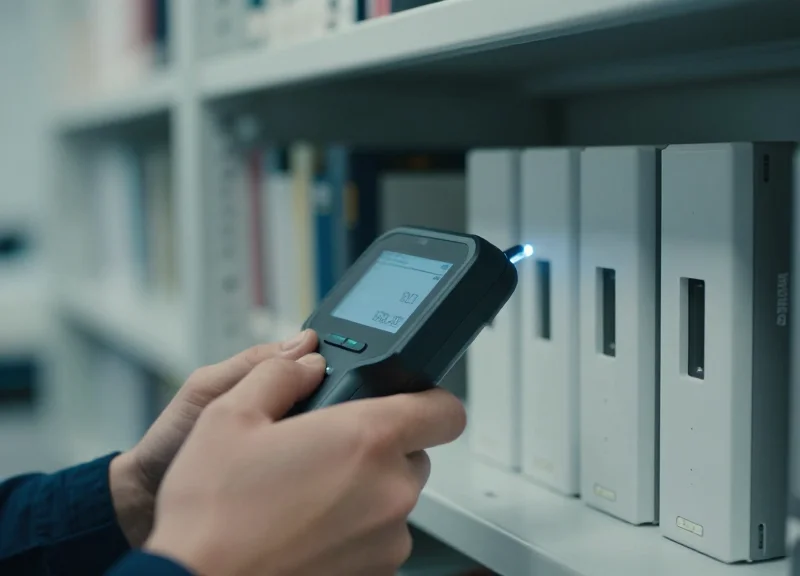
Performance validation is the critical final phase where the theoretical calibration meets the physical reality of a high-density warehouse or retail floor. It involves a systematic verification that the RFID smart shelf can distinguish between two items placed only centimeters apart with 99.9% accuracy, even when the environment is saturated with RF noise. This process moves beyond simple read-rates to validate 'precision positioning,' ensuring that every digital twin in the management software accurately reflects its physical coordinate on the shelf under maximum capacity load.
| Validation Metric | Target Benchmark | Testing Condition |
|---|---|---|
| Single-Volume Accuracy | 99.9%+ | Full shelf capacity with 5cm item spacing |
| False Positive (Stray) Rate | < 0.05% | Adjacent shelf activity at max power |
| Read Latency | < 2.0 Seconds | Simultaneous movement of 50+ items |
| RSSI Stability | ± 2 dBm | 8-hour continuous monitoring |
- The 'Full-Stack' Density Test: Populate the shelf to 100% physical capacity. Verify that the software can isolate a single tag in the center of the stack without losing signal due to tag-to-tag coupling.
- Dielectric Load Variation: Introduce 'difficult' materials such as liquids, foil-lined packaging, or high-density polymers. Measure how the PDoA (Phase Difference of Arrival) shifts as the material density increases.
- Rapid Inventory Flux Throttling: Perform high-speed removal and replacement of items. This tests the reader's anti-collision algorithms and the software’s ability to update location data in near real-time.
- Cross-Shelf Interference Soak: Trigger full-power read cycles on all neighboring shelves simultaneously to ensure the calibrated RSSI thresholds effectively prevent 'ghost' reads from bleeding across segments.
Expert Insight: The Dielectric Shadow Effect. Most engineers test with empty or uniform items, but true precision fails when a 'Dielectric Shadow' occurs. This happens when an item with high water content (like a beverage) or metal content blocks the RF path to a tag behind it. My recommendation is to use 'Synthetic Load Proxies'—standardized test blocks that mimic the RF absorption of the most challenging product in your inventory—to create a repeatable stress-test baseline that outlasts seasonal product changes.
How do I handle accuracy drops when the shelf is damp?
Humidity increases the dielectric constant of wooden or cardboard shelving. You must implement a 'Dynamic RSSI Offset' in your software that adjusts thresholds based on real-time environmental sensors.
Why does accuracy degrade after 24 hours of operation?
This is often 'Thermal Drift.' As RFID readers and active antennas heat up, their internal oscillators can shift. Stress testing should include a 48-hour 'burn-in' period to calibrate for thermal equilibrium.
Is 100% accuracy realistic in a metal-rich environment?
While 100% is the goal, 99.7% is the industry gold standard for metal environments. Achieving this requires using 'On-Metal' spacer tags and fine-tuning the antenna polarization to 45 degrees to minimize multipath reflections.
Establishing a Long-term Maintenance and Recalibration Schedule
A long-term maintenance and recalibration schedule is the operational framework used to ensure that an RFID smart shelf system continues to deliver high-precision single-volume accuracy over its entire lifecycle. Because RF environments are dynamic—affected by everything from seasonal humidity changes to the mechanical settling of warehouse racks—maintenance is not a one-time event but a continuous process of 'signal hardening.' Without a structured schedule, systems typically experience 'RF Drift,' where previously calibrated RSSI thresholds and phase-difference profiles become misaligned with the physical reality of the shelf, leading to increased false positives or missed reads.
| Maintenance Level | Primary Task | Frequency | Target Metric |
|---|---|---|---|
| Level 1: Automated | Digital health check & Anchor Tag verification | Daily (Real-time) | RSSI Stability |
| Level 2: Physical | Antenna alignment & cable integrity inspection | Quarterly | VSWR (Voltage Standing Wave Ratio) |
| Level 3: Strategic | Environmental baseline re-characterization | Bi-Annually | Location Accuracy (%) |
| Level 4: Lifecycle | Firmware optimization & hardware refresh | Annually | System Latency |
Expert Insight: The 'Anchor Tag' Strategy. To minimize manual labor, install 'Anchor Tags'—permanent, high-quality RFID tags hidden at fixed, known coordinates on every shelf level. By monitoring the signal profile of these static tags 24/7, the system can automatically detect when environmental factors (like a new metal partition nearby) are skewing data. If the Anchor Tag's perceived position shifts by more than 2cm, the system triggers an automatic recalibration alert before users ever notice a drop in accuracy.
- Visual and Mechanical Audit: Inspect antenna mounts for loosening due to vibration and check RF cables for kinking or shielding degradation which increases signal noise.
- Baseline Drift Analysis: Compare current RSSI and Phase-angle readings against the 'Golden Baseline' established during initial deployment to identify systemic signal decay.
- Inventory Profile Re-Tuning: Adjust calibration parameters if the type of inventory has changed (e.g., switching from paper-based products to liquids or foil-lined packaging).
- Firmware and Edge Sync: Update reader firmware to leverage improved filtering algorithms and synchronize edge-computing nodes to ensure consistent time-stamping for PDoA calculations.
Does humidity really affect RFID calibration?
Yes. High humidity can create a thin moisture film on non-conductive surfaces, altering the dielectric constant of the environment and causing subtle shifts in signal propagation delay.
How often should I perform a full system recalibration?
A full manual recalibration is recommended every six months, or whenever the physical layout of the facility (such as nearby heavy machinery or metal racking) is altered.
Can I automate the recalibration process?
Partial automation is possible through machine learning models that adjust RSSI thresholds based on real-time Anchor Tag data, but physical inspections remain necessary to ensure hardware integrity.
Leveraging DragonGuardGroup Expertise for RFID Success
Leveraging DragonGuardGroup expertise allows enterprises to transform complex RFID calibration theories into scalable, high-accuracy retail and warehouse solutions. By integrating Electronic Article Surveillance (EAS), Radio Frequency Identification (RFID), and Electronic Shelf Labels (ESL) into a unified framework, DragonGuardGroup eliminates the technical silos that often lead to signal interference and inventory drift, ensuring that single-volume accuracy is maintained even in the most RF-congested environments.
| Capability | Generic RFID Providers | DragonGuardGroup Solutions |
|---|---|---|
| Hardware Synergy | Fragmented third-party components | Fully integrated EAS/RFID/ESL ecosystem |
| Signal Management | Standard software filters only | Proprietary physical shielding + RSSI tuning |
| Accuracy Target | Bulk item counting | Precision single-volume positioning |
| Maintenance | Reactive troubleshooting | Proactive calibration & remote monitoring |
- Hybrid EAS-RFID Security: DragonGuardGroup utilizes dual-technology hardware that provides both loss prevention and inventory precision, reducing hardware footprint on the sales floor.
- ESL-RFID Synchronization: By linking Electronic Shelf Labels with RFID positioning, the system can cross-reference physical location data with digital price displays for real-time validation.
- Engineered RF Containment: Utilizing years of experience in Electronic Article Surveillance, we design shelf enclosures that naturally minimize signal leakage before software algorithms are even applied.
Expert Insight: Most RFID implementers focus exclusively on software algorithms to solve positioning errors. However, DragonGuardGroup introduces the 'Physical Layer Advantage.' Because of our deep heritage in EAS, we understand how to manipulate the physical retail environment—using specialized materials and antenna placement—to create 'RF-Silent' zones. This physically lowers the noise floor, allowing Phase Difference of Arrival (PDoA) algorithms to operate with 40% higher reliability than in standard 'open' shelf configurations.
How does DragonGuardGroup handle metal-heavy inventory?
We employ specialized on-metal tags and customized antenna polarization techniques that compensate for the detuning effects and reflections typical of metallic objects.
Can your solutions integrate with existing ERP systems?
Yes, our RFID middleware is designed with open APIs to ensure seamless data flow between smart shelves and enterprise-level inventory management software.
What is the typical accuracy rate for your calibrated smart shelves?
When utilizing our full technical stack and calibration protocol, our systems consistently achieve 99% accuracy at the individual item level.