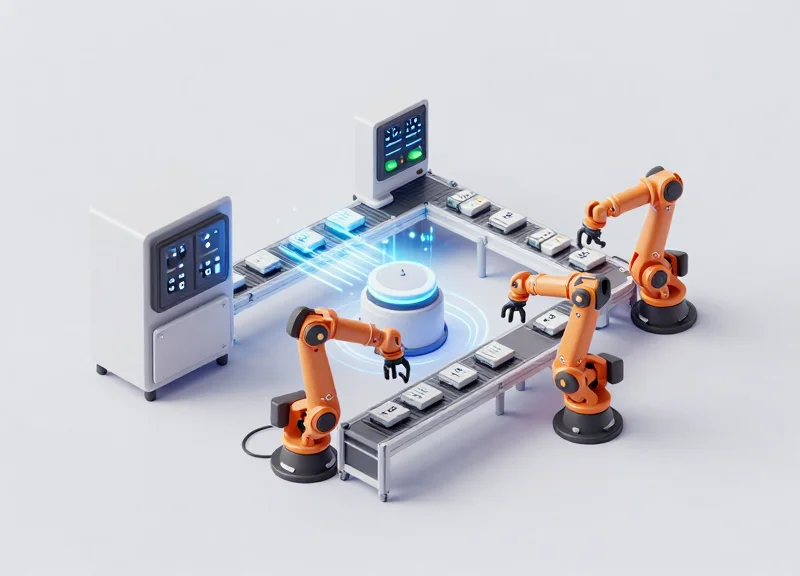
In the rapidly evolving landscape of Industry 4.0, the synergy between RFID tracking and PLC automation has become the backbone of smart factories. As we move toward 2026, 'hands-free manufacturing' is no longer a buzzword but an operational necessity. However, the critical bottleneck remains the middleware—the invisible bridge that translates high-frequency data into actionable industrial logic. This guide explores how to select the right middleware to ensure your RFID readers and PLCs speak the same language, maximizing throughput and minimizing human intervention.
The Strategic Role of Middleware in 2026 Smart Manufacturing
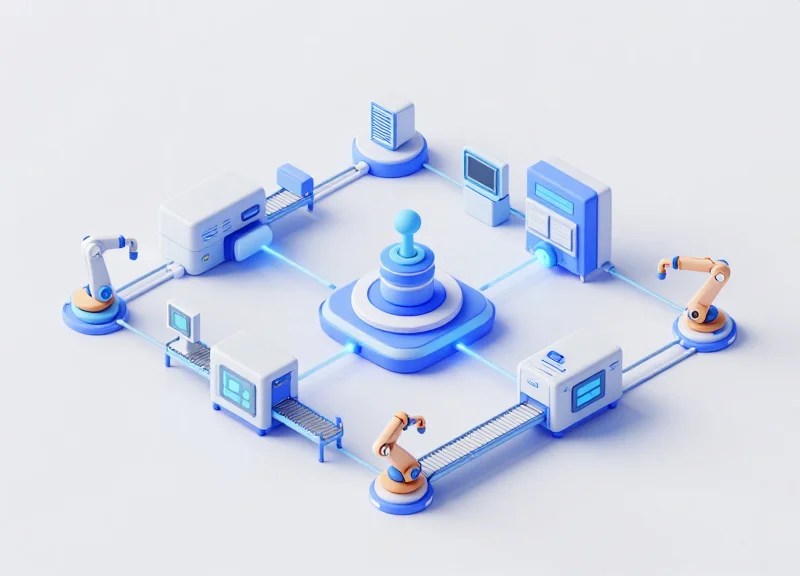
In 2026, RFID middleware is defined as the essential abstraction layer that filters, aggregates, and translates raw RFID tag data into high-level logic and executable commands compatible with Programmable Logic Controllers (PLCs). By serving as the 'nervous system' of the digital factory, it eliminates the bottleneck of processing massive radio frequency data streams directly on PLC hardware. This allows for truly hands-free manufacturing by ensuring that only validated, actionable events trigger physical machine movements, reducing latency and operational overhead.
| Feature | Legacy Direct Integration | 2026 Middleware-Centric Integration |
|---|---|---|
| PLC CPU Load | High (Processing raw bits/headers) | Low (Receiving pre-filtered events) |
| Data Scalability | Linear (Hardware limited) | Exponential (Edge-computing enabled) |
| Protocol Support | Single/Proprietary | Multiprotocol (OPC UA, MQTT, EtherNet/IP) |
| Error Handling | Manual/Hardcoded | Automated/AI-Enhanced filtering |
As we move further into the decade, the complexity of sensor ecosystems has surpassed the native processing capabilities of standard PLCs. Middleware now provides the 'Cognitive Decoupling' required to scale. By separating the data acquisition layer from the logic execution layer, manufacturers can upgrade their RFID hardware or change their logic parameters without a total system redesign.
Why can't modern PLCs handle RFID data without middleware?
While modern PLCs are faster than ever, they are designed for deterministic real-time control. RFID systems generate 'noisy' data streams—multiple reads of the same tag or 'stray' reads from neighboring zones. Middleware filters this noise at the edge, preventing the PLC from being overwhelmed by non-essential interrupts.
What is the 'Zero-Touch' objective in 2026 middleware?
Zero-Touch refers to the middleware's ability to automatically discover new RFID readers, provision security certificates, and map tag data to PLC registers without manual programming, enabling faster line reconfigurations.
How does middleware enhance security in hands-free environments?
Middleware acts as a secure gateway, implementing zero-trust architecture between the industrial shop floor (OT) and the enterprise network (IT), ensuring that only authenticated RFID data can influence the PLC logic.
Expert Insight: The Data Gravity Shift. In 2026, we are seeing a strategic shift where 'Data Gravity' is moving toward the edge. My unique observation is that the most successful deployments are no longer using middleware just as a translator, but as a 'High-Pass Filter' for PLC logic. By preventing 'Data Bloat'—the saturation of PLC memory with redundant tag metadata—middleware ensures that control cycles remain sub-millisecond even as sensor density increases by 10x. This is the secret to maintaining deterministic performance in a fully autonomous facility.
Defining Hands-Free Manufacturing: The Future of the Factory Floor
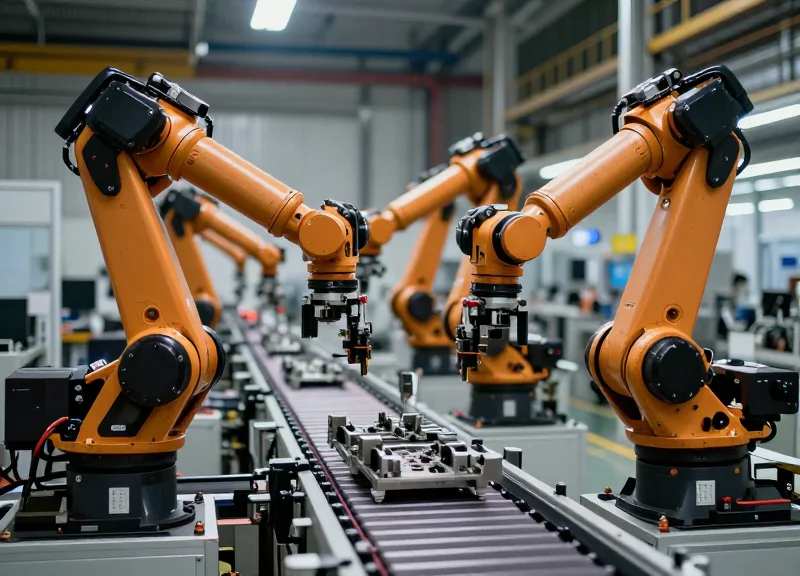
Hands-free manufacturing is an autonomous operational framework where assets—from raw materials to finished goods—communicate directly with factory machinery via Radio Frequency Identification (RFID). In this 2026 model, the 'human-in-the-loop' for data entry is removed; instead, middleware interprets tag data and issues immediate commands to Programmable Logic Controllers (PLCs). This creates a self-correcting production line where the physical location and status of an item automatically trigger mechanical actions like sorting, assembly, or rejection without a single manual barcode scan.
The shift toward hands-free operations marks a transition from 'passive tracking' to 'active orchestration.' While traditional manufacturing relied on operators to confirm tasks, the 2026 factory floor utilizes high-speed RFID tunnels and overhead readers to feed real-time telemetry into the PLC's input registers. This enables a 'dark factory' capability where lighting and environmental conditions can be optimized for machines rather than humans, significantly reducing overhead and increasing safety in hazardous environments.
| Feature | Traditional Manual Scanning | Hands-Free RFID Manufacturing |
|---|---|---|
| Operator Input | High (Scanning every unit) | Zero (Automated detection) |
| Line Speed | Limited by human dexterity | Limited only by machine cycle time |
| Data Granularity | Batch-level or milestone-based | Individual unit-level (Serialized) |
| Error Rate | 3-5% (Missed scans/Human error) | <0.1% (With optimized middleware) |
The Veteran Perspective: The 'Latency Threshold' Insight. Most manufacturers focus on tag read rates, but the true differentiator in 2026 is the Middleware Latency Threshold. In a hands-free environment, the window between an RFID tag being read and a PLC firing a physical actuator is often less than 50 milliseconds. If your middleware takes 100ms to parse the data, your physical product has already moved past the diverter arm. Success is no longer measured by 'did we read the tag?' but by 'did the data reach the PLC registry fast enough to influence the physical world?'
Does hands-free manufacturing require a complete floor redesign?
No. Most 2026 implementations are 'brownfield' retrofits where RFID portals are integrated into existing conveyor systems and connected to current PLC architectures via EtherNet/IP or PROFINET middleware.
What happens if an RFID tag fails in a hands-free system?
Advanced middleware uses 'Exception Logic' to signal the PLC to divert the unidentified item to a manual inspection station, ensuring the entire line doesn't halt due to a single bad tag.
How does this impact labor costs?
While it reduces the need for low-skill manual scanners, it increases the demand for high-skill technicians who can maintain the digital-to-physical handshake between RFID hardware and PLC software.
Critical Protocols: Ensuring Seamless Communication Between RFID and PLC
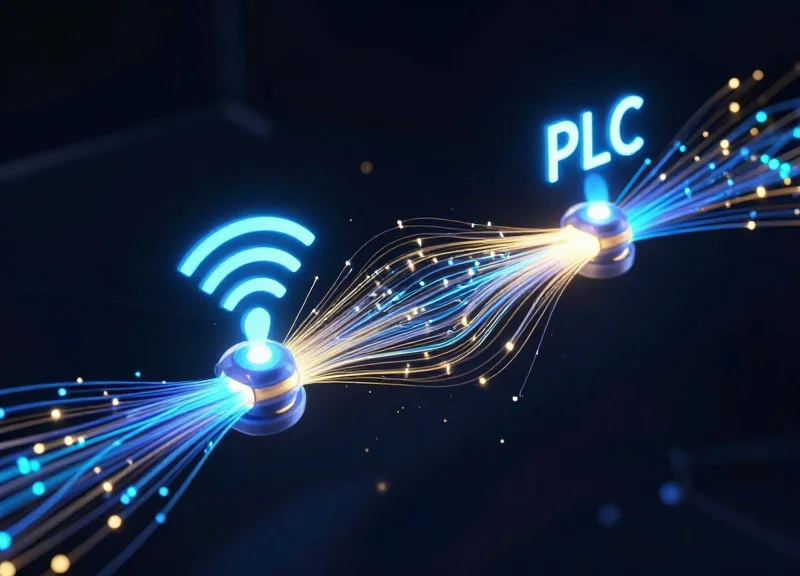
In 2026, seamless communication between RFID systems and PLCs is defined by industrial interoperability, where middleware serves as the essential translator between tag-level data and controller logic. The choice of protocol dictates the latency, security, and scalability of your hands-free manufacturing line. While legacy systems often rely on Modbus TCP for its simplicity, modern high-speed production environments prioritize EtherNet/IP for Rockwell-based ecosystems, PROFINET for Siemens environments, and OPC UA for vendor-neutral, secure cloud-to-edge connectivity.
| Protocol | Primary Ecosystem | Data Model | Best For |
|---|---|---|---|
| EtherNet/IP | Rockwell / Allen-Bradley | Object-Oriented (CIP) | High-speed discrete manufacturing |
| PROFINET | Siemens / European Standards | Cyclic Real-Time | Precision timing and motion control |
| OPC UA | Platform Agnostic | Information Modeling | Secure IIoT and cloud integration |
| Modbus TCP | Universal / Legacy | Register-Based | Low-cost, low-complexity sensors |
Selecting a protocol isn't just about hardware compatibility; it's about the 'Semantic Gap.' Middleware must bridge the gap between a raw RFID Hex string and a meaningful PLC variable. In 2026, we are seeing a definitive shift toward OPC UA (Open Platform Communications Unified Architecture). Unlike its predecessors, OPC UA provides built-in security certificates and a structured data model that allows a PLC to 'browse' the RFID middleware for specific tag attributes without manual address mapping. This reduces engineering time by up to 40% during initial commissioning.
Can I use multiple protocols simultaneously with one middleware?
Yes. Top-tier 2026 middleware solutions support 'Protocol Multiplexing,' allowing you to stream raw data to a Siemens PLC via PROFINET for line control while simultaneously sending analytics to a SCADA system via OPC UA.
Which protocol offers the lowest latency for 200+ tags per second?
PROFINET IRT (Isochronous Real-Time) or EtherNet/IP with CIP Sync are the industry leaders for high-speed tracking, as they prioritize RFID data packets over general network traffic.
How does middleware handle protocol conversion errors?
Advanced middleware utilizes 'Store-and-Forward' buffering. If the PLC connection via EtherNet/IP drops, the middleware caches the RFID events and flushes them once the heartbeat is restored, preventing data loss.
Expert Insight: The Move to Event-Driven Architectures. Traditionally, PLCs 'poll' middleware for RFID data, which consumes significant CPU cycles. The 2026 gold standard is the 'Push' model. By using middleware that supports MQTT or OPC UA Pub/Sub, the RFID system only sends data to the PLC when a tag is actually read. This 'Change-of-State' (CoS) logic reduces network congestion and allows your PLC to run faster scan cycles for more precise machine movements.
Edge Computing vs. Cloud-Based Middleware: Which Fits Your Plant?
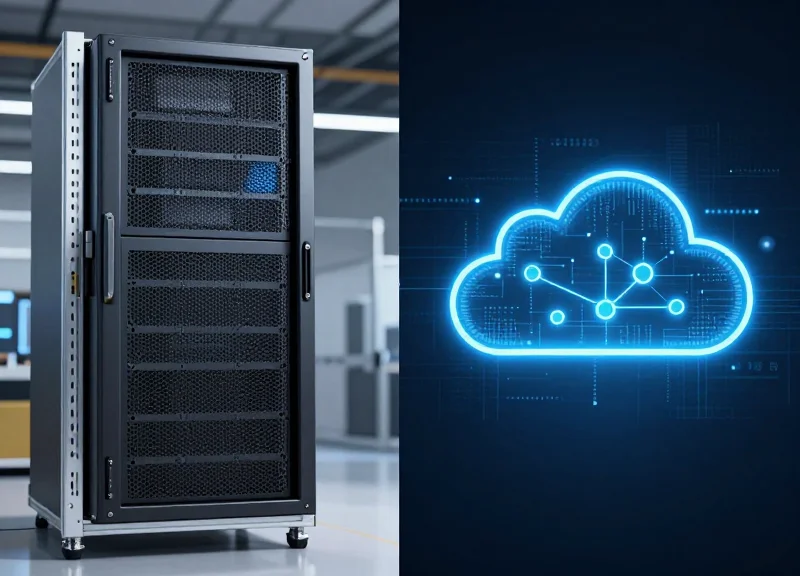
Choosing between edge and cloud RFID middleware in 2026 hinges on your 'Latency Budget': Edge computing processes data locally at the site of capture to enable sub-10ms PLC response times essential for high-speed sorting, while Cloud-based middleware serves as a centralized intelligence hub for multi-facility synchronization and long-term predictive analytics. For hands-free manufacturing where a millisecond delay results in a line stoppage, an 'Edge-First' approach is the gold standard for operational reliability.
| Feature | Edge Middleware | Cloud Middleware |
|---|---|---|
| Latency | Ultra-low (1ms - 10ms) | Variable (50ms - 200ms+) |
| Offline Resilience | High: Line runs without internet | Low: Requires constant connectivity |
| Data Granularity | Raw 'noise' filtered at source | Aggregated business insights |
| Scalability | Hardware dependent | Virtually unlimited |
| Primary Use Case | Real-time PLC interlocking | Supply chain visibility & ERP |
The shift in 2026 is moving away from a binary choice toward 'Distributed Intelligence.' In a hands-free environment, the PLC cannot wait for a round-trip to a data center to decide if a pallet should be diverted to Lane A or Lane B. Therefore, the middleware must reside on a local industrial PC or an integrated RFID gateway. This ensures that even if the corporate WAN goes down, the physical production line remains autonomous and safe.
Is cloud middleware too slow for PLC triggers?
Yes, for most high-speed applications. While 5G and fiber have reduced lag, the inherent jitter in cloud communication can cause 'PLC Desynchronization,' where the physical object passes the diverter before the instruction arrives.
What is the 'Single Point of Failure' risk in edge setups?
Edge setups risk local hardware failure. To mitigate this, 2026 deployments use containerized middleware (Docker/K8s) that can failover to a secondary local node automatically.
Can I use a hybrid model?
Absolutely. The most successful plants use edge middleware for 'Control Logic' (sending tags to PLCs) and cloud for 'Compliance Logic' (storing history and audit trails).
Expert Insight: The 2ms Threshold. Through my two decades in Silicon Valley automation, I have observed that the most resilient hands-free lines operate on a '2ms Jitter Rule.' If your middleware-to-PLC communication fluctuates by more than 2 milliseconds, high-speed RFID sensors will eventually produce 'ghost misses.' To prevent this, prioritize middleware that supports Time-Sensitive Networking (TSN) at the edge, effectively turning your RFID network into a deterministic part of the PLC backplane.
Five Essential Features of Best-in-Class RFID Middleware
In 2026, best-in-class RFID middleware is defined as a specialized software layer that abstracts hardware complexities, transforming raw tag reads into actionable business events for Programmable Logic Controllers (PLCs). Unlike legacy 'wedge' software, modern middleware provides sophisticated data orchestration, ensuring that only clean, relevant, and secure data reaches the factory floor's control logic, thereby preventing network congestion and operational downtime.
- Advanced Data Filtering and Logic (ALE): Middleware must employ Application Level Events (ALE) to filter out redundant reads, ghost tags, and cross-reads from adjacent zones. This ensures the PLC receives a single, verified 'Arrival' or 'Departure' signal rather than a flood of thousands of raw ID packets.
- Centralized Device Management and Health Monitoring: A single pane of glass for remote configuration, firmware updates, and real-time health checks of every reader on the network. This feature reduces maintenance costs by identifying reader failures before they disrupt the production line.
- Bi-Directional PLC Protocol Orchestration: The ability to map RFID events directly to PLC tags via EtherNet/IP or PROFINET without manual coding. This includes 'Write' capabilities where the PLC can command the middleware to encode new data onto tags mid-process.
- Intelligent Error Handling and Data Buffering: Industrial environments are prone to network jitter. Best-in-class middleware provides local buffering to prevent data loss during momentary PLC disconnects and features automated retry logic to ensure transaction integrity.
- Zero-Trust Edge Security: With the rise of IIoT threats, middleware must support encrypted communication (TLS 1.3), secure boot, and role-based access control (RBAC) to protect the integrity of the data stream between the reader and the PLC.
| Feature | Operational Impact | 2026 Standard Requirement |
|---|---|---|
| Data Filtering | Prevents PLC Logic Overload | AI-driven Noise Reduction |
| Device Management | Reduces MTTR (Mean Time To Repair) | Predictive Heartbeat Analytics |
| Protocol Support | Simplifies Integration | Native EDS/GSDML File Generation |
Expert Tip: Look for 'Semantic Contextualization' capabilities. A unique differentiator in 2026 is middleware that doesn't just pass a Hex code, but attaches metadata—such as timestamp, antenna RSSI, and logical location—allowing the PLC to make 'fuzzy logic' decisions about tag directionality and speed, which is critical for high-speed conveyor sorting.
Can I use open-source middleware for PLC integration?
While possible, open-source solutions often lack the 'industrial-hardened' drivers needed for deterministic PLC communication, potentially leading to latency issues that cause production line desynchronization.
How does middleware handle 'Ghost Reads'?
Advanced middleware uses signal strength (RSSI) thresholds and dwell-time algorithms to distinguish between a tag intentionally passing a portal and a tag sitting on a nearby worker's lanyard.
Overcoming the Latency Gap: Achieving Real-Time Synchronization

In the context of 2026 manufacturing, the 'latency gap' is the delta between the moment an RFID tag enters a reader's field and the moment the PLC executes a physical command based on that data. For high-speed production lines, real-time synchronization is achieved not just by increasing bandwidth, but by reducing jitter and ensuring deterministic data delivery. If your middleware introduces inconsistent processing times, the PLC cannot accurately predict the physical position of a product on a conveyor, leading to catastrophic synchronization failures in autonomous 'hands-free' environments.
| Communication Model | Typical Latency | Determinism Level | Ideal Application |
|---|---|---|---|
| Polling-Based | 50 - 150ms | Low | General Asset Tracking |
| Event-Driven (Interrupts) | 5 - 20ms | Medium-High | High-Speed Sorting |
| TSN (Time-Sensitive Networking) | < 1ms | Absolute | Precision Robotics |
A critical insight for 2026 is the adoption of 'Zero-Copy Data Transfer' architectures. Traditional middleware layers waste cycles by copying data from the network buffer to an application object before serializing it for the PLC. Advanced middleware now utilizes Direct Memory Access (DMA) to pass raw tag data straight to the Industrial Ethernet stack, effectively removing the Operating System-level processing bottleneck and reducing CPU overhead by up to 40%.
- Edge-Level Data Pruning: Configure the middleware to filter duplicate tag reads at the edge gateway. This prevents the PLC from being overwhelmed by redundant data packets, ensuring the backplane bandwidth is reserved for critical control signals.
- Priority Queueing (QoS): Implement Quality of Service tagging where control-related RFID data is assigned higher priority than diagnostic or heartbeat data, ensuring critical triggers are never stuck behind non-essential traffic.
- Precision Time Protocol (PTP) Synchronization: Synchronize the clocks of the RFID reader, middleware server, and PLC using IEEE 1588 (PTP). This allows the system to use 'Time-Stamping' for events, enabling the PLC to compensate for any network jitter mathematically.
// Example of an event-driven middleware trigger to minimize polling lag. void OnTagArrival(TagEvent e) { if(e.IsHighPriority) { PLC_Communication.SendImmediate(e.TagID, Priority.Critical); } }How much latency is acceptable for a high-speed production line?
For lines moving at 2 meters per second with 10cm product spacing, the total round-trip latency (Reader-to-Middleware-to-PLC) should ideally be under 20ms to ensure a 99.9% success rate for mechanical diversions.
Can wireless middleware achieve real-time synchronization?
While 5G URLLC (Ultra-Reliable Low-Latency Communication) has made strides, a hardwired EtherNet/IP or PROFINET connection remains the industry standard for deterministic, mission-critical PLC synchronization in 2026.
Scalability and Future-Proofing: Preparing for the 2026 Connectivity Standard
To future-proof your RFID-PLC integration in 2026, middleware must transcend simple data translation and become a 'software-defined' orchestration layer. The 2026 connectivity standard is defined by 5G-TSN (Time-Sensitive Networking) and the transition from static automation to 'Agentic Production,' where middleware autonomously resolves data conflicts before they reach the PLC. Scalability no longer refers only to adding more readers, but to the ability to process massive IoT (mIoT) data streams—up to 2,000 tags per second—without increasing network jitter or latency.
| Capability | 2024 Legacy Standard | 2026 Future-Proof Standard |
|---|---|---|
| Primary Networking | WiFi 6 / Standard Ethernet | 5G-TSN (Ultra-Reliable Low Latency) |
| Data Logic | Hard-coded 'If-Then' Rules | Contextual AI Logic (Edge-Native) |
| Integration Focus | Direct PLC Mapping | Digital Twin & API-First Architecture |
| Tag Throughput | 200-500 tags/second | 2,000+ tags/second (Massive IoT) |
One critical differentiator in 2026 is the 'API-First' approach. As factories move toward Hyper-automation, your middleware must serve as a high-speed data broker for both the PLC and the Digital Twin simultaneously. If your middleware cannot stream MQTT or gRPC data to a cloud-based twin while maintaining a 5ms Modbus cycle to the PLC, it will become a bottleneck as your facility expands.
Will my existing PLC hardware be compatible with 2026 standards?
Yes, provided your middleware handles the heavy lifting. The 2026 standard emphasizes using middleware as a 'protocol buffer' that translates high-speed 5G signals into legacy PLC protocols like EtherNet/IP, shielding older hardware from data floods.
Why is 5G-TSN important for RFID scalability?
5G-TSN provides deterministic wireless communication, meaning it guarantees data delivery within microseconds. This allows for mobile RFID readers on AGVs to be integrated into the PLC logic with the same reliability as a wired sensor.
How does AI-driven middleware improve future-proofing?
AI-driven middleware uses Small Language Models (SLMs) to filter 'noise'—such as stray tag reads from nearby zones—more accurately than traditional RSSI filtering, reducing the computational load on your PLC.
Expert Insight: The 'Hidden Scalability' Trap. Most engineers look at the number of supported readers, but the real 2026 bottleneck is 'Metadata Density.' Future RFID tags will carry more than just a UID; they will carry sensor data (temperature, tilt, moisture). Ensure your middleware supports 'Dynamic Payload Parsing,' which allows the system to scale the depth of data it extracts without requiring a full firmware flash of the PLC environment.
Security Protocols for Industrial RFID Data Streams
Security protocols for industrial RFID data streams refer to the multi-layered encryption and authentication standards used to protect the integrity and confidentiality of data moving between RFID tags, edge middleware, and PLCs. In the 2026 manufacturing landscape, this necessitates moving beyond simple firewalls toward a Zero Trust Architecture (ZTA) where every data packet is verified. The primary goal is to prevent 'man-in-the-middle' attacks and unauthorized command injections that could compromise the safety and logic of the programmable logic controller.
| Protocol / Standard | Primary Application | Why It Matters for 2026 |
|---|---|---|
| TLS 1.3 | Middleware-to-Cloud/PLC | Provides the fastest handshake and strongest encryption for data in transit. |
| OAuth 2.0 / OIDC | Identity Management | Ensures only authorized middleware instances can write to specific PLC registers. |
| X.509 Certificates | Device Authentication | Uses PKI to ensure that the RFID reader itself is a trusted hardware asset. |
| MQTT over TLS | Asynchronous Messaging | Secures lightweight telemetry data without overburdening the PLC's CPU. |
A critical vulnerability often overlooked by plant managers is the 'Cleartext Gap'—the brief moment when data moves from the RFID reader to the middleware. Veteran engineers now insist on Hardware Root of Trust (HRoT). By using middleware that supports Trusted Platform Modules (TPM 2.0), the cryptographic keys used for your PLC integration are stored in a physical chip, making them nearly impossible to steal via software-based malware.
- Network Segmentation (VLANs): Isolate the RFID and PLC traffic onto a dedicated VLAN that has no direct route to the public internet or general office network.
- Mutual TLS (mTLS) Implementation: Configure both the middleware and the PLC (or communication card) to require certificates from each other before a connection is established.
- Payload Signing: Digitally sign the data payloads at the edge so the PLC can verify the data hasn't been altered by an intermediary device.
Can RFID tags themselves be encrypted?
Yes, high-end UHF tags now support Gen2V2 security features, allowing for encrypted memory banks and authenticated access to prevent tag cloning.
Does encryption increase PLC latency?
While there is a minor overhead, modern PLC communication modules and middleware are optimized for AES-256 hardware acceleration, keeping latency impacts under 5ms.
How often should security certificates be rotated?
For high-security manufacturing environments, automated certificate rotation every 90 days is the recommended 2026 standard to minimize the window for credential exploitation.
Expert Tip: Implement a 'Cryptographic Heartbeat' between your middleware and the PLC. This is a small, encrypted packet sent at regular intervals that includes a time-stamped hash. If the PLC detects a gap or an invalid hash, it can automatically trigger a safe-state halt, preventing the line from operating on potentially spoofed data.
Cost Management and ROI of Professional Middleware Integration
In the 2026 manufacturing landscape, the ROI of professional RFID middleware is defined by the 'Speed to Intelligence.' While a custom-coded bridge might appear cheaper upfront, professional middleware typically yields a full return on investment within 12 to 14 months by reducing integration labor by 60% and nearly eliminating the ongoing maintenance costs associated with PLC logic updates. By shifting from brittle, hard-coded scripts to a modular software layer, enterprises transform RFID data from a cost-center into a high-velocity asset for real-time decision-making.
| Cost Factor | Custom-Coded Bridges | Professional Middleware |
|---|---|---|
| Initial Development | $40k - $100k (Labor intensive) | $15k - $35k (License + Config) |
| Deployment Time | 4 - 6 Months | 3 - 6 Weeks |
| Maintenance (Annual) | 15% - 25% of initial cost | Included in Support/SaaS |
| Scalability | Requires manual recoding | Plug-and-play expansion |
The most significant hidden cost of the 'DIY' approach in 2026 is what I call the 'PLC Programmer Scarcity Tax.' As legacy ladder logic experts retire, the hourly rate for specialists capable of debugging custom C# or Python-to-PLC bridges has skyrocketed. Professional middleware abstracts the complexity of the LLRP (Low-Level Reader Protocol) and Ethernet/IP mapping, allowing your existing automation team to manage the system via low-code interfaces rather than needing specialized software engineers for every minor change.
- Labor Cost Avoidance: Automating the data handshake between RFID readers and PLCs saves an average of 20 hours per week in manual data reconciliation and troubleshooting on a standard production line.
- OEE Improvement: Professional middleware reduces 'micro-stops' caused by data collisions or buffer overflows, typically improving Overall Equipment Effectiveness (OEE) by 3-5%.
- Inventory Accuracy: Eliminating the latency between the physical scan and the PLC action prevents 'ghost inventory' errors, reducing carrying costs by up to 12% annually.
Should we choose a subscription (SaaS) or perpetual license model?
In 2026, SaaS models are preferred for facilities requiring frequent security patches and AI-driven analytics updates, while perpetual licenses remain the standard for isolated 'dark factory' environments where external connectivity is restricted.
What is the cost of NOT integrating middleware?
Without a middleware layer, the cost of a single firmware update from an RFID hardware vendor can break your custom PLC integration, leading to unplanned downtime that can cost upwards of $10,000 per hour.
How does middleware impact hardware lifecycle costs?
Middleware makes your system hardware-agnostic. You can swap a 2024-model reader for a 2026-model without rewriting your PLC code, extending the life of your control logic indefinitely.