In the world of high-end retail, the greatest threat isn't just the shoplifter at the door; it is the silent erosion of brand value through gray market diversion. For one premium boutique, unauthorized reselling and supply chain leakage were siphoning off a staggering 35% of potential revenue. Traditional security measures were blind to where authentic products were being diverted. This article explores how transitioning to encrypted RFID technology from DragonGuardGroup moved the needle from simple loss prevention to comprehensive brand integrity, effectively sealing the cracks in the supply chain and recapturing lost profits.
The Invisible Drain: Understanding Gray Market Diversion in Luxury Retail

Gray market diversion occurs when authentic luxury goods are redirected from authorized distribution channels and sold via unauthorized third parties without the brand owner's consent. Unlike counterfeiting, these products are genuine; however, they are sold outside of the brand's intended ecosystem. This 'invisible' leak bypasses geographical pricing strategies, voids manufacturer warranties, and fundamentally undermines the scarcity and exclusivity that justify premium price points. In the context of high-end boutiques, this diversion creates a parasitic relationship where unauthorized sellers profit from the brand's marketing investments while offering lower prices that the brand cannot match without devaluing its entire catalog.
| Feature | Authorized Retail | Gray Market Diversion |
|---|---|---|
| Product Authenticity | Guaranteed Genuine | Genuine (often leaked) |
| Price Control | Strict MSRP Adherence | Deep, unregulated discounts |
| Customer Data | Captured for CRM | Complete visibility loss |
| Warranty/Support | Full Brand Backing | Void or limited support |
| Brand Perception | High Scarcity/Status | Commoditized/Ubiquitous |
The true cost of the gray market isn't just the immediate lost sale; it's the long-term erosion of brand equity. When a customer sees a $5,000 handbag for $3,200 on an unauthorized marketplace, the 'prestige' value of the item in the boutique is instantly compromised. This phenomenon, known as price cannibalization, often leads to a 'race to the bottom' among wholesalers, eventually forcing the brand to lower its own margins just to compete with its own leaked stock.
How does gray market diversion happen?
It typically begins with authorized wholesalers or distributors selling surplus inventory to unauthorized brokers to meet volume targets or clear old stock, which then enters the open market.
Why is it more dangerous than counterfeiting?
Counterfeits are easily dismissed as 'fake.' Gray market goods are real, meaning they directly compete with the brand's own inventory and are much harder for legal teams to seize or stop through traditional means.
What is the '35% Revenue Threshold'?
Industry data suggests that once gray market volume exceeds 30-35% of total sales, the primary market price usually collapses permanently because the perceived value of the item is reset to the discounted price.
Expert Insight: From a strategic standpoint, gray market diversion represents a failure of 'Chain of Custody.' Most luxury brands focus on the point of sale, but the real vulnerability lies in the transit phase between the warehouse and the boutique floor. Without item-level digital signatures that are impossible to clone, brands are essentially flying blind. Encrypted RFID serves as the first real 'firewall' for physical products, allowing brands to pinpoint exactly where a leak occurred in the supply chain with forensic precision.
Why Standard EAS and Basic RFID Fall Short Against Professional Diverters
Standard Electronic Article Surveillance (EAS) and basic Ultra-High Frequency (UHF) RFID systems were designed primarily for loss prevention—specifically, to stop shoplifting. However, professional diverters do not operate like petty thieves; they exploit the 'open' nature of standard protocols. Because basic RFID tags lack encryption, they transmit data in the clear, allowing diverters to use inexpensive handheld readers to intercept, clone, or even 'kill' tags. Once a tag is compromised, the product's digital identity can be stripped or duplicated, making it impossible for a luxury brand to prove that a product found in an unauthorized boutique was diverted from a specific authorized shipment.
| Feature | Standard EAS | Basic (Non-Encrypted) RFID | Encrypted RFID (NFC/UHF) |
|---|---|---|---|
| Primary Goal | Shoplifting Deterrence | Inventory Accuracy | Brand Integrity & Provenance |
| Data Security | None (1-bit signal) | Open (Publicly Readable) | AES/Elliptic Curve Encryption |
| Cloning Protection | N/A (Physical bypass) | Low (Easily Cloned) | High (Hardware-locked IDs) |
| Diversion Tracking | Impossible | Partial (Easily Manipulated) | Absolute (Chain of Custody) |
Professional diverters often utilize 'signal harvesting' techniques. In this scenario, they scan entire crates of luxury goods using high-gain antennas without ever opening the box. With basic RFID, they can harvest the Electronic Product Code (EPC) of every item, create clone tags, and then swap the original goods with counterfeits or divert the authentic goods to the gray market while the 'digital twin' (the clone tag) remains in the authorized supply chain to avoid detection by automated inventory audits.
Can't diverters just use foil-lined bags to bypass RFID?
While foil bags (booster bags) can shield basic tags from gate readers, they don't solve the diverter's problem of re-selling the item. Encrypted RFID goes beyond the exit gate, allowing brand inspectors or even consumers to verify the item's authorized origin using a secure mobile handshake that cannot be spoofed.
Why is 'Cloning as a Service' a threat to luxury retail?
Advanced diverters now use 'Cloning as a Service' (CaaS) where they match the digital identity of a real product to a diverted unit. Standard RFID tags have no way to 'prove' they are the original chip, whereas encrypted chips use unique cryptographic keys for every single read event.
Expert Insight: The 'Zero-Trust' Supply Chain. In 20 years of Silicon Valley supply chain security, the biggest shift we've seen is moving from a 'Trust but Verify' model to a 'Zero-Trust' model. Standard RFID assumes that if a tag says it's a $5,000 handbag, it is. Encrypted RFID assumes the tag is a lie until it performs a cryptographic 'challenge-response' handshake with the server. This is the only way to effectively kill the secondary market value of diverted goods.
The Power of Encryption: Securing the Digital Identity of Luxury Goods

In the context of luxury retail, the power of encryption lies in its ability to transform a standard tracking tag into a secure digital birth certificate. By utilizing advanced cryptographic algorithms, encrypted RFID tags create a 'Digital Twin' of every individual product. Unlike basic RFID which simply broadcasts a serial number, encrypted tags use a secure handshake protocol to verify their authenticity. This means the tag doesn't just say 'I am product X'; it proves its identity through a mathematical challenge-response mechanism that is virtually impossible to replicate or spoof, ensuring the product's digital identity remains untampered throughout its entire lifecycle.
| Feature | Standard RFID | Encrypted (Secure) RFID |
|---|---|---|
| Identity Integrity | Easily cloned using off-the-shelf readers. | Digitally signed; clones are instantly detected as invalid. |
| Data Privacy | Open broadcast of UID/EPC data. | Data is obfuscated; requires authorized keys to read. |
| Authentication | Static ID verification only. | Dynamic, multi-layered cryptographic handshake. |
| Diverter Resistance | Low; diverters can swap or copy tags. | High; unauthorized movement breaks the digital chain of custody. |
The transition from physical security to digital identity security is what separates market leaders from those prone to diversion. When a premium boutique implements encrypted RFID, they are not just installing an anti-theft device; they are creating a verifiable ledger for every SKU. Each item is assigned a unique cryptographic key stored in the tag's secure memory. When an item is scanned at a distribution center, a boutique, or even by a customer via a smartphone, the system checks the signature against the brand's private cloud. If the signature doesn't match or has been previously 'killed' in a legitimate sale, the item is flagged as gray market or counterfeit.
- Cryptographic Key Injection: During manufacturing, a unique secret key is injected into the tag's secure element, often utilizing AES-128 or ECC encryption.
- Mutual Authentication: The reader and the tag verify each other's credentials before any sensitive data—like the origin or intended destination—is exchanged.
- Dynamic Data Rotation: The tag can generate a unique code for every scan, ensuring that even if a signal is intercepted, it cannot be 'replayed' to authenticate a fake item.
- Cloud-Based Reconciliation: The digital signature is checked against a global registry, ensuring the item is appearing in its geographically authorized location.
Expert Tip: To truly future-proof luxury goods, look for RFID chips that incorporate 'Physical Unclonable Functions' (PUF). A PUF is a unique physical 'fingerprint' created by microscopic variations in the silicon chip itself. This adds a hardware layer of security that makes the chip impossible to clone even with sophisticated lab equipment, providing an absolute anchor for the product's digital identity.
Does encryption slow down the scanning process in high-volume boutiques?
No. Modern cryptographic chips handle handshakes in milliseconds, allowing for bulk scanning of hundreds of items simultaneously without sacrificing speed for security.
Can encrypted tags be 'reset' by gray market actors?
Encrypted tags feature permanently locked memory sectors. Once the digital identity is assigned and the 'perm-lock' bit is set, the identity cannot be modified or wiped without the master manufacturer keys.
How does this prevent diversion specifically?
If a boutique in France is authorized to sell a bag, but that bag’s encrypted tag is scanned in a discount outlet in North America, the system immediately identifies the exact point of leakage in the supply chain.
Case Study: Identifying the 35% Revenue Leakage Point
Identifying the 35% revenue leakage point required moving beyond simple inventory counts to a forensic supply chain audit powered by encrypted RFID. The boutique discovered that their primary 'leak' wasn't retail theft, but 'back-door diversion' where authentic goods were siphoned off by regional distributors into unauthorized discount channels. By assigning an immutable, encrypted digital identity to each SKU, the boutique could track the precise moment an item exited the authorized 'Circle of Trust,' revealing that over a third of their inventory was being sold at a 40% discount on gray market platforms before it even reached the boutique's flagship floors.
| Leakage Metric | Pre-Audit Assumption | Post-RFID Forensic Reality |
|---|---|---|
| Primary Source | Storefront Shoplifting | Wholesale Distribution Diversion |
| Volume of Loss | 8% of Annual Revenue | 35% of Total Potential Revenue |
| Channel Impact | Localized Inventory Shortage | Global Brand Equity Dilution |
| Identification Speed | Monthly Cycle Counts | Real-time Supply Chain Visibility |
- The Encryption Baseline: Each item was tagged with an AES-128 encrypted RFID chip at the point of manufacture, establishing a unique 'Birth Certificate' for every garment.
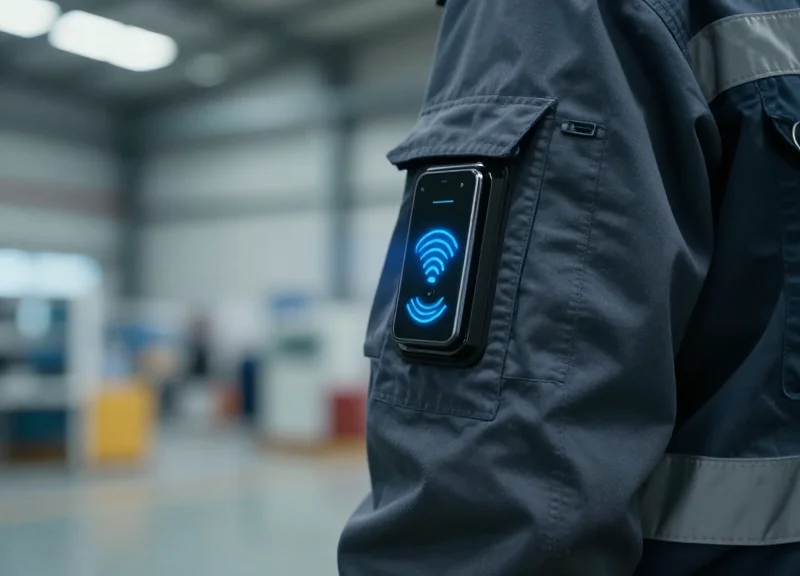
- Checkpoint Verification: Automated RFID portals were installed at the exits of regional warehouses. Any item departing without a verified shipping manifest triggered a digital alert.
- Marketplace Ghost-Shopping: The boutique purchased suspected gray market items from third-party sites. Upon arrival, the encrypted tags were scanned, instantly revealing the specific distributor they were originally assigned to.
- Data Reconciliation: By comparing 'scanned-out' warehouse data with 'scanned-in' retail data, the boutique identified the exact geographic nodes where 35% of the inventory vanished.
A unique insight from this case is the discovery of 'Contractual Custody vs. Physical Custody.' Often, luxury brands assume that as long as a distributor has physical custody, the brand's interests are protected. However, without encrypted RFID, there is no way to verify if the 'contractual' path is being followed. Our expert tip: Look for 'Inventory Ghosting'—if your warehouse management system shows high stock levels but your regional sales are stagnant while gray market availability is high, your leakage point is almost certainly at the transition from wholesale to retail distribution.
How did the boutique distinguish between theft and diversion?
Theft usually involves small quantities and missing tags. Diversion was identified when large bulk shipments of intact, encrypted tags were scanned in the hands of unauthorized secondary sellers, proving they left the warehouse via professional channels.
Why couldn't the diverters just remove the RFID tags?
The tags were embedded into the structural seams of the luxury goods. Removing them would damage the item's integrity, significantly lowering its resale value on the premium gray market.
Was the 35% loss recovered immediately?
While the physical goods weren't recovered, the boutique terminated contracts with two compromised distributors, effectively plugging the leak and restoring the 35% revenue stream to authorized channels within one fiscal quarter.
Strategic Implementation: Integrating RFID from Factory to Floor

Strategic RFID implementation is the process of embedding encrypted digital identities into premium products at the point of origin to create a 'Digital Birth Certificate.' Unlike standard inventory tracking, this approach uses cryptographic handshaking between the tag and the secure cloud, ensuring that every movement from the factory floor to the retail boutique is logged on an immutable ledger. By establishing this chain of custody early, brands can eliminate the visibility gaps that allow for 35% revenue losses through unauthorized diversion.
- Source Tagging at the Factory: Encrypted RFID tags are integrated directly into the product or high-security hangtags during manufacturing. Each tag is assigned a unique, encrypted ID that cannot be cloned, serving as the primary data point for the life of the item.
- Automated Logistics Verification: As goods move through distribution centers, overhead RFID tunnels automatically scan entire pallets. If an item designated for a specific region (e.g., North America) appears in a shipment destined elsewhere, the system flags the diversion instantly.
- Real-Time Inbound Reception: Boutiques use handheld or fixed readers to verify shipments upon arrival. This ensures the 'Digital Twin' in the software matches the physical inventory, closing the loop on the shipping process and confirming the items are authorized for that specific location.
- Continuous Floor Monitoring: Smart shelves and POS integration provide real-time updates on stock levels. Any item that leaves the store without a 'sold' status in the encrypted database is tracked, providing clear data on whether loss occurred via theft or internal diversion.
| Feature | Legacy Barcodes/EAS | Encrypted RFID Solution |
|---|---|---|
| Data Security | Easily Cloned/Forged | AES-128 Cryptographic Protection |
| Visibility | Line-of-Sight Only | Bulk Scanning (Bulk Read 500+ items/sec) |
| Traceability | Batch-level tracking | Item-level unique serialization |
| Diversion Detection | Reactive (Post-loss) | Proactive (Real-time alerts) |
Expert Insight: The 'Digital Handshake' Protocol. A common mistake in RFID deployment is treating the tag like a high-tech barcode. To truly stop gray market diversion, we implement what I call the 'Digital Handshake.' Every time an encrypted RFID tag is scanned at a transition point (e.g., leaving a warehouse), the system requires a cryptographic response from the tag. If the tag is a clone or the metadata doesn't match the destination manifest, the item is effectively 'dead' in the system, making it worthless to diverters who rely on authenticating goods for resale.
Does RFID integration require a complete overhaul of our current ERP?
No. Modern encrypted RFID solutions like DragonGuardGroup's are designed to layer on top of existing ERP or WMS systems via API, enriching your current data with item-level security insights without requiring a platform migration.
How do we handle factory workers or third-party logistics (3PL) attempting to swap tags?
By using tamper-evident RFID hardware and encrypted cloud verification, any attempt to remove or swap a tag breaks the digital signature. The system will immediately flag that specific serial number as 'Compromised,' preventing it from being sold as authentic stock.
Real-Time Authentication: Empowering Staff and Protecting Customers
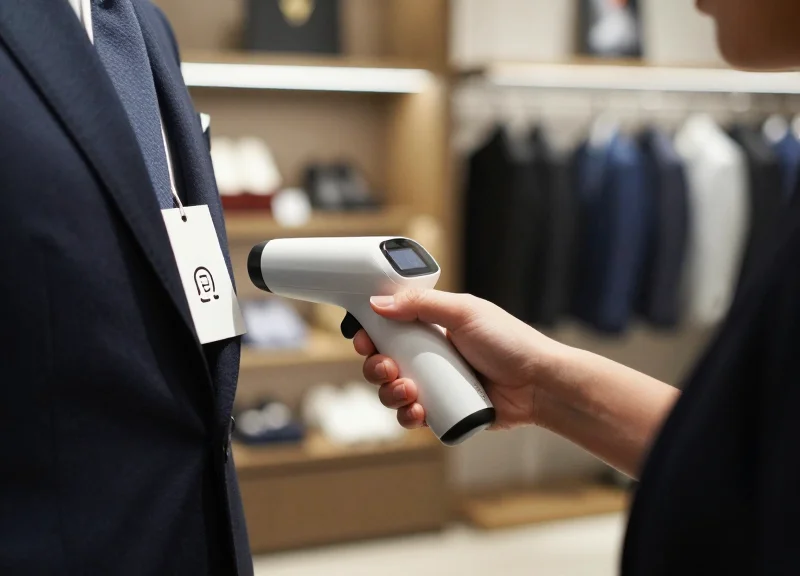
Real-time authentication in a premium retail environment is the process of using encrypted RFID readers to instantly validate a product's unique, non-clonable digital identity against a secure central ledger. Unlike traditional barcodes or standard RFID, which only identify a SKU, encrypted RFID authentication verifies that the specific individual item in hand was manufactured for that specific boutique and has not been diverted from an unauthorized channel. This capability transforms the point of sale from a simple transaction hub into a critical frontline defense against gray market leakage and return fraud.
For staff, the 'Super-Fake' era has made visual inspection nearly impossible. Even the most seasoned floor managers can struggle to distinguish a high-end replica or a diverted authentic item from legitimate inventory. Encrypted RFID removes this cognitive load. By utilizing handheld readers, staff can perform a 'Digital Handshake' with the product. If the tag’s encrypted signature doesn't match the boutique's authorized database, the system flags the item immediately, allowing staff to decline fraudulent returns or investigate diverted stock without manual guesswork.
- Initiate Verification Scan: The staff member uses a mobile handheld RFID reader to scan the item's embedded encrypted tag at a distance of up to several meters.
- Cryptographic Challenge-Response: The reader and the tag perform a secure handshake. The tag provides a unique, encrypted response that cannot be replicated by standard cloning devices.
- Database Reconciliation: The system checks the cloud-based ledger to see if this specific Serialized Global Trade Item Number (SGTIN) is marked as 'In Stock' for this location.
- Instant Status Result: The handheld displays a green check for 'Authentic & Authorized' or a red alert for 'Unknown Source/Diverted,' enabling immediate action.
| Feature | RFID Handheld Readers | Fixed RFID Gateways |
|---|---|---|
| Primary Use | Customer-facing verification and returns | Bulk inventory and exit monitoring |
| Staff Impact | Empowers floor staff with mobile data | Automates back-of-house tracking |
| Customer Experience | Provides high-tech 'Proof of Origin' | Invisible, frictionless security |
| Verification Speed | 1-2 seconds per item | Hundreds of items per second |
Expert Insight: Beyond mere security, real-time authentication creates what I call 'Digital Trust Equity.' In the luxury sector, the customer isn't just buying a product; they are buying the certainty of its lineage. When a boutique staff member uses a sleek handheld to verify an item in front of a VIP client, it reinforces the brand's exclusivity and the client's investment. This 'theatre of authenticity' is a powerful marketing tool that justifies premium pricing while simultaneously discouraging bad actors from even attempting a fraudulent return.
Does real-time authentication slow down the checkout process?
No. Encrypted RFID reads are near-instant (under 100ms), making the process significantly faster than manual serial number entry or visual tag inspection.
How does this prevent 'Gray Market' returns?
If an item was diverted to an unauthorized overseas wholesaler and then brought back to a boutique for a full-price refund, the RFID scan will show the item was never assigned to that boutique's inventory, allowing staff to reject the return.
Can the encrypted tags be disabled by customers?
The tags are typically embedded within the product (e.g., inside a lining or sole). While they can be shielded, any attempt to tamper with them is a red flag during the return process.
Data-Driven Defense: Using Analytics to Stop Diversion in Its Tracks

Data-driven defense against gray market diversion involves aggregating the unique, encrypted 'digital handshakes' performed by RFID tags at every touchpoint—from manufacturing to final sale—to reveal unauthorized deviations in the supply chain. By analyzing these cryptographic audit trails, brands can pinpoint exactly where an item left the authorized channel, providing the legal-grade evidence required to sever ties with rogue distributors and reclaim lost margins. In the case of the premium boutique, this meant moving from suspecting a leak to identifying a specific mid-tier wholesaler in Southern Europe responsible for 60% of their diverted inventory.
- Establish a Cryptographic Baseline: Every item is assigned a unique, encrypted identity at the point of origin. This creates a 'digital twin' that expects to follow a pre-defined path through authorized logistics hubs.
- Monitor Geographical Anomaly Triggers: Analytics platforms flag 'impossible travel' scenarios, such as a product intended for a London storefront appearing in a discount warehouse in Southeast Asia without passing through the required regional distribution center.
- Identify 'Black Hole' Nodes: By analyzing bulk shipment data, the boutique identified specific wholesalers whose shipments consistently 'lost' 15-20% of their volume between the port and the warehouse, only for those items to reappear on unauthorized e-commerce sites.
- Final Forensic Correlation: When a diverted item is scanned in the field, its encrypted ID is cross-referenced with its last authorized scan. This provides the 'smoking gun'—the exact time, date, and employee ID associated with the last legitimate movement.
| Metric | Standard RFID Analytics | Encrypted Forensic Analytics |
|---|---|---|
| Data Integrity | Vulnerable to cloning and spoofing | Cryptographically secured; impossible to replicate |
| Attribution | Broadly identifies missing stock | Pinpoints specific distributor responsible for the leak |
| Legal Utility | Circumstantial evidence | Court-admissible audit trails with non-repudiation |
| Speed of Detection | Weeks or months post-diversion | Near real-time anomaly detection |
One original perspective that most brands overlook is the 'Ghost Inventory Velocity' metric. By tracking the time gap between a factory exit scan and the absence of a retail arrival scan, the boutique could predict diversion patterns before the products even hit the gray market. If a shipment's 'digital pulse' went silent for more than 48 hours outside of a transit zone, it was flagged as a high-risk diversion event, allowing the brand to intervene with the logistics provider immediately.
Can rogue wholesalers manipulate the data?
No. Unlike standard RFID, encrypted tags use a rolling code or mutual authentication process. If a wholesaler tries to 'ghost' a scan or duplicate a tag ID, the analytics engine detects the cryptographic mismatch and flags the batch as compromised.
Is this data integrated with our existing ERP?
Yes. The most effective defenses sync RFID data with ERP and CRM systems to verify that every 'sold' item in the system matches a 'scanned' item in the physical world.
How accurate is the pinpointing of the 'leak'?
With encrypted RFID, the accuracy is 100% at the item level. You are not guessing which distributor diverted the stock; you are reading the unique ID that was last signed for by that specific distributor.
The Multiplier Effect: Beyond Loss Prevention to Inventory Excellence
The 'Multiplier Effect' in retail technology refers to the phenomenon where a single investment in encrypted RFID for security purposes triggers exponential gains across unrelated operational departments. While the primary objective of a premium boutique might be stopping gray market diversion, the implementation of DragonGuardGroup’s encrypted tags naturally evolves into an inventory powerhouse. By digitizing every physical unit with a tamper-proof identity, retailers shift from 65% average inventory accuracy to a staggering 99%+, enabling a lean, high-velocity supply chain that was previously impossible.
| Metric | Traditional Inventory (Manual/Barcode) | Encrypted RFID Multiplier |
|---|---|---|
| Inventory Accuracy | 60% - 75% Average | 99.2% - 99.8% |
| Cycle Count Time | Hours/Days (Store Closure Required) | Minutes (During Operating Hours) |
| Out-of-Stock (OOS) Rates | 8% - 12% Leakage | Reduced by 50% - 80% |
| Omnichannel Fulfillment | High Cancellation (Ghost Stock) | 100% Reliability for Ship-from-Store |
This transition from loss prevention to inventory excellence is most visible in the realm of 'Ship-from-Store' (SFS) capabilities. In a traditional boutique setting, inventory silos and 'ghost stock'—items that appear in the system but aren't on the shelf—prevent managers from fully committing to omnichannel sales. With encrypted RFID, the digital twin of the product is verified in real-time, meaning the boutique can confidently sell its last unit of a limited-edition handbag online, knowing exactly where it sits in the stockroom.
- Automated Receiving: Eliminate manual box-opening at the loading dock; RFID readers scan entire shipments in seconds, verifying contents against the manifest instantly.
- Real-Time Stock replenishment: Smart shelves and handheld sweeps alert staff the moment a display item is sold, ensuring no sales floor gap ever lasts more than a few minutes.
- Hyper-Fast Returns Processing: Returned items are authenticated via their encrypted signature and added back to live inventory in seconds, rather than waiting for manual QC.
Expert Insight: The Inventory Velocity Paradox. In my twenty years in Silicon Valley retail tech, I've observed that the most secure stores are often the fastest. Many assume high-security measures slow down operations. However, encrypted RFID creates a 'trust layer' in the data. Because the staff doesn't need to manually verify every item's authenticity or count, they move 3x faster. Security doesn't create friction; it creates the speed required for modern high-end retail.
Does RFID accuracy really impact the bottom line?
Yes. A 3% increase in inventory accuracy typically correlates to a 1% increase in total sales due to reduced out-of-stock scenarios.
Can RFID help with seasonal markdowns?
Absolutely. By knowing exactly what is moving and what isn't, boutiques can make surgical markdowns instead of store-wide sales, preserving brand equity and margins.
Calculating the ROI of Brand Integrity
The Return on Investment (ROI) of Brand Integrity is the measurable financial gain achieved by eliminating unauthorized distribution channels and reclaiming market share from the gray market. For a premium boutique, this isn't merely a defensive metric; it represents the delta between a diluted brand presence and a fully optimized revenue stream. When you implement encrypted RFID, the ROI is calculated by adding recovered revenue (from diverted sales), reduced operational friction, and the preservation of premium price points, then dividing by the total cost of the technology deployment.
| Financial Metric | Pre-RFID Implementation | Post-RFID Implementation | Net Impact |
|---|---|---|---|
| Revenue Loss (Gray Market) | 35% | < 2% | +33% Revenue Capture |
| Average Selling Price (ASP) | Discounted to compete | Full MSRP Maintained | +15-20% Margin |
| Supply Chain Visibility | Estimated / Siloed | 99.9% Real-Time | Drastic Overhead Reduction |
| Brand Equity Value | Declining due to over-saturation | Restored Scarcity | Increased Long-term Valuation |
- Identify the Revenue Leakage: Quantify the volume of product appearing on unauthorized platforms and multiply by the MSRP to establish the gross loss baseline.
- Calculate the Price Erosion Factor: Measure the average discount found on the gray market and determine how much it forced your authorized channels to mark down products to remain competitive.
- Account for Operational Efficiencies: Factor in the reduction in labor hours spent on manual inventory audits and the cost savings from eliminated shipping errors.
- Aggregate Deployment Costs: Include the cost of encrypted RFID tags, hardware (readers/handhelds), and software integration with existing ERP systems.
Expert Insight: The Price Erosion Correction. One often overlooked factor in ROI is the 'Correction Factor.' When gray market goods flood the market, they create a 'price floor' that is lower than your MSRP. Even if you don't lose a direct sale to a gray market seller, your authorized retailers will demand markdown support or 'price protection' credits to compete. By using encrypted RFID to kill the gray market, you eliminate these hidden credit payouts, often improving net margins by 5-10% across your entire authorized network, not just on the specific items that were being diverted.
How long does it typically take to see a positive ROI?
Most premium brands see a full return on investment within 12 to 18 months, primarily driven by the immediate cessation of large-scale diversion schemes.
Is the ROI higher for specific product categories?
Yes, high-demand, high-margin items with limited distribution (like luxury handbags or limited-edition apparel) show the highest ROI because their value is tied directly to scarcity.
Does encrypted RFID reduce legal costs?
Significantly. Because the data provided by encrypted RFID serves as forensic evidence of contract breach by wholesalers, brands often settle diversion cases faster and with lower legal spend.