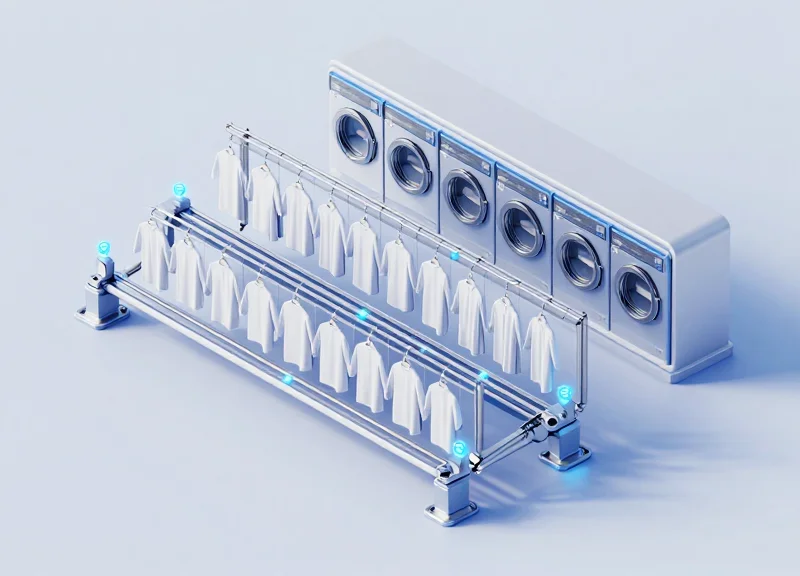
As we approach 2026, the global apparel and laundry logistics industry is facing an unprecedented demand for speed and accuracy. For decades, barcodes were the gold standard for tracking, but their limitations—manual line-of-sight requirements and susceptibility to wear—are becoming bottlenecks. Enter Next-Gen Laundry management powered by UHF RFID. This technology isn't just an upgrade; it is a fundamental shift that enables 99.9% precision in inventory management, even in the harshest industrial washing environments. At DragonGuardGroup, we see this transition as the definitive move toward fully autonomous apparel logistics.
The Evolution of Textile Tracking: Why Barcodes are Reaching Their Limit
For over five decades, the ubiquitous barcode has been the undisputed standard for textile identification. However, as we approach 2026, the 'optical bottleneck' of barcode technology has become the primary inhibitor of logistics scalability. Unlike modern wireless solutions, barcodes require a direct, unobstructed line-of-sight between the scanner and the tag. In an era where 99.9% precision is the baseline for global apparel brands, the sequential, manual nature of barcode scanning is no longer a viable method for managing millions of circulating assets.
| Feature | Traditional Barcode Systems | 2026 Logistics Requirements |
|---|---|---|
| Read Speed | 1 item per 2-5 seconds (Manual) | 700+ items per second (Automated) |
| Visibility | Direct Line-of-Sight Required | Non-Line-of-Sight (Bulk Scanning) |
| Durability | Prone to fading, tearing, or soiling | Resistant to high-temp/high-pressure wash |
| Data Capacity | Static (Read-only SKU) | Dynamic (Life-cycle & Repair History) |
The fundamental flaw in legacy tracking is the 'Hidden Labor Tax.' In a typical industrial laundry environment, workers spend up to 35% of their shift manually orienting garments so a laser can hit a 1D or 2D code. This manual manipulation is not just slow; it introduces a 3-5% human error rate that compounds across the supply chain, leading to lost inventory, incorrect billing, and dissatisfied enterprise clients.
Why can't barcodes handle bulk processing?
Barcodes are serial processors. To scan 500 linens in a bin, a worker must physically touch and scan each piece. This creates a massive throughput ceiling that cannot be solved by simply hiring more staff.
How does laundry environment affect barcode ROI?
The harsh chemicals and high heat of industrial washing degrade the thermal paper or polyester labels used for barcodes, leading to unreadable tags and a 'blind' inventory system within months.
Is 2D/QR better than 1D barcodes?
While 2D codes store more data, they still suffer from the same line-of-sight and manual handling limitations as 1D barcodes, failing to address the core issue of labor-intensive data capture.
Expert Insight: In 2026, the industry is moving toward the 'Scan-to-Labor Ratio' (SLR) as a key performance metric. High-performing facilities are realizing that any tracking method requiring a human to touch an item solely for the purpose of data entry is a net-loss operation. Barcodes have reached their physical limit because they cannot transcend the need for human intervention.
UHF RFID vs. Barcodes: A Technical Performance Comparison
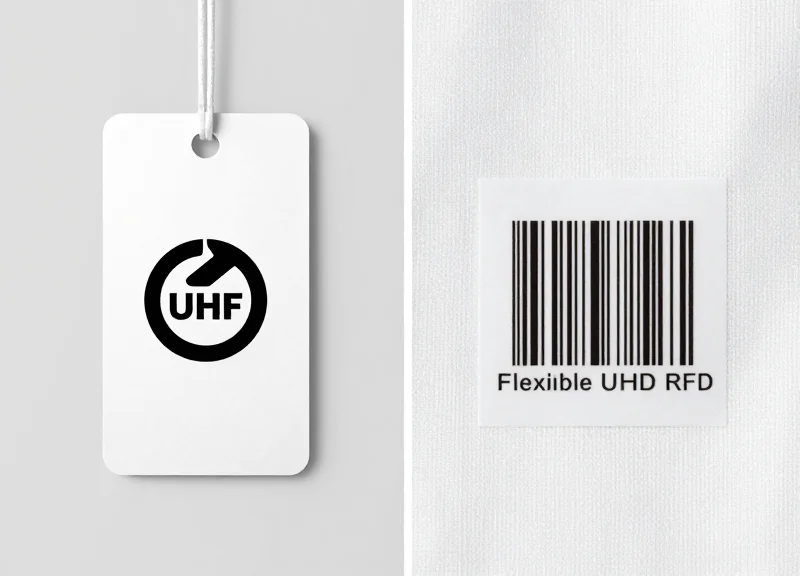
UHF RFID (Ultra-High Frequency Radio Frequency Identification) represents a paradigm shift from traditional optical scanning to automated radio-wave data capture. Unlike barcodes, which require a direct line-of-sight and manual triggers for each item, UHF RFID allows for the simultaneous identification of hundreds of textile items at distances of up to 12 meters, achieving 99.9% accuracy even when items are hidden inside laundry bags or stacked in dense piles.
| Feature | 1D/2D Barcodes | UHF RFID (EPC Gen2) |
|---|---|---|
| Read Method | Optical (Line-of-Sight required) | Radio Wave (Non-Line-of-Sight) |
| Read Quantity | 1 item at a time | 700+ items per minute |
| Read Distance | Close range (0.1m - 0.5m) | Long range (Up to 12m) |
| Durability | Low (Susceptible to stains/tears) | High (Heat/Chemical resistant) |
| Data Capacity | Small (Fixed ID) | Large (Rewritable/Extended memory) |
| Labor Intensity | High manual involvement | Fully autonomous/Hands-free |
The technical core of this transition lies in the 'Anti-Collision' algorithm and the 'Backscatter' mechanism. In a high-volume laundry facility, hundreds of tags respond to a single reader query. UHF RFID protocols use sophisticated algorithms to ensure each tag's signal is processed individually without interference—a feat impossible for barcodes, which would require an operator to physically orient every piece of apparel toward a scanner.
How does UHF RFID handle 'Stray Reads' in 2026 environments?
Modern 2026 systems utilize software-defined power zones and RSSI (Received Signal Strength Indicator) filtering. This allows the system to distinguish between a garment actually passing through a portal and one simply sitting on a nearby rack, solving the historical problem of data 'noise' in dense logistics hubs.
Can UHF RFID tags survive 200+ industrial wash cycles?
Yes. Current-gen textile tags are encapsulated in high-grade PPS or epoxy resins, rated for 60 bars of extraction pressure and temperatures exceeding 180°C (356°F) during ironing, far outlasting the physical integrity of a printed barcode.
Does moisture affect read accuracy in apparel logistics?
While water absorbs UHF energy, 2026 tag designs and frequency-hopping spread spectrum (FHSS) technology ensure that damp linens can still be read with 99.5%+ accuracy, provided the reader antennas are calibrated for 'lossy' environments.
Expert Insight: The true 'hidden' advantage of UHF RFID is data auditability. While a barcode only tells you 'what' an item is, the rewritable user memory on an RFID tag allows for the local storage of 'wash counts' or 'repair history.' In 2026, this 'on-tag intelligence' is becoming the foundation for predictive textile maintenance, allowing managers to retire assets before they fail on a customer.
Achieving 99.9% Precision: The Engineering Behind the Numbers
Achieving 99.9% precision in apparel logistics is not merely about faster scanning; it is the result of shifting from manual, line-of-sight data capture to automated electromagnetic interrogation. While barcodes rely on human discipline to ensure every item is scanned, UHF RFID (Ultra-High Frequency Radio Frequency Identification) utilizes sophisticated anti-collision algorithms and bulk-reading protocols that eliminate human-in-the-loop errors. This engineering shift ensures that 100% of a shipment is accounted for in milliseconds, even when items are densely packed in soil bags or clean linen carts, maintaining data integrity that is mathematically superior to manual methods.
| Metric | Barcode Scanning (Manual) | UHF RFID (Automated) |
|---|---|---|
| Typical Error Rate | 1% to 3% (Human fatigue/misses) | < 0.1% (Algorithmic validation) |
| Data Capture Method | Manual Trigger / Single Point | Autonomous Pulse / Multi-Point |
| Reading Logic | Optical Line-of-Sight | Probabilistic Waveform Analysis |
| Validation Step | Visual confirmation by staff | Cloud-sync & Checksum verification |
The 'engineering' of this precision relies on a concept called 'Singulation.' In a high-volume laundry tunnel, hundreds of tags are powered by a single reader pulse. Without logic, they would all respond at once, causing a signal collision. Modern UHF systems use the Slotted Aloha protocol to assign specific time slots for each tag response, ensuring every unique ID is captured without interference.
- Automated Singulation: The reader sends a command to 'quiet' tags that have already responded, allowing it to focus on remaining signals until the entire population is accounted for.
- Middleware Filtering (The 'Truth' Layer): Advanced software filters out 'stray reads' from nearby carts or adjacent rooms, ensuring only the intended assets are logged into the system.
- Circular Polarization: Unlike barcodes which require specific orientation, UHF antennas use circular polarization to catch signals regardless of how a garment is folded or twisted.
Expert Insight: To hit 99.9% in 2026, the industry is moving beyond just 'reading' to 'RSSI (Received Signal Strength Indicator) mapping.' By analyzing the signal strength, smart portals can determine if a tag is actually passing through a door or just sitting nearby on a shelf. This spatial intelligence is the final bridge to near-perfect accuracy, preventing the 'ghost inventory' problems that plagued early RFID adoptions.
Does the environment affect 99.9% precision?
Yes. Metals and liquids can reflect or absorb RF energy. However, modern laundry-specific tags are engineered with spacers and specialized antennas to maintain high read rates even in moisture-heavy environments.
How is 99.9% precision verified?
Most industrial systems use a 'Golden Load' test—a cart with a known quantity of tags. The system must hit 100% on the cart across multiple passes to calibrate the 99.9% operational baseline.
What happens if a tag is damaged?
Industrial UHF tags for textiles are rated for 200+ wash cycles and high-pressure extractors. Precision remains high because the physical failure rate of the tag is lower than the human failure rate of barcode scanning.
The Industrial Laundry Environment: Durability and Tag Resilience
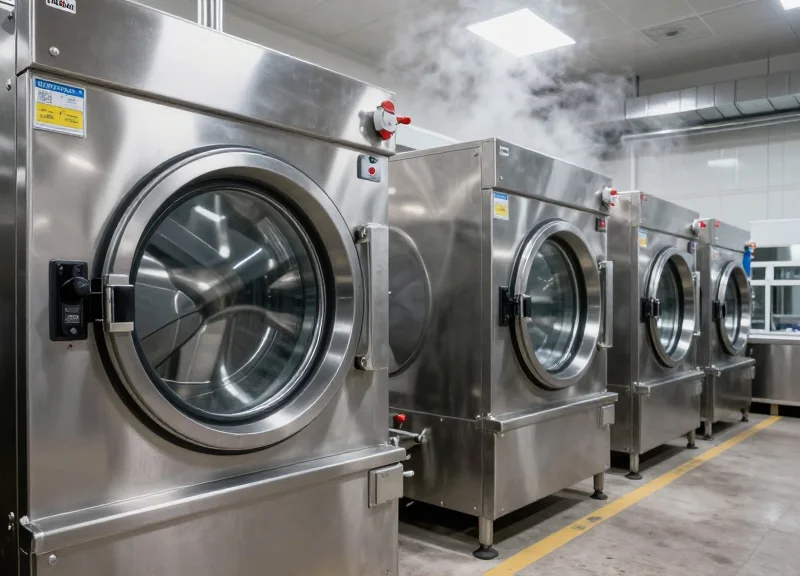
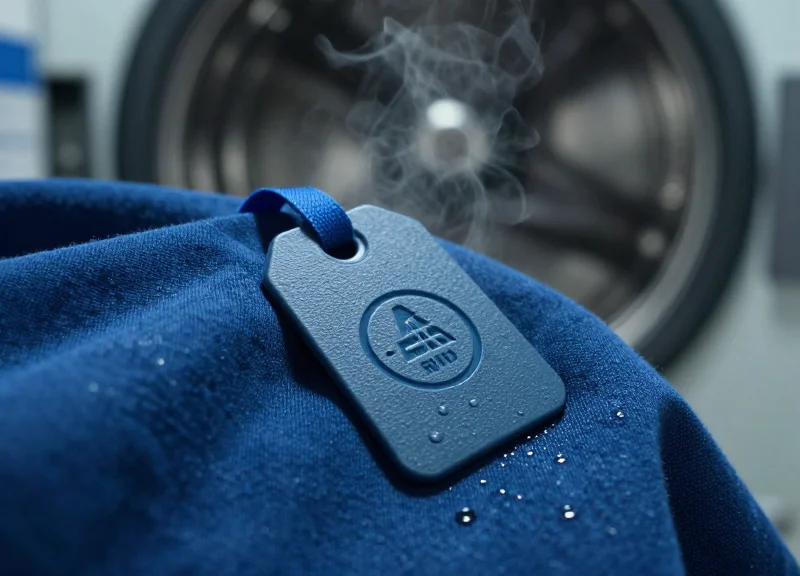
In industrial laundry, durability is defined by a tag’s ability to survive the 'mechanical meat grinder' of high-pressure extractors and the aggressive chemical surfactants required for medical-grade sterilization. Unlike barcodes that peel or fade, next-gen UHF RFID laundry tags are encapsulated in high-strength thermoset polymers or flexible silicone. This engineering allows them to maintain 99.9% read rates even after being subjected to 60 bars of extraction pressure and repeated thermal shocks in drying tunnels reaching 180°C (356°F). To achieve a viable ROI, these tags must withstand a minimum of 200 wash cycles, matching the typical lifecycle of high-quality hospitality linens.
| Stress Factor | Standard Adhesive Barcodes | Industrial UHF RFID Tags |
|---|---|---|
| Mechanical Pressure | Peels/Tears at < 5 bar | Resilient up to 60 bar |
| Chemical Exposure | Ink dissolves in bleach/alkalis | pH 2 to pH 12 resistance |
| Heat Resistance | Adhesive fails at 60°C | Stable up to 180°C (Ironing) |
| Typical Lifespan | 1 - 10 cycles (Degrades) | 200+ cycles (Full integrity) |
A critical innovation in 2026-spec tags is the move toward 'Micro-Antenna Flexibility.' Historically, RFID tags failed not because the chip died, but because the rigid antenna would snap under the torque of industrial centrifuges. Modern flexible tags use braided wire or conductive polymers that bend with the textile. This flexibility ensures that the electrical connection between the chip and the antenna remains intact despite thousands of mechanical 'workings' during the tumbling and folding processes. This mechanical resilience is what enables a 'fit and forget' deployment strategy for global hotel chains and hospital networks.
Can RFID tags survive industrial autoclaves?
Yes. High-grade laundry tags are rated for medical autoclaves, maintaining data integrity through high-pressure steam sterilization cycles common in surgical textile management.
Does chemical pH affect read range?
The encapsulation material is chemically inert, meaning exposure to harsh alkalis (high pH) or acid sours (low pH) does not corrode the internal electronics or reduce signal strength.
Are these tags uncomfortable for the end-user?
No. At less than 2mm thick and roughly the size of a shirt stay, these flexible tags are designed to be sewn into hems or heat-sealed into discreet patches without affecting wearer comfort.
Expert Tip: When auditing tag resilience, don't just look at the 'survivability' rate. Look at the 'Read Distance Decay.' A low-quality tag might still 'work' after 100 washes, but its read range may have dropped from 5 meters to 1 meter due to antenna micro-fractures. Top-tier 2026 tags maintain a consistent read-distance profile throughout their entire 200+ cycle lifespan, ensuring that automated sorting gates don't miss items as the linen ages.
Operational Efficiency: Moving from Individual Scans to Bulk Processing

Transitioning from barcodes to UHF RFID transforms apparel logistics from a sequential, labor-intensive task into a parallel, automated bulk-capture system. Unlike barcodes, which require a direct line-of-sight and physical orientation for every individual item, UHF RFID allows for 'Bulk Processing.' This enables facilities to identify and record an entire cart of 200+ garments simultaneously as it passes through a portal or tunnel. By removing the need to manually locate and scan every tag, industrial laundries can increase their processing throughput by over 1,000%, effectively turning a 20-minute manual check-in into a 5-second automated event.
| Operational Metric | Manual Barcode Scanning | Automated UHF RFID Bulk Processing |
|---|---|---|
| Items per Scan | 1 Item | 200-500+ Items |
| Orientation Required | Yes (Line-of-Sight) | No (Omnidirectional) |
| Typical Processing Time | 2-5 Seconds per item | Sub-10 Seconds per bulk load |
| Labor Intensity | High (Constant manual handling) | Low (Passive monitoring) |
The Veteran Perspective: Moving to Exception-Based Management. The true value of bulk processing isn't just speed; it is the shift in labor philosophy. In a barcode-based system, your staff spends 90% of their time performing 'Active Verification'—physically proving each item exists. With UHF RFID portals, you shift to 'Exception-Based Management.' The system handles 99.9% of the data capture automatically; your humans only intervene when the software flags a discrepancy (e.g., a missing item or an incorrect route). This allows you to reallocate roughly 70% of your scanning personnel to higher-value production roles.
- Portal Intake: As soiled linens arrive in bulk carts, they pass through a dock-door portal. Thousands of tags are read instantly without unfolding a single garment.
- Shielded Tunnel Validation: Inside the facility, conveyor-belt tunnels use RF shielding to isolate specific batches, ensuring 99.9% accuracy by preventing 'stray reads' from nearby items.
- Automated Sorting Triggers: The data from bulk scans instantly triggers automated sorters, directing garments to specific wash zones or customer-specific bins without manual inspection.
- Final Outbound Audit: Clean bundles pass through an exit portal, where the system automatically generates an electronic packing list and confirms the order is 100% complete.
Can RFID tunnels handle wet or damp laundry?
Yes. Modern UHF RFID 'laundry-grade' tags and high-power readers are specifically tuned to penetrate moisture, though specialized antenna placement is used to maintain 99.9% precision.
What happens if a tag is missing in a bulk scan?
The system instantly compares the bulk read against the expected inventory list and triggers a visual or audible alert for the operator to inspect that specific cart.
How much floor space is saved by switching to portals?
By eliminating manual scanning stations, facilities typically reclaim 15-25% of their floor space, allowing for more washing or finishing equipment.
Loss Prevention and Inventory Visibility in 2026
In 2026, loss prevention in apparel logistics has evolved from reactive searching to proactive, automated asset management. UHF RFID technology provides a 'digital heartbeat' for every garment and linen, ensuring 99.9% visibility from the moment an item enters the supply chain until its final retirement. By removing the need for line-of-sight scanning, RFID portals and smart cabinets instantly log the movement of thousands of items, effectively eliminating 'ghost inventory'—stock that appears in the database but is physically missing or misplaced. This level of precision allows facilities to identify the exact point of loss, whether it occurs during transit, at the customer site, or within the laundry process itself.
| Feature | Barcode System (Legacy) | UHF RFID System (2026 Standard) |
|---|---|---|
| Average Annual Shrinkage | 15% - 25% | Less than 1% |
| Inventory Reconciliation | Monthly / Quarterly (Manual) | Real-time (Automated) |
| Loss Attribution | Speculative / Anecdotal | Precise (Last-seen Portal Log) |
| Asset Lifecycle Tracking | Incomplete / Error-prone | Full 'Cradle-to-Grave' History |
A critical advantage of the 2026 RFID framework is the establishment of 'Immutable Custody Chains.' When a hospitality client sends soiled linens to a central laundry, the UHF RFID portal at the loading dock creates an instantaneous digital manifest. This creates a legally and financially binding record of transfer. If 500 towels are sent and only 495 are scanned at the laundry intake, the system flags the discrepancy within seconds, not weeks. This transparency eliminates 'he-said, she-said' disputes between service providers and clients, fostering a high-trust logistics environment.
How does RFID prevent 'ghost inventory' in 2026?
Ghost inventory occurs when manual scanning errors or theft create a gap between system records and physical stock. UHF RFID prevents this by performing automated, bulk inventory counts daily without human intervention, ensuring the digital twin always matches physical reality.
Can RFID help recover items lost outside the facility?
Yes. Handheld RFID 'Geiger counters' allow staff to locate missing items in seconds by following signal strength, even if the items are buried at the bottom of a bin or hidden behind other equipment.
What is the impact of RFID on procurement budgets?
By reducing annual loss rates by up to 95%, organizations can significantly reduce their replacement budgets. Precise tracking also prevents 'over-purchasing'—a common practice used to compensate for predicted losses.
Expert Tip: The most significant 2026 innovation in loss prevention is 'Predictive Shrinkage Analysis.' By integrating RFID data with machine learning, facilities can now identify patterns in item loss. For example, if a specific delivery route or hospital floor consistently shows a 2% higher loss rate, the system automatically triggers a management alert. This shifts the focus from merely counting losses to actively preventing them through targeted operational changes, a strategy that typically delivers a full ROI on RFID implementation within 12 to 18 months.
Integrating RFID with Cloud Logistics and AI Analytics

Integrating RFID with cloud logistics and AI analytics creates a 'Digital Twin' of every garment within a facility, enabling a shift from manual oversight to automated, data-driven intelligence. By streaming raw UHF RFID tag data into cloud-native platforms via MQTT or REST APIs, industrial laundries can achieve real-time visibility across the entire supply chain. This connectivity allows AI models to process billions of data points—tracking wash counts, chemical exposure, and transit times—to provide actionable insights that optimize inventory rotation and drastically reduce operational waste.
| Feature | Legacy Barcode Systems | Cloud/AI-Integrated RFID |
|---|---|---|
| Data Access | Local/Siloed databases | Global Cloud synchronization |
| Analysis Type | Reactive (what happened?) | Predictive (what will happen?) |
| Inventory Velocity | Slow, manual updates | Real-time streaming telemetry |
| Decision Making | Human-led estimation | AI-driven automated workflows |
Expert Insight: The Wash-Cycle Degradation Curve. While competitors focus on simple location tracking, the true 2026 advantage lies in predictive textile health. By applying machine learning to the cumulative data of a garment's life—specifically its exposure to pH levels and thermal stress recorded at each RFID gate—AI can predict the 'point of failure' for fabric tensile strength. This allows facilities to retire linens exactly one cycle before they tear in front of a customer, preserving brand reputation through data rather than guesswork.
- Edge Data Filtering: RFID readers at the facility floor act as edge devices, filtering out 'noise' and redundant reads before sending clean event data (e.g., 'Inbound Clean') to the cloud.
- Cloud Ingestion & Processing: Data is ingested into a central logistics engine where it is timestamped and mapped to specific customer accounts and service level agreements (SLAs).
- AI Lifecycle Modeling: Neural networks analyze the frequency of use versus resting time to identify 'hoarded' inventory at client sites, triggering automated rebalancing alerts.
- Automated Execution: The system automatically generates procurement orders or maintenance schedules based on real-time depletion rates and fabric health scores.
Does cloud integration increase data latency?
No. Modern 2026 RFID architectures use 5G and edge computing to ensure that data processing occurs in milliseconds, maintaining the speed of high-speed conveyor belts.
How does AI improve inventory ROI?
AI identifies 'dead stock'—items that are purchased but rarely circulated—allowing managers to reduce capital expenditure by 15-20% through better stock utilization.
Is the data secure?
Yes. Enterprise-grade integrations use end-to-end encryption and SOC2-compliant cloud providers to ensure that client textile data remains confidential.
The ROI of RFID: Calculating the Long-Term Financial Benefits
The Return on Investment (ROI) for UHF RFID in apparel logistics is no longer a theoretical projection; by 2026, it is a proven financial framework where the initial capital expenditure (CAPEX) for tags and hardware is offset by a 30-50% reduction in operational labor and a near-total elimination of manual inventory shrinkage. While a barcode costs fractions of a cent, its 'hidden' cost lies in the human hours required for line-of-sight scanning. In contrast, UHF RFID allows for bulk processing of hundreds of items in seconds, shifting the financial focus from 'cost per tag' to 'total cost of ownership per cycle.' For a mid-sized facility processing 50,000 items weekly, the transition from manual to automated tracking frequently results in a full payback within 14 months.
| Financial Metric | Traditional Barcode System | Next-Gen UHF RFID (2026) |
|---|---|---|
| Throughput Speed | 100 items per 15 minutes | 100 items per 10 seconds |
| Labor Dependency | High (Manual Scan) | Minimal (Automated Portals) |
| Annual Inventory Loss | 5% - 12% Average | < 0.2% Verified |
| Data Accuracy | 82% (Human error prone) | 99.9% (Automated) |
| Operational ROI | Negative (Ongoing Labor Drain) | Positive (12-18 Month Payback) |
- Phase 1: CAPEX Assessment: Calculate the cost of heat-sealable UHF tags, portal readers at entry/exit points, and software integration fees.
- Phase 2: OPEX Reduction Tracking: Measure the reduction in man-hours spent on sorting, counting, and reconciling lost items. Use a standard labor rate to quantify these savings.
- Phase 3: Asset Recovery Value: Quantify the decrease in 'replacement orders' for linens and uniforms. Most facilities see a 20% reduction in new textile purchases within the first year.
- Phase 4: Client Retention Analytics: Factor in the 'Soft ROI' of customer satisfaction. Accurate billing and zero-loss guarantees significantly reduce client churn.
Expert Insight: The 'Over-Provisioning Tax' — One of the most significant yet overlooked financial benefits of RFID is the elimination of the 'Over-Provisioning Tax.' Traditionally, laundry managers purchase 15-20% more inventory than necessary as a safety buffer against loss and scanning errors. With 99.9% visibility, this safety stock can be slashed to 3%, freeing up thousands of dollars in stagnant capital that would otherwise be tied up in excess textile inventory.
Is the high cost of RFID tags still a barrier in 2026?
No. The cost of durable, high-pressure-resistant laundry tags has dropped by 40% since 2020, while their lifespan now exceeds 200 wash cycles, making the cost-per-wash negligible compared to labor savings.
How does RFID affect insurance premiums?
Many logistics insurers are beginning to offer lower premiums for facilities using RFID-based tracking, as the system provides an immutable audit trail that reduces claims related to theft and lost shipments.
Can RFID integration reduce energy costs?
Yes. By optimizing load sizes through real-time inventory data, facilities can ensure machines run at peak efficiency, reducing water and energy waste per kilogram of laundry.
Future-Proofing Your Business: Steps to Implement Next-Gen Laundry Solutions

Future-proofing your laundry operations for 2026 involves a systematic migration from manual, line-of-sight barcode scanning to an automated Ultra-High Frequency (UHF) RFID ecosystem. This transition enables facilities to capture data on hundreds of items simultaneously without human intervention, effectively eliminating the 'dark spots' in apparel logistics where items frequently go missing. Success requires a phased approach that aligns hardware selection with specific textile lifecycles and integrates real-time data into existing Enterprise Resource Planning (ERP) systems.
- Infrastructure Audit and Gap Analysis: Evaluate current laundry flow to identify bottlenecks where manual scanning slows down throughput. Determine 'read zones' such as soil-in areas, clean-out portals, and delivery vehicle docks.
- Select Industry-Specific RFID Hardware: Choose heat-stabilized, pressure-resistant UHF RFID tags capable of withstanding 200+ industrial wash cycles. Pair these with fixed readers for automated portals and handhelds for spot-checking.
- Middleware and Cloud Integration: Implement a middleware layer that filters 'raw reads' to prevent data flooding. Ensure this data pushes directly to your cloud management platform for real-time inventory visibility.
- Pilot Program (The 'Room-Level' Test): Deploy RFID in a controlled segment of your inventory—such as high-value linens or a specific client's uniform set—to refine antenna positioning and signal strength before a full-scale rollout.
- Operational Training and Scaling: Train staff on the shift from 'scanning' to 'monitoring.' Once the pilot yields 99.9% accuracy, scale the deployment across the entire facility and integrate automated billing features.
| Implementation Component | Legacy Barcode Requirement | Next-Gen UHF RFID Requirement |
|---|---|---|
| Staff Interaction | Manual, one-by-one scanning | Passive, bulk-gate processing |
| Data Capture Speed | ~2-3 seconds per item | ~500+ items per second |
| Inventory Visibility | Periodic/Snapshots | Real-time/Continuous |
| Durability | Prone to fading/peeling | Embedded/Industrial-grade longevity |
Expert Tip: To maximize your investment, focus on 'Lifecycle Capital Optimization.' Most laundry managers carry 20% more safety stock than necessary due to inventory uncertainty. UHF RFID doesn't just track items; it reveals your 'Shadow Inventory'—items stuck in the repair loop or forgotten at client sites—allowing you to reduce capital expenditure on new textiles by accurately utilizing what you already own.
Can we use RFID and barcodes simultaneously during the transition?
Yes, a 'hybrid labeling' approach is common. Many facilities use tags that feature both a UHF chip and a printed barcode to ensure 100% compatibility while legacy systems are phased out.
What is the biggest technical hurdle in RFID implementation?
Signal interference from metal and water. In a laundry environment, this is managed by using specialized 'on-metal' tags for carts and tuning antenna frequencies to penetrate wet textile bundles.
How long does a typical full-scale deployment take?
For a mid-sized facility, the process usually takes 4 to 6 months from the initial audit to a fully operational, integrated system.