The retail industry is standing on the brink of a major technological paradigm shift. For years, Electronic Shelf Labels (ESL) have streamlined pricing, while RFID has tackled inventory tracking. However, a significant functional gap remained: the ability to monitor real-time stock levels and item-specific identity simultaneously without manual intervention. By 2026, the convergence of RFID and weight-sensing technology is set to bridge this divide, creating a unified 'Smart Shelf' ecosystem that offers unprecedented visibility and operational efficiency.
The Evolution of Retail Displays: From Paper to Intelligence

The evolution of retail displays represents a shift from static information carriers to dynamic, autonomous data nodes. While the industry began with manual paper tags that required significant labor for every price change, it has progressed through the era of basic Electronic Shelf Labels (ESL) to a new paradigm of 'Sensor Fusion.' By 2026, the traditional ESL will no longer be seen as just a display tool, but as the interface for a complex network of RFID and weight-sensing technologies that bridge the gap between physical inventory and digital management systems.
| Era | Technology Stack | Primary Function | Operational Constraint |
|---|---|---|---|
| Pre-2000s: The Static Era | Paper & Adhesive Labels | Price Communication | High labor costs; 25% error rate |
| 2010s: The Digital Shift | Segmented LCD / E-ink ESL | Centralized Price Updates | Uni-directional; No inventory awareness |
| 2020s: The IoT Wave | BLE / NFC Integrated ESL | Omnichannel Syncing | Limited to 'What is displayed', not 'What is present' |
| 2026+: The Intelligent Edge | RFID + Weight-Sensing + ESL | Autonomous Shelf Replenishment | None; Achieve 99% inventory accuracy |
The 'Traditional ESL Gap' refers to the disconnect between the price shown on the shelf and the actual physical stock levels. Even with modern digital tags, a store manager might see a correct price but have no automated way of knowing a product is mismanaged or out of stock without manual inspection. This creates 'Ghost Inventory'—a state where systems believe items are available because the tag is active, but the shelf is actually empty. The convergence of RFID and weight-sensing tech is designed specifically to eliminate this blind spot by providing a real-time heartbeat of every SKU on the floor.
Why is the transition to intelligent displays happening now?
The convergence is driven by the decreasing cost of high-precision load cells and the maturation of RAIN RFID infrastructure, allowing retailers to justify the ROI through labor savings and reduced shrinkage.
What was the biggest failure of first-generation ESLs?
First-gen ESLs solved the pricing speed issue but failed to provide 'feedback loops.' They could tell a customer the price but couldn't tell the retailer if the last item was just picked up by a customer.
Expert Insight: In my two decades observing Silicon Valley's impact on retail, the most significant shift isn't the display itself—it's the 'Data Density' per square inch of shelf space. We are moving from a world where a shelf was a piece of furniture to a world where a shelf is a high-fidelity IoT peripheral. By 2026, the 'Intelligence' in displays will be measured by its ability to predict a stock-out before it happens, using weight-sensing gradients to trigger automated supply chain orders.
Understanding the 'Traditional ESL Gap'
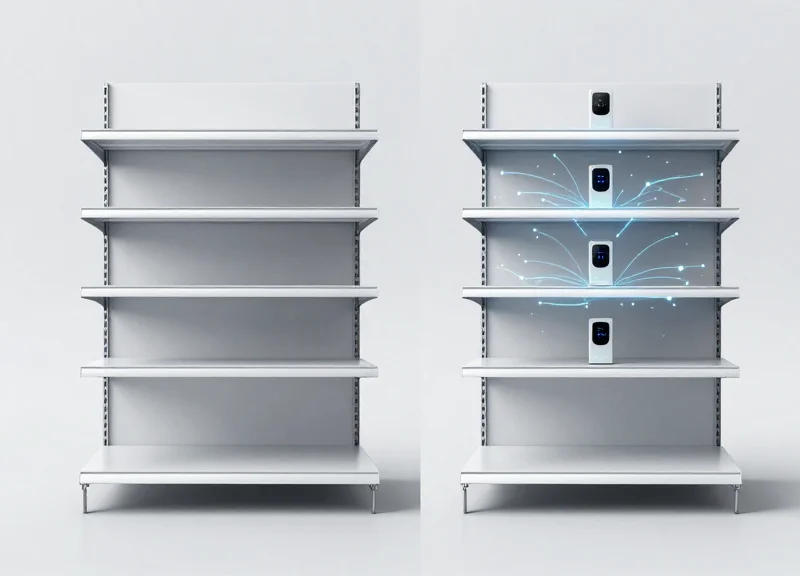
In the context of modern retail, the 'Traditional ESL Gap' describes the functional disconnect between digital price automation and physical inventory reality. While standard Electronic Shelf Labels (ESLs) solved the labor-intensive problem of manual price updates, they remained 'data-blind' regarding the physical state of the shelf. An ESL can display the correct promotional price for a bottle of detergent, but it has no inherent way of knowing if that bottle is actually present, misplaced in the wrong aisle, or hidden behind other merchandise. This gap creates a friction point where the digital record (ERP system) and the physical shelf are frequently out of sync, leading to lost sales and operational inefficiency.
| Feature Capability | Legacy ESL Systems | The 2026 Integrated Standard |
|---|---|---|
| Price Synchronization | Real-time via RF/IR | Real-time via RF/IR |
| Inventory Awareness | Zero (Requires manual scan) | Automated (Weight + RFID) |
| Planogram Compliance | Manual Audit | Real-time AI Alerts |
| Customer 'Pick' Data | None | Captured via Weight Change |
Why is price synchronization no longer sufficient for retailers?
In an omnichannel world, pricing is just the baseline. Retailers now require high-velocity data on stock levels to support 'Buy Online, Pick Up In-Store' (BOPIS). If an ESL shows a price but the item is out of stock, it results in a failed digital order and a frustrated customer.
What are the primary symptoms of the ESL Gap?
The most common symptoms include 'Phantom Stock' (where systems think items are available but shelves are empty), high rates of 'walk-outs' due to out-of-stocks, and excessive labor costs spent on manual shelf audits.
How does 'Shelf-Health' differ from simple inventory counting?
Shelf-health refers to the qualitative state of the display, including proper facing, cleanliness, and planogram compliance. Traditional ESLs cannot detect if a product is knocked over or if a premium item has been replaced with a cheaper alternative by a shopper.
Expert Insight: The Ghost Inventory Paradox. My twenty years in Silicon Valley retail tech have shown that the 'Gap' isn't just a lack of data—it is the presence of false data. I call this the Ghost Inventory Paradox: when your ERP system claims five units are in stock, the ESL displays the correct price, but the shelf is empty due to theft or misplacement. This halts automated reordering because the system believes stock exists, leading to a cycle of perpetual out-of-stocks. Convergence technology (RFID + Weight) is the only way to kill the 'ghost' and ensure the digital twin of your store matches the physical reality.
The Power of RFID in 2026 Retail Environments

In the 2026 retail landscape, Radio Frequency Identification (RFID) has evolved from a simple inventory tool into the 'digital nervous system' of the physical store. Unlike traditional barcodes that identify a product category, item-level RFID provides every single unit with a unique digital signature (UID). This capability allows retailers to track an individual item's journey from the manufacturing plant through the distribution center and onto the specific shelf location, effectively eliminating the blind spots that have historically plagued brick-and-mortar operations.
| Feature | Traditional RFID (2020) | Next-Gen RFID (2026) |
|---|---|---|
| Read Accuracy | 80-92% (Bulk scans) | 99.8% (Continuous monitoring) |
| Data Granularity | SKU-level only | Unique Item-level (Digital Twin) |
| Energy Profile | Passive (Battery-free) | Energy-harvesting (Self-powered) |
| Interference | High (Liquid/Metal issues) | Advanced Waveform (Material-agnostic) |
The breakthrough in 2026 lies in 'Ambient Intelligence.' Modern RFID readers are no longer just handheld devices; they are integrated into the store's lighting and shelving infrastructure (often co-located with ESLs). This creates a persistent read zone where the location of every item is known within a few centimeters. Expert Tip: The strategic shift for 2026 is moving from 'Inventory Counting' to 'Inventory Flow.' By tracking the velocity of movement at the item level, retailers can predict out-of-stock events hours before they happen, rather than reacting after the shelf is empty.
How does item-level RFID solve the 'Phantom Inventory' problem?
Phantom inventory occurs when the system thinks an item is in stock, but it is actually lost, stolen, or misplaced. RFID provides real-time validation of the physical presence of each UID, ensuring that the digital record and the physical shelf are always in 100% synchronization.
Is RFID tag cost still a barrier for low-margin goods?
By 2026, the 'Silicon-to-Shelf' initiative has reduced tag costs to under $0.03 for high-volume orders. Furthermore, the labor savings from automated cycle counts and the reduction in shrink provide a ROI that justifies tagging even mid-range grocery and FMCG items.
What is the 'Digital Twin' concept in 2026 retail?
Every physical product has a corresponding data object in the cloud. This Digital Twin stores the item's origin, expiration date, and movement history, which is accessible instantly by scanning the RFID tag through the ESL interface or a mobile app.
Ultimately, the power of RFID in 2026 is not just in identifying what is on the shelf, but in providing the 'Identity' layer that weight-sensing technology lacks. While a weight sensor can tell the system that a bottle is missing, it is the RFID tag that identifies exactly which bottle was taken, its batch number, and whether it was moved to a different aisle or the checkout counter. This convergence is the final piece of the puzzle in creating a truly autonomous retail environment.
Weight-Sensing Tech: The Missing Piece for Quantity Control

Weight-sensing technology in a 2026 retail context refers to the integration of high-precision strain gauges and load cells directly into shelf hardware to provide a 'tactile' layer of data. While traditional Electronic Shelf Labels (ESL) manage price and RFID manages identity, weight-sensing technology provides the definitive proof of quantity. By detecting incremental changes in mass—often as sensitive as a single gram—the system can instantly verify when a customer removes a product or, more importantly, when a misplaced item is returned to the wrong shelf, filling the critical data gap left by optical and radio-frequency systems.
The fundamental problem with previous 'smart shelf' iterations was a reliance on singular data points. If an RFID tag is shielded by a hand or another product, the system 'loses' it. Weight sensing serves as the 'Ground Truth' because gravity cannot be shielded or spoofed. In the 2026 retail ecosystem, weight sensors transform a passive shelf into an active inventory auditor that operates with zero manual intervention.
| Feature | Traditional ESL | RFID Tagging | Weight-Sensing Tech |
|---|---|---|---|
| Primary Data | Price & Promo | Unique ID & Location | Mass & Exact Quantity |
| Detection Trigger | System Update | Radio Scan | Physical Displacement |
| Blind Spots | Physical Stock | RF Shielding/Metal | Identical Weight Items |
| Real-time Accuracy | Low (Display Only) | High (Tracking) | Absolute (Quantity) |
Expert Insight: The 'Gravity Fingerprint' Strategy. In my two decades observing Silicon Valley hardware shifts, the breakthrough isn't just the sensor—it's the algorithmic 'Gravity Fingerprint.' Modern systems now use machine learning to distinguish between a customer leaning on a shelf (temporary pressure) and an actual product removal (static mass change). This eliminates the false positives that plagued early weight-based systems in the 2010s.
- The Displacement Event: A customer picks up a 400g jar of artisanal honey. The load cell detects an instantaneous 400g reduction in shelf pressure.
- Cross-Reference Validation: The system queries the local RFID array to see which specific Serialized Global Trade Item Number (SGTIN) vanished from the zone at that exact millisecond.
- ESL Interface Update: The ESL screen subtly updates or the backend inventory log triggers a 'low stock' alert if the remaining weight falls below the reorder threshold.
How does weight-sensing handle 'Grazing' or theft?
Because the sensors are calibrated to the specific SKU weight, if a customer consumes a portion of a product and puts it back, the weight discrepancy triggers an immediate 'mismatch' alert to floor staff, a feature RFID alone cannot provide.
Can it distinguish between two different items of the same weight?
This is where convergence is key. The weight sensor flags that an item was taken; the RFID tag identifies which item it was. Together, they create a fail-safe system for 100% inventory accuracy.
The Synergy of Convergence: Identity Meets Quantity

The convergence of RFID and weight-sensing technology represents the 'holy grail' of retail operations: the ability to marry unique item identity with physical mass verification. While RFID identifies specific units (the 'Who'), weight sensors provide immediate feedback on physical presence (the 'How Much'). This integration closes the 'Traditional ESL Gap' by ensuring that what the digital system records matches the physical reality of the shelf in real-time, effectively eliminating 'phantom inventory'—items that are digitally 'present' but physically missing or misplaced.
| Feature | RFID Only | Weight Only | Converged System (2026) |
|---|---|---|---|
| Accuracy Source | Digital Signal | Physical Mass | Hybrid Validation |
| Primary Use Case | Item Tracking | Bulk/Gravity Feed | Autonomous Restocking |
| Detects Theft? | Partial (Exit Only) | High (Shelf Removal) | Instant Real-Time Alert |
| Inventory Visibility | Item-Level | Quantity-Level | Total Veracity |
- The Weight Trigger: A customer removes an item, triggering a high-precision weight change on the load-cell-equipped shelf sensor.
- RFID Handshake: The system immediately queries the localized RFID reader to confirm which specific item IDs are no longer detected in that specific zone.
- Discrepancy Logic: If weight drops but the RFID signal remains—indicating a potential tag-clipping or shielding incident—the system flags a security alert.
- ESL Dynamic Update: The Electronic Shelf Label updates instantly to reflect current stock levels, while the cloud-based ERP adjusts procurement schedules.
Unique Expert Insight: The Micro-Fulfillment Guardrail. By 2026, retail stores will increasingly function as micro-fulfillment centers. The synergy of identity and weight acts as a physical 'unit-test' for automated and human pickers. If a picker selects a 500g unit of premium coffee but the RFID tag identifies it as a 250g unit (due to a labeling error), the weight sensor acts as the ultimate truth-teller. This 'Double-Gate' verification is projected to reduce shipping errors in store-to-home delivery by over 22%.
How does this prevent phantom inventory?
It cross-references digital records with physical weight. If the system says 10 units are present but the weight only accounts for 8, it flags a discrepancy immediately rather than waiting for a manual cycle count.
Can it handle lightweight products?
Yes, 2026-grade sensors utilize advanced strain-gauge technology capable of detecting changes as small as 0.5 grams, making it viable for small cosmetics, electronics, or pharmaceuticals.
Does it work with items placed on the wrong shelf?
Absolutely. When an item is misplaced, the RFID identifies the 'foreign' ID while the weight sensor detects an unexpected mass increase, allowing the system to guide staff to the exact location of the misplaced stock.
Eliminating Shrinkage and Misplacement with Hybrid Sensors
Hybrid sensors eliminate retail shrinkage and inventory inaccuracy by establishing a 'dual-handshake' verification system: the weight sensor confirms the physical movement of mass, while the RFID reader confirms the specific identity of the item. This convergence solves the primary flaw of standalone systems where RFID signals can be shielded by foil bags or bodies, and weight sensors alone cannot distinguish between two different products of similar mass. In the 2026 retail landscape, this means that if a high-value item is removed from a shelf, the system immediately cross-references the loss in weight with a corresponding RFID 'exit' event. Any discrepancy triggers a silent alert to floor staff, effectively closing the gap where traditional ESL and EAS (Electronic Article Surveillance) systems often fail.
| Feature | Legacy RFID-Only | Hybrid (RFID + Weight) |
|---|---|---|
| Theft Detection | Delayed (discovered during audits) | Real-Time (active alerts) |
| Shielding Resistance | Low (easily blocked by foil) | High (weight still detects removal) |
| Misplacement Tracking | Approximate location | Pinpoint shelf-level accuracy |
| Bulk Item Accuracy | Poor (signal collision issues) | High (weight confirms exact count) |
Beyond theft, the hybrid approach addresses the 'abandoned item' problem, which costs retailers billions in spoilage and lost labor. When a customer picks up a chilled item but leaves it in an ambient-temperature aisle, the hybrid sensor in the new location detects an 'unauthorized weight gain' while the RFID identifies the misplaced SKU. This allows the system to generate a task for associates to return the item to the cold chain before it spoils. Expert Insight: By 2026, we expect to see 'Dynamic Heuristic Thresholds,' where AI analyzes the velocity of weight change. A slow lift indicates a browsing customer, while a high-velocity 'sweep' of the shelf triggers an immediate focus from overhead PTZ cameras.
How do hybrid sensors prevent 'sweethearting' at the shelf?
Sweethearting usually involves hiding items or manipulating tags. With hybrid sensors, the shelf knows the exact weight of the inventory. If three items are physically removed but only one RFID tag is scanned or registered by the system’s intent logic, it flags an immediate mismatch that can be verified at the point of sale.
Can this system differentiate between items of the same weight?
Yes. This is where the RFID component is critical. While the weight sensor provides the 'quantity' and 'presence' trigger, the RFID tag provides the unique serialized identity. Together, they ensure that if a customer swaps a high-value item with a cheaper one of the same weight, the ID mismatch is logged instantly.
Does this technology require constant calibration?
Modern 2026-gen sensors utilize 'Auto-Tare' algorithms. Every time the RFID reader confirms the shelf is in a 'steady state' (no movement detected), the weight sensors recalibrate to zero out environmental factors like dust or humidity, ensuring long-term accuracy without manual maintenance.
Enhancing the Customer Experience: Frictionless and Informed

The convergence of RFID and weight-sensing technology enhances the customer experience by removing the friction of manual scanning and providing 100% accurate, real-time stock availability. In the 2026 retail landscape, this hybrid system acts as the technical backbone for 'Just Walk Out' environments. While weight sensors detect the precise moment a product is removed from a shelf, RFID confirms the specific identity of that item. This dual-verification eliminates the 'phantom inventory' errors that plague traditional Electronic Shelf Labels (ESL), ensuring that if a customer’s app says a product is in stock, it is physically there.
| Customer Pain Point | Traditional ESL Approach | 2026 RFID + Weight Convergence |
|---|---|---|
| Inaccurate Stock Info | Manual updates; high lag time | Instant synchronization via weight triggers |
| Checkout Queues | Barcode scanning at kiosks | Automated 'Grab-and-Go' billing |
| Product Misplacement | Staff manually hunt for items | Real-time location alerts on store maps |
| Information Access | Static pricing/QR codes | Contextual data triggered by 'lifting' item |
Beyond simple automation, this technology enables a new era of 'Informed Shopping.' When a customer picks up a product, the weight sensor can trigger a nearby display or a mobile notification via the store's app, providing tailored information such as allergen alerts, carbon footprint data, or complementary product pairings. This 'Lift-to-Learn' interaction transforms the shelf from a passive storage unit into an active digital concierge.
Will I still need to scan items at a kiosk?
In most converged environments, no. The weight sensor registers the removal of the item and the RFID identifies it, automatically adding it to your virtual basket.
How does this prevent overcharging if I put an item back?
The weight-sensing shelf detects the return of the item's exact mass, while the RFID re-verifies the identity, instantly removing it from your digital bill.
Is my privacy protected in these high-tech stores?
Yes. Unlike facial recognition systems, RFID and weight sensors track the product's movement and identity rather than the individual shopper's biometric data.
Expert Insight: The End of the 'Stockout Search'. A unique advantage of this convergence is 'Dynamic Hyper-Localization.' By 2026, retailers will use these sensors to provide shoppers with a 'Heat Map of Availability' on their smartphones. This allows customers to navigate directly to the exact shelf coordinate where a single remaining item sits, even if it was misplaced by another shopper. This level of precision eliminates the primary reason for customer frustration: the inability to find an 'in-stock' item.
Operational Efficiency and Labor Cost Reduction
In the 2026 retail landscape, the 'Traditional ESL Gap'—the disconnect between the price shown on a digital tag and the actual physical count of the product on the shelf—is being bridged by autonomous shelf management. By integrating RFID (for identity) and weight sensors (for quantity), the labor-intensive process of manual stock counts is replaced by a real-time, 'always-on' auditing system. This transformation shifts the operational focus from reactive replenishment to proactive, data-driven floor management, effectively eliminating the thousands of hours annually spent on 'walking the floor' to spot-check inventory levels.
| Operational Metric | Legacy Manual/ESL Only Process | Hybrid RFID + Weight-Sensing System |
|---|---|---|
| Inventory Audit Frequency | Weekly or Monthly (Scheduled) | Real-Time (Continuous) |
| Labor Hours per Department | 15–20 Hours per week | < 2 Hours per week |
| Stock-out Detection Speed | Hours or Days (Reactive) | Seconds (Automated Alert) |
| Data Accuracy | 75% - 85% (Human Error Risk) | 99.8% (Dual-Factor Verification) |
Expert Insight: The 'Cognitive Load' Pivot. Beyond simple hour-saving, the true value of this convergence lies in reducing 'Cognitive Labor.' In traditional environments, store associates are mentally taxed with tracking thousands of SKUs and predicting shelf depletion. By offloading this 'mental inventory' to an automated hybrid system, retailers report a 25% increase in employee morale and a significant reduction in staff turnover, as associates are empowered to perform as brand ambassadors rather than mere stock-runners.
How does this technology impact the 'Bottom Line' of labor costs?
By automating shelf audits, retailers can reduce 'shrinkage-related labor'—the time staff spends searching for misplaced items—while simultaneously lowering the total headcount required for night shifts and inventory cycles, often resulting in a 30-40% reduction in overhead for back-of-house operations.
Does this mean robots will replace retail workers?
No. The trend for 2026 is 'Human-Centric Automation.' The tech handles the repetitive, low-value task of counting boxes, while the saved labor hours are redirected to high-touch customer consultations, upselling, and complex problem-solving that sensors cannot perform.
Can existing ESL systems be upgraded?
Modern converged systems are being designed as modular 'smart rails' that snap into existing shelving units, allowing retailers to add weight-sensing and RFID capabilities without a total store tear-down, significantly shortening the ROI window.
Strategic Implementation: Building the Infrastructure for 2026
Strategic implementation of converged RFID and weight-sensing technology requires moving beyond simple hardware installation toward a Unified Physical-Digital Architecture (UPDA). By 2026, the retailers who dominate will be those who have transitioned their infrastructure to treat the shelf-edge as an intelligent edge-computing node. This convergence doesn't just fill the ESL gap; it creates a self-healing inventory layer where identity (RFID) and quantity (Weight) act as mutual fail-safes. To achieve this, organizations must prioritize a high-throughput backhaul and localized data processing to handle the millisecond-level telemetry generated by thousands of sensors.
- Phase 1: High-Bandwidth Backbone Deployment: Upgrade store connectivity to WiFi 6E or WiFi 7 and ensure Power over Ethernet (PoE) is available at the shelf level to support high-density sensor arrays without battery fatigue.
- Phase 2: Hybrid Shelf Retrofitting: Begin installing weight-sensitive load cells in high-velocity categories while maintaining universal RFID coverage to create a dual-verification zone.
- Phase 3: Edge Logic Integration: Deploy local edge gateways that can process the 'heartbeat' of weight sensors and RFID pings locally, sending only verified inventory changes to the cloud to minimize latency.
- Phase 4: Algorithmic Calibration: Implement machine learning models to differentiate between a customer picking up an item and a misplaced product from another category being set down.
| Infrastructure Component | Legacy ESL Setup | 2026 Converged Setup |
|---|---|---|
| Data Frequency | Periodic (Minutes/Hours) | Real-Time (Milliseconds) |
| Verification Method | Visual/Manual | Dual-Factor (RFID + Mass) |
| Network Load | Low (Text/Price only) | High (Continuous Telemetry) |
| Edge Requirement | Minimal | Critical for Real-time Processing |
How does this impact existing RFID investments?
Current Gen-2 RFID tags remain the gold standard; the weight-sensing layer acts as an enrichment tool, not a replacement, meaning your existing tag inventory remains valid.
What is the '5% Threshold Rule' for ROI?
Expert Tip: To maximize ROI and reduce network noise, configure sensors to only trigger an RFID verification scan when weight fluctuations exceed 5% of a product's mass, effectively ignoring vibrations or dust.
Is the infrastructure cost-prohibitive?
While initial CAPEX is higher, the reduction in manual labor and shrinkage typically results in a break-even point within 14-18 months for high-volume retailers.