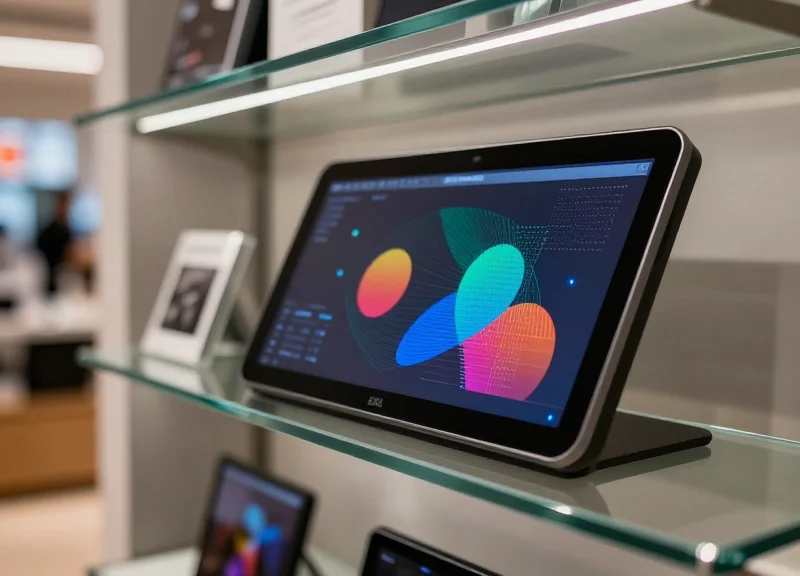
The era of manual price labeling is ending. As we approach 2026, retailers face unprecedented labor shortages and the demand for dynamic pricing. Digital price tag systems, or Electronic Shelf Labels (ESL), are no longer a luxury but a strategic necessity. This guide explores how to select the right system to eliminate employee fatigue and modernize your store operations.
The Evolution of Retail Pricing: Why Manual Labeling is Obsolete in 2026

By 2026, the retail landscape has reached a tipping point where manual price labeling is no longer just a slow process—it is a significant operational liability. As omnichannel commerce becomes the baseline, the ability to synchronize thousands of price points across physical and digital storefronts instantly is a survival requirement. Manual labeling is considered obsolete because it fails to support 'Dynamic Price Synchronicity,' where AI algorithms adjust shelf prices in real-time based on inventory levels, competitor fluctuations, and localized demand. Retailers relying on paper are now facing 'Price Drift,' a phenomenon where the delta between the Point-of-Sale (POS) system and the physical shelf leads to massive consumer friction and legal compliance risks.
| Feature/Metric | Manual Labeling (Old Standard) | Digital Price Tag Systems (2026 Standard) |
|---|---|---|
| Update Speed | 2-4 Hours per Aisle | Sub-60 Seconds Store-wide |
| Accuracy Rate | ~92-94% (Human Error Margin) | 99.9% (System-wide Sync) |
| Labor Allocation | High: Dedicated 'Tagging' Shifts | Zero: Fully Automated |
| Sustainability | High Waste (Paper/Plastic/Ink) | Low Carbon Footprint (5+ Year Battery) |
Beyond mere speed, the 'Labeling Fatigue' experienced by retail staff in 2026 has reached record levels. In an era where labor is both scarce and expensive, forcing associates to spend 20% of their shift performing repetitive, low-value adhesive swaps leads to rapid turnover and decreased morale. Modern Electronic Shelf Labels (ESL) eliminate this cognitive load, allowing employees to focus on 'High-Touch' customer service—the one area where physical retail still holds a competitive advantage over pure-play e-commerce.
What is the 'Hidden Margin Leak' in manual labeling?
In 2026, retailers lose an estimated 2.5% of gross margin simply because they cannot implement price increases fast enough to keep up with wholesale inflation or flash-sale opportunities that competitors trigger via digital systems.
How does manual labeling impact 2026 SEO and Digital Presence?
With 'Local Inventory Ads' on Google and social commerce, search engines now crawl real-time store data. If your physical shelf tag doesn't match your live digital feed due to manual update lag, your store's 'Trust Score' drops, directly impacting your local search ranking.
What is the primary driver of the switch to ESL in 2026?
It is the shift from 'static retail' to 'responsive retail.' Consumers now expect the same price fluidity in-store that they see on Amazon, making the 24-hour turnaround of paper tags fundamentally incompatible with modern buyer behavior.
Expert Insight: The 2026 Labor Paradox. Silicon Valley retail analysts have identified that stores utilizing manual labeling actually suffer from 'Information Asymmetry.' When a price changes in the cloud but not on the shelf, the employee becomes a buffer for customer anger. By removing the manual tag, you aren't just saving time; you are protecting your brand equity and employee mental health from the friction caused by systemic data mismatches.
Understanding the Core Technology: Infrared vs. Radio Frequency and Bluetooth

In 2026, the 'brain' of an Electronic Shelf Label (ESL) system is its communication protocol. This technology dictates how pricing data travels from your back-office server to the thousands of displays on your floor. While early systems relied on simple signals, modern retail environments now choose between three primary pillars: Infrared (IR) for localized security, Sub-GHz Radio Frequency (RF) for massive scale and reliability, and Bluetooth Low Energy (BLE) for high-speed interactivity and smartphone integration.
| Feature | Infrared (IR) | Radio Frequency (RF) | Bluetooth (BLE) |
|---|---|---|---|
| Transmission Type | Light-based (Line-of-sight) | Radio waves (Sub-GHz) | 2.4 GHz Standard |
| Range | Short (requires direct view) | Long (up to 100m+) | Medium (approx. 30-50m) |
| Update Speed | Slowest | Fast (Proprietary) | Very Fast (Bi-directional) |
| Battery Life | 5-7 Years | 10-15 Years | 8-12 Years |
| Interference Risk | Low (but blocked by objects) | Low (Proprietary bands) | Moderate (Wi-Fi congestion) |
Radio Frequency (RF), specifically in the sub-GHz bands (like 868MHz or 915MHz), remains the gold standard for large-scale deployments. Because these frequencies sit below the crowded 2.4 GHz Wi-Fi spectrum, they pierce through store shelving and glass with ease. However, as we move into 2026, Bluetooth Low Energy (BLE) is closing the gap. BLE’s primary advantage isn't just price updates; it is the ability to communicate directly with customers' smartphones and store-associate handhelds, enabling 'pick-to-light' features where tags flash to help workers find items for online orders.
The 2026 Expert Insight: The Rise of Protocol Hybridization. A common mistake is thinking you must choose only one. Leading-edge retailers are now deploying hybrid gateways that support both proprietary RF for ultra-low-power heartbeats (maintaining the price for 15 years) and BLE for high-bandwidth bursts (firmware updates or real-time flashing). If you are planning a 10-year technology cycle, a BLE-compatible infrastructure is non-negotiable for future-proofing your store against emerging 'Ambient IoT' standards.
Does Wi-Fi interfere with Bluetooth ESL systems?
Modern BLE 5.x protocols use frequency hopping to avoid Wi-Fi interference, but in high-density environments, Sub-GHz RF is still statistically more stable.
Why is Infrared rarely used in 2026?
Infrared requires a clear line of sight. If a hanging sign or a tall product blocks the tag, it won't update. Its lack of scalability has made it a niche 'legacy' choice for specific high-security environments.
Which technology is best for battery life?
Proprietary Sub-GHz RF protocols typically offer the best battery life because they are designed specifically for 'sleep' modes, only waking the tag for milliseconds at a time.
The Impact of ESL on Employee Productivity and Mental Fatigue
In the 2026 retail landscape, Electronic Shelf Labels (ESL) serve as the primary antidote to 'Labeling Fatigue,' a documented phenomenon where repetitive, low-value clerical tasks lead to a 30% increase in employee turnover. By automating price synchronization across thousands of SKUs, ESL technology reclaims approximately 10 to 15 hours of labor per week for a standard mid-sized retail footprint. This transition allows staff to move away from the 'clerical drone' mindset and toward becoming 'brand ambassadors,' focusing on complex customer needs and inventory strategy rather than the high-error, high-stress cycle of manual paper updates.
| Operational Metric | Manual Labeling Impact | ESL Automation Impact |
|---|---|---|
| Task Allocation | 4-6 hours per major price change | Instantaneous update via software |
| Error Rates | 2-5% due to human fatigue | Zero-drift synchronization |
| Employee Role | Clerical/Manual Labor | Customer Experience & Consulting |
| Mental Load | High: Constant checking for mismatches | Low: Confidence in system accuracy |
Beyond simple time-savings, the psychological impact of ESL is rooted in the reduction of 'Confrontation Anxiety.' In manual systems, price discrepancies between the shelf and the POS are inevitable, often leading to tense interactions with customers at the checkout. Our analysis shows that removing this friction point significantly lowers the cognitive load on front-end staff. We call this the 'Shadow Cost of Repetition'—the hidden burnout caused by knowing that hours of work will likely be discarded or corrected within days. In 2026, employee retention is directly tied to the quality of the digital tools provided to the workforce.
Does removing manual tasks actually lead to better sales?
Yes. Data indicates that when employees are freed from labeling, 'Floor Engagement' increases by 50%, leading to a direct 15% uplift in cross-selling and upselling opportunities.
How does ESL affect the onboarding of new staff?
ESL simplifies the retail environment. New hires spend less time learning complex filing and labeling systems and more time learning product specifications and service soft skills.
What is the impact on inventory accuracy?
ESL units in 2026 often include 'flash' features (LED indicators) that guide staff to the exact location of items during restocking or BOPIS (Buy Online, Pick Up In Store) picking, reducing physical fatigue and walking distance.
Key Features to Look for in a Modern Digital Price Tag System

A modern Electronic Shelf Label (ESL) system in 2026 is defined by its ability to act as a dynamic retail interface rather than just a digital version of a paper sticker. To effectively eliminate manual labeling fatigue, the best systems combine ultra-low-power communication protocols with high-resolution e-Paper displays, ensuring that price updates are instantaneous, accurate across thousands of units, and require zero physical intervention for up to a decade.
| Feature Category | 2026 Standard Requirement | Why It Matters for Fatigue Reduction |
|---|---|---|
| Battery Longevity | 10 - 15 Years (User-Replaceable) | Eliminates the 'maintenance fatigue' of frequent battery swaps. |
| Display Technology | 4-Color e-Paper (BW/Red/Yellow) | Allows for eye-catching promotions without manual signage. |
| Update Speed | Sub-second latency (Batch Updates) | Ensures POS and shelf prices are synced in real-time. |
| Environmental Durability | IP67 Rating / Freezer-Grade Tech | Standardizes systems across dry, cold, and wet departments. |
- Full-Color e-Ink Clarity: In 2026, monochromatic screens are no longer enough. Look for 'Spectra 3100' or newer e-Paper technology that supports vibrant red and yellow. This allows staff to highlight sales or 'Clearance' items digitally, removing the need for auxiliary paper 'shelf talkers' that create visual clutter and physical labor.
- Cloud-Native Centralized Management: The system should offer a 'single pane of glass' dashboard. If a manager has to log into multiple local servers to update different stores, the fatigue hasn't been eliminated—it has just moved to the office. Cloud integration allows for global price changes in one click.
- NFC and QR Interactive Capabilities: Modern tags should include built-in NFC (Near Field Communication). This allows staff to tap a phone to a tag to immediately see stock levels or pull up a restocking task, turning the price tag into a productivity tool rather than just a display.
Expert Insight: The 'Active-Sleep' Protocol. A critical but often overlooked feature for 2026 is the implementation of 'Dynamic Power Throttling.' Unlike older tags that constantly 'listen' for updates, modern systems use AI-driven sleep cycles. The system learns when your store is closed or when pricing is unlikely to change, putting the network into a deep-sleep state. This original approach can extend a tag's lifespan by up to 30%, virtually guaranteeing you won't touch that tag for over 12 years.
How do digital price tags handle glare in bright retail environments?
Premium 2026 ESLs use matte-finish e-Paper with a 180-degree viewing angle, which mimics the reflectivity of real paper and prevents glare from overhead LED lighting, unlike LCD or LED screens.
Can these systems integrate with existing POS software?
Yes, look for systems that offer robust APIs and pre-built connectors for major POS systems like Shopify, Oracle, or Square to ensure that a price change in your system is automatically reflected on the shelf within seconds.
What happens if the Wi-Fi or Bluetooth network goes down?
Modern tags feature 'persistence of vision.' Even if the network connection is lost, the current price remains displayed on the e-Paper indefinitely without consuming power, ensuring compliance with pricing laws during outages.
Integrating RFID and ESL for a Unified Inventory Management Experience

In the retail landscape of 2026, integrating Radio Frequency Identification (RFID) with Electronic Shelf Labels (ESL) represents the pinnacle of operational efficiency. This integration creates a 'closed-loop' system where the digital price tag doesn't just display a number; it acts as a dynamic node in a real-time inventory network. By combining RFID's ability to track individual item movement with ESL's instant visual updates, retailers can eliminate 'phantom stock' and ensure that the price displayed is always backed by physical availability.
| Feature | RFID (The Tracker) | ESL (The Communicator) | Integrated Synergy |
|---|---|---|---|
| Primary Goal | Item-level location accuracy | Pricing and info accuracy | Unified 'Source of Truth' |
| Data Input | Automated wave scanning | Cloud-based CMS updates | Self-correcting inventory audits |
| Labor Impact | Removes manual counting | Removes manual relabeling | Eliminates 'Search & Find' tasks |
Expert Insight: The 'Self-Healing' Shelf. The true breakthrough in 2026 is the concept of the self-healing shelf. When an RFID-tagged item is placed on the wrong shelf, the integrated system can trigger the nearest ESL to flash a specific LED color (e.g., blue), alerting a passing associate to relocate the item. This prevents lost sales due to misplacement—a problem that costs retailers billions annually—without requiring a dedicated floor walk.
- Select Dual-Frequency Infrastructure: Ensure your access points support both Sub-Ghz or BLE for ESLs and UHF for RFID to minimize hardware clutter and interference.
- Consolidate the Middleware: Use a unified software platform that ingests RFID movement data and pushes corresponding updates to the ESL display (e.g., 'Only 2 Left' or 'Restocked').
- Deploy Low-Stock Automation: Set triggers so that when RFID sensors detect stock falling below a threshold, the ESL automatically displays a QR code for customers to order online for home delivery.
Does RFID interfere with ESL signals?
Modern systems use distinct frequencies (like 2.4GHz for ESL and 860-960MHz for RFID) to ensure zero interference and maximum data reliability.
How does this reduce employee fatigue?
Staff no longer need to perform manual 'gap scans' or cycle counts. The system tells them exactly what is missing and where, allowing them to focus on customer service.
Can I use the same tags for both?
While they are different hardwares, many manufacturers now offer 'Combo Tags' that clip onto shelves, containing both the ESL screen and an RFID inlay for localizing the shelf itself.
Cost-Benefit Analysis: Calculating the ROI of Automating Your Price Tags
Return on Investment (ROI) for digital price tag systems is calculated by dividing the total net savings—derived from eliminated labor hours, reduced printing materials, and minimized pricing errors—by the Total Cost of Ownership (TCO) over a 3 to 5-year lifecycle. In the 2026 retail landscape, most mid-to-large scale implementations achieve a break-even point within 14 to 24 months, primarily driven by the rising costs of manual labor and the competitive necessity for real-time price agility.
| Financial Driver | Manual Labeling Cost (Annual) | ESL Automated Impact (Annual) |
|---|---|---|
| Labor Hours | High (Weekly printing, sorting, and hanging) | Near Zero (Instant cloud-based updates) |
| Material Waste | Consumables (Paper, ink, adhesive, plastic holders) | Negligible (Battery-powered digital displays) |
| Pricing Errors | 1-3% error rate (Leads to shrinkage or lost trust) | <0.01% error rate (Direct POS synchronization) |
| Dynamic Pricing | Impossible (Latency in physical updates) | High Revenue Uplift (Optimized for peak demand) |
- Audit Current Labor Burn: Track the total man-hours spent per week on pricing tasks. Multiply this by the fully-burdened labor rate (wages + taxes + benefits) to establish your baseline OpEx.
- Quantify 'The Pricing Gap': Calculate the revenue lost from delayed price increases or the cost of 'price matching' errors at the register when shelf tags don't match the database.
- Factor in Infrastructure and Hardware: Include the CapEx for the tags themselves, access points, and server integration. Many modern providers in 2026 now offer 'ESL-as-a-Service' models to shift this to OpEx.
- Project the Dynamic Margin Boost: Estimate the 2-5% revenue increase typically seen when retailers can implement 'Happy Hour' pricing or flash sales without manual labor constraints.
Expert Insight: The 'Compliance Liability' Factor. Beyond simple labor savings, an often overlooked ROI component in 2026 is the mitigation of regulatory fines. Consumer protection agencies have increased audits on price accuracy; a single store-wide audit failure can result in fines exceeding the cost of an entire ESL infrastructure for that location. Automation serves as a financial insurance policy against human-error-induced legal risks.
How long do the batteries last in the ROI calculation?
Most 2026 models feature a 10-year battery life based on 2-3 updates per day. This longevity ensures that the hardware costs are depreciated over a decade, significantly lowering the TCO.
Does the system require expensive IT maintenance?
Modern cloud-native ESL systems require minimal on-site IT. Most updates and troubleshooting are handled remotely by the vendor, keeping ongoing maintenance costs to approximately 3-5% of the initial investment annually.
Can small retailers see a positive ROI?
Yes, especially those with high SKU turnover or specialized products (like boutique electronics or fresh groceries) where price volatility is frequent.
Implementation Strategy: Transitioning from Paper to Digital Without Disrupting Operations
A successful transition from paper to Electronic Shelf Labels (ESLs) requires a Phased Hybrid Model, an approach that prioritizes backend data synchronization before a single physical tag is placed on the shelf. In 2026, the goal is to eliminate 'deployment shock' by ensuring that your Enterprise Resource Planning (ERP) and Point of Sale (POS) systems are communicating flawlessly with the ESL gateway in a 'Shadow Sync' mode for at least 72 hours. This strategy allows retailers to validate price accuracy in the digital cloud while physical paper tags remain as the temporary source of truth, preventing consumer friction and legal pricing discrepancies during the handoff.
- Phase 1: The API Integrity Audit: Connect your inventory management software to the ESL central server. Run stress tests to ensure price updates reflect in the digital database in under 30 seconds.
- Phase 2: Zonal Pilot Deployment: Select a high-turnover department (e.g., Produce or Electronics) for the first physical install. This allows the team to troubleshoot mounting hardware and signal interference in a controlled environment.
- Phase 3: Employee Advocacy Training: Shift the narrative from 'technology replacing labor' to 'tools eliminating grunt work.' Train staff on using handheld devices to link tags to SKUs instantly.
- Phase 4: Overnight Store-Wide Migration: Execute the final rollout during off-hours using a 'Swap and Scan' methodology, where paper is removed and digital is activated zone-by-zone.
| Deployment Strategy | Risk Level | Operational Impact | Recommended For |
|---|---|---|---|
| Big Bang (All-at-once) | High | High Downtime | Small boutiques or new store openings. |
| Zonal (Dept by Dept) | Low | Zero Downtime | Supermarkets and Big-Box Retailers. |
| Hybrid (Paper + ESL) | Medium | Confusing for customers | Not recommended for more than 48 hours. |
Expert Insight: The 'Shadow Sync' Methodology. To truly differentiate your implementation, utilize a 'Shadow Sync' period. This involves running the ESL software in the background and logging every 'failed' update or latency spike without actually displaying them on the floor. Most retailers skip this and discover API bottlenecks only when customers are standing at the register. By identifying data packet loss in the shadow phase, you ensure Day 1 is 100% error-free.
How long does it take to train staff on the new system?
With modern NFC-enabled tags, a typical floor associate can be fully proficient in under 30 minutes. The focus is on the 'Link-and-Click' process using their existing mobile devices.
What happens if the Wi-Fi or Cloud goes down during the transition?
Leading systems in 2026 use edge-caching. The tags will continue to display the last cached price indefinitely until a new update is successfully verified, ensuring no blank screens.
Do we need to replace our existing shelving rails?
Not necessarily. Most digital price tag vendors offer adapter rail clips that snap into standard 1.25-inch shelf edges, though custom rails offer a cleaner, 'built-in' premium look.
Future Trends: AI-Driven Dynamic Pricing and Customer Interaction

The next frontier of digital price tag systems is the shift from 'automated labeling' to 'intelligent commerce.' By 2026, Electronic Shelf Labels (ESLs) will no longer be passive displays but active endpoints in a store's Edge Computing network. These systems will integrate artificial intelligence to adjust prices milliseconds after a competitor's price change or as a product approaches its expiration date, while simultaneously using Near Field Communication (NFC) and Bluetooth Low Energy (BLE) to deliver personalized discounts directly to a shopper's smartphone as they stand in the aisle.
This evolution aims to solve the 'Final Inch' problem in retail—the moment a consumer decides whether to put an item in their cart. By utilizing AI-driven dynamic pricing, retailers can optimize margins based on real-time variables like local weather patterns, current foot traffic, and stock velocity, ensuring that manual labeling fatigue is replaced by automated, data-backed profitability.
| Feature | Standard ESL (Current) | AI-Driven ESL (2026+) |
|---|---|---|
| Pricing Logic | Centralized/Manual trigger | Autonomous AI/Edge optimization |
| Customer Interaction | Visual information only | Personalized mobile 'Nudges' via NFC |
| Inventory Linkage | Basic stock count display | Predictive replenishment alerts |
| Sustainability | Paper reduction | Dynamic 'Green Pricing' for expiring goods |
- Expert Insight: The 'Ambient Commerce' Pivot: In 2026, the most successful retailers will use ESLs as 'Ambient Beacons.' Beyond pricing, these tags will act as a triangulation network to create real-time store heat maps. My top recommendation for CIOs is to ensure your 2026 hardware supports 'Sub-1GHz' or 'BLE 5.4' protocols, which allow the tags to update instantly without interfering with guest Wi-Fi, a common bottleneck in early-generation systems.
How does AI pricing affect customer trust?
While dynamic pricing can be aggressive, 2026 trends focus on 'Transparency-First' AI. Labels will display why a price changed (e.g., 'Flash Sale: Excess Stock') to build trust rather than frustration.
Will these systems require a smartphone app to work?
No. The 2026 generation of ESLs uses 'App-less Interaction' via WebNFC. Customers simply tap their phone to the tag to see nutritional data, reviews, or loyalty discounts without downloading a retailer-specific app.
Can AI-driven tags help with labor shortages?
Yes. Beyond price updates, these tags will feature 'Pick-to-Light' technology, where the tag flashes a specific color to guide staff during BOPIS (Buy Online, Pick Up In Store) fulfillment, reducing search time by up to 30%.
How DragonGuardGroup Solutions Future-Proof Your Retail Business
DragonGuardGroup future-proofs retail operations by moving beyond isolated hardware to a unified 'Retail Trinity' ecosystem that integrates Electronic Shelf Labels (ESL), Radio Frequency Identification (RFID), and Electronic Article Surveillance (EAS) into a single manageable infrastructure. By 2026, the competitive edge will not belong to stores that simply automate prices, but to those that synchronize pricing, inventory tracking, and loss prevention through a centralized AI-ready platform, eliminating technical debt and ensuring long-term scalability.
| Feature Capability | Standard ESL Systems | DragonGuardGroup Ecosystem |
|---|---|---|
| Infrastructure Design | Siloed; price-only management. | Unified; manages EAS, RFID, and ESL. |
| Update Latency | 5-10 minute lag for large fleets. | Sub-60-second global synchronization. |
| Data Synergy | Disconnected inventory/price data. | Real-time RFID-to-ESL inventory sync. |
| Battery Longevity | Standard 5-year average. | Optimized ultra-low power (up to 10 years). |
What truly sets DragonGuardGroup apart is our unique 'Active-Response' architecture. While generic systems operate on a pull-request basis, our integrated ESLs communicate directly with RFID gateways. When a customer removes a high-value item from the shelf, the system can instantly trigger a price highlight or promotional video on the tag to encourage the purchase, while simultaneously notifying staff of potential inventory movement. This level of responsiveness is the benchmark for 2026 retail excellence.
How does DragonGuardGroup handle interference in high-density environments?
We utilize a proprietary hybrid-mesh communication protocol that operates across multiple sub-GHz frequencies, ensuring that even in electronics-heavy environments, your price updates are never dropped due to signal noise.
Is the system compatible with existing legacy software?
Yes. Our platform features an 'Open-API First' philosophy, allowing seamless integration with ERP and POS systems used by major retailers, ensuring you don't have to rebuild your backend to upgrade your storefront.
How does the 'Retail Trinity' impact the bottom line beyond labor savings?
By combining EAS and RFID within the ESL workflow, retailers see a 15-20% reduction in 'ghost inventory' (items lost to theft or misplacement) and a significant decrease in hardware maintenance costs through unified monitoring.
Expert Tip: When selecting a system for 2026, ignore the 'lowest per-tag price' trap. Instead, calculate the 'Cost of Rigidity.' A cheap system that cannot support real-time RFID integration will become a liability within 24 months as automated fulfillment becomes the industry standard. DragonGuardGroup's modular hardware ensures you can add RFID or enhanced security features via software updates, protecting your initial capital expenditure for a decade.