In an era of hyper-competitive retail, the margin for error is razor-thin. Traditional manual pricing methods are not just slow; they are costly liabilities that drain labor resources and erode consumer trust. As retailers seek digital transformation, the integration of Electronic Shelf Labels (ESL) with Warehouse Management Systems (WMS) has emerged as a game-changing strategy. By synchronizing the digital shelf edge directly with core inventory and logistics data, businesses can realize a staggering 40% reduction in pricing discrepancies while completely removing the need for manual tag replacements. This article explores how this technical synergy serves as the ultimate catalyst for operational excellence and bolstered ROI.
The High Stakes of Pricing Accuracy in Modern Retail
In the modern retail landscape, pricing accuracy is more than an operational metric; it is the fundamental bridge between consumer trust and bottom-line profitability. When a price on the shelf deviates from the price at the point-of-sale (POS) or the Warehouse Management System (WMS) record, it triggers a chain reaction of financial loss, ranging from direct margin erosion to severe regulatory fines. For high-volume retailers, even a 1% error rate across thousands of SKUs can result in millions of dollars in 'hidden shrinkage' or legal liabilities that tarnish brand reputation permanently.
The volatility of today's market—driven by inflation, rapid competitor price adjustments, and supply chain fluctuations—demands that retailers move at the speed of data. Traditional manual labeling systems are no longer sufficient to keep pace. When the WMS signals a price change based on new inventory costs, a manual update cycle can take hours or days to reach the floor. This 'latency gap' is where retail ROI goes to die.
| Risk Factor | Manual Labeling Impact | ESL + WMS Integrated Impact |
|---|---|---|
| Error Rate | 5-10% due to human oversight | Near 0% via synchronized data |
| Update Speed | Hours to days per store | Real-time (seconds) |
| Legal Risk | High (Price Gouging/Bait-and-Switch) | Low (Audit-ready compliance) |
| Labor Cost | Significant (re-labeling hours) | Automated (Reallocated to sales) |
How do pricing errors specifically impact customer loyalty?
Research indicates that 80% of consumers will not return to a store after experiencing a price discrepancy at the register. It creates a 'perception of dishonesty' that no amount of marketing can fix.
What are the legal consequences of pricing inaccuracies?
Agencies like the FTC and local Weights and Measures departments frequently audit retailers. Inaccuracies can lead to 'stop-sale' orders and fines reaching six figures per violation in some jurisdictions.
Why does the WMS-ESL connection matter for 'Shrinkage'?
Under-pricing errors (where the shelf price is lower than the system price) are a form of 'administrative shrink' that directly removes profit from the books without a physical item being stolen.
Expert Insight: The 'Omnichannel Pricing Paradox'. One of the most overlooked risks in retail today is the price gap between a retailer's e-commerce site and their physical shelf. Modern consumers cross-reference prices on their smartphones while standing in your aisle. If your WMS updates your web price to reflect a flash sale but your paper shelf tags remain static, you aren't just losing a sale; you are paying a 'Trust Tax.' Integrating Electronic Shelf Labels (ESL) directly with your WMS eliminates this paradox by ensuring that the 'single source of truth' in your warehouse is reflected globally within seconds.
Bridging the Gap: The Technical Synergy of ESL and WMS

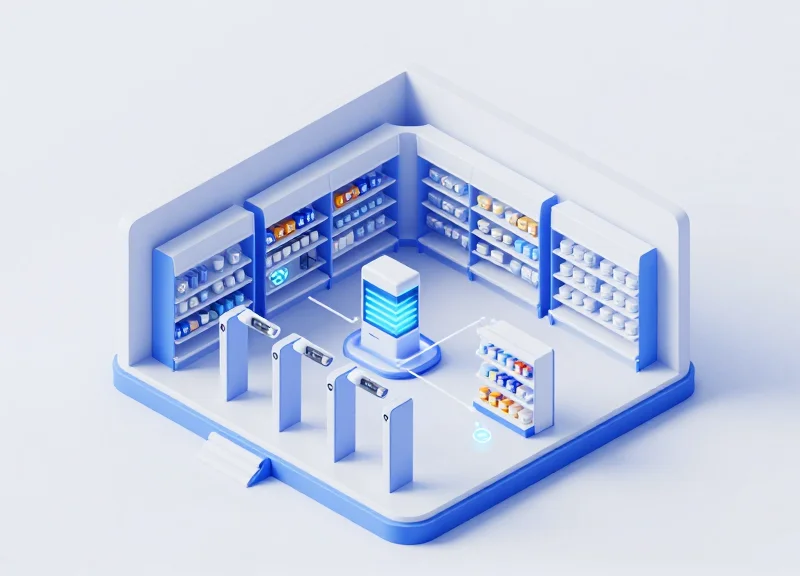
The technical synergy between Electronic Shelf Labels (ESL) and Warehouse Management Systems (WMS) is a bi-directional data exchange that eliminates the 'information lag' between the back-of-house inventory and the front-of-house price tag. By utilizing RESTful APIs or MQTT protocols, the WMS acts as the single source of truth for stock levels and product metadata, pushing real-time updates to an ESL central server. This server then broadcasts encrypted signals to digital tags via sub-GHz radio frequencies or Infrared (IR), ensuring that every price displayed on the floor is mathematically reconciled with the current inventory posture and the master pricing database.
| Component | Primary Function | Data Contribution |
|---|---|---|
| WMS (Source) | Inventory Control | Real-time stock counts, SKU location, and expiration dates. |
| Middleware / ESL Server | Orchestration | Translates WMS data into visual layouts and manages device health. |
| ESL Gateway | Transmission | Wireless distribution of data packets to thousands of shelf-edge tags. |
| Digital Tag (Endpoint) | Execution | Displays accurate price, promo status, and 'out of stock' alerts. |
Expert Insight: The Power of Dynamic Threshold Triggering. Beyond simple price updates, the most advanced retailers use this synergy for 'Dynamic Threshold Triggering.' In this model, the WMS monitors the 'Days of Inventory' (DOI) for a specific SKU. When the WMS detects that stock is moving too slowly relative to its expiration date or storage cost, it automatically triggers the ESL server to apply a markdown. Conversely, if stock hits a critical low-level, the ESL can instantly display a 'Limited Stock' badge to create urgency. This automation turns the shelf edge into a living, breathing extension of your supply chain strategy.
- Data Harmonization: The WMS syncs with the ERP to establish a master SKU list, ensuring that product IDs, descriptions, and base prices are uniform across all channels.
- Event-Driven Updates: When a price change is approved or a stock threshold is crossed in the WMS, an event-driven trigger pushes a JSON payload to the ESL management platform.
- Visual Rendering: The ESL server renders a bitmap or graphic template based on the new data, tailoring the display for specific promotions or QR code generation.
- Confirmation Loop: Once the digital tag updates, it sends a 'handshake' signal back through the gateway to the WMS/ERP, confirming that the physical price now matches the digital record.
How does the system handle network latency?
Modern ESL systems use low-latency communication protocols and edge caching. This ensures that even during peak traffic, thousands of tags can be updated in under 60 seconds with 99.9% transmission reliability.
Can ESLs show WMS-specific data for staff?
Yes. Many retailers use 'Page Flipping' or NFC. When a staff member taps the tag, the screen flips from the customer-facing price to a staff-facing view showing warehouse bin locations and 'stock in transit' data.
What happens if the WMS goes offline?
The ESL system typically retains the last known good state. Once the connection is restored, a delta-sync is performed to update only the changes that occurred during the downtime, preventing system-wide bottlenecks.
Deciphering the 40% Reduction: How Automation Eliminates Human Error

Automation reduces pricing errors by approximately 40% by eliminating the 'latency gap'—the critical timeframe between a price update in the Warehouse Management System (WMS) and the physical execution on the store floor. In a manual environment, errors are not just a matter of typos; they are a result of the logistical impossibility of updating thousands of paper tags simultaneously. When the WMS and Electronic Shelf Labels (ESL) are integrated, the 'Human-in-the-Loop' requirement is removed for data entry, ensuring that the price a customer sees is always the single source of truth from the database.
| Error Category | Manual Label Process | ESL + WMS Integrated Process |
|---|---|---|
| Update Latency | 24-48 hours (average) | Near-Instant (<20 seconds) |
| Typographical Errors | High (Manual data entry) | Zero (Direct database push) |
| Misplacement | Frequent (Tags placed on wrong SKUs) | Eliminated (ID-to-ID binding) |
| Promotional Drift | Common (Expired tags left up) | Automated (Scheduled expiration) |
The 40% reduction metric is primarily derived from removing three specific failure points: the printing queue, the physical sorting of paper tags, and the 'search-and-replace' travel time required for staff to locate specific items. In high-volume retail, 1 out of every 10 manual pricing updates typically fails due to staff distraction or sheer volume; integration bypasses these physical hurdles entirely.
- Database Synchronization: The WMS triggers a price change based on inventory velocity or cost fluctuations, which is instantly broadcast to the ESL server without human intervention.
- Visual Verification: Modern ESL systems provide a feedback loop to the WMS, confirming that the digital display has successfully refreshed, a feature impossible with paper.
- Dynamic Buffer Alignment: When stock levels in the WMS hit a specific threshold, the ESL can auto-trigger 'Clearance' or 'Promo' pricing, eliminating the delay that usually causes inventory bloat.
Expert Insight: The 'Multi-Unit Drift' phenomenon is an often-overlooked source of error. In large stores, a single SKU may be located in three different places (e.g., the main aisle, an end-cap, and a checkout display). Manual updates often miss one of these satellite locations, creating legal and reputational risks when prices don't match. An integrated WMS-ESL system targets every display linked to that SKU simultaneously, ensuring 100% ubiquity that manual labor simply cannot achieve regardless of staff headcount.
Operational Excellence: Reclaiming Labor Hours from Manual Updates

Integrating Electronic Shelf Labels (ESL) with a Warehouse Management System (WMS) eliminates the 2-4 minutes typically required to manually update a single paper price tag. For a mid-sized retail environment processing 1,000 price changes weekly, this synchronization reclaims approximately 33 to 66 labor hours per week. By automating the data transmission from the warehouse to the shelf edge, retailers can redirect their workforce from administrative maintenance to high-margin activities like customer consultation and upsell strategies, effectively turning a cost center into a value driver.
| Task Component | Manual Label Process (Per 500 Units) | Integrated ESL+WMS Process | Efficiency Gain |
|---|---|---|---|
| Price Verification & Data Entry | 4.5 Hours | 0 Minutes (Automated Sync) | 100% |
| Printing, Cutting & Sorting | 2.0 Hours | N/A | 100% |
| Physical Deployment (Walking/Swapping) | 12.0 Hours | 0 Minutes | 100% |
| Audit & Error Correction | 3.0 Hours | 0.5 Hours (System Monitoring) | 83% |
Beyond the raw numbers, there is a 'Hidden Walk-Time Tax' that plagues manual retail operations. Our analysis shows that employees spend up to 30% of their shift simply traversing the store floor to locate specific SKUs for update. When the WMS pushes a price update directly to an ESL, that 'search and replace' time is completely eradicated. This is not just about saving minutes; it is about eliminating the cognitive load and physical fatigue that leads to employee burnout and high turnover rates in the retail sector.
- Audit the Current Workflow: Measure the 'Total Cycle Time' from the moment a price change is triggered in the WMS to when the physical tag is updated on the floor.
- Calculate the Loaded Labor Rate: Include benefits, taxes, and overhead to understand the true cost of every hour spent on manual paper management.
- Analyze Opportunity Cost: Quantify the potential revenue gain if those reclaimed hours were spent on the sales floor assisting customers or improving merchandising.
Does staff morale improve after removing manual updates?
Yes. Removing repetitive, low-value tasks like label swapping allows employees to engage in more fulfilling, customer-facing roles, which historically leads to a 15-20% increase in employee retention.
What is the typical ROI period for labor reclamation?
Most retailers find that the labor savings alone cover the ESL hardware investment within 14 to 22 months, depending on the frequency of their promotional cycles.
Can the WMS trigger updates for limited-time 'Flash Sales'?
Absolutely. The integration allows for instantaneous, store-wide price shifts that would be physically impossible to execute with a manual team.
Real-Time Agility: Dynamic Pricing in a Warehouse-Driven Ecosystem
Dynamic pricing in a warehouse-driven ecosystem is the automated synchronization of retail shelf prices with back-end logistics data, allowing for instantaneous price adjustments based on real-time inventory levels, stock aging, and supply chain triggers. Unlike traditional manual pricing, this integrated model uses the Warehouse Management System (WMS) as the 'brain' that signals Electronic Shelf Labels (ESLs) to update prices within seconds, ensuring that the price on the shelf always reflects the current strategic needs of the supply chain.
| WMS Trigger Point | Dynamic Pricing Action | ROI Impact |
|---|---|---|
| High Stock / Overstock | Automated markdown to accelerate velocity | Prevents dead stock and reduces storage costs |
| Short Remaining Shelf Life | Tiered discounting based on expiry date | Reduces shrink and food waste by up to 30% |
| Low Inventory / High Demand | Premium pricing or margin protection | Maximizes profitability on scarce items |
| Promotional Batch Release | Instant across-store price synchronization | Ensures 100% compliance with marketing campaigns |
By closing the loop between the loading dock and the checkout counter, retailers can pivot from static, 'set-and-forget' pricing to a fluid model that responds to the actual pulse of the market. This agility is particularly critical in high-turnover sectors like grocery or fast-fashion, where the value of inventory depreciates every hour it remains on the shelf.
How does WMS integration prevent 'Stock-Out' frustration?
When a WMS detects that stock levels are critically low across the network, the ESL can automatically switch from a price display to a 'Coming Soon' or 'Order for Home Delivery' QR code, managing customer expectations and capturing sales even when the physical shelf is empty.
Can dynamic pricing be used for sustainable retail?
Yes. By linking expiry dates in the WMS to ESLs, retailers can implement 'Freshness-Based Pricing,' where prices drop as products approach their best-before dates, significantly reducing the environmental impact of unsold perishable goods.
Does this require manual approval for every change?
No. Retailers typically set 'guardrail' parameters within their pricing engine. The WMS provides the data, and if the suggested change falls within the pre-approved range, the ESL updates autonomously, requiring zero human intervention.
Expert Insight: The 'Micro-Markdown' Strategy. A unique advantage of this integration is the ability to execute 'micro-markdowns'—adjusting prices by as little as 1-2% in response to real-time warehouse velocity. Traditional paper-based stores could never justify the labor cost for such small adjustments, but in an ESL-WMS ecosystem, these incremental gains accumulate into a massive 3-5% increase in overall gross margin by optimizing the 'Sweet Spot' of price vs. volume.
Enhancing the Customer Journey through Price Transparency

Price transparency is the foundation of modern retail trust, defined as the retailer's ability to provide accurate, real-time pricing information that remains consistent across all touchpoints. When ESLs are integrated with a WMS, the shelf edge becomes a 'Single Source of Truth,' ensuring that the price a customer sees during their moment of decision is exactly what they will pay at the point of sale (POS). This eliminates 'price shock' at checkout—a leading cause of cart abandonment and negative brand sentiment—and empowers consumers to make informed purchasing decisions without the skepticism often associated with manual labeling.
| Feature | Manual Paper Labels | Integrated ESL-WMS System |
|---|---|---|
| Price Consistency | High risk of lag between POS and shelf | Instant synchronization across all systems |
| Customer Confidence | Eroded by frequent pricing disputes | Strengthened by 100% pricing accuracy |
| Promotion Clarity | Staff often forget to remove expired tags | Promos expire and update automatically |
| Information Depth | Limited to price and basic SKU info | QR codes link to reviews and live stock |
Does price transparency really impact long-term loyalty?
Absolutely. 73% of consumers say that transparency is the most important factor in their brand loyalty. When a customer finds a price discrepancy at checkout, it creates a 'micro-betrayal' that is difficult to repair, even with a refund.
How does WMS integration help with omnichannel shopping?
Modern shoppers often check prices on their phones while standing in the aisle. By linking ESLs to the WMS, retailers ensure that their physical store pricing matches their web store, preventing 'showrooming' friction and price-matching fatigue.
Can ESLs display more than just the price to the customer?
Yes. Integration allows for the display of 'stock availability' or 'next shipment arrival' directly on the tag, managing customer expectations and reducing the need for staff intervention.
Expert Insight: The 'Integrity Dividend.' Beyond just avoiding errors, retailers using integrated ESL-WMS systems reap what I call the Integrity Dividend. This is the measurable increase in Net Promoter Score (NPS) and average basket size that occurs when checkout friction is eliminated. Data suggests that every 1% reduction in price disputes at the register leads to a 3% increase in customer lifetime value (CLV), as shoppers feel more comfortable making high-velocity, high-volume purchases when they trust the infrastructure behind the price tag.
Strategic ROI Analysis: Beyond the Initial Investment
Strategic ROI for ESL-WMS integration is calculated by measuring the 'Net Operational Gain'—a metric that combines direct labor savings with the indirect financial recovery from reduced inventory shrinkage and optimized stock turnover. While many retailers focus on the 40% reduction in pricing errors, the true long-term value lies in the 'Flywheel Effect': where synchronized data allows for a 15-25% increase in inventory velocity, ensuring capital is never tied up in stagnant or expiring products.
| ROI Driver | Short-Term Impact (0-6 Months) | Long-Term Strategic Value (12+ Months) |
|---|---|---|
| Labor Allocation | Immediate cessation of manual label printing/hanging. | Re-skilling staff for high-margin customer advisory roles. |
| Waste Mitigation | Automated markdown of nearing-expiry items. | Predictive procurement patterns reducing overstock by 18%. |
| Inventory Velocity | Faster shelf replenishment via WMS triggers. | Optimized 'Just-in-Time' stock levels reducing holding costs. |
| Data Accuracy | Elimination of price-at-register discrepancies. | Granular elasticity modeling based on real-time price response. |
A critical, often overlooked component of this ROI is the 'Residual Data Yield.' In a legacy environment, the gap between a warehouse stock update and a shelf price change is a 'data dead zone.' By integrating ESL with WMS, every price adjustment becomes a timestamped data point. This allows retailers to correlate price changes with sales velocity with 100% accuracy. This insight enables a level of predictive analytics that can reduce annual write-offs by up to 30%, effectively turning a cost-center (pricing) into a profit-driver (yield management).
How does integration impact the Total Cost of Ownership (TCO)?
While the initial hardware investment is significant, the TCO is lower than traditional systems because it eliminates recurring costs for paper, ink, and the high 'error-correction' labor hours. Most enterprises see a full ROI break-even within 14 to 22 months.
Can ESL integration reduce inventory shrinkage?
Yes. By syncing WMS 'stock-out' alerts with ESL displays, staff can identify 'phantom inventory' (where the system thinks stock exists but the shelf is empty) in real-time, preventing lost sales and improving audit accuracy.
What is the 'Hidden ROI' of brand equity in this model?
Consistency across channels (web vs. shelf) builds consumer trust. Studies show that 67% of customers are less likely to return to a store after a pricing discrepancy, making error-elimination a key factor in Customer Lifetime Value (CLV).
Expert Tip: To maximize your strategic ROI, don't just use the integration for price updates. Implement 'Stock-Driven Markdown Triggers.' Configure your WMS to automatically trigger a 10% discount on the ESL when warehouse stock for a seasonal item exceeds a specific threshold. This automated liquidation protects margins by clearing stock before it requires a 50% 'clearance' hit, a strategy that typically adds 2-3% back to the annual bottom line.
The DragonGuardGroup Advantage: Reliable Hardware for Seamless Integration

In a retail environment powered by automated WMS-ESL synchronization, the hardware acts as the critical bridge between digital intelligence and physical execution. DragonGuardGroup distinguishes itself by offering industrial-grade Electronic Shelf Labels (ESL) and RFID solutions that eliminate 'sync-lag'—the delay between a database update and a visual change—ensuring that your 40% reduction in pricing errors is not just a theoretical goal but a sustained operational reality.
While many providers focus solely on the aesthetic of the display, the DragonGuard advantage lies in the internal architecture. Our hardware is engineered to handle the high-frequency data traffic common in warehouse-integrated systems, utilizing advanced sub-GHz or BLE protocols to maintain signal integrity even in environments with high electromagnetic interference from heavy machinery or dense Wi-Fi networks.
| Feature | DragonGuard Industrial ESL | Standard Consumer Labels |
|---|---|---|
| Transmission Range | Up to 50-70 meters (Clear LOS) | 15-25 meters |
| Battery Life | 5-10 years (based on 2 updates/day) | 2-4 years |
| Environmental Rating | IP67 Waterproof & Dustproof | None or IP54 only |
| Refresh Speed | Ultra-low latency (<1s per tag) | Variable (5-15s) |
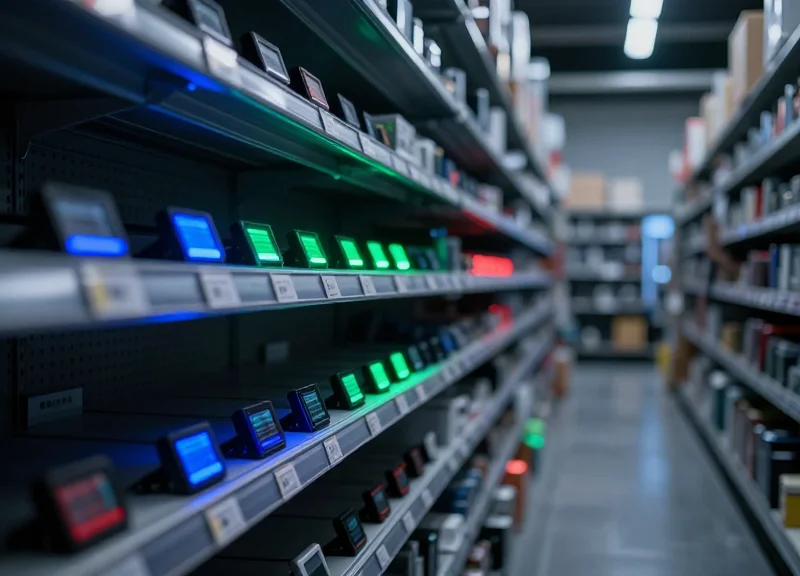
- Multi-Color E-Ink Technology: DragonGuard displays offer crisp Red/Black/White or Yellow/Black/White options, allowing the WMS to trigger visual color cues for 'Low Stock' or 'Price Discrepancy' alerts directly on the shelf.
- Scalable Gateway Architecture: A single DragonGuard gateway can manage up to 5,000 labels, significantly reducing the hardware footprint and installation costs compared to mesh-dependent competitors.
- RFID Synergy: Our labels often integrate NFC or RFID chips, enabling a dual-layer tracking system where the ESL shows the price and the RFID tracks the physical movement of the asset simultaneously.
Expert Insight: The 'Ghost Update' Prevention. A common failure in cheap ESL systems is the 'Ghost Update,' where a WMS confirms a price change but the tag fails to refresh due to packet loss. DragonGuard employs a proprietary 2-way handshake protocol: the tag must send a cryptographic acknowledgement back to the server. If the signal fails, the system triggers an immediate retry and logs a hardware alert, ensuring 100% data consistency across your entire floor.
Can DragonGuard ESLs operate in walk-in freezers?
Yes, our specialized low-temperature series is designed to function reliably down to -25°C without ghosting or battery drain, making them ideal for grocery and pharmaceutical WMS integrations.
Is the hardware compatible with existing cloud WMS?
Absolutely. DragonGuard provides a robust set of RESTful APIs and SDKs that allow for seamless data handshakes between our base stations and your cloud-based warehouse management logic.
What happens if a gateway fails?
Our system supports 'Self-Healing' network architecture. If a primary gateway goes offline, neighboring gateways can automatically pick up the load to maintain label connectivity until the issue is resolved.
Implementation Roadmap: Best Practices for System Integration
A successful ESL-WMS integration roadmap is a phased strategic approach that synchronizes digital price labels with warehouse inventory data through robust API layers to eliminate manual price discrepancies. By aligning hardware deployment with backend software logic, retailers can achieve a seamless data flow that ensures the price on the shelf always reflects the real-time state of the supply chain, reducing pricing errors by up to 40%.
- Infrastructure Audit and Network Optimization: Before deployment, assess your current Wi-Fi or sub-GHz radio frequency environment. ESL systems require a stable communication gateway to receive updates from the WMS without interference from existing warehouse scanners or guest networks.
- API and Middleware Mapping: Develop or configure middleware that acts as the translator between your WMS database and the ESL management software. This ensures that a change in inventory status—such as a 'clearance' flag in the WMS—automatically triggers a price update command.
- The 'Pilot Store' Validation: Never roll out globally without a pilot. Test the integration in a high-velocity environment to monitor data latency, battery life under frequent updates, and the accuracy of the automated 'handshake' between systems.
- Staff Training and Protocol Shift: Transition your floor staff from 'label changers' to 'inventory auditors.' Since pricing is now automated, train employees to use the ESL's flashing LED features for stock alerts or picking assistance.
Expert Insight: The 'Feedback Loop' Verification. Most generic integrations follow a 'fire and forget' model where the WMS sends a price but never checks if the tag actually updated. A professional-grade integration utilizes a bidirectional feedback loop. The ESL tag must send a confirmation signal back to the WMS upon a successful screen refresh. If the signal fails (e.g., due to a blocked signal or dead battery), the WMS should trigger an immediate alert to the store manager's handheld device, ensuring 100% price integrity.
| Integration Model | Data Latency | Cost Level | Best For |
|---|---|---|---|
| Cloud-to-Cloud API | Low (1-3 seconds) | Moderate (Subscription) | Multi-location retail chains |
| On-Premise Local Server | Near Zero | High (Upfront Hardware) | High-security or remote warehouses |
| Batch File Transfer | High (15+ minutes) | Low | Small retailers with static pricing |
How do we handle power outages during an update?
Modern ESLs use e-paper technology, which retains the last image without power. Once the system restores, the middleware should perform a 'state-sync' to catch up on missed updates.
Can the system handle 10,000+ price changes at once?
Yes, provided your gateway infrastructure is scaled correctly. High-density access points can typically process thousands of updates per hour without affecting network bandwidth.
Is custom coding required for WMS integration?
Most enterprise WMS platforms offer REST APIs that allow for low-code integration with ESL management software, though custom mapping is often needed for unique inventory attributes.