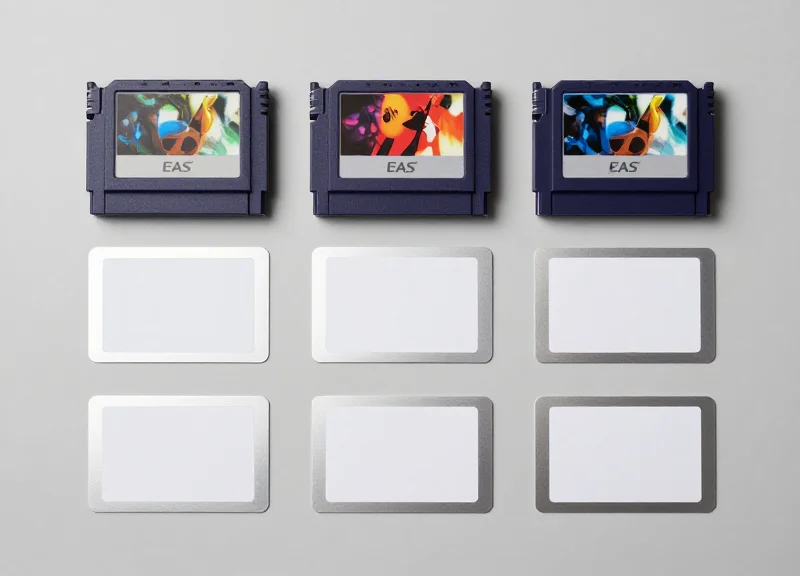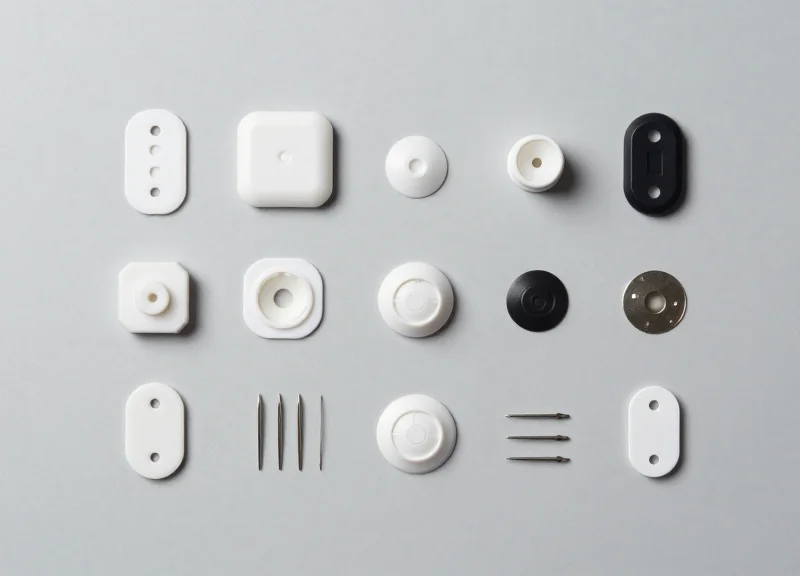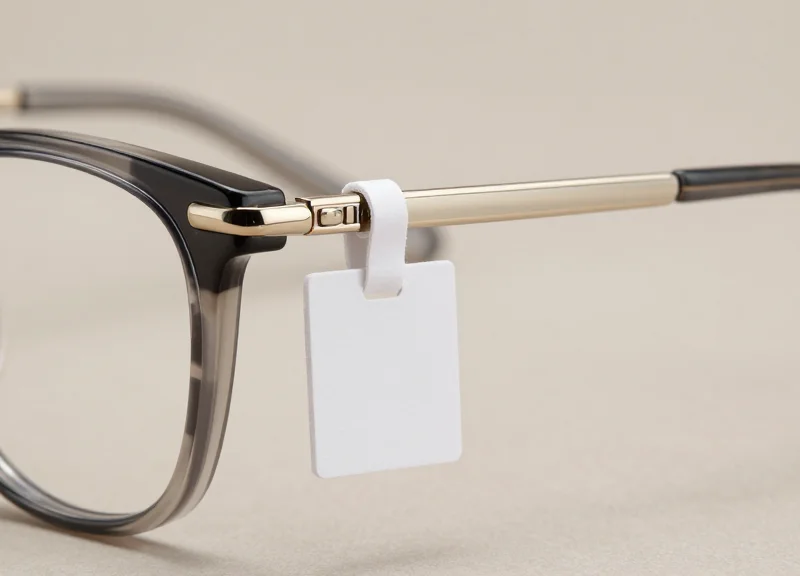
In the high-stakes world of optical retail, the challenge of loss prevention is often a trade-off between security and product integrity. Luxury eyewear, crafted from delicate cellulose acetate and premium metals like titanium, requires a specialized touch. Traditional security tags, if poorly designed, can leave permanent indentations, scratches, or adhesive residue that devalues the product. This guide provides a technical deep-dive into the latest non-damaging temple tag technologies, offering retailers a roadmap to shield sensitive frames from theft while preserving their pristine condition and aesthetic appeal.
The Material Science of Modern Eyewear Frames
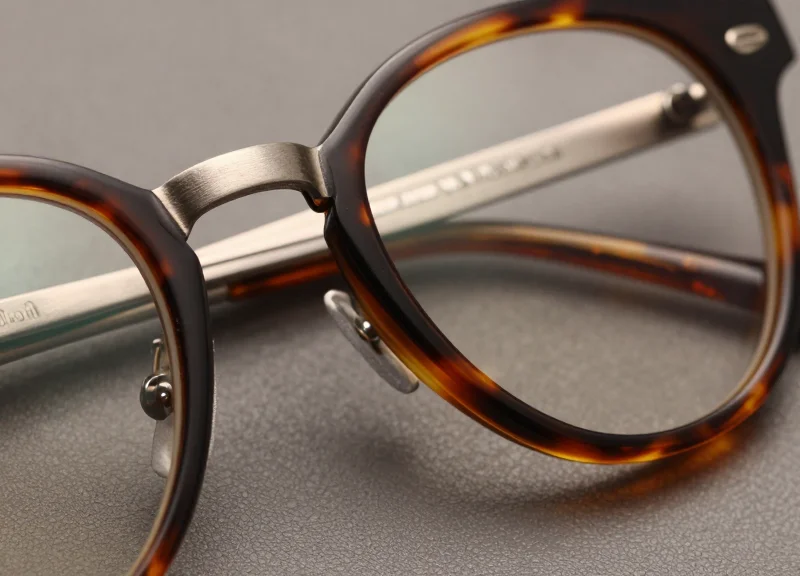
Modern eyewear frames are sophisticated composite structures—ranging from organic cellulose acetate to high-performance titanium alloys—each possessing unique thresholds for mechanical pressure and chemical exposure that dictate how security tags should be applied to avoid permanent deformation or surface degradation. Protecting these assets requires a deep understanding of 'material memory' and chemical reactivity, as the wrong tagging method can lead to irreversible 'cold flow' indentations in plastics or the delamination of expensive PVD coatings on metals.
| Material Type | Structural Property | Environmental Stressor | Tagging Risk |
|---|---|---|---|
| Cellulose Acetate | Thermoplastic / Porous | UV & Body Oils | Plasticizer migration and clouding |
| Titanium | Crystalline / Rigid | Oxidation (minimal) | Abrasive scratching of Ion Plating |
| Monel Metal | Ductile Alloy | Corrosion / Sweat | Mechanical deformation from clamp pressure |
| Stainless Steel | High Elasticity | Salt-air corrosion | Surface marring of mirror finishes |
Acetate is not a traditional plastic; it is a plant-based material that 'breathes.' Because it contains plasticizers to maintain flexibility, it is highly susceptible to chemical reactions with adhesive-backed tags. When an adhesive sits on acetate, the chemicals can leach into the frame, resulting in a permanent 'etched' mark or yellowing. Furthermore, acetate exhibits a property known as 'Cold Flow'—if a temple tag is applied too tightly, the material will slowly move away from the pressure point, creating a permanent notch in the temple that cannot be buffed out.
Why does adhesive residue damage acetate more than metal?
Acetate is a porous organic polymer. The solvents in many industrial adhesives can penetrate the surface layer, causing a chemical bond that alters the frame's molecular structure, whereas metals are generally non-porous and only face surface-level contamination.
Can non-adhesive tags still damage metal frames?
Yes. Metal frames often feature thin electroplated layers or Physical Vapor Deposition (PVD) finishes. Hard plastic tags that vibrate or shift during shipping can act as an abrasive, micro-scratching the finish and exposing the base metal to oxidation.
What is the 'memory' of a frame material?
Material memory refers to the ability of a frame to return to its original shape after being bent. Metals like Beta-Titanium have high memory, while acetate has low memory, meaning pressure from a tag is far more likely to cause a permanent 'set' in acetate.
Expert Insight: From an engineering perspective, the most overlooked threat is 'Galvanic Corrosion' in tagged metal frames. If a tag traps moisture or salt (from handling) against a plated metal temple, it can create a micro-environment that accelerates the breakdown of the protective clear coat, leading to green 'verdigris' oxidation long before the frame even reaches the customer's face.
Identifying the Risks: How Conventional Tags Damage Frames
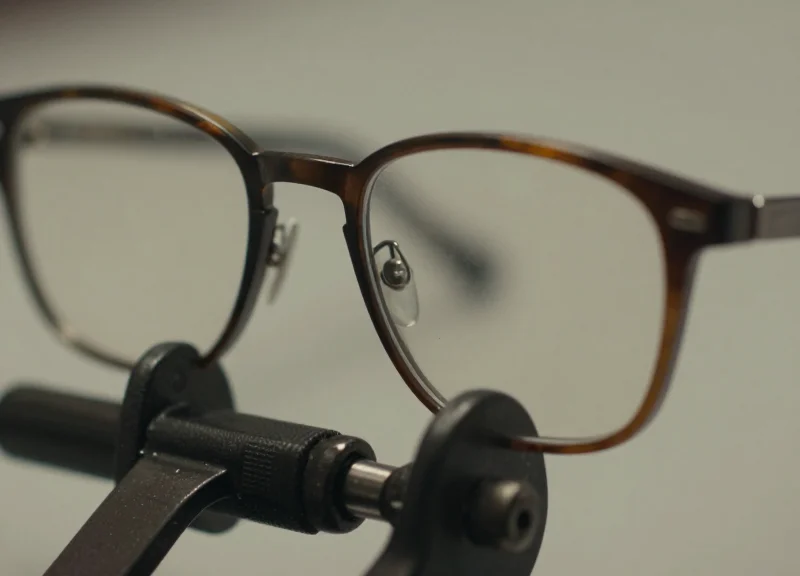
Conventional security tags pose a significant threat to high-end eyewear through a combination of localized mechanical stress and chemical degradation. Most standard Electronic Article Surveillance (EAS) systems rely on high-tension clamping mechanisms designed for generic retail goods, which often exceed the material tolerances of delicate acetate and plated metal alloys. When these tags are applied without precision-calibrated pressure, they cause 'silent shrinkage'—inventory that is technically present but commercially unsellable due to permanent surface marring or structural warping.
| Risk Factor | Impact on Acetate | Impact on Metal Alloys |
|---|---|---|
| Clamping Pressure | Permanent indentation and 'cold flow' deformation. | Structural bending or snapping of the temple core wire. |
| Adhesive Leaching | Clouding and 'blooming' due to plasticizer reaction. | Pitting and oxidation of the protective clear coat. |
| Surface Friction | Micro-scratches that dull the hand-polished finish. | Galvanic corrosion and stripping of gold/rhodium plating. |
Expert Insight: The 'Vapor Trap' Effect. A unique risk often overlooked by general retailers is the 'Vapor Trap.' When a non-breathable rubber or plastic tag lining is clamped tightly against a frame, it can trap ambient moisture and skin oils against the surface. In acetate frames, this accelerated localized humidity causes 'whitening'—a chemical reaction where the cellulose acetate begins to revert to its raw form. In metals, this micro-environment facilitates electrolytic reaction, leading to green oxidation (verdigris) in record time.
What is 'Cold Flow' in acetate tagging?
Cold flow refers to the tendency of acetate to permanently deform under constant pressure at room temperature. A tag applied too tightly for even 48 hours can create a 'notched' temple that cannot be buffed out or heat-repaired.
Why do standard adhesive tags fail on luxury metal frames?
The solvents in most commercial adhesives react with the protective lacquers on metal frames. When the tag is removed, it often pulls the lacquer or plating away with it, exposing the base metal to rapid oxidation.
Can mechanical tension cause lens misalignment?
Yes. If a tag is placed too close to the hinge, the lateral pressure can torque the frame front, leading to lens 'popping' or optical distortion that ruins the wearer's experience.
To mitigate these risks, technical implementation must move away from 'one-size-fits-all' clamping. Identifying these specific failure points is the first step in transitioning to non-damaging solutions that prioritize the metallurgical and polymer-specific needs of modern eyewear.
Core Technologies in Non-Damaging Temple Tags
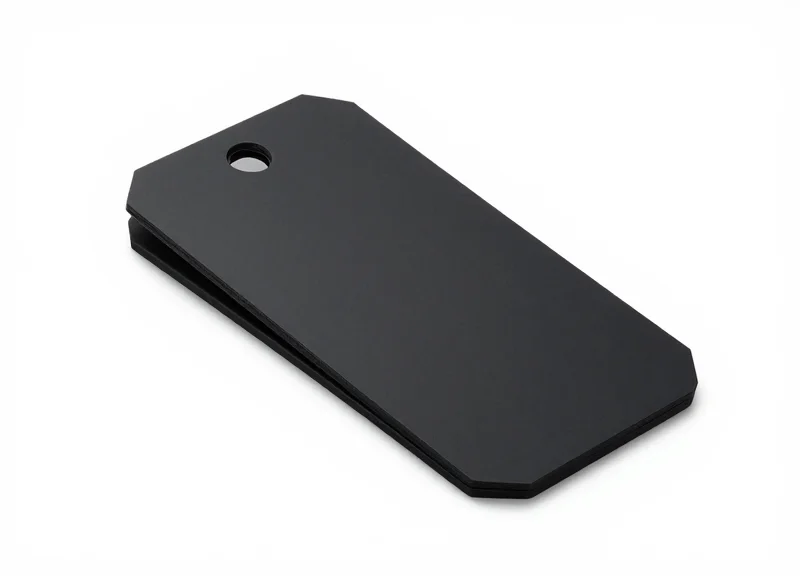
Core technologies in non-damaging temple tags utilize a combination of high-friction thermoplastic elastomers (TPE), precision-engineered tension limiters, and mechanical interlocking geometries to secure eyewear frames without the use of corrosive adhesives or high-compression clamping. Unlike traditional security tags that rely on raw force, these modern solutions leverage surface physics to provide a 'zero-scar' grip that maintains the aesthetic and structural integrity of both porous acetate and polished metal alloys.
| Component | Standard Tag Technology | Advanced Non-Damaging Tech |
|---|---|---|
| Contact Interface | Hard ABS Plastic / Metal Teeth | Medical-Grade TPU / Silicone Liners |
| Retention Method | High-Pressure Compression | Coefficient of Friction (CoF) Grip |
| Locking Mechanism | Manual Ratchet / Spring Pin | Calibrated Torque-Limited Clutches |
| Removal Method | Magnetic Detacher (Often Sticky) | Clean Mechanical Release (Adhesive-Free) |
- Soft-Grip Elastomeric Linings: These linings use Thermoplastic Polyurethane (TPU) with specific Shore A durometer ratings. The material 'wets' the surface of the temple at a microscopic level, creating a high-friction bond that prevents sliding without needing to crush the material underneath.
- Tension-Controlled Locking Hubs: Engineering a non-damaging tag requires a physical limit on how much force can be applied. Advanced tags incorporate internal clutch mechanisms that 'click' or slip once the optimal holding force is reached, preventing the overtightening that causes stress fractures in acetate.
- Geometric Interlocking (Adhesive-Free): Instead of chemical glues which leach plasticizers from frames, these tags use 'cradle' geometries. The tag is designed to wrap around the temple's natural taper, using the frame's own shape to stay secure rather than sticky residues.
Expert Insight: The 'Differential Hardness' Principle. In Silicon Valley material labs, we've found that the secret to a perfect non-damaging tag is maintaining a Delta-H (Hardness Difference) of at least 15 points on the Shore A scale. If your tag lining is too close in hardness to the frame material (especially on softer cellulose acetate), environmental heat can cause 'fusion bonding' where the two materials microscopically merge. Always specify liners with a Shore A rating between 40 and 60 for maximum protection.
Will these soft-grip materials degrade over time?
High-quality TPE and silicone liners are UV-stabilized and resistant to skin oils, ensuring they don't become gummy or brittle during long-term display cycles.
Can these technologies support both ultra-thin metal and thick acetate?
Yes. The combination of flexible liners and modular spacing inserts allows the internal cavity to adjust its volume while maintaining a constant, safe pressure profile.
Do non-damaging tags sacrifice security for safety?
Actually, the higher coefficient of friction provided by TPE liners often makes the tags harder to forcibly slide off than traditional hard-plastic tags.
Implementing EAS vs. RFID Solutions for Sensitive Inventory
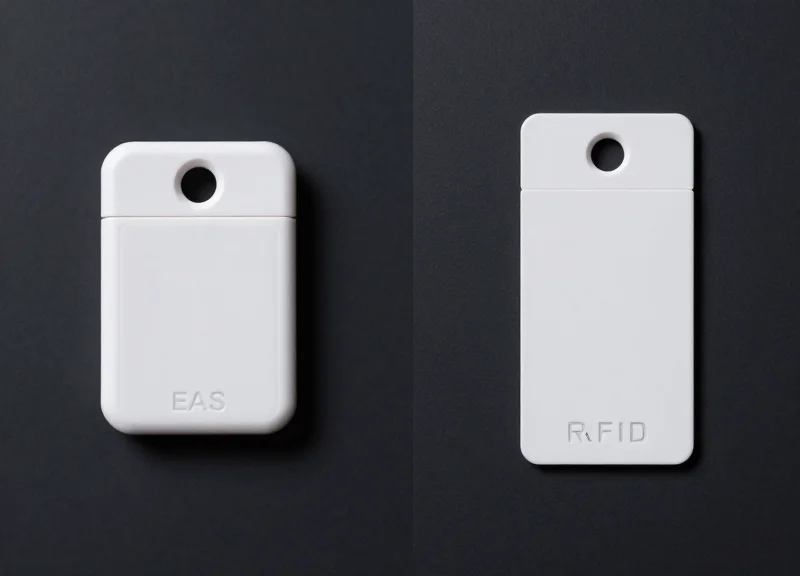
The choice between EAS and RFID for sensitive eyewear hinges on the primary objective: Electronic Article Surveillance (EAS) is a 'one-bit' technology designed strictly for loss prevention, triggering an alarm when a non-deactivated tag passes through a pedestal. Conversely, Radio Frequency Identification (RFID) provides 'multi-bit' data, allowing retailers to identify the specific SKU, color, and size of the frame instantly. For high-end acetate and metal frames, the implementation must balance these security protocols with the physical constraints of the material to avoid signal interference or mechanical stress.
| Feature | EAS (AM or RF) | RFID (UHF) | Optical Application Impact |
|---|---|---|---|
| Primary Goal | Theft Deterrence | Inventory Intelligence | RFID reduces 'out of stock' lost sales. |
| Detection Range | 0.9 - 1.8 Meters | Up to 6+ Meters | RFID allows for 'smart mirrors' and kiosks. |
| Data Capacity | On / Off only | 96-bit to 512-bit EPC | RFID tracks frame age and rotation. |
| Material Conflict | Low interference | High (Metal frames) | Metal frames require 'spacer' tags. |
Expert Insight: The 'Faraday Shielding' Challenge in Titanium Frames. In my two decades of Silicon Valley systems engineering, the most common failure I see in optical deployments is the oversight of signal attenuation caused by metallic frame alloys. Titanium and high-nickel stainless steel can act as a Faraday cage, effectively 'shielding' the RFID tag from the reader. To combat this without using damaging mechanical clamps, implementation must utilize tags with a 1-2mm dielectric spacer, ensuring the antenna is offset from the metal surface to maintain resonance.
- Determine Strategic Priority: Assess if your primary pain point is shrink (choose EAS) or stock accuracy and omni-channel fulfillment (choose RFID).
- Select Frequency Profile: For optical boutiques, Acousto-Magnetic (AM) 58kHz EAS is preferred over 8.2MHz RF because it is less prone to interference from metal frame displays.
- Prototype Attachment Mechanics: Test non-damaging temple tags on both high-gloss acetate and matte-finish metals to ensure the tension-lock doesn't leave 'witness marks' over time.
Can I use both EAS and RFID on the same frame?
Yes, 'Dual-Technology' tags exist that house both an AM EAS strip and a UHF RFID inlay within a single non-damaging temple housing, providing both security and data.
Does RFID hardware require store remodeling?
Unlike EAS pedestals which are fixed, RFID can be implemented using handheld readers, though overhead 'smart' antennas offer the best real-time visibility.
Will RFID tags affect the balance of the frame during fitting?
Modern non-damaging RFID temple tags weigh less than 1.5 grams and are designed to be centered on the temple arm to minimize ergonomic impact during customer trials.
Step-by-Step Installation Guide for Optical Technicians
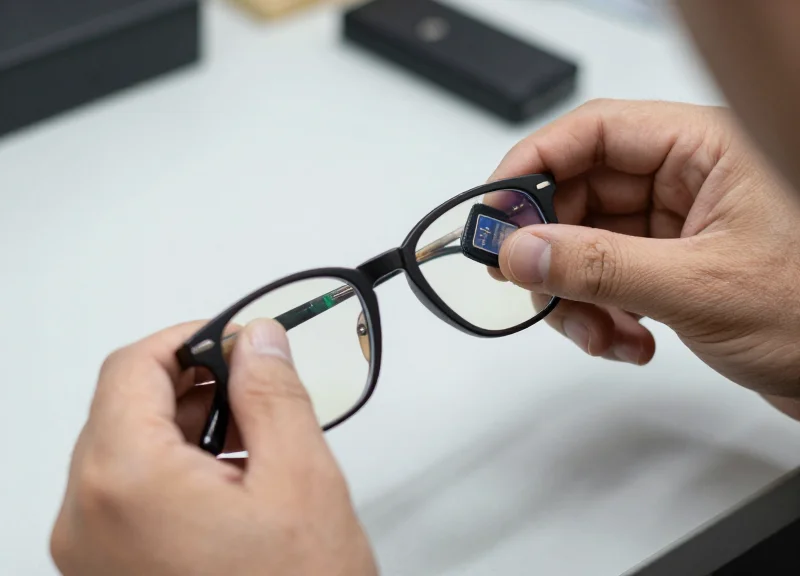
Implementing non-damaging temple tags is a precision procedure that balances mechanical security with material preservation, utilizing soft-grip interfaces and calibrated tension to prevent the stress fractures common in acetate or the surface abrasions found on luxury metal alloys. By following a standardized installation workflow, optical technicians can ensure 100% security coverage while maintaining the 'factory-new' condition of the frame inventory.
| Installation Phase | Primary Objective | Key Tools Required |
|---|---|---|
| Phase 1: Surface Prep | Remove contaminants that cause slippage or chemical reactions. | Anhydrous Isopropyl Alcohol & Microfiber |
| Phase 2: Positioning | Ensure ergonomic comfort for the customer during trials. | Digital Calipers or Alignment Jig |
| Phase 3: Securement | Apply specific tension without exceeding material yield points. | Torque-limited Driver or Precision Pliers |
| Phase 4: Validation | Confirm RF/AM resonance and tag stability. | EAS Gate Verifier / Manual 'Tug' Test |
- Clean the Contact Zone: Using a microfiber cloth and a mild, frame-safe cleaning solution, remove all sebum and manufacturing oils from the mid-temple area. For acetate, ensure the frame is at room temperature to prevent thermal-induced warping during cleaning.
- Identify the 'Dead Zone': Place the tag at the widest part of the temple that does not interfere with the hinge mechanism or the curve of the ear-piece. This ensures the tag remains immobile without requiring excessive clamping force.
- Engage the Soft-Grip Interface: Align the internal silicone or rubberized cushions of the tag with the frame edges. Ensure the lining fully envelopes the temple width to distribute pressure evenly across the surface area.
- Calibrated Tightening: Apply pressure until the tag is snug. For screw-based mechanisms, stop immediately once resistance is felt. On metal frames, check that the tag does not rotate, as rotation is the primary cause of hairline scratches.
- Final Verification: Pass the tagged frame through a tabletop verifier to ensure the internal coil has not been compromised during installation. Check for 'temple flare' to ensure the tag isn't bowing the material.
Expert Insight: The 24-Hour Acetate Relaxation Rule. Acetate is a semi-organic polymer with a 'memory' effect. If a frame has recently been adjusted using a hot air blower, wait at least 24 hours before applying a temple tag. Tagging warm acetate often leads to permanent 'sink marks' (depressions in the plastic) as the material cools and shrinks around the tag's pressure points.
Will these tags leave marks on matte-finish frames?
If the tag utilizes a high-durometer silicone lining, it prevents the burnishing (polishing) of matte surfaces that typically occurs with hard plastic tags.
How do I handle ultra-thin titanium wire temples?
Use a specialized 'spacer insert' within the tag to increase the effective diameter of the wire, allowing the tag to grip firmly without bending the titanium.
Can I use ultrasound cleaners with tags attached?
No. Ultrasonic vibrations can cause the tag's internal components to vibrate against the frame, leading to micro-pitting. Always remove tags before deep cleaning.
Aesthetic Considerations: Maintaining the Luxury Customer Experience

In the luxury optical segment, the 'try-on' is a critical emotional touchpoint where the customer evaluates the frame's weight, balance, and haptic quality; therefore, an effective non-damaging temple tag must be virtually imperceptible to the wearer. High-end implementations prioritize low-profile geometries—typically less than 4mm in thickness—and neutral or translucent color palettes that do not distract from the frame’s design. By utilizing tags that align with the temple’s natural curvature and maintaining a total weight under 2 grams, retailers can ensure the security device does not disrupt the ergonomic fit or the customer's perception of the brand's quality.
| Feature | Standard Security Tags | Luxury-Grade Temple Tags |
|---|---|---|
| Visual Profile | Large, opaque, and protruding | Ultra-slim, translucent, or color-matched |
| Weight Impact | 5g - 10g (causes nose-bridge sliding) | < 2g (preserves original balance) |
| Ear-Stem Clearance | Obstructs contact with the mastoid bone | Contoured to sit flush with the temple |
| Material Finish | Hard, abrasive recycled plastic | Soft-touch polymer or silicone-lined |
Expert Insight: The Center-of-Gravity (CoG) Rule. Most generic security articles overlook the 'lever effect' of tag placement. In luxury eyewear, especially with lightweight titanium or top-heavy acetate, placing a tag too far toward the temple tip shifts the frame's Center of Gravity. This causes the glasses to slide down the wearer's nose during the mirror check. To maintain the luxury experience, optical technicians should utilize tags with a 'neutral-weight' distribution, ensuring the tag's mass is centered over the ear-bend to prevent any perceived loss of fit quality.
How do tags affect the customer's view in the mirror?
Low-profile tags use clear or matte-black polymers that blend into the temple's shadow line, ensuring the customer focuses on the frame's silhouette rather than the security device.
Can tags interfere with high-wrap or sporty frames?
Modern non-damaging tags feature flexible 'hinge-points' or articulated grips that allow them to conform to the high-base curves of sports luxury frames without snapping or popping off.
Do these tags scratch the customer's skin during try-on?
No, premium tags are engineered with ultrasonic welding on the seams, removing the sharp burrs found on cheap injection-molded tags that often cause discomfort behind the ear.
Ultimately, the goal of aesthetic integration is to reduce 'security friction.' When a tag is light enough and thin enough that the customer forgets it is there, the likelihood of a successful sale increases significantly. Investing in tags that respect the industrial design of the eyewear is not just a loss-prevention strategy; it is a vital component of the high-end retail marketing mix.
Durability and Maintenance: Ensuring Long-Term Performance
Ensuring the durability of temple tags involves more than just a firm attachment; it requires a lifecycle management strategy that accounts for 'micro-friction' and chemical exposure. High-performance tags are designed to withstand an average of 300 to 500 handling cycles—including customer try-ons and technician adjustments—without losing their structural integrity or damaging the delicate acetate and metal surfaces they protect. The primary goal is to maintain a constant, non-deforming pressure that prevents the tag from sliding while ensuring the internal soft-grip lining does not undergo 'compression set,' a state where the material loses its elasticity and fails to provide a secure grip.
| Maintenance Frequency | Action Item | Technical Objective |
|---|---|---|
| Daily | Visual Alignment Check | Identify 'creeping' tags that may have shifted due to customer handling. |
| Weekly | Surface Decontamination | Remove skin oils and sweat that can degrade synthetic rubber linings. |
| Monthly | Tension Calibration | Verify the locking mechanism hasn't loosened on high-traffic frames. |
| Quarterly | RFID/EAS Signal Audit | Ensure internal resonators or chips are functioning at peak detection range. |
- Isolate the Cleaning Zone: When cleaning frames, use a targeted application of pH-neutral lens cleaner on a microfiber cloth rather than spraying the frame directly. This prevents liquid from seeping into the tag's locking core.
- Inspect for Plasticizer Migration: Regularly check the interface between the tag lining and acetate temples. If a 'cloudy' residue appears, it indicates a chemical reaction; the tag should be removed, cleaned, and repositioned.
- Verify Mechanical Lock Integrity: Use a specialized torque-limited tool to ensure the tag is tightened to the manufacturer's specification, preventing overtightening that leads to metal fatigue in the tag's housing.
Expert Insight: The Ultrasonic Cleaning Conflict. A common technical oversight in optical retail is placing tagged frames into ultrasonic cleaners. The cavitation bubbles generated by these machines can penetrate the ultrasonic welding of the tag's plastic housing, leading to internal moisture buildup and eventual failure of the EAS resonator or RFID inlay. Always remove temple tags before an ultrasonic deep-clean to preserve the delicate internal electronics and the integrity of the non-slip lining.
Can I use alcohol-based wipes on the tags?
No. Alcohol can cause the specialized TPU or silicone linings of non-damaging tags to become brittle and crack, eventually scratching the frame temple.
What should I do if a tag starts to slide?
Clean the frame temple with a dry microfiber cloth to remove oils. If sliding persists, the internal lining may have reached its wear limit and the tag should be replaced.
Do metal frames require different maintenance than acetate?
Yes. Metal frames have lower friction coefficients; ensure the tag's lining is free of debris, as even microscopic dust can act as an abrasive between the tag and the metal plating.
ROI Analysis: Balancing Shrinkage Control and Inventory Value

The Return on Investment (ROI) for optical security tagging is traditionally measured by the reduction in shrinkage (theft), but for luxury acetate and metal frames, a more accurate metric is Net Inventory Yield. This formula accounts for the cost of the security hardware against the mitigation of 'damage-induced depreciation'—a phenomenon where permanent indentations or adhesive residue from budget tags force retailers to mark down premium inventory by 20% to 50%. By utilizing non-damaging temple tags, optical retailers preserve the full MSRP of their high-end collections while simultaneously deterring theft.
| Financial Metric | Standard Budget Tags | Premium Non-Damaging Tags |
|---|---|---|
| Average Unit Cost | $0.15 – $0.45 | $0.90 – $1.65 |
| Frame Damage Rate | 4.5% (Pressure Marks/Scratches) | <0.05% (Precision Grip) |
| Labor Cost (Removal/Cleaning) | High (Adhesive/Mark Mitigation) | Negligible (Clean Release) |
| Asset Value Retention | Diminished (B-Stock Risks) | 100% (Pristine Condition) |
| 3-Year Projected ROI | 2.1x | 5.8x |
A unique insight derived from luxury retail analytics is the 1:5 Depreciation Rule: For every $1 saved by purchasing substandard, high-tension security tags, a boutique typically loses $5 in gross margin due to required markdowns on marred frames. For high-transparency acetates or soft gold-plated metals, the 'cost' of a cheap tag isn't the price on the invoice—it is the permanent loss of the item's luxury status. Non-damaging tags effectively function as an insurance policy for your highest-margin assets.
Does the weight of premium tags affect the 'Try-On' conversion rate?
Yes. Heavy, poorly balanced tags pull the frame forward on the customer's face, creating a negative fit perception. Premium tags use lightweight polymers to maintain the frame’s natural center of gravity, increasing the likelihood of a sale.
How does tag-related damage impact insurance premiums?
While theft is a covered loss, 'internal handling damage' or merchant-inflicted depreciation is rarely covered. Premium tags eliminate this unrecoverable financial leak.
Is the transition to RFID-enabled temple tags financially viable?
For retailers with over 500 SKUs, RFID integration typically pays for itself within 14 months by reducing labor hours spent on manual cycle counts by up to 85%.
Future Trends in Smart Optical Security
The future of smart optical security lies in the seamless integration of Electronic Shelf Labels (ESL) and ultra-thin IoT sensors that transform traditional temple tags from mere theft-deterrents into active data-harvesting nodes. By moving toward a 'Connected Boutique' model, retailers are shifting away from standalone security hardware toward integrated ecosystems where inventory tracking, pricing, and loss prevention occur simultaneously through a single digital thread.
As we move into the next decade, the focus is shifting toward 'invisible' security. High-end acetate and metal frames will no longer require external physical clamps. Instead, we are seeing the emergence of RF-thread integration—conductive fibers woven into the frame itself or embedded within the temple core—allowing for 100% aesthetic preservation while maintaining 24/7 traceability.
| Feature | Traditional Temple Tags | Next-Gen Smart Security |
|---|---|---|
| Primary Function | Theft Deterrence | Real-time Inventory & Analytics |
| Form Factor | External Plastic Housing | Micro-encapsulated / ESL Integrated |
| Data Connection | Passive (EAS/RFID) | Active IoT / BLE Mesh |
| Customer Insight | None | Heat-mapping & Try-on Duration |
Expert Insight: The 'Try-on Analytics' Revolution. My primary prediction for the next 36 months is the rise of 'Soft-ID' harvesting. Future temple tags will not only trigger alarms but will record how many times a specific frame was touched, how long it was worn, and its location within the store. This allows boutique owners to identify 'dead stock' versus 'popular but unpurchased' items, enabling data-driven discounting and merchandising that was previously impossible in the optical industry.
Will future tags be compatible with existing EAS gates?
Most future-gen tags are being designed as 'Hybrid Nodes,' supporting both legacy 8.2MHz RF gates and newer UHF RFID protocols to ensure a phased transition without requiring immediate gate replacement.
How does ESL integration help with security?
Electronic Shelf Labels can be synced with temple tags; if a tag moves more than 10 feet from its assigned display without a 'sold' status in the POS, the ESL can trigger a localized, discrete notification to staff handhelds.
Is IoT security expensive for small boutiques?
While initial hardware costs are higher, the ROI is realized through a 40% reduction in manual inventory time and a significant decrease in internal shrinkage due to the permanent digital audit trail.