In the high-stakes world of modern retail, knowing a product's location within a few meters is no longer sufficient. To prevent shrink and optimize customer flow, sub-1 meter accuracy is the new industry standard. However, achieving this precision while utilizing legacy EAS (Electronic Article Surveillance) hardware presents unique technical challenges. This guide dives into the architecture of BLE (Bluetooth Low Energy) beacon integration, transforming your existing EAS pedestals into high-performance positioning anchors that bridge the gap between security and operational intelligence.
The Evolution of Retail Asset Visibility

The evolution of retail asset visibility represents a fundamental shift from binary gate-checks to granular, real-time spatial awareness; specifically, the transition to sub-1 meter accuracy allows retailers to pinpoint exact item coordinates within high-density environments, moving beyond simple 'in or out' detection to sophisticated location intelligence that prevents loss and optimizes inventory flow.
| Technology Generation | Primary Function | Detection Range/Accuracy | Loss Prevention Strategy |
|---|---|---|---|
| Legacy EAS (RF/AM) | Threshold Detection | N/A (Binary) | Reactive: Alarms at the exit gate. |
| Passive RFID | Inventory Auditing | 1 to 3 Meters | Semi-Proactive: Identifies what was stolen post-event. |
| Modern BLE (with AoA) | Real-Time Tracking | Sub-1 Meter | Proactive: Real-time alerts based on dwell time and pathing. |
In the early days of retail security, Electronic Article Surveillance (EAS) was a blunt instrument. If an Acousto-Magnetic (AM) or Radio Frequency (RF) tag passed between pedestals, an alarm sounded. While effective for deterrence, these systems offered zero visibility into the 'shopper journey' or internal shrink occurring away from the storefront. As retail environments grew more dense and omnichannel fulfillment became the norm, the margin for error in inventory location shrank significantly.
Why is sub-1 meter accuracy critical for loss prevention?
In high-density retail, a 'near-exit' zone might contain hundreds of items. Sub-1 meter precision allows the system to distinguish between an item being browsed on a shelf 1.5 meters away and an item actually crossing the 0.5-meter 'theft threshold' at the pedestal.
How does this impact inventory management?
Precision tracking eliminates 'ghost inventory' by ensuring that items are correctly mapped to specific aisles or displays, rather than just being registered as 'somewhere in the store,' which is the limitation of traditional RSSI-based BLE.
Expert Insight: The 'Verticality Crisis' in modern retail is often overlooked. In high-density environments with multi-tiered shelving, traditional 2D location data creates 'Ghost Movements' where items on high shelves are incorrectly triggered as being in motion toward an exit. Sub-1 meter accuracy, when integrated with existing EAS pedestals using Angle of Arrival (AoA) technology, provides the Z-axis data necessary to filter out these false positives, ensuring that loss prevention teams only react to genuine threats.
EAS Pedestals as BLE Anchors: A Strategic Advantage

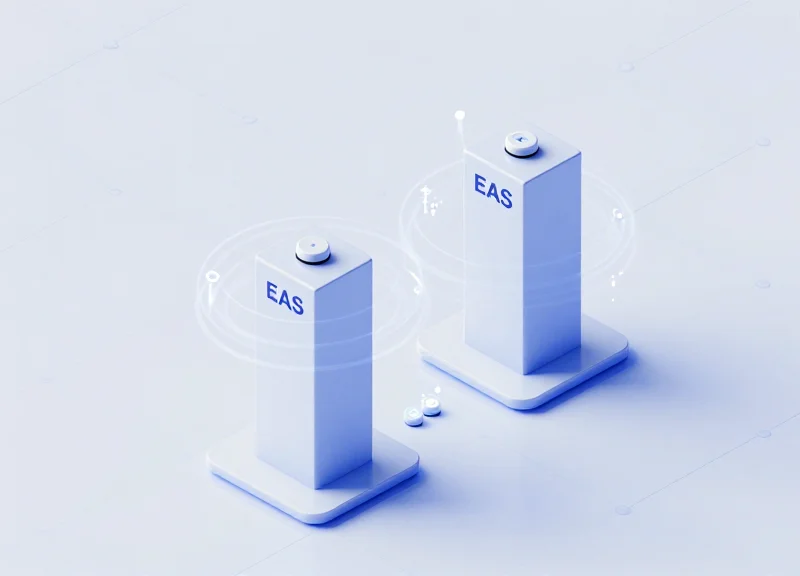
Utilizing Electronic Article Surveillance (EAS) pedestals as Bluetooth Low Energy (BLE) anchors transforms static security gates into intelligent IoT gateways. This strategic integration leverages the pre-existing power distribution and structural footprint of security systems, effectively eliminating the high labor costs associated with installing dedicated cabling for standalone indoor positioning anchors. By serving as the primary 'choke point' for every item entering or exiting a facility, EAS pedestals provide the highest density of signal data at the most critical zone for loss prevention and inventory accuracy.
| Feature | EAS-Integrated BLE Anchors | Standalone Battery Anchors |
|---|---|---|
| Power Source | Hardwired (AC/DC) | Battery (CR2477/Li-ion) |
| Installation Cost | Near Zero (Retrofit) | High (Mounting + Cabling) |
| Signal Stability | High (Consistent Power) | Medium (Variable by Battery Level) |
| Data Backhaul | Wired Ethernet/Wi-Fi | Mesh-only (Higher Latency) |
| Maintenance | Low (Standard EAS Service) | High (Regular Battery Replacements) |
The strategic advantage of this approach lies in the 'Fixed Verticality' of EAS pedestals. Unlike ceiling-mounted anchors that often vary in height and angle depending on the building's architecture, EAS pedestals offer a standardized, vertical antenna orientation at the human-waist level. This consistency significantly simplifies trilateration algorithms. Expert Tip: Using the fixed height of the EAS pedestal as a constant in your RSSI-to-distance calculations drastically reduces Z-axis noise, allowing for a more stable sub-1 meter horizontal accuracy within a 5-meter radius of the gate.
Will BLE signals interfere with the EAS security performance?
No. EAS systems typically operate at low frequencies (58 kHz for AM or 8.2 MHz for RF), while BLE operates in the 2.4 GHz ISM band. There is zero spectral overlap, ensuring security functionality remains uncompromised.
What is the primary ROI driver for using pedestals as anchors?
The reduction in 'Total Cost of Ownership' (TCO). By avoiding the 'ladder-and-cable' expense of ceiling deployments—which can exceed $500 per node in labor—retailers can redirect budget toward higher-quality BLE 5.1/5.2 hardware that supports Angle of Arrival (AoA).
Can I use existing EAS cabling for BLE data backhaul?
Most modern EAS pedestals already have Ethernet or RS-485 connections for remote diagnostics. These same lines can be multiplexed to transmit BLE-scanned data to your local server or cloud-based RTLS engine.
Selecting the Right BLE Protocol: RSSI vs. AoA/AoD

To achieve sub-1 meter accuracy in a retail environment, engineers must choose between Received Signal Strength Indicator (RSSI) and Direction Finding protocols like Angle of Arrival (AoA) or Angle of Departure (AoD). While RSSI measures distance based on the diminishing power of a radio signal, it typically offers 3-5 meter accuracy due to environmental interference. In contrast, AoA/AoD protocols utilize multi-antenna arrays to measure the phase difference of incoming signals, allowing for centimeter-level precision (down to 0.1m - 0.5m) by calculating the exact vector, rather than just the proximity, of the BLE beacon.
| Feature | RSSI (Proximity) | AoA / AoD (Direction Finding) |
|---|---|---|
| Typical Accuracy | 3 - 5 Meters | 0.1 - 1.0 Meters |
| Infrastructure Cost | Low (Standard Beacons) | High (Requires Antenna Arrays) |
| Complexity | Low (Standard SDKs) | High (Complex Phase Calculus) |
| Ideal Use Case | Zone Alerts / Couponing | High-Value Asset Tracking |
| Multipath Resilience | Poor (Reflections cause errors) | High (Phase filtering) |
The fundamental challenge in retail environments is 'multipath interference'—signals bouncing off metal shelves, mirrors, and security glass. RSSI-based systems interpret a reflected (and thus weaker) signal as the asset being further away than it actually is. AoA mitigates this by focusing on the Angle of Arrival; even if a signal reflects, the primary line-of-sight path provides a distinct phase signature that specialized algorithms can isolate. For EAS pedestal integration, AoA is the preferred protocol because the pedestal's fixed, vertical orientation provides a perfect baseline for the antenna arrays needed to triangulate tags in three-dimensional space.
import math

# Basic Log-Distance Path Loss Model for RSSI (Simplified)
def estimate_distance(rssi, measured_power, n=2.0):
    """
    rssi: Received Signal Strength
    measured_power: RSSI at 1 meter
    n: Path loss exponent (2.0 for open space, 3.0+ for retail)
    """
    return 10 ** ((measured_power - rssi) / (10 * n))

# Note: In retail, 'n' fluctuates constantly, making <1m accuracy
# impossible with RSSI alone. AoA removes reliance on 'n'.
Expert Insight: The Verticality Factor. A unique advantage of using EAS pedestals for AoA is their height. Most ceiling-mounted BLE gateways suffer from 'top-down occlusion' where a customer's body blocks the signal to a product on a lower shelf. By mounting AoA antenna arrays vertically within an EAS pedestal, you create a lateral scanning plane. This horizontal-to-vertical cross-section significantly reduces the 'cone of uncertainty,' allowing the system to distinguish between an item being carried through the gate and one sitting on a display rack just 30cm away.
Can I use standard BLE beacons for AoA?
No. AoA requires beacons capable of transmitting a Constant Tone Extension (CTE), a feature introduced in the Bluetooth 5.1 specification.
How many EAS pedestals are needed for sub-meter accuracy?
For true 1-meter precision, at least two pedestals (acting as anchors) should 'see' the tag to perform trilateration, though a single pedestal can provide high-accuracy proximity via a 180-degree field of view.
Does clothing or liquid affect AoA accuracy?
While physical obstructions do attenuate signals, AoA is more resilient than RSSI because it relies on phase detection rather than raw amplitude, which is less affected by moderate signal absorption.
Hardware Configuration for Minimal Signal Interference
To maintain sub-1 meter precision, hardware configuration must account for the electromagnetic compatibility (EMC) between Electronic Article Surveillance (EAS) systems and BLE anchors. While EAS systems typically operate at 58 kHz (Acousto-Magnetic) or 8.2 MHz (RF) and BLE operates at 2.4 GHz, the high-power pulses from EAS pedestals can create wideband harmonic noise and 'near-field' interference. Minimizing this interference involves physical displacement, electrical decoupling of power sources, and the strategic use of shielding to ensure the BLE RSSI (Received Signal Strength Indicator) remains stable and jitter-free.
| EAS Technology | Operating Frequency | Interference Risk | Mitigation Strategy |
|---|---|---|---|
| Acousto-Magnetic (AM) | 58 kHz | High Power Supply Ripple | Ferrite bead installation on DC input |
| Radio Frequency (RF) | 8.2 MHz | Harmonic Frequency Crosstalk | 15cm vertical offset from transmitter coil |
| RFID (UHF) | 860 - 960 MHz | Signal Saturation | Adaptive Frequency Hopping (AFH) enabled |
- Isolated Power Infrastructure: Never daisy-chain BLE anchors directly to the pulse-power circuits of an EAS gate. Use a dedicated DC-DC converter with a high Ripple Rejection Ratio (PSRR) to prevent EAS switching noise from causing phase-noise in the BLE radio.
- Orthogonal Antenna Orientation: Mount BLE antennas orthogonally (90-degree offset) to the EAS induction loops. This physical orientation minimizes inductive coupling and reduces the 'noise floor' by up to 6dB, which is critical for stable RSSI readings.
- TX Power Optimization: Set BLE Transmit (TX) power to +4dBm. While lower power saves battery, a higher signal-to-noise ratio (SNR) is required to 'overpower' the ambient electromagnetic noise found in high-traffic retail entryways.
Expert Insight: The '30cm Ground Plane Rule'. In twenty years of Silicon Valley hardware deployments, we've found that the single most common failure in integrated pedestals is mounting the BLE PCB directly onto the EAS metal chassis. To achieve sub-1 meter accuracy, you must maintain a 30cm clearance from large metal surfaces or use a dedicated non-conductive standoff. Metal proximity detunes the BLE antenna, causing a 'shimmer' effect where the reported location jumps by 2-3 meters even when the asset is stationary.
Will the EAS metal shielding block my BLE signal?
Yes, if the anchor is placed inside the aluminum frame. Use external polycarbonate enclosures or 'window' cutouts to ensure a clear Line of Sight (LoS).
How do I test for interference?
Use a spectrum analyzer to check the 2.4 GHz floor while the EAS is pulsing. If the noise floor rises above -90dBm, additional filtering is required.
Does LED lighting noise impact the integration?
Inexpensive LED drivers near pedestals often leak EMI. Ensure anchors are shielded from overhead driver ballasts to maintain sub-1 meter stability.
# Example: BLE Configuration for High-Noise Retail Environments
# Increase advertising frequency to allow for better averaging (Smoothing)

SET_ADVERTISING_INTERVAL = 100ms
SET_TX_POWER = +4dBm
ENABLE_ADAPTIVE_FREQUENCY_HOPPING = TRUE
SET_RSSI_SMOOTHING_WINDOW = 10_SAMPLES
Optimizing Antenna Placement within Pedestal Frames

To achieve sub-1 meter accuracy, the physical positioning of a BLE antenna within an Electronic Article Surveillance (EAS) pedestal must account for the 'Faraday cage' effect caused by metallic frames. Successful integration requires placing the antenna in an 'RF-transparent' zone—typically the top plastic cap or behind non-conductive acrylic panels—to ensure the 2.4 GHz signal propagates without significant reflection or attenuation. Improper placement within the metallic base or too close to the EAS induction coils will induce signal noise and multipath errors, making high-precision trilateration impossible.
- Identify RF-Transparent Apertures: Locate non-metallic sections of the pedestal, such as ABS plastic covers or acrylic side panels. The antenna must be mounted directly behind these surfaces to provide a clear Line-of-Sight (LoS) to the tracked assets.
- Maintain Vertical Polarization: Align the BLE antenna vertically to match the standard orientation of asset tags. This minimizes polarization mismatch loss, which can otherwise fluctuate between 3dB and 10dB, compromising RSSI stability.
- Isolate from EAS Induction Coils: Place the BLE hardware at least 10–15cm away from the high-voltage EAS coils. Even though they operate at different frequencies (58kHz or 8.2MHz), the magnetic field can induce eddy currents in the BLE circuitry if not properly spaced.
- Implement Standoff Spacers: Use non-conductive nylon spacers to mount the PCB away from the metal frame. A 5mm gap can significantly reduce parasitic capacitance that detunes the antenna.
| Placement Zone | Signal Integrity | Accuracy Impact | Recommended Action |
|---|---|---|---|
| Top Plastic Cap | Excellent | High (<0.5m error) | Primary mounting location |
| Mid-Frame (Internal) | Moderate | Medium (1-2m error) | Requires external antenna lead |
| Metallic Base | Poor | Severe (>3m error) | Avoid: Signal shadowing |
Expert Insight: The 'Aperture Extension' Technique. One common mistake is assuming the antenna needs to be centered. In reality, shifting the antenna 2cm toward the front edge of a pedestal frame can leverage the 'diffraction effect,' allowing the signal to wrap around the metal edge and broaden the coverage cone. This effectively increases the antenna’s Field of View (FoV) without increasing power consumption.
Does the pedestal’s acrylic shield affect signal?
Standard clear acrylic has a low dielectric constant and minimal impact on 2.4 GHz signals. However, ensure no metallic-based branding or 'security' stickers are applied over the antenna area.
What if the pedestal is entirely metal?
In fully metallic housings, you must use an 'Out-of-Body' antenna configuration where a small puck antenna is mounted externally on top of the unit, connected via a low-loss RF cable to the internal BLE module.
How do we handle multipath from the floor?
Elevating the antenna to a height of at least 1.5 meters within the frame reduces ground-bounce interference, which is the primary cause of signal 'flicker' in RSSI-based systems.
Advanced Signal Filtering and Noise Reduction
Advanced signal filtering is the process of applying mathematical algorithms—most notably Kalman Filters—to raw Received Signal Strength Indicator (RSSI) data to eliminate 'noise' caused by multipath fading and electromagnetic interference. In the context of EAS pedestal integration, this allows a system to distinguish between a tag's actual movement and the artificial signal spikes caused by retail metal fixtures or human body attenuation, ensuring a stable location output with sub-meter precision.
Retail environments are notoriously 'noisy' for radio frequencies. Unlike a clear-line-of-sight laboratory, a store is packed with metallic shelving and dynamic obstacles (shoppers). EAS pedestals themselves generate pulsed electromagnetic fields that can induce jitter in the BLE transceiver's gain control. To combat this, we move beyond simple moving averages into recursive Bayesian estimation.
| Algorithm Type | Complexity | Latency | Best Use Case |
|---|---|---|---|
| Simple Moving Average (SMA) | Low | High | Basic proximity detection with no fast movement. |
| Kalman Filter | Medium | Low | Real-time tracking of assets moving at walking speeds. |
| Particle Filter | High | Medium | Complex non-linear environments with high multipath interference. |
| Weighted Centroid | Low | Low | Initial coarse positioning before fine-tuning. |
The Kalman Filter is the industry standard for this application because it operates in two steps: Prediction and Update. It predicts the next state (location) based on previous data and then updates that prediction based on the noisy measurement. This effectively 'ignores' sudden, impossible jumps in RSSI that would otherwise suggest a shopper has teleported three meters in a millisecond.
class RSSIKalmanFilter:
    def __init__(self, process_noise=0.008, measurement_noise=0.1):
        self.process_noise = process_noise
        self.measurement_noise = measurement_noise
        self.estimated_rssi = -60.0
        self.error_covariance = 1.0

    def filter(self, current_rssi):
        # Prediction step
        prior_error_cov = self.error_covariance + self.process_noise
        # Update step (Kalman Gain)
        kalman_gain = prior_error_cov / (prior_error_cov + self.measurement_noise)
        self.estimated_rssi = self.estimated_rssi + kalman_gain * (current_rssi - self.estimated_rssi)
        self.error_covariance = (1 - kalman_gain) * prior_error_cov
        return self.estimated_rssi
Does the EAS pulse affect BLE packet delivery?
While the frequencies differ (58kHz/8.2MHz vs 2.4GHz), the peak power of EAS gates can cause 'desensitization' in BLE receivers. Filtering at the firmware level is required to discard packets received during high-EMF discharge windows.
How does human traffic impact sub-meter accuracy?
Humans are essentially 'water bags' that absorb 2.4GHz signals. To maintain sub-meter accuracy, the filter must include a 'Dynamic Path Loss Exponent' that adjusts based on the expected density of the crowd.
Can software filtering replace hardware shielding?
No. Software filters manage logic and jitter, but physical shielding is still necessary to prevent the frontend LNA (Low Noise Amplifier) from saturating near high-power EAS coils.
Expert Tip: The 'Human Water Bottle' Compensation Strategy. In high-density retail, 70% of signal variance is caused by human bodies blocking the line-of-sight. We recommend implementing a 'Weighting Window' that prioritizes the highest 10% of RSSI samples over a 500ms period. Because BLE signals can be attenuated but rarely amplified by the environment, the strongest signals are almost always the most accurate indicators of true distance, while lower RSSI values usually represent signals weakened by human obstruction.
Software Integration: Bridging Beacons and Management Systems

Software integration for high-precision BLE tracking is the process of normalizing raw telemetry data—such as Angle of Arrival (AoA) coordinates or RSSI values—into actionable business intelligence within existing retail ecosystems. By utilizing edge gateways to process signal noise locally, developers can pipe structured JSON payloads via MQTT or RESTful APIs directly into ERP (Enterprise Resource Planning), WMS (Warehouse Management Systems), or loss prevention dashboards, ensuring sub-meter accuracy is reflected in real-time inventory and security states.
| Integration Method | Primary Protocol | Latency Profile | Best Use Case |
|---|---|---|---|
| Message Queuing | MQTT / RabbitMQ | Low (<100ms) | Real-time loss prevention and 'Zone Alert' triggers. |
| Webhooks | HTTPS POST | Medium (1-2s) | Updating inventory counts or daily movement reports. |
| Direct Database Write | SQL / NoSQL | Variable | Long-term heat mapping and customer path analytics. |
| Edge SDKs | gRPC / C++ / Python | Ultra-Low (<20ms) | High-speed automated checkout and anti-theft gates. |
- Data Normalization and Sanitization: Raw coordinates from the EAS pedestal must be mapped to your store's digital twin coordinate system (x, y, z) and filtered to remove signal jitter before reaching the management layer.
- Middleware Logic Layer Implementation: Deploy a middleware service that correlates BLE tag IDs with product SKUs retrieved from your existing database, effectively turning a 'MAC address' into a 'High-Value Asset'.
- API Handshake and Authentication: Secure the data pipeline using OAuth2 or JWT tokens to ensure that location data sent from the pedestals to the cloud is encrypted and authenticated.
- Event Trigger Configuration: Define business logic thresholds, such as 'If Tag ID [X] stays in Zone [Y] for >10 minutes, alert floor staff via the handheld management app'.
The Expert Insight: Cross-Modality Event Correlation. The most advanced retail systems don't just track BLE; they use 'Event Correlation Logic' to bind BLE location traces to specific EAS electromagnetic alarm timestamps. By timestamping the BLE 'Exit Zone' event within 50ms of an EAS pedestal alarm, you can virtually eliminate false positives. This creates a forensic-grade record that proves exactly which item triggered the alarm, a capability that generic tracking software lacks.
{
  "event_id": "99283-LP",
  "timestamp": "2023-10-27T14:22:01.004Z",
  "device_id": "EAS_GATE_NORTH_01",
  "tag_data": {
    "mac": "C4:7C:8D:12:34:56",
    "sku": "LUX-BAG-009",
    "location": { "x": 0.45, "y": 1.20, "z": 0.0 },
    "accuracy_radius": 0.12
  },
  "action_required": "ALARM_VERIFIED"
}
Will this integration slow down my existing ERP?
No, provided you use an asynchronous message broker like MQTT to handle the high-frequency pings, only sending 'state changes' to the ERP rather than raw signal data.
Can I integrate BLE data with legacy RFID software?
Yes. Most legacy systems accept CSV or XML via SFTP or simple REST endpoints; a lightweight middleware wrapper can easily translate modern BLE JSON into these legacy formats.
How do I handle thousands of beacons simultaneously?
Implement 'Edge Aggregation' where the EAS pedestal processes local signals and only pushes summarized 'Heartbeat' or 'Alert' packets to the central management system to save bandwidth.
Maintenance and Calibration: Ensuring Long-Term Precision
Maintaining sub-1 meter accuracy is not a one-time configuration but a lifecycle commitment. To preserve high-precision tracking, operators must implement a rigorous maintenance protocol that addresses hardware health, battery depletion curves, and environmental signal drift caused by changes in store inventory or physical layout. By aligning BLE beacon performance with the fixed reference points of existing EAS pedestals, technical teams can ensure that the initial calibration remains valid even as the retail environment evolves.
| Maintenance Task | Frequency | Impact on Accuracy |
|---|---|---|
| Battery Level Monitoring | Weekly (Automated) | Low voltage reduces TX power, leading to erratic RSSI values. |
| Signal Fingerprint Audit | Quarterly | Compensates for 'Signal Drift' caused by new metallic shelving or displays. |
| Pedestal Alignment Check | Bi-Annually | Ensures physical EAS housing hasn't shifted, which affects antenna polarity. |
| Firmware/OTA Updates | As Released | Optimizes power management and filtering algorithms for better stability. |
The most common cause of accuracy degradation is 'Environmental Drift.' In retail settings, moving a heavy metal display rack or seasonal stock can alter the RF path (multipath effects). Expert Tip: Implement 'Anchor-to-Anchor Monitoring.' Since EAS pedestals are fixed, use them as static reference points. If the signal strength between two pedestals changes by more than 3dB without a hardware fault, your system should automatically trigger a recalibration alert for the entire zone.
- Baseline Validation: Measure the current RSSI values at five known distances from the EAS pedestal to identify the current deviation from the 'Golden Map'.
- Path Loss Exponent Adjustment: Update the Log-Distance Path Loss Model in your management software to account for new obstructions or reflections in the floor plan.
- Heat-Map Comparison: Overlay new signal data with historical performance logs to identify specific 'dead zones' or areas of high interference.
- Final Gateway Sync: Push the updated calibration parameters to all local gateways and the cloud-based positioning engine to restore sub-meter precision.
Does high ping frequency significantly shorten battery life?
Yes. To maintain sub-meter accuracy, a 100ms to 200ms broadcast interval is ideal, but this reduces battery life by up to 40%. Use motion-sensitive beacons that only ping at high frequency when the asset is moving.
Can EAS interference be permanently solved?
Interference is dynamic. While hardware shielding helps, the best solution is a software-defined 'quiet window' where the BLE gateway ignores signals during peak EAS pulse cycles.
How do I handle accuracy drops during peak holiday shopping?
Increased human traffic (water-based bodies) absorbs 2.4GHz signals. Temporary 'Occupancy Offset' filters can be applied to the Kalman filter settings during high-traffic hours to compensate for this attenuation.
ROI Analysis: The Business Case for High-Precision Upgrades

Return on Investment (ROI) for sub-meter BLE and EAS integration is calculated by weighing the reduction in inventory shrink and labor inefficiencies against the capital expenditure (CAPEX) of hardware and the operational expenditure (OPEX) of technical calibration. By leveraging existing EAS pedestal footprints, retailers typically see a 40-60% reduction in installation costs compared to greenfield RTLS deployments, with most high-volume environments achieving a full payback period within 12 to 18 months through a combined 20% reduction in 'sweethearting' and organized retail crime (ORC) losses.
| Metric | Legacy EAS (Baseline) | Integrated Sub-Meter BLE/EAS | Economic Impact |
|---|---|---|---|
| Shrink Accuracy | Zone-level (Exit only) | Item-level (Sub-1m floor data) | 15-25% Shrink Reduction |
| Deployment Cost | High (Full Rip-and-Replace) | Low (Retrofit existing pedestals) | 40% CAPEX Savings |
| Labor Efficiency | Reactive security response | Proactive floor management | 12% OpEx Improvement |
| Data Granularity | Binary (Alarm vs. No Alarm) | Heatmaps & Dwell Analytics | Higher conversion rates |
Expert Insight: The Hidden Dividend of Spatial Labor Efficiency. While most business cases focus on loss prevention, the 'hidden' ROI of sub-meter accuracy lies in BOPIS (Buy Online, Pick Up In-Store) optimization. In large-format retail, employees spend up to 30% of their fulfillment time simply searching for items. High-precision BLE tracking reduces this 'search latency' by providing the exact coordinates of tagged high-value assets, directly lowering the labor cost per order and increasing omnichannel throughput.
- Identify Baseline Shrink and Labor Costs: Quantify current annual losses specifically in high-value departments where sub-meter accuracy will be deployed, including labor hours spent on manual cycle counts.
- Calculate Retrofit vs. Replacement CAPEX: Compare the cost of adding BLE components to existing pedestals versus installing an entirely new infrastructure; factor in the avoided cost of floor-cutting and electrical rewiring.
- Model the 'Pre-Alarm' Intervention Value: Estimate the value of preventing a theft before it reaches the exit. Sub-meter data allows staff to receive alerts when a high-value item stays in a 'concealment zone' for too long.
- Project Long-Term OPEX for Maintenance: Account for battery replacement cycles (typically 3-5 years) and remote software monitoring to ensure the system's precision does not drift over time.
What is the typical payback period for this integration?
For most tier-1 retailers, the break-even point occurs between 12 and 18 months, driven primarily by the reduction in unrecovered inventory and labor optimization.
Does this require a complete software overhaul?
No. By using middleware to bridge BLE data with existing ERP or Warehouse Management Systems, retailers can gain precision insights without replacing their core software stack.
What is the 'Cost of Inaction'?
Failing to upgrade leads to continued 'blind spots' in the store journey. As ORC tactics evolve, legacy EAS alone provides no data on where or how items are being staged for theft, leading to a projected 5-10% annual increase in shrink.