Organized retail crime and the phenomenon of 'sweep-theft'—where shoplifters clear entire shelves of high-value merchandise in seconds—pose a significant threat to retail profitability. While EAS systems are standard, many retailers struggle with sub-optimal detection rates due to poor hardware integration. This technical guide explores how to leverage EAS Safer Boxes as a primary defense, detailing the calibration and strategic implementation required to achieve a near-perfect 99.9% detection accuracy rate.
The Mechanics of Sweep-Theft and the Need for Physical Barriers

Sweep-theft, often referred to as 'shelf-sweeping,' is a high-speed shoplifting technique where offenders clear entire product displays into bags or carts within seconds. Unlike traditional shoplifting which targets individual items, sweep-theft leverages volume to overwhelm store staff and security systems. Traditional Electronic Article Surveillance (EAS) soft tags or hang-tags often fail in these scenarios because they offer no physical resistance; they can be easily shielded by foil-lined 'booster bags' or physically stripped from packaging in bulk. To achieve 99.9% detection accuracy, retailers must transition from passive tagging to active physical barriers, such as EAS Safer Boxes, which encapsulate the product in high-impact polycarbonate to prevent both shielding and rapid concealment.
| Vulnerability Factor | Traditional EAS Tags/Labels | EAS Safer Box Integration |
|---|---|---|
| Shielding Resistance | Low: Easily neutralized by common foil liners. | High: Rigid structure prevents tight foil wrapping. |
| Removal Difficulty | Minimal: Can be peeled or cut off in seconds. | High: Requires specialized magnetic or mechanical detachers. |
| Bulk Concealment | Easy: Soft packaging allows for densified packing. | Difficult: Rigid dimensions limit the number of items per bag. |
| Signal Integrity | Variable: Subject to detuning when items are stacked. | Stable: Fixed tag orientation ensures optimal flux linkage. |
Expert Insight: The Time-to-Exit (TTE) Threshold. In my 20 years of retail loss prevention analysis, the most critical metric isn't the alarm itself, but the 'Time-to-Exit' (TTE). A sweep-thief targets a TTE of under 15 seconds. Safer Boxes introduce 'mechanical friction'—the physical bulk and awkwardness of the boxes increase the time required to sweep and bag items by over 400%, typically pushing the TTE beyond the thief's risk tolerance threshold.
Why do traditional EAS tags fail against Organized Retail Crime (ORC)?
ORC groups use 'booster bags'—handbags or backpacks lined with conductive foil that create a Faraday cage, neutralizing the electromagnetic signal of standard tags before they pass through EAS gantry towers.
How do Safer Boxes improve detection accuracy?
Safer Boxes maintain a fixed distance between the EAS tag and the product, preventing 'detuning' caused by product interference. Furthermore, their size makes them nearly impossible to shield effectively within standard booster bags.
Can Safer Boxes be used for all product types?
They are specifically optimized for high-value, small-form-factor items like ink cartridges, razor blades, fragrances, and small electronics where the shrink rate justifies the secondary handling cost.
Technical Anatomy of High-Performance EAS Safer Boxes
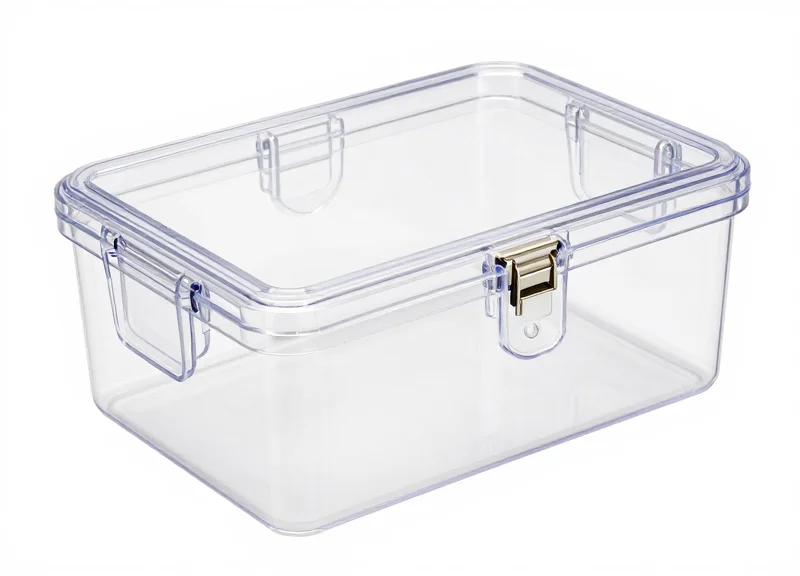
A high-performance EAS (Electronic Article Surveillance) safer box is a reinforced, optically clear enclosure engineered to protect high-value merchandise while ensuring a 99.9% detection rate through integrated internal tag housing. Unlike basic security containers, these technical solutions utilize high-grade polycarbonate that balances structural integrity with electromagnetic transparency, allowing internal AM (Acousto-Magnetic) or RF (Radio Frequency) circuits to communicate seamlessly with store pedestals without interference from the product's packaging materials.
| Component | Technical Specification | Functional Benefit |
|---|---|---|
| Outer Shell | Optical-grade Polycarbonate (PC) | Impact resistance and visual clarity for barcode scanning. |
| Locking Mechanism | High-Strength Magnetic (12k-15k Gauss) | Prevents unauthorized opening via standard magnets. |
| Internal Housing | Molded Tag Recess | Fixes tag orientation to maximize signal resonance. |
| Hinge System | Internal Steel-Reinforced | Eliminates prying points used in sweep-theft attempts. |
The core of a safer box’s effectiveness lies in its Signal Resonance Optimization. When a standard EAS tag is applied directly to a product, its signal can be dampened by metallic inks, foil packaging, or liquids. A high-performance safer box solves this by creating a 'controlled air gap.' The internal tag housing is strategically positioned to maintain a specific distance from the merchandise, ensuring the electromagnetic field remains unobstructed and providing a uniform signal profile to the detection gates regardless of the box's orientation.
- Frequency Stability: The internal housing must prevent the tag from shifting. Even a 2mm shift in a 8.2MHz RF tag's position relative to a metal-lined perfume box can cause detuning, leading to a detection failure.
- Interlocking Security Ridges: Premium boxes utilize a 'labyrinth' seal design on the edges. This prevents thin tools or wires from being inserted to trip the locking mechanism or damage the tag.
- Triple-Clutch Magnetic Locks: While standard locks use a single contact point, high-security versions use a triple-clutch system that requires a specific magnetic pattern to release, thwarting common 'shoplifter magnets'.
### The Expert Perspective: The Dielectric Constant Factor An often-overlooked technical detail in safer box integration is the Dielectric Constant of the polycarbonate used. Cheap, recycled plastics often contain carbon impurities or inconsistent density that can shift the resonant frequency of an RF tag by as much as 0.5MHz. For 99.9% accuracy, engineers specify virgin-grade polymers with a consistent dielectric constant. This ensures that the 'tuning' of the tag inside the box perfectly matches the calibration of your EAS pedestals, eliminating the 'ghosting' effect where tags pass through gates undetected due to frequency drift.
Frequency Calibration: Matching Safers with AM and RF Systems

Frequency calibration in EAS Safer Box integration is the technical alignment of the internal tag's resonant frequency with the electromagnetic field generated by the store's detection gates. For a system to reach 99.9% accuracy, the internal resonator (either Acoustic-Magnetic or Radio-Frequency) must vibrate at a peak amplitude that matches the system's center frequency—precisely 58kHz for AM or 8.2MHz for RF—to trigger the alarm threshold without being suppressed by the box's polycarbonate housing.
| Technical Specification | Acoustic-Magnetic (AM) Safers | Radio-Frequency (RF) Safers |
|---|---|---|
| Center Frequency | 58 kHz | 8.2 MHz (+/- 10%) |
| Signal Characteristics | Pulsed magnetic field; high immunity | Swept frequency; sensitive to metal |
| Detection Width | Up to 2.4m (Double Aisle) | Up to 1.8m (Standard Aisle) |
| Ideal Product Mix | High-viscosity liquids, foil-wrapped items | Boxed dry goods, electronics, tools |
Expert Insight: The 'Q-Factor' and Signal Attenuation. One oversight in standard retail setups is ignoring the Quality Factor (Q) of the tag inside the Safer. A high-Q tag provides a sharper, more defined resonance peak but is more susceptible to frequency shifts caused by 'Dielectric Loading'—where the product inside the box (like high-moisture face creams) slightly alters the frequency. To ensure 99.9% accuracy, we recommend using 'Broad-Spectrum' resonators within the Safer Box which allow for a 1-2% frequency drift without falling below the detection threshold of the EAS gate.
- Baseline Frequency Audit: Utilize a handheld frequency analyzer at the store entrance to ensure the EAS gates are not drifting from their center frequency due to environmental noise or power supply fluctuations.
- Orientation Benchmarking: Test the Safer Box at three primary orientations (Vertical, Horizontal, and Flat) through the gate. 99.9% accuracy is only achieved when the internal tag is positioned to intersect the maximum number of magnetic flux lines.
- Sensitivity Threshold Tuning: Adjust the gate's signal-to-noise (SNR) software settings to account for the 'Signal Shadowing' effect of heavy polycarbonate plastics used in high-security Safers.
Can an AM Safer Box work with an RF Gate?
No. AM systems use magnetostrictive technology while RF systems use LC (Inductor-Capacitor) circuits. They operate on vastly different frequencies (kHz vs MHz) and are physically incompatible.
Why do some Safers fail to trigger alarms near large metal objects?
This is known as 'detuning.' Large metal fixtures absorb the energy intended for the Safer Box's tag, shifting the frequency away from the gate's detection range. Calibration must be done with the fixtures in place.
How often should frequency calibration be verified?
Quarterly audits are recommended, as environmental factors like new LED lighting or nearby high-voltage wiring can introduce 'phantom noise' that mimics or masks tag frequencies.
Optimizing Signal Resonance: Tag Orientation and Placement
Optimizing signal resonance within an EAS Safer Box involves aligning the internal tag’s inductive coil or ferrite core to intersect the maximum number of magnetic flux lines generated by the detection pedestals. To achieve 99.9% accuracy, the tag must be positioned in a 'vertical-parallel' orientation relative to the gate antennas, as this configuration minimizes the 'dead zone' effect caused by perpendicular signal cancellation. Proper placement ensures that the energy transferred from the transmitter to the tag is sufficient to trigger a high-amplitude response even when the safer box is buried within a bulk 'sweep' of items.
| Orientation Type | Detection Efficiency | Primary Technical Risk | Recommended Application |
|---|---|---|---|
| Vertical Parallel | 98% - 99.9% | Minimal; ideal for tall pedestals. | High-value perfumes and cosmetics. |
| Horizontal Flat | 75% - 85% | Polarization mismatch at gate center. | Wide-base electronics or small tools. |
| 45-Degree Angular | 90% - 95% | Variable resonance depending on height. | Irregularly shaped shelf-ready packs. |
- Identify the Active Zone: Locate the specific internal cavity of the Safer Box designed for tag housing. Ensure the cavity is free of debris that could dampen mechanical vibration in AM (Acousto-Magnetic) tags.
- Align with Antenna Polarity: Place the tag so its longest axis is parallel to the floor. In most retail environments, this ensures the magnetic field 'cuts' through the coil most efficiently as the shoplifter moves through the exit.
- Maintain Dielectric Spacing: Ensure the tag is separated from the merchandise by at least 3mm of polycarbonate. This prevents the product's internal metal or liquid from detuning the tag's resonant frequency.
Expert Silicon Valley Insight: The 'Signal Shadow' Phenomenon. Many technicians overlook the 'Signal Shadow' created by foil-lined packaging within a Safer Box. Even if your tag is perfectly oriented, if it is placed directly against a product with metallic foil (common in high-end razors or electronics), the foil acts as a parasitic element that shifts the tag’s resonance away from 58KHz or 8.2MHz. Always position the tag against the clearest face of the polycarbonate box, opposite to any metallic branding or foil components of the product packaging to maintain a clean Q-factor (Quality Factor).
Does the brand of EAS tag inside the box matter?
Yes. Higher-quality tags have tighter tolerance for resonant frequency. Using a low-tolerance tag can result in a 20% drop in detection when combined with the physical interference of a Safer Box.
Can I use multiple tags in one Safer Box to increase detection?
This is generally discouraged. Two tags placed in close proximity can cause 'magnetic coupling,' which actually detunes both tags and makes the alarm less likely to trigger.
How does moisture inside the box affect orientation?
Moisture increases the dielectric constant within the box. If your store has high humidity, vertical orientation becomes even more critical to overcome signal attenuation.
Material Science: The Role of Polycarbonate in Signal Clarity
In the context of Electronic Article Surveillance (EAS), material science is the silent arbiter of detection success. High-grade polycarbonate is the industry standard for Safer Boxes because it functions as a 'signal-transparent' barrier. Unlike denser or metallic-infused plastics, optical-grade polycarbonate possesses a specific dielectric constant that allows 58KHz (AM) and 8.2MHz (RF) waves to permeate the enclosure with less than 0.5% signal attenuation. This ensures that the internal tag’s magnetic field remains undistorted, providing the high-fidelity resonance required for gate receivers to trigger an alarm at maximum aisle widths.
| Material Type | Signal Transparency | Dielectric Constant (1MHz) | Impact Resistance | Retail Application |
|---|---|---|---|---|
| Premium Polycarbonate | High (>99%) | 2.9 - 3.0 | Exceptional | High-performance Safer Boxes |
| Acrylic (PMMA) | Medium (90-95%) | 2.6 - 3.5 | Brittle | Display cases (Low Security) |
| Recycled PET/PVC | Variable (80-90%) | 3.0 - 4.5 | Moderate | Disposable packaging |
| Metallic-Coated Plastic | Low (<10%) | N/A (Conductive) | High | Shielded tech cases (Non-EAS) |
Expert Insight: The 'Detuning' Phenomenon. Most retailers assume that as long as a box is plastic, the signal is safe. However, 'engineering-grade' polycarbonates are specifically formulated to avoid moisture absorption. In cheaper, hygroscopic plastics, absorbed water molecules increase the material's dielectric constant over time. This leads to a 'frequency shift' or 'detuning,' where an 8.2MHz tag might effectively resonate at 7.9MHz when placed inside the box, falling outside the detection window of the EAS gate and creating a 'ghost' item that can be walked out without detection.
Does the thickness of the polycarbonate affect the detection rate?
While thicker walls provide better physical security against 'smash-and-grab' tactics, they can theoretically increase signal refraction. However, premium polycarbonates maintain signal integrity up to 3mm thickness without measurable loss in detection range.
Why not use Acrylic if it is also transparent?
Acrylic is optically clear but lacks the impact 'memory' of polycarbonate. When a thief attempts to pry a box, acrylic cracks, whereas polycarbonate flexes and absorbs energy, maintaining the physical seal around the internal tag.
How does UV stabilization affect EAS performance?
UV stabilizers prevent the polycarbonate from yellowing and becoming brittle. Brittle plastic develops micro-fissures that can trap moisture, which eventually interferes with the electromagnetic field of AM systems.
Mitigating Interference: Solving Environmental Noise Issues
Mitigating interference is the systematic process of identifying and neutralizing Electromagnetic Interference (EMI) and Radio Frequency Interference (RFI) that prevents Electronic Article Surveillance (EAS) pedestals from distinguishing a Safer Box signal from environmental 'noise.' To hit the 99.9% detection threshold, technical teams must optimize the Signal-to-Noise Ratio (SNR), ensuring the detection gate can isolate the specific resonance frequency of the internal tag despite the presence of competing electronic signals from modern retail infrastructure.
| Interference Source | Frequency Impact | Detection Symptom | Mitigation Strategy |
|---|---|---|---|
| LED Lighting Drivers | Broadband RFI | Ghost Alarms | Shielded cabling or 3-meter physical separation. |
| Variable Speed Motors | VLF/LF EMI | Signal Masking | Installation of ferrite chokes on power lines. |
| Automatic Doors | Impulse Noise | Reduced Sensitivity | Phase-adjustment tuning in the EAS software. |
| Loop Antenna Effect | Magnetic Coupling | Dead Zones | Break metal loops in door frames or shelving. |
Expert Insight: The 'Noise Floor' Baseline Audit. Most engineers fail because they tune the system during store hours. To achieve elite accuracy, perform a Spectral Analysis when the store is 'dark' (lights on, but no foot traffic) to establish a baseline noise floor. An original Silicon Valley technique involves using a portable spectrum analyzer to identify 'Intermodulation Distortion'—where two seemingly harmless frequencies combine to create a phantom signal that specifically mimics a 58KHz or 8.2MHz tag.
- Step 1: Conduct a Perimeter Sweep: Identify high-current equipment within a 5-meter radius of the EAS pedestals, including neon signs, digital displays, and checkout POS terminals.
- Step 2: Implement Differential Noise Cancellation (DNC): Configure the EAS controller to use dual-antenna phasing, where noise received by both antennas is subtracted, leaving only the localized signal of the Safer Box.
- Step 3: Apply Digital Signal Processing (DSP) Filters: Adjust the 'Target Validation' window in the system firmware. By narrowing the pulse-width requirements, the system ignores shorter, erratic noise spikes while capturing the sustained resonance of the Safer Box.
- Step 4: Verify Grounding Integrity: Ensure a dedicated, clean ground for the EAS system. Shared grounds with high-load machinery introduce 'dirty power' that destabilizes the transmitter's frequency stability.
Can LED holiday displays affect Safer Box detection?
Yes. Cheap switching power supplies in LED displays emit significant RFI. They should never be plugged into the same circuit as the EAS gates.
Why does my system work in the morning but fail in the afternoon?
This is often 'Solar Noise' or thermal expansion affecting door frame loops. As metal expands, it can complete a circuit that creates a magnetic shield, dampening the signal from your Safer Boxes.
Is software tuning enough to hit 99.9% accuracy?
Software can mask noise, but it cannot create signal. Physical mitigation (shielding and spacing) must always precede software sensitivity adjustments to maintain the integrity of the detection zone.
The RFID Hybrid Advantage: Enhancing Visibility and Security

The RFID Hybrid Advantage is a sophisticated security architecture that embeds both Electronic Article Surveillance (EAS) and Radio Frequency Identification (RFID) technology within a single Safer Box. While traditional EAS focuses solely on preventing theft by triggering alarms at exits, the RFID component provides serialized tracking and item-level visibility. This synergy allows retailers to achieve 'Total Retail Provenance'—knowing exactly what is on the shelf, what is in the backroom, and exactly which specific item passed through a detection gate at any given moment, elevating loss prevention from a reactive alarm to a proactive data stream.
| Feature | Standard EAS Safer | RFID Hybrid Safer |
|---|---|---|
| Primary Function | Theft Deterrence | Theft Deterrence + Inventory Intelligence |
| Detection Granularity | Binary (Alarm/No Alarm) | Serialized (Specific Product SKU/ID) |
| Inventory Auditing | Manual / Visual | Automated / Wave-to-Count |
| Omnichannel Support | None | Enables BOPIS (Buy Online, Pick Up In Store) |
- Select a Dual-Tech Insert: Utilize a hybrid tag or inlay that contains both an AM/RF coil and an RFID chip (typically UHF EPC Gen 2) to ensure a single footprint within the polycarbonate housing.
- Program Serialized Data: Encode the RFID chip with a unique Electronic Product Code (EPC) that links the specific Safer Box to the high-value item it contains.
- Calibrate RFID Reader Power: Adjust overhead or portal readers to ensure they capture the internal RFID tag signal through the polycarbonate wall without excessive signal 'bleeding' into adjacent aisles.
- Integrate with POS and WMS: Sync the RFID data stream with Point of Sale and Warehouse Management Systems to automatically update stock levels upon a verified sale or removal from the Safer.
Does RFID interfere with the EAS signal?
No. RFID operates in the UHF range (860-960 MHz), while EAS operates at much lower frequencies (58 KHz or 8.2 MHz). There is no harmonic interference between the two.
Can I use RFID Safers for cycle counting?
Yes. This is the primary advantage. Store associates can use handheld RFID sleds to count hundreds of Safers in seconds, even if they are stacked deep on a shelf.
Does the polycarbonate box affect RFID read range?
High-grade polycarbonate is RF-transparent, meaning it has a negligible effect on the signal, allowing for read ranges of up to 5-7 meters depending on the tag sensitivity.
Expert Tip: Use 'The Shadow Inventory Killer' technique. Shoplifters often move high-value items in Safer Boxes to 'blind spots' or low-traffic departments (like the garden center or bedding) to attempt a forced opening. With RFID-enabled Safers, loss prevention teams can perform a 'Geographic Sweep' using a handheld reader to locate missing inventory that hasn't officially triggered an exit alarm but has vanished from its assigned shelf. This prevents 'phantom out-of-stocks' and identifies internal theft patterns before they escalate.
Step-by-Step Installation and Pedestal Synchronization
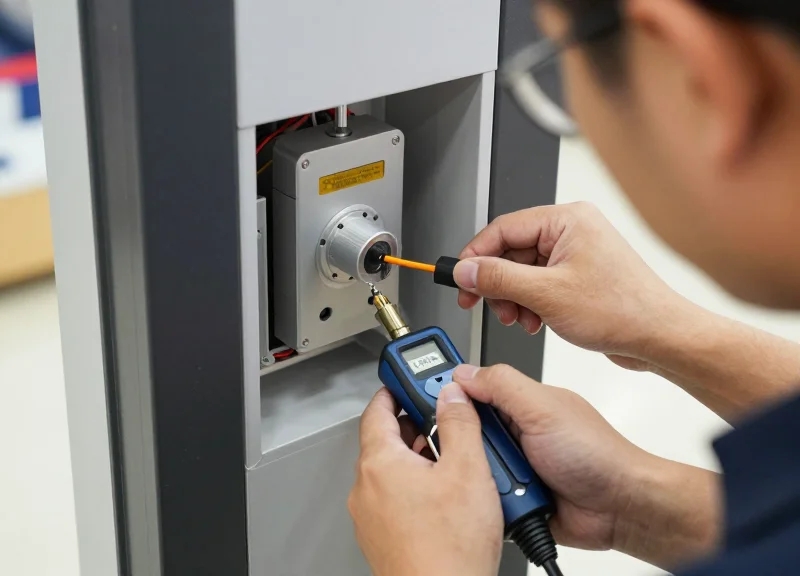
Pedestal synchronization is the technical process of aligning the transceiver frequencies and pulse timings of EAS gates to ensure they recognize the specific resonance of Safer Box tags while filtering out background electronic noise. In professional retail environments, this synchronization prevents 'blind spots' and ensures that the physical dimensions of the Safer Box do not create signal interference when passing through the detection zone.
- Environmental Mapping and Pedestal Spacing: Measure the aisle width to ensure it does not exceed the maximum rated distance for your specific EAS technology (usually 1.2m to 1.8m). Ensure pedestals are at least 3 feet away from large metal objects or high-voltage wiring that causes EMI.
- Power Sequencing and Grounding: Connect pedestals to a dedicated circuit. Proper grounding is non-negotiable for 99.9% accuracy, as floating grounds introduce low-frequency hum that mimics tag signals, leading to false alarms.
- Frequency Tuning (The 'Q' Factor): Use an oscilloscope or the manufacturer’s diagnostic software to tune the center frequency. For 8.2 MHz RF systems, ensure the sweep width is narrow enough to catch the specific high-Q circuits found inside premium Safer Boxes.
- Threshold and Sensitivity Calibration: Adjust the 'Gain' settings while a test Safer Box is moved through the gate at different heights (floor level, waist, and head height). The goal is to set the threshold just above the ambient noise floor.
| Feature | RF Systems (8.2 MHz) | AM Systems (58 kHz) |
|---|---|---|
| Sync Method | Phase-locked loop (PLL) | Zero-crossing / Pulse-width |
| Interference Risk | High (Fluorescent lights) | Medium (Switching power supplies) |
| Safer Box Tag Type | Flat coil inductor | Magnetostrictive strips |
| Recommended Gain | Medium-High | Dynamic/Auto-adjust |
Expert Tip: When installing multiple pedestals in a row, implement a 180-degree phase offset between adjacent units. This technique, known as 'Anti-Phase Sync,' eliminates crosstalk where one pedestal's transmit burst is mistaken for a tag by the neighboring receiver, significantly reducing phantom alarms in high-density retail corridors.
Why is my pedestal alarming even when no Safer Box is present?
This is likely 'Phantom Alarming' caused by environmental noise or poor synchronization with neighboring systems. Check the sync cable or wireless sync settings to ensure all pedestals are pulsing in unison.
Can I use Safer Boxes from different brands on the same pedestal?
Yes, provided they operate on the same frequency (e.g., all 8.2 MHz). However, detection accuracy varies based on the 'Q factor' of the internal tag; always re-calibrate the pedestal sensitivity when introducing new box models.
How often should I re-sync my pedestals?
A technical audit is recommended every six months or whenever significant changes are made to the store's electrical layout or LED lighting systems.
Audit and Testing Protocols for Maximum Reliability
To maintain a 99.9% detection rate, retailers must transition from reactive maintenance to a proactive, tiered auditing framework. Maximum reliability is not a static state; it is the result of continuous validation that the magnetic or radio-frequency (RF) signature of the Safer Box remains detectable in all orientations. This involves verifying both the physical integrity of the box and the electronic resonance of the internal tag against the ambient noise floor of the retail environment.
| Audit Level | Frequency | Primary Objective | Assigned Personnel |
|---|---|---|---|
| Functional Sweep | Daily | Identify dead zones or deactivated pedestals | Floor Staff / LP |
| Verification Audit | Weekly | Test 10% of Safer Box inventory in 3-plane orientations | LP Supervisor |
| System Integrity Audit | Quarterly | Signal-to-noise ratio (SNR) and phantom alarm analysis | EAS Technical Engineer |
- The 'Three-Plane' Walk-Test: Pass the Safer Box through the detection gate in three orientations: Vertical, Horizontal, and Parallel to the gate. A failure in any one orientation indicates a de-tuned internal tag or pedestal synchronization issue.
- Signal-to-Noise Ratio (SNR) Mapping: Using a diagnostic laptop connected to the EAS controller, measure the ambient environmental noise. Ensure the Safer Box signal is at least 3dB above the background interference to prevent missed detections.
- Mechanical Stress Inspection: Physically inspect the locking mechanism and the polycarbonate casing for micro-fissures. Structural damage can allow shoplifters to exploit 'sweep-points' where the tag is further from the gate antenna.
- Log and Analyze Null Zones: Record every 'non-alarm' event during testing into a digital log. If a specific gate consistently misses a box in a certain position, recalibrate the phased-array settings of the pedestal.
Expert Silicon Valley Tip: The 'Blind Tagging' Method. One original perspective I’ve implemented for top-tier retailers is 'Blind Tagging.' Every quarter, introduce five 'dummy' Safer Boxes into the inventory that have been intentionally de-tuned or have their internal tags removed. Track how long it takes for your automated systems or manual audits to identify these 'duds.' This measures the effectiveness of your human audit protocol and ensures staff are actually performing the tests rather than just checking boxes.
Why do some Safer Boxes fail after 12 months?
Most failures are due to 'ferrite fatigue' or mechanical shock. If a box is dropped frequently, the internal antenna or tag can shift, changing its resonant frequency and dropping it below the detection threshold.
Can LED lighting interfere with audit results?
Yes. Newer LED drivers emit electronic noise at frequencies that can mask the signal of an EAS tag. Always perform audits during full store operating hours to ensure the environment matches real-world conditions.
How many boxes should I test in a weekly audit?
For a 99.9% confidence interval, we recommend the 'Square Root + 1' rule. If you have 400 boxes in rotation, you should technically test at least 21 boxes selected at random each week.