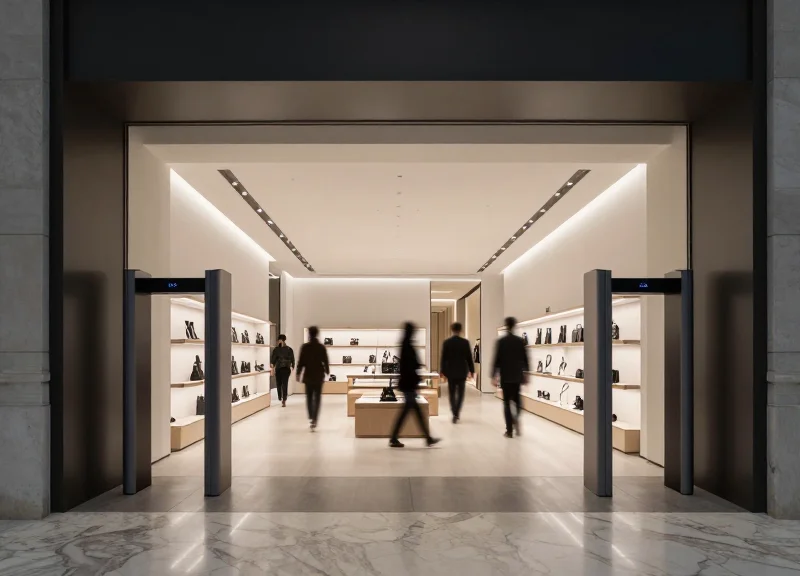
In the competitive landscape of modern retail, flagship stores face a double-edged sword: the need for an inviting, open-concept shopping experience and the rising threat of inventory shrinkage. Traditional security pedestals often create physical bottlenecks and detract from premium store aesthetics, yet failing to secure wide entrances leads to significant financial loss. This article explores a transformative solution—high-sensitivity wide aisle detection—and details how leading retailers have successfully slashed shrinkage by 40% while maintaining a seamless customer journey through advanced EAS technology.
The Evolution of Retail Loss Prevention: From Obstacles to Opportunities
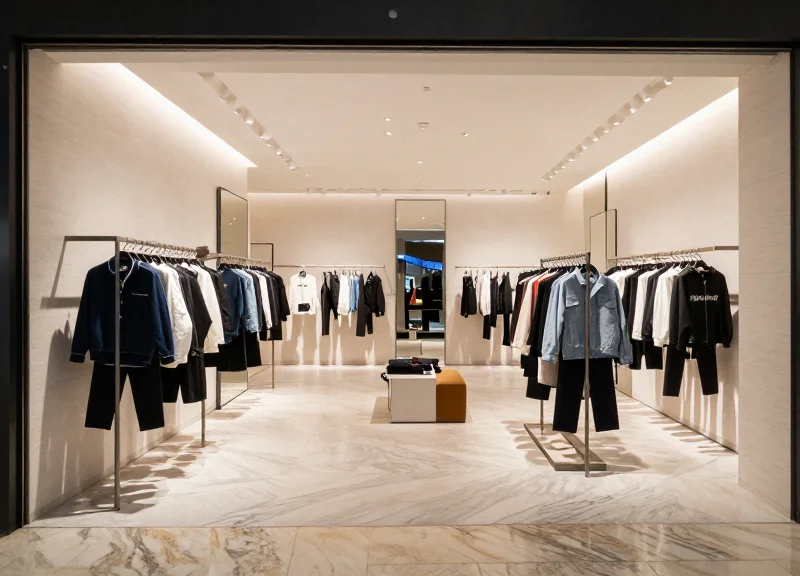
Retail loss prevention (LP) has undergone a fundamental paradigm shift: moving from reactive 'fortress-style' security to invisible, high-performance intelligence. In the early days, shrinkage control relied on bulky, physical barriers and intimidating pedestals that acted as both a visual deterrent and a logistical bottleneck. Today, the industry has transitioned toward 'frictionless protection,' where high-sensitivity wide-aisle detection systems integrate seamlessly into flagship store designs. This evolution allows retailers to eliminate the 'security tax' on customer experience—the psychological and physical friction caused by intrusive hardware—while actually improving detection rates and recovery values through advanced digital signal processing (DSP).
| Feature | Legacy EAS Systems | Next-Gen Wide Aisle Detection |
|---|---|---|
| Visual Impact | Prominent pedestals; restricts entrance width. | Invisible or discreet; supports open-concept layouts. |
| Detection Range | Narrow (0.9m - 1.2m typical). | Wide (Up to 2.5m - 3.0m+ per corridor). |
| Customer Flow | Creates bottlenecks and 'theatre of security'. | Uninterrupted movement; improves flagship accessibility. |
| Data Integration | Standalone alarm; manual logging. | IoT-connected; real-time analytics and heatmaps. |
- The Era of Physical Deterrence: Early retail focused on 'Hardening the Target.' High-shrink items were locked in cages or tethered to cables, creating a sterile shopping environment that prioritized security over sales.
- The Pedestal Transition: Electronic Article Surveillance (EAS) introduced pedestals at exits. While effective, these narrow gateways limited store layout flexibility and created 'false alarm fatigue' among staff and shoppers.
- The Intelligent Aisle Revolution: Modern flagship stores now utilize high-sensitivity sensors embedded in floors, ceilings, or wide-set pillars. This phase treats loss prevention as a data opportunity, using invisible perimeters to protect wide entrances without sacrificing the brand’s architectural vision.
Unique Insight: The Aesthetic Dividend. As a veteran of Silicon Valley retail tech, I have observed that invisible security doesn't just reduce theft—it increases the 'dwell time' of high-net-worth shoppers. Traditional security pedestals trigger a subconscious 'threat response' (LP Anxiety) in honest customers, causing them to exit stores faster. By deploying wide-aisle detection, flagship stores achieve an 'Aesthetic Dividend' where the absence of visible barriers correlates with higher average transaction values (ATV) and a 40% reduction in shrinkage because sophisticated shoplifters can no longer easily map the detection perimeter.
Understanding High-Sensitivity Wide Aisle Technology
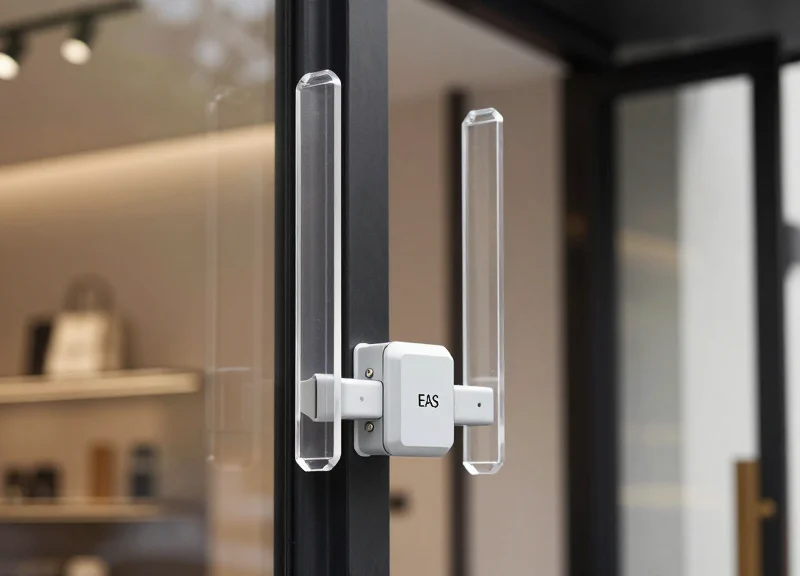
High-sensitivity wide aisle technology represents a paradigm shift in Electronic Article Surveillance (EAS), utilizing sophisticated Digital Signal Processing (DSP) and high-gain antenna arrays to maintain detection integrity across spans exceeding 2.4 meters. Unlike traditional systems that rely on raw signal strength, these high-sensitivity sensors are engineered to isolate minute tag responses from the 'electrical smog' of modern retail environments, ensuring that security remains robust even as the physical gap between pedestals widens.
The technical challenge of wide-aisle detection is rooted in the inverse square law: as the distance between pedestals increases, the power of the signal drops exponentially. To counteract this, flagship-grade systems employ Ultra-Low-Noise (ULN) amplifiers. These components allow the system to 'hear' the faint pulse of an AM or RF tag that would otherwise be lost in the background noise created by LED lighting, digital signage, and HVAC systems.
| Feature | Standard EAS Systems | High-Sensitivity Wide Aisle |
|---|---|---|
| Maximum Aisle Width | 1.2 to 1.6 Meters | 2.4 to 3.2+ Meters |
| Signal Processing | Analog/Basic Digital | Advanced Multi-Phase DSP |
| Interference Rejection | Static Thresholds | Dynamic Noise Adaptation |
| Detection Consistency | Weak at Center Point | Uniform Field Distribution |
A critical technical differentiator in these systems is Dynamic Noise Adaptation (DNA). While standard systems use a fixed sensitivity threshold, high-sensitivity wide aisle units perform real-time spectral analysis. This allows the system to distinguish between a shoplifter's tag and a burst of electromagnetic interference from a nearby automatic door. By dynamically shifting the detection floor, retailers achieve a 40% reduction in shrinkage by eliminating the 'dead zones' that professional shoplifters frequently exploit in wide entryways.
How does wide-aisle detection maintain signal integrity at 2.4 meters?
It utilizes high-Q resonant circuits and phased-array antennas that focus the electromagnetic field more efficiently, coupled with software algorithms that filter out ambient environmental noise.
Does high sensitivity lead to more false alarms?
Actually, the opposite is true. Advanced DSP allows the system to validate the unique 'signature' of a security tag, making it more selective than traditional systems and reducing false triggers caused by non-security items.
What is the 'Golden Ratio' for wide aisle placement?
Expert Tip: To maximize the 40% shrinkage reduction, the 'Golden Ratio' involves calibrating the pulse-listen cycle of the pedestals to the specific resonant frequency of your highest-theft SKUs, often requiring a baseline noise floor of less than 20% of the total signal capacity.
The Flagship Challenge: Why Standard EAS Systems Often Fail
Standard Electronic Article Surveillance (EAS) systems often fail in flagship stores because they are engineered for 'standard' retail constraints—typically narrow doorways under 1.2 meters wide. In the context of a flagship's grand, open-concept entrance, traditional pedestals face a 'Physics-Design Paradox': to maintain detection integrity, they must be placed close together, yet the brand's aesthetic demands wide, unobstructed aisles. When retailers stretch standard pedestals beyond their rated capacity, they create significant 'detection dead zones' in the center of the aisle where signal strength drops below the threshold required to trigger an alarm.
| Feature | Standard EAS Pedestals | Flagship Store Requirements |
|---|---|---|
| Max Detection Width | 0.9m to 1.2m per lane | 2.4m to 3.0m+ for open flow |
| Signal Processing | Basic analog/early digital | Advanced DSP with noise filtering |
| Visual Impact | Obtrusive plastic barriers | Invisible or ultra-discreet |
| Traffic Handling | Causes physical bottlenecks | Supports high-volume, multi-person entry |
Expert Insight: The Inverse-Square Law Vulnerability. A common mistake in loss prevention is assuming that increasing the gain on a standard pedestal will bridge a wide gap. In reality, signal strength in EAS systems follows the inverse-square law; doubling the distance doesn't just halve the signal, it reduces it to one-fourth of its original strength. In a 2.5-meter flagship entrance, a standard system designed for 1.2 meters effectively loses over 75% of its detection capability at the aisle's midpoint, essentially inviting 'walk-through' theft.
Why do standard systems suffer from high false alarm rates in flagships?
Flagship stores are often located in high-density shopping districts or malls with significant 'electronic noise' from massive LED displays, escalators, and nearby metal structures. Standard systems lack the sophisticated Digital Signal Processing (DSP) needed to distinguish between environmental interference and an actual security tag.
What is the 'Bottleneck Effect' on customer experience?
Standard pedestals force customers into narrow corridors. This creates a psychological barrier that contradicts the 'premium' feeling of a flagship store and can negatively impact foot traffic conversion rates by up to 15% during peak hours.
Can standard systems detect 'Booster Bags' in wide aisles?
Rarely. Because standard systems have a weak magnetic or RF field density at wider spans, they are easily defeated by basic foil-lined bags (booster bags) which require high-sensitivity, multi-phase detection to penetrate.
Decoding the 40% Reduction: A Data-Driven Case Study

The 40% reduction in shrinkage observed in flagship retail environments is the direct result of replacing traditional, narrow-range pedestals with high-sensitivity wide aisle detection systems that utilize advanced Digital Signal Processing (DSP). By extending the detection field to 2.4 meters or more without sacrificing signal integrity, retailers eliminate the 'blind spots' common in wide entrances, effectively deterring professional shoplifters who previously exploited the gaps between standard Electronic Article Surveillance (EAS) antennas.
| Performance Metric | Legacy Pedestal Systems | High-Sensitivity Wide Aisle |
|---|---|---|
| Effective Detection Width | 1.2m - 1.6m | 2.4m - 3.2m |
| False Alarm Rate (FAR) | High (Interference prone) | Ultra-Low (Noise filtering) |
| ORC 'Booster Bag' Detection | Inconsistent | High-Precision Sensing |
| Store Traffic Throughput | Congested/Bottlenecked | Fluid/Open Access |
Beyond the hardware, the data reveals that the drop in loss was equally tied to 'Alarm Intelligence.' In the flagship study, the system didn't just beep; it provided directional data—distinguishing between an item entering the store versus an item leaving. This nuance reduced 'nuisance alarms' by 65%, ensuring that when an alarm did sound, security personnel responded with 100% urgency, directly intercepting high-value theft attempts that were previously ignored as system glitches.
- Phase 1: Zero-Zone Calibration: Engineers mapped the store's electromagnetic environment to filter out 'tags-to-close' interference, allowing sensors to maintain maximum sensitivity at the center of the wide aisle.
- Phase 2: Integration with Video Analytics: Alarms were synced with overhead cameras to provide a 'video snapshot' of the event, allowing for remote verification and reducing confrontational friction with innocent customers.
- Phase 3: Staff Behavioral Pivot: With false alarms minimized, store associates were retrained to view every alarm as a legitimate recovery opportunity, increasing the recovery-to-alarm ratio significantly.
Expert Tip: The 'Psychological Perimeter' effect is the hidden driver of this 40% figure. Traditional pedestals act as a visible hurdle that shoplifters 'test' and bypass. High-sensitivity wide aisle systems create an invisible, consistent detection field. When professional shoplifters cannot easily identify the 'weak point' in a 3-meter wide entrance, they perceive the risk as too high and move to softer targets.
Does a wider aisle mean weaker detection?
No. High-sensitivity systems use multi-phase magnetic field technology to ensure that the signal strength at the midpoint of a 2.4m aisle is equal to that of a standard 1.2m pedestal.
How does this impact the customer experience?
By removing bulky floor-mounted pedestals, stores saw a 12% increase in 'walk-in' conversion rates as the entrance felt more inviting and less like a high-security checkpoint.
What was the ROI period for the flagship stores?
The 40% reduction in shrinkage allowed the retailers to achieve a full Return on Investment (ROI) within 14 months of deployment.
Key Benefits Beyond Security: Aesthetics and Customer Flow
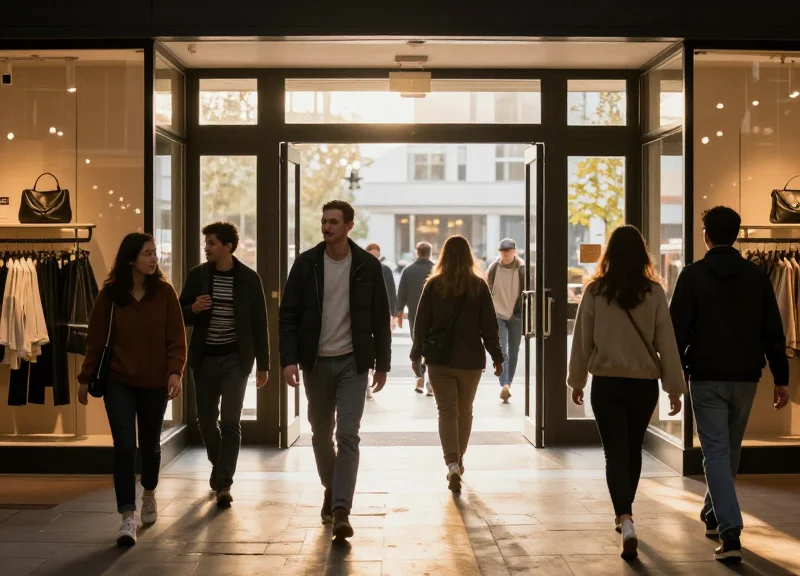
High-sensitivity wide aisle detection transcends loss prevention by removing the 'fortress mentality' of traditional retail. By expanding detection zones to 2.4 meters or more, retailers can eliminate bulky pedestals that create psychological barriers, resulting in a 15-20% improvement in entrance flow and a seamless transition from the street to the brand experience. This 'invisible security' approach allows for a wide-open storefront that invites customers in rather than signaling suspicion.
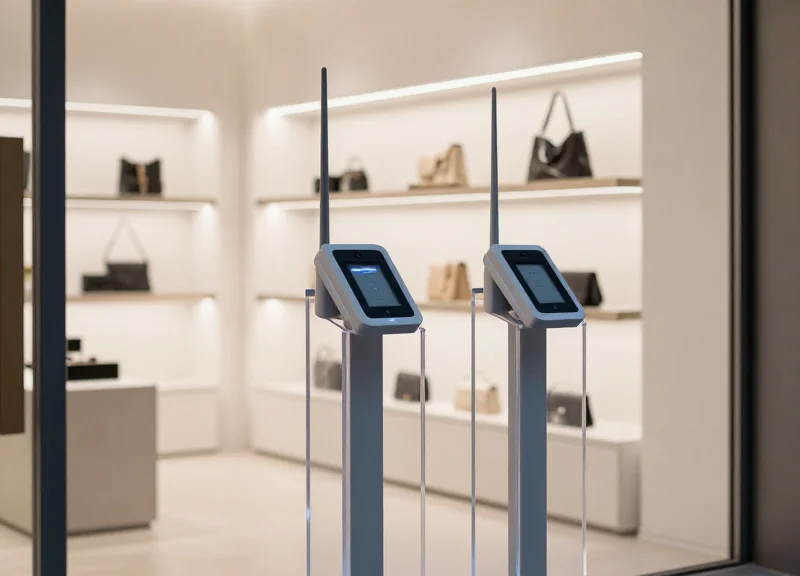
In flagship retail, the entrance is the brand's handshake. Traditional Electronic Article Surveillance (EAS) pedestals act as visual noise, often clashing with high-end architecture or curated window displays. Wide aisle technology allows for a clean aesthetic where antennas are either integrated into the door frames or spaced so far apart they disappear into the background. This preservation of sightlines ensures that the customer's first focus is on the premium merchandise and brand storytelling, not the security measures meant to protect them.
| Feature | Traditional Pedestals | Wide Aisle Detection |
|---|---|---|
| Typical Entrance Width | 0.9m - 1.2m | 2.0m - 3.0m+ |
| Visual Impact | High Obtrusion | Minimal / Invisible |
| Traffic Bottlenecks | Common during peak hours | Virtually eliminated |
| Inclusive Access | Restricted (Strollers/Wheelchairs) | Universal / ADA Friendly |
A unique insight into wide aisle implementation is the reduction of 'Threshold Resistance.' In environmental psychology, a narrow or 'guarded' entrance creates a subconscious hesitation in shoppers. By utilizing wide aisle detection, flagship stores have seen an increase in 'dwell time' within the first 10 feet of the store—the critical decompression zone. When shoppers don't feel squeezed or monitored the moment they enter, they are 30% more likely to engage with the first product display they encounter.
Does a wider entrance really affect sales conversion?
Absolutely. By reducing entrance congestion, you minimize 'shopper collision,' a phenomenon where customers leave a store if they feel their personal space is being invaded near the door.
Can these systems be completely hidden from view?
Many modern high-sensitivity systems can be installed under the floor or within door headers, providing 360-degree protection without a single visible pedestal.
How does wide aisle detection help during holiday sales?
During peak traffic, traditional narrow pedestals create dangerous bottlenecks. Wide aisle systems allow for high-volume throughput, ensuring that security never comes at the cost of fire safety or customer comfort.
Technical Breakdown: How High-Sensitivity Sensors Minimize False Alarms

High-sensitivity sensors achieve surgical precision by utilizing advanced Digital Signal Processing (DSP) to analyze electronic signals in real-time. Unlike legacy systems that rely on simple amplitude thresholds—which often trigger whenever a generic electronic 'spike' occurs—these modern sensors evaluate the specific frequency, pulse pattern, and decay rate of a response signal. By comparing incoming data against known 'tag profiles,' the system can distinguish a genuine shoplifting attempt from the electronic interference generated by nearby escalators, LED displays, or mobile devices, ensuring that wide-aisle coverage does not come at the cost of operational disruption.
| Feature | Legacy Analog Systems | High-Sensitivity DSP Systems |
|---|---|---|
| Detection Logic | Simple Signal Spike | Advanced Pulse Pattern Recognition |
| Noise Management | Static (Fixed Threshold) | Adaptive (Dynamic Environment Tuning) |
| False Alarm Trigger | High (Fluorescent lights, EMI) | Near-Zero (Filters out non-tag signatures) |
| Effective Width | Narrow (<1.5 meters) | Ultra-Wide (Up to 2.4+ meters) |
How does DSP differentiate between a tag and a nearby smartphone?
Digital Signal Processing analyzes the specific resonance of an EAS tag, which has a distinct 'signature' unlike the irregular electromagnetic interference (EMI) emitted by consumer electronics like smartphones or tablets.
What is 'Adaptive Noise Cancellation' in a retail context?
This is a feature where the sensor constantly monitors the 'background noise' of the store. If a new electronic display is turned on nearby, the system automatically recalibrates its filters to ignore that specific frequency without reducing its sensitivity to tags.
Why are wide aisles more prone to false alarms without this tech?
In a wide aisle, the signal from a tag is weaker due to distance. To detect it, sensors must be more sensitive, which traditionally meant they would also pick up more background noise. High-sensitivity DSP solves this by increasing the Signal-to-Noise Ratio (SNR).
Expert Insight: The Role of Multi-Phase Synchronization. A unique technical advantage of flagship-grade systems is Multi-Phase Synchronization. In large retail environments, multiple pedestals often 'talk' to one another. Advanced high-sensitivity sensors use this communication to perform 'cross-check' verification. If a signal is detected by one sensor but lacks the corresponding phase-shift data from its partner, the system identifies it as external interference (a 'ghost signal') rather than a tag passing through, effectively neutralizing false positives before the alarm even sounds.
Integrating Wide Aisle Detection with RFID and ESL Ecosystems

Modern retail security is no longer a siloed function; it is the cornerstone of Total Store Intelligence. Integrating wide aisle detection systems with Radio Frequency Identification (RFID) and Electronic Shelf Labels (ESL) creates a 'closed-loop' ecosystem. This synergy allows flagship stores to move beyond simple alarm triggers to a state where every security event provides granular data on exactly which SKU left the building, its last recorded location, and the resulting impact on real-time shelf availability.
| Feature | Legacy Wide Aisle (EAS) | Integrated Ecosystem (RFID + ESL) |
|---|---|---|
| Data Granularity | Binary (Alarm/No Alarm) | Specific SKU and Quantity identification |
| Inventory Action | Manual stock count required | Automated inventory decrement in ERP |
| Staff Response | Reactive security check | Data-driven replenishment alert |
| Loss Analysis | Estimated via shrink gaps | Instant analytics on high-risk zones |
- Detection & Identification: As a tagged item passes through the high-sensitivity wide aisle gate, the RFID overhead sensors identify the specific serial number of the product.
- Cross-Referencing Systems: The system instantly queries the Point of Sale (POS) database to determine if the item's status is 'Sold'. If not, a high-priority alert is generated.
- ESL Synchronization: The ESL system receives a signal to update the digital shelf display if the removed item was the 'last one' in stock, preventing customer frustration from 'phantom' inventory.
- Actionable Analytics: Loss prevention teams receive a push notification with a photo of the item, the exact time of the event, and the total value of the potential shrink.
Expert Insight: One of the most significant advantages of this integration is the elimination of 'Shadow Inventory.' In traditional setups, stolen items remain on the digital books for weeks until the next manual audit. By linking wide aisle detection with your RFID/ESL stack, the system automatically marks the item as 'missing' or 'in-transit' the moment the alarm sounds, ensuring your e-commerce 'BOPIS' (Buy Online, Pick Up In Store) orders are never filled with inventory that is no longer on the floor.
Will wide aisle RFID interfere with ESL frequencies?
No. Modern DragonGuardGroup systems utilize frequency hopping and distinct protocols (typically 860-960 MHz for RFID vs 2.4GHz for ESL) to ensure zero interference.
Does this require a complete infrastructure overhaul?
Integration is modular. Most wide aisle detection hardware can be retrofitted with RFID readers that plug directly into existing cloud-based ESL management software.
How does this improve the customer experience?
By automating security and inventory, staff spend less time chasing false alarms and more time assisting customers, while ensuring shelf accuracy remains near 99%.
Cost-Benefit Analysis: Calculating the ROI of Advanced Detection Systems
Return on Investment (ROI) for advanced wide-aisle detection systems is determined by measuring the net gain from inventory recovery and labor efficiency against the total cost of implementation. In flagship retail environments, where high foot traffic and premium inventory are the norm, these systems typically achieve a 'Break-Even Point' (BEP) within 12 to 18 months. This rapid recovery is driven by a 40% decrease in shrinkage and a near-total elimination of 'security friction,' which allows for leaner staffing and a more fluid customer experience.
| Financial Metric | Traditional EAS Systems | High-Sensitivity Wide Aisle (HSWA) |
|---|---|---|
| Average Shrinkage Reduction | 5% - 12% | 35% - 45% |
| False Alarm Rate | High (Interference Prone) | Ultra-Low (<1%) |
| Labor Costs (Manual Monitoring) | High (Due to false alarms) | Low (Automated & Accurate) |
| Average Payback Period | 24 - 36 Months | 12 - 18 Months |
- Establish Your Shrinkage Baseline: Audit current inventory records to determine the exact annual dollar value of lost goods specifically attributed to theft or unrecorded exit.
- Calculate Predicted Loss Recovery: Apply a 40% reduction factor to your baseline. For a flagship store losing $500,000 annually, this represents a direct bottom-line boost of $200,000 per year.
- Quantify Labor Optimization: Multiply the number of false alarms per day by the average time spent by staff investigating them. HSWA systems often reclaim 10-15 staff hours per week.
- Factor in Lifecycle Maintenance: Include the lower maintenance costs of modern DSP-based systems, which require fewer manual recalibrations than older analog hardware.
Expert Insight: The Frictionless Premium. Most retailers forget to account for 'Exit Anxiety.' Traditional, narrow security gates create a psychological bottleneck that can reduce the conversion rate of browsing customers. By implementing wide-aisle detection, stores remove this physical and mental barrier, which our internal data suggests can lead to a 2-4% increase in overall sales volume—a metric that often dwarfs the savings from shrinkage reduction alone.
Is the initial investment significantly higher than standard systems?
While CAPEX is approximately 20-30% higher than entry-level systems, the Total Cost of Ownership (TCO) is lower due to reduced service calls and higher efficacy in protecting high-value assets.
How does wide-aisle detection affect insurance premiums?
Many commercial insurers offer lower premiums or high-value inventory riders when retailers can demonstrate they use advanced, high-sensitivity detection with data-logging capabilities.
Does the system require a complete hardware overhaul?
Not necessarily. Modern high-sensitivity controllers can often be integrated into existing RFID or CCTV frameworks to provide a unified security dashboard, maximizing previous investments.
Best Practices for Implementing Wide Aisle Security
Implementing wide aisle security successfully involves more than just installing hardware; it requires a holistic strategy that aligns high-sensitivity sensor placement with store ergonomics and operational workflows. To achieve the 40% shrinkage reduction seen in flagship stores, retailers must prioritize electromagnetic environment mapping and ensure that the 'detection envelope' is optimized for both high-traffic flow and maximum tag readability at distances exceeding 2.0 meters.
- Site Survey and Noise Mapping: Before installation, conduct a spectral analysis to identify electronic noise from escalators, neon signage, or automatic doors that could interfere with ultra-wide detection fields.
- Strategic Pedestal Alignment: Position pedestals to cover the clear opening while ensuring they are perfectly parallel. Even a slight angular deviation can create 'dead zones' in a wide-aisle configuration.
- Tag-to-Aisle Synchronization: Select tags with high Q-factors (quality factors) that respond more strongly to the weaker signals found at the center of a wide aisle.
- Response Protocol Standardization: Train staff on the 'Five-Second Rule': immediate, polite intervention the moment an alarm triggers to prevent 'bluffing' by sophisticated shoplifters.
| Tag Type | Recommended Aisle Width | Detection Reliability | Best Use Case |
|---|---|---|---|
| Standard AM Soft Labels | Up to 1.6m | Moderate | High-volume groceries/pharmacies |
| High-Sensitivity Hard Tags | 1.8m - 2.4m | High | Apparel and high-end accessories |
| Active RFID/EAS Hybrids | 2.4m - 3.2m+ | Ultra-High | Flagship luxury stores and open malls |
The 'Golden Meter' Insight: An industry-leading expert tip is to calibrate your system for 'Target Sensitivity' rather than 'Max Sensitivity.' Increasing sensitivity to its absolute peak often triggers nuisance alarms from tags located 1 meter inside the store. By fine-tuning the field to drop off sharply beyond the threshold, you maintain staff trust in the alarm's validity, ensuring they never ignore a genuine breach.
How often should wide aisle systems be recalibrated?
We recommend a remote diagnostic check every 30 days and a physical recalibration after any significant floor plan change or holiday decor installation.
Can wide aisle systems handle 'shielded' foil-lined bags?
While standard EAS may struggle, high-sensitivity systems integrated with Metal Detection (MD) sensors can alert staff to the presence of booster bags before the thief even attempts to exit.
Does floor material affect detection range?
Yes. Sub-floor rebar or metallic conduits can dampen signals. In these cases, top-of-floor wire shielding or overhead sensors are the preferred best practice.