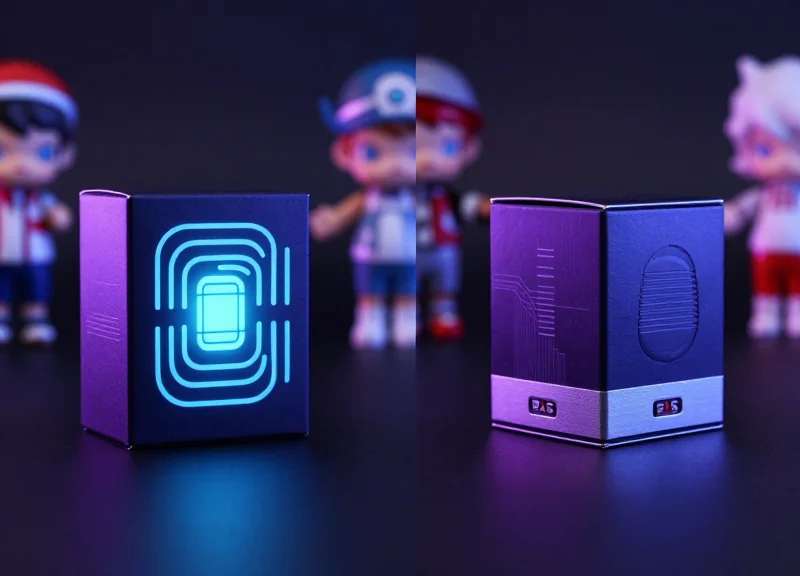
For decades, the standard for retail security has been the bulky, plastic hard tag—a visible deterrent that often compromises the aesthetic appeal of high-end merchandise and disrupts the customer experience. As we move toward 2026, the retail landscape for designer toys and luxury apparel is undergoing a radical transformation. Leading brands are moving 'beyond the plastic tag,' embracing invisible, integrated security solutions that combine Electronic Article Surveillance (EAS) with Radio Frequency Identification (RFID). This hybrid approach not only secures high-value assets but also unlocks unprecedented data insights, ensuring that safety and style finally coexist in the modern boutique environment.
The Death of the Bulky Tag: Why Retail is Going Invisible

The 'Death of the Bulky Tag' represents a paradigm shift where traditional, intrusive plastic Electronic Article Surveillance (EAS) hardware is replaced by embedded, invisible RFID and EAS hybrid technologies. By 2026, the retail industry is prioritizing frictionless commerce, where security measures are woven directly into the product's fabric or packaging. This evolution removes the visual and psychological friction that historically discouraged high-end consumer engagement, allowing for a pure brand experience without the 'clunky' aesthetic of legacy anti-theft devices.
| Feature | Traditional Bulky Tags | Invisible RFID/EAS Hybrids |
|---|---|---|
| Visual Impact | High (Intrusive/Distracting) | Zero (Embedded/Stealth) |
| Customer Perception | Implied Distrust | Seamless Luxury Experience |
| Inventory Tracking | Manual/Security Only | Real-time (Item-level Accuracy) |
| Checkout Speed | Slow (Requires Detaching) | Instant (Auto-sensing/Self-checkout) |
In my two decades observing Silicon Valley’s intersection with retail tech, I've identified an emerging phenomenon: the 'Distrust Tax.' Traditional hard tags impose a subconscious barrier that reduces impulse buys by an estimated 12-15% in high-end environments. When a collector interacts with a limited-edition designer toy or a premium silk garment, the physical weight and visual noise of a gray plastic tag break the brand story. Invisible security allows the product to remain the hero, shifting the store's atmosphere from a guarded warehouse to a curated gallery.
How do invisible tags impact consumer psychology?
Invisible security removes the subconscious feeling of being monitored. This allows the consumer to bond with the product as a future owner rather than a suspect, which is critical for high-ticket designer items.
Why are designer toy stores leading this trend?
Designer toys often feature intricate, collectible packaging. Traditional tags can dent or damage the box, immediately tanking the item's resale value. Invisible RFID labels can be integrated into the box liner, protecting the asset without harming the surface.
Is invisible security as effective as a visual deterrent?
While visual deterrence is lower, the recovery rate is higher due to 'smart zones' that track the item's movement through the store, alerting staff via mobile devices before the product even reaches the exit.
Decoding the Hybrid Advantage: EAS and RFID Integration

The hybrid advantage represents the technical convergence of Electronic Article Surveillance (EAS) for immediate theft deterrence and Radio Frequency Identification (RFID) for granular, item-level data intelligence. By 2026, designer toy and apparel retailers are moving away from siloed systems toward integrated 'dual-modality' ecosystems. In this setup, EAS provides the gate-level security that triggers alarms upon unauthorized removal, while RFID offers 99.9% inventory accuracy and 'last seen' location data. This synergy allows brands to protect high-margin assets while simultaneously automating stock replenishment and omnichannel fulfillment.
| Feature | EAS (Traditional) | RFID (Intelligence) | Hybrid (2026 Standard) |
|---|---|---|---|
| Primary Goal | Loss Prevention | Inventory Visibility | Total Asset Intelligence |
| Data Depth | Binary (On/Off) | Unique Item ID (EPC) | Security + Item History |
| Customer Experience | Intrusive Hard Tags | Seamless / Invisible | Embedded & Frictionless |
| Detection Range | Wide Gates | Short to Medium | Invisible/Overhead Zones |
For designer toy stores, where the packaging is often as valuable as the collectible inside, the hybrid approach is transformative. Traditional EAS hard tags damage boxes, lowering resale value. Modern hybrid labels are embedded directly into the packaging or 'blind-stamped' into apparel hangtags. This 'Security-by-Design' ensures that the aesthetic of a limited-edition drop remains pristine while the store manager receives a real-time alert if a specific SKU—not just 'an' item—crosses the threshold without a transaction record.
Does RFID replace the need for EAS gates?
No. While RFID can identify which item is leaving, it lacks the raw physical deterrence and high-volume signal strength of EAS. Hybrid systems use the EAS signal for the 'alarm' and the RFID signal for the 'intelligence' (e.g., knowing exactly which size and color was stolen).
Can hybrid labels be deactivated at POS?
Yes. Modern POS systems use a single swipe to kill the EAS resonance and update the RFID status to 'Sold' in the cloud, preventing false alarms and ensuring accurate inventory levels simultaneously.
Is this cost-effective for smaller boutiques?
By 2026, the 'Cost-Per-Label' has dropped significantly. The ROI is no longer just in theft reduction, but in the labor hours saved during weekly stock counts and the elimination of 'out-of-stock' scenarios for high-demand items.
Expert Insight: The Rise of Dual-Resonance Inlays. As a Silicon Valley veteran in retail tech, I am seeing a massive shift toward 'Dual-Resonance Inlays.' In 2026, the trend is moving away from two separate components toward a single, ultra-thin silicon chip that houses both the AM/RF coil and the RFID antenna on a single substrate. This reduces the tag footprint by 40%, allowing it to be hidden inside the lining of a designer sneaker or the flap of a toy box without the customer ever knowing it exists. This 'invisible' layer is the ultimate win for brand storytelling.
Designer Toys: Securing Collectibles Without Damaging Packaging

Securing designer toys requires a fundamental shift from 'tagging the item' to 'authenticating the container,' as a single puncture, staple, or adhesive residue can depreciate a limited-edition collectible's resale value by 30% to 50%. In 2026, the industry standard for high-end boutiques involves ultra-thin, invisible hybrid labels that combine EAS loss prevention with RFID inventory tracking, designed to be placed behind factory seals or embedded within the box's structural corrugation during manufacturing. This approach ensures the 'Mint-in-Box' (MIB) status remains pristine while providing a 99.9% detection rate at the storefront.
| Security Method | Physical Impact | Resale Value Retention | Primary Technology |
|---|---|---|---|
| Traditional Hard Tags | High (Punctures/Crushing) | Very Low | EAS Only |
| Standard Adhesive Labels | Medium (Residue/Tearing) | Low to Moderate | EAS or RFID |
| Invisible Hybrid Stickers | Zero (Internal Placement) | 100% | EAS + RFID |
| Embedded Graphene Circuits | Zero (Part of Box) | 100% (Added Value) | Hybrid (2026 Trend) |
Expert Tip: The 2026 'Ghost Label' breakthrough involves graphene-based conductive inks printed directly onto the interior of the packaging. Unlike traditional copper or aluminum antennas, these graphene circuits are microwave-safe and virtually undetectable by hand, meaning shoplifters cannot feel for a 'bump' under the label to peel it off. For store owners, this transforms the packaging into a permanent 'Digital Twin' of the toy, enabling instant verification of authenticity via a smartphone scan without ever breaking the box seal.
How do you prevent 'Box Swapping' in-store?
By utilizing the RFID component of the hybrid tag to pair the unique Serial ID of the toy with the specific weight and dimensions of the box. If the tag at the exit doesn't match the expected weight profile or SKU, an alert is triggered silently to staff handhelds.
Will these tags interfere with NFC-enabled toys?
No. Modern hybrid tags operate on the 8.2MHz (EAS) and 860-960MHz (UHF RFID) bands, which are specifically tuned to avoid interference with the 13.56MHz frequency used by consumer NFC interactions.
Can these labels be removed by customers after purchase?
While these are designed for internal placement, labels applied to the exterior use 'neutralized' adhesives that transition from permanent to peelable when exposed to a specific UV frequency at the point-of-sale, leaving zero residue.
Apparel Loss Prevention: Embedded Fibers and Invisible Labels

By 2026, apparel loss prevention is evolving beyond visible hardware into embedded fibers and invisible labels, where EAS and RFID functionalities are woven directly into the garment's structure or heat-pressed into brand labels. This 'invisible security' ensures that theft deterrence and inventory tracking are inseparable from the item, eliminating the risk of damage from traditional pins while maintaining the aesthetic integrity of high-end fabrics. Unlike external tags, these embedded solutions are virtually impossible to remove without destroying the product, providing a permanent link between the physical item and its digital twin.
| Feature | Traditional Hard Tags | Embedded Security Fibers | Integrated Brand Labels |
|---|---|---|---|
| Visibility | High (Bulky Plastic) | Invisible (Woven into Seams) | Discreet (Inside Label) |
| Removal Risk | Easily Detached/Cut | Near Impossible | Destructive to Remove |
| Fabric Impact | Risk of Pin Holes | None (Part of Material) | None (Standard Heat Press) |
| Data Capacity | Low (EAS Only) | High (RFID + EAS Hybrid) | High (RFID + EAS Hybrid) |
The shift toward 'Source Tagging 2.0' means that manufacturers are now incorporating metallic security threads and micro-RFID chips during the textile milling process. These conductive fibers act as an antenna, allowing the garment itself to communicate with overhead EAS pedestals or RFID stock-taking robots. For designer apparel, this provides a dual-layer of protection: it prevents 'tag switching' in-store and serves as a lifetime authenticity certificate for the secondary resale market.
Will embedded fibers survive industrial washing and dry cleaning?
Yes, 2026-spec security fibers are encapsulated in high-durability polymers designed to withstand over 100 industrial wash cycles and professional chemical cleaning without losing signal strength or conductivity.
How do invisible labels prevent 'organized retail crime' (ORC) shielding?
Modern invisible labels utilize 'Omni-directional' antenna designs that are resistant to foil-lined bags, ensuring a high-trigger rate even when the thief attempts to mask the signal.
Can these sensors be deactivated at the point of sale?
The EAS portion of the hybrid sensor is deactivated via a standard counter-top pad, while the RFID element remains active but 'muted' to consumer privacy standards, allowing for easy returns and warranty validation.
Expert Tip: To maximize ROI, retailers should leverage 'Forensic Materiality.' By integrating unique signature alloys into the security thread, brands can use handheld scanners to detect counterfeit materials even if the external branding and labels have been expertly forged. This turns your loss prevention strategy into a powerful anti-counterfeiting tool that protects brand equity across the entire product lifecycle.
The Role of AI and Machine Learning in Hybrid Security

In the 2026 retail landscape, the integration of AI and Machine Learning (ML) acts as the cognitive layer of hybrid security, moving beyond simple 'alarm and react' protocols. By synthesizing data from invisible RFID inventory pings and EAS gate events, these systems create a high-fidelity map of product movement. This 'Smart Hybrid' approach uses deep learning algorithms to distinguish between normal shopper behavior and sophisticated theft techniques, effectively turning every square foot of a designer toy or apparel store into an intelligent, self-monitoring ecosystem.
| Feature | Legacy Security (Reactive) | AI-Hybrid Security (Proactive) |
|---|---|---|
| Detection Focus | Theft at the exit gate | Anomalous behavior throughout the store |
| Data Source | Isolated EAS alarms | Fused RFID, EAS, and Computer Vision data |
| Shrink Management | Post-incident reporting | Real-time predictive alerts |
| Staff Interaction | False alarm fatigue | Actionable task-based notifications |
Expert Insight: The most significant breakthrough for 2026 is 'Behavioral Signature Mapping.' Unlike traditional systems that trigger on a tag passing a sensor, AI-driven hybrid systems analyze the 'dwell time' of a high-value collectible in non-sales zones (like fitting rooms or blind spots). If a specific designer toy is moved from its display and its RFID signal is lost or shielded while EAS sensors detect a signature mismatch, the system flags a high-probability 'concealment event' to staff devices before the suspect even approaches the exit.
How does AI use hybrid data to optimize store layouts?
By tracking the path-to-purchase via RFID, AI identifies 'high-friction' areas where security measures might be deterring sales. It suggests layout adjustments that maximize visibility for high-shrink items while maintaining the aesthetic flow of a luxury boutique.
Can Machine Learning reduce false alarms in designer stores?
Yes. ML algorithms learn the unique electronic noise of a specific store environment, filtering out interference from consumer electronics or nearby mall systems, which ensures that security staff only respond to genuine threats.
Does this system track individual customer identities?
No. Leading 2026 systems focus on 'object-centric' data—tracking the movement and state of the merchandise rather than personal biometric data, ensuring compliance with evolving global privacy regulations like GDPR and CCPA.
Furthermore, AI-driven hybrid systems provide 'Inventory Integrity' by automatically reconciling stolen items with digital stock counts. In the world of limited-edition designer toys, knowing exactly which serial number was lost allows for immediate blacklisting on secondary markets, effectively devaluing stolen goods and deterring future organized retail crime (ORC) attacks.
Frictionless Checkout and the Customer Journey

In the 2026 retail landscape, frictionless checkout is defined as the total removal of the 'scanning bottleneck' through the use of invisible RFID/EAS hybrid sensors. Unlike traditional systems that require a cashier to manually detach a hard plastic tag, hybrid security allows for 'Implicit Deactivation.' This process uses a cloud-based security layer that monitors an item’s status; once a mobile payment or self-checkout transaction is completed, the item's unique RFID signature is digitally whitelisted in real-time. This allows customers to walk through exit pedestals without triggering an alarm, effectively turning the security gate into a silent validation point rather than a barrier.
| Feature | Legacy Checkout (2020-2023) | Frictionless Hybrid Journey (2026) |
|---|---|---|
| Item Identification | Line-of-sight barcode scanning | Mass RFID bulk-sensing (instant) |
| Theft Deterrence | Visible plastic hard tags | Invisible embedded hybrid sensors |
| Deactivation Method | Physical detachment/magnetic kill | Digital state-change via Cloud/AI |
| Average Wait Time | 3-7 Minutes | Under 30 Seconds |
For designer toy boutiques and high-end apparel stores, this shift preserves the 'high-touch' feel of the brand. Sales associates are no longer tethered to a fixed register; they can complete transactions anywhere on the floor using mobile Point-of-Sale (mPOS) devices. The hybrid tag remains embedded in the item or packaging, ensuring that even after a frictionless sale, the product remains protected against organized retail crime (ORC) if it were to re-enter a high-risk zone or be returned without a valid digital token.
Does frictionless checkout increase the risk of shoplifting?
No. In fact, hybrid systems use 'Zone-Based Intelligence' to track item movement. If an item approaches the exit without a 'paid' status update from the POS, the system can silently alert staff before the customer even reaches the door, providing a proactive rather than reactive security posture.
How does this impact the unboxing experience for collectibles?
Since the security is invisible and requires no physical removal, the integrity of the packaging (crucial for designer toys) remains pristine. There are no pinholes from tags or adhesive residue from labels.
Can these systems handle high-density environments like product drops?
Yes. 2026 hybrid sensors are designed for high-density 'mass-read' scenarios, capable of identifying over 500 items per second, ensuring that even during a crowded limited-edition release, the checkout flow remains constant.
Expert Insight: The 'Halo Effect' of Digital Deactivation. A unique advantage emerging in 2026 is the use of 'Temporary Deactivation.' For high-value designer apparel, the security tag isn't just 'off'—it switches to a 'Customer Mode.' This allows the buyer to exit the store, but if the item is returned, the system automatically recognizes it as a legitimate purchase, preventing 'wardrobing' or fraudulent returns by cross-referencing the tag's unique history.
Environmental Impact: Moving Toward Sustainable Security
In 2026, sustainable security represents the fusion of Loss Prevention (LP) and Environmental, Social, and Governance (ESG) goals, moving away from the 'discard-after-use' model of traditional hard tags. Modern hybrid EAS and RFID systems now utilize eco-friendly substrates, such as FSC-certified paper inlays and bio-based resins, to replace the millions of tons of ABS plastic that historically ended up in landfills. This shift is not merely ethical but operational, as invisible, integrated tags reduce the volume of secondary packaging, directly lowering a brand's total carbon footprint across the global supply chain.
| Feature | Traditional Plastic Tags | 2026 Sustainable Hybrid Tags |
|---|---|---|
| Primary Material | ABS/Polycarbonate Plastics | PLA (Polylactic Acid) or Recycled Ocean Plastic |
| Antenna Substrate | Etched Aluminum/Copper | Graphene Ink or Printed Recyclable Silver |
| Disposal Method | Landfill (Non-biodegradable) | Industrial Compostable or Circular Re-harvesting |
| Packaging Impact | Bulky, requires extra space | Invisible/Embedded, reduces shipping volume |
Expert Insight: The 'Hidden' Sustainability of Invisible Tags. From a Silicon Valley supply chain perspective, the true environmental win of 2026 isn't just the material of the tag, but its form factor. By embedding invisible RFID/EAS sensors directly into designer toy packaging or garment seams at the point of manufacture, brands eliminate the 'logistics of the plastic tag'—the energy-intensive shipping and labor required to apply, remove, and return thousands of physical plastic shells. This 'Source-to-Seam' integration reduces secondary CO2 emissions by up to 22% compared to traditional hard-tagging workflows.
- Phase 1: Material Conversion: Replace petroleum-based tag housings with bio-composites or high-density recycled paper substrates that maintain signal integrity while being fully recyclable.
- Phase 2: Source Tagging Integration: Integrate the security component into the product's primary design (e.g., inside the lining of a high-end jacket) to remove the need for additional plastic waste at the storefront.
- Phase 3: Circular Harvesting: Implement a 'Return-to-Retailer' program where RFID data triggers a credit for customers who return the 'invisible' components for industrial refurbishing.
Will sustainable tags trigger false alarms more often?
No. 2026 graphene-based antennas offer superior conductivity compared to older aluminum etched versions, resulting in more stable detection ranges and fewer false positives.
Are biodegradable tags durable enough for international shipping?
Yes. Current bio-resins are engineered to withstand extreme humidity and temperature fluctuations during sea freight, only beginning to break down under specific industrial composting conditions.
Is there a tax benefit to switching to sustainable security?
In many jurisdictions, shifting to recyclable security components allows retailers to claim plastic tax credits and improve their overall ESG rating, which is increasingly tied to lower corporate borrowing rates.
Cost-Benefit Analysis: The ROI of Upgrading to Invisible Tech
The Return on Investment (ROI) for invisible RFID and EAS hybrid security is no longer calculated solely on theft prevention; in 2026, it is defined by the 'Triple Threat' of operational efficiency: a 30-35% reduction in shrinkage, a 50% decrease in labor costs associated with tag management, and a near-perfect (99.8%) inventory accuracy rate. For high-end designer toy and apparel retailers, this transition shifts security from a sunk cost to a profit-driving asset by protecting product integrity and enabling frictionless omnichannel fulfillment.
| Metric | Traditional Plastic Tags | Invisible Hybrid Systems (2026) |
|---|---|---|
| Tagging Labor | High: 10-15 seconds per unit | Zero: Integrated at source/factory |
| Shrinkage Rate | 2.5% - 4% average | 1.2% - 1.8% average |
| Inventory Accuracy | 65% - 75% (Manual) | 99.8% (Automated/Real-time) |
| Product Damage | 5% (Pin holes/Box denting) | 0% (Non-invasive) |
| Payback Period | Ongoing OpEx | 14 - 18 Months |
A unique financial driver often overlooked in these analyses is the 'Box Integrity Premium.' In the designer toy market, a hole from a security pin or a crease from a wrap-around spider tag can depreciate a limited-edition item's resale value by 20% to 40%. Invisible tech preserves the 'Mint in Box' status, directly protecting the store's gross margins and secondary market reputation. Furthermore, by removing the physical 'clutter' of tags, stores see a 12% lift in browse-to-buy conversion rates as customers interact more freely with the merchandise.
How does invisible tech reduce labor costs?
Traditional security requires staff to manually apply and remove tags, a process that consumes hundreds of man-hours monthly. Invisible systems use source-applied fibers or labels, allowing staff to focus entirely on customer service and sales rather than 'processing' inventory.
What is the primary driver of the 14-18 month payback period?
The payback is driven by 'Ghost Stock' recovery. By having 99.8% inventory accuracy, retailers stop losing sales on items they 'thought' were out of stock, while simultaneously reducing the capital tied up in safety stock.
Does invisible tech lower insurance premiums?
Yes. Many commercial insurers in 2026 offer discounted premiums for stores utilizing 'Active Real-Time Tracking' (ARTT) systems, as they provide forensic data that traditional EAS systems cannot, significantly lowering the risk profile of the business.
Expert Tip: When calculating your TCO (Total Cost of Ownership), include the 'Omnichannel Efficiency' factor. Invisible RFID allows for 10x faster 'BOPIS' (Buy Online, Pick Up In Store) picking. In a high-velocity apparel environment, the labor saved in fulfilling just 20 orders a day can offset the monthly subscription cost of a cloud-based hybrid security platform.
Strategic Implementation: How to Transition Your Store by 2026
Successfully transitioning to an invisible RFID and EAS hybrid ecosystem by 2026 involves a three-stage migration: performing a hardware audit to determine retrofit compatibility, deploying dual-mode 'bridge' tags for existing inventory, and finally integrating cloud-based analytics to replace manual EAS gate responses. For designer toy and apparel retailers, this transition ensures that the move from bulky plastic tags to embedded, invisible sensors occurs without disrupting the customer experience or increasing shrinkage during the 'rip-and-replace' phase.
- Phase 1: The Infrastructure Audit (Q4 2024): Assess your current EAS pedestals for Acousto-Magnetic (AM) or Radio Frequency (RF) compatibility. Most modern gates can be retrofitted with RFID overheads or floor-mounted sensors, saving up to 40% on hardware costs compared to full replacement.
- Phase 2: Hybrid Tagging Implementation (2025): Begin source-tagging new arrivals with 'Hybrid Labels'—thin, adhesive strips that contain both an EAS circuit for theft prevention and an RFID chip for inventory tracking. This allows your store to operate under dual-security modes while you phase out old plastic hard tags.
- Phase 3: Software and API Integration (Early 2026): Connect your security hardware to your POS and ERP systems via a unified middleware. This enables 'Invisible Checkout,' where the system automatically deactivates security and updates stock levels as the customer walks through the exit.
- Phase 4: Staff Training and Data Optimization (Mid 2026): Shift store personnel focus from 'tagging and detaching' to 'data-driven replenishment.' Use the real-time location data from the invisible sensors to ensure high-value designer toys are always on the shelf, not stuck in the backroom.
| Feature | Legacy Systems (Current) | Hybrid Transition (2025) | Invisible Future (2026+) |
|---|---|---|---|
| Security Tag | Visible Plastic Clamshell | Hybrid Adhesive Label | Woven/Embedded Sensor |
| Theft Alert | Generic Gate Alarm | Identified Alarm (Item Data) | Silent/Mobile Staff Alert |
| Inventory Speed | Manual Barcode Scanning | Weekly RFID Cycle Counts | Real-time Continuous Sync |
| Customer Path | Gate Bottlenecks | Reduced Friction | Seamless Walk-Through |
Expert Insight: The 'Shadow Inventory' Cleanse. Use the implementation of invisible RFID as a strategic opportunity to eliminate 'ghost assets.' During my 20 years in retail tech, I’ve found that the transition period is the only time retailers can truly achieve 99.9% inventory accuracy. By only applying hybrid tags to incoming stock and keeping old stock on 'clearance' with legacy tags, you create a natural sunset period that minimizes the labor costs of re-tagging an entire store at once.
Can I keep my existing EAS gates during the 2026 transition?
Yes. Most retailers will use 'Bridge Hardware'—add-on RFID readers that mount to your existing pedestals—allowing you to leverage your current investment while gaining the benefits of invisible tracking.
What is the biggest risk during the transition?
Signal interference between old AM tags and new RFID chips. It is critical to ensure your hybrid labels are designed with 'isolation layers' to prevent the EAS frequency from dampening the RFID read range.
Will I still need a security guard at the door?
The role will evolve. Instead of checking bags, staff will use tablets to receive real-time notifications of exactly which SKU left the store without payment, allowing for a more discreet and professional recovery.