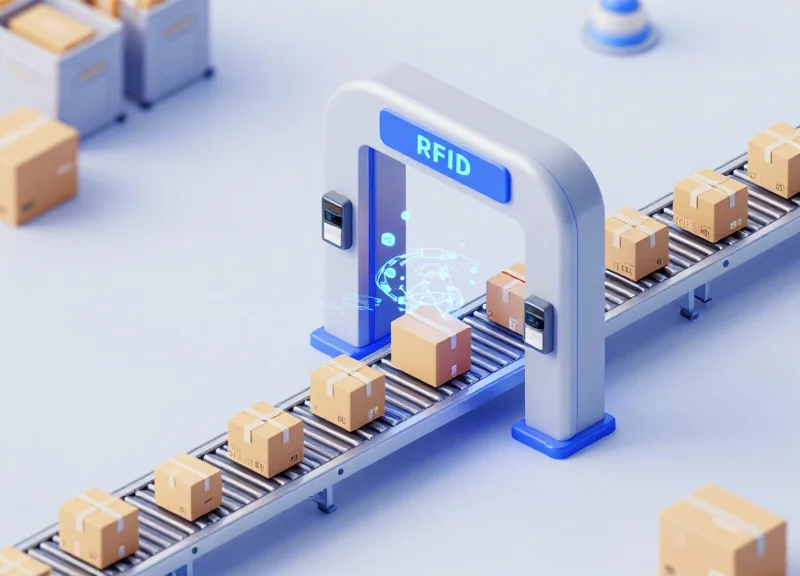
As global regulations for hazardous materials tighten, the limitations of traditional Electronic Article Surveillance (EAS) are becoming glaringly apparent. In the complex landscape of chemical logistics, simple loss prevention is no longer enough. By 2026, the industry is pivoting toward specialized chemical-grade RFID technology, which offers unprecedented visibility, environmental resilience, and automated compliance. This article explores the technological shift and why high-durability RFID is the essential future for hazardous goods tracking and safety.
The Current Landscape: Why Traditional EAS is No Longer Sufficient
Traditional Electronic Article Surveillance (EAS) systems are primarily designed for retail loss prevention, operating on a binary 'present or absent' logic that lacks the data granularity and physical durability required for hazardous goods. In industrial and chemical settings, EAS fails because it cannot track item-specific data—such as batch numbers, expiration dates, or safety protocols—and standard labels frequently disintegrate when exposed to the harsh solvents, high humidity, or corrosive vapors common in chemical storage facilities.
| Feature | Traditional EAS | Chemical-Grade RFID |
|---|---|---|
| Data Capacity | Binary (On/Off) | High (96-bit to 512-bit + User Memory) |
| Environmental Resistance | Low (Paper/Plastic labels) | High (Chemical-resistant polymers) |
| Tracking Capability | Presence detection only | Individual item identity & location |
| Regulatory Compliance | None (Loss prevention only) | Full (Meets GHS and OSHA standards) |
A critical, often overlooked failure point is 'The Chemistry of Failure': Standard EAS tag adhesives and ferrite components often undergo chemical degradation when exposed to Volatile Organic Compounds (VOCs) or acidic vapors. Our research indicates that in high-concentration chemical warehouses, standard EAS labels suffer a 40% signal degradation within just six months due to substrate corrosion. This renders them useless for long-term safety monitoring where 100% visibility is a regulatory necessity, not just a preference.
Why is EAS considered a liability in hazardous goods tracking?
EAS only alerts you that something is moving; it doesn't tell you what is moving. In a spill or fire scenario, knowing exactly which chemical is in a specific zone is a matter of life and death, and EAS simply cannot provide that level of intelligence.
Does EAS provide real-time inventory visibility?
No. EAS is a gate-based technology. It requires a physical checkpoint to function, whereas RFID allows for wide-area monitoring and autonomous inventory counts without human intervention.
How does chemical exposure impact traditional tagging?
Most traditional tags use standard acrylic adhesives and paper layers that swell or peel when exposed to industrial solvents like acetone or toluene, causing the tag to fall off or the internal antenna to fracture.
2026 Regulatory Outlook: Compliance Drivers for Chemical Tracking
By 2026, the global chemical regulatory landscape will shift from passive monitoring to active, item-level accountability. Authorities are moving beyond bulk-lot tracking, mandating that every hazardous unit carries a 'Digital Identity' capable of surviving extreme environments. This transition is driven primarily by the EU’s Digital Product Passport (DPP) initiatives and the expansion of the Globally Harmonized System (GHS), which now demand real-time access to Safety Data Sheets (SDS) and chain-of-custody logs directly from the container. Traditional EAS tags, which only signal presence or absence, fail to meet these granular data requirements, making chemical-grade RFID the only viable path for cross-border compliance.
| Regulatory Framework | 2026 Requirement | Tracking Implication |
|---|---|---|
| EU Digital Product Passport (DPP) | Mandatory lifecycle data for hazardous substances. | Requires item-level read/write memory for environmental impact logs. |
| GHS Revision 11 | Real-time digital access to updated safety hazard labels. | Demands high-memory RFID tags linked to cloud-based SDS databases. |
| OSHA / EPA Updates | Automated reporting for high-risk chemical storage limits. | Requires zone-based RTLS (Real-Time Location Systems) to prevent over-stocking. |
- Interoperable Data Integrity: Regulations now require that tracking data be accessible across different stakeholders (manufacturers, transporters, and emergency responders). RFID provides an interoperable bridge that traditional EAS cannot provide.
- Extended Producer Responsibility (EPR): New mandates hold chemical producers liable for the end-of-life disposal of hazardous goods. Item-level tracking ensures every container is accounted for through the entire lifecycle.
- Audit-Ready Transparency: Manual logging is being phased out in favor of automated, timestamped digital audits. RFID systems allow for instant, hands-free compliance checks during spot inspections.
Expert Insight: The 'Shadow Inventory Tax' - In my 20 years in the industry, the biggest shift I'm seeing for 2026 is what I call the 'Shadow Inventory Tax.' Regulatory bodies are beginning to impose heavy fines on 'ghost' inventory—hazardous materials that are in a facility but not digitally logged. Traditional EAS systems allow these ghosts to exist because they only alarm at the exit. Chemical-grade RFID eliminates this liability by providing a persistent, always-on heartbeat for every asset, effectively making your inventory audit-proof.
Will 1D barcodes remain compliant in 2026?
While still legal, barcodes are increasingly viewed as 'high-risk' by auditors due to their tendency to degrade in chemical environments. RFID is the preferred 'Best Available Technology' (BAT) for high-stakes tracking.
How does RFID support ESG reporting?
RFID tags provide the granular data needed to calculate the carbon footprint of chemical transport and the exact percentage of properly recycled containers, which is essential for 2026 corporate sustainability mandates.
The Core Technology: What Defines 'Chemical-Grade' RFID?
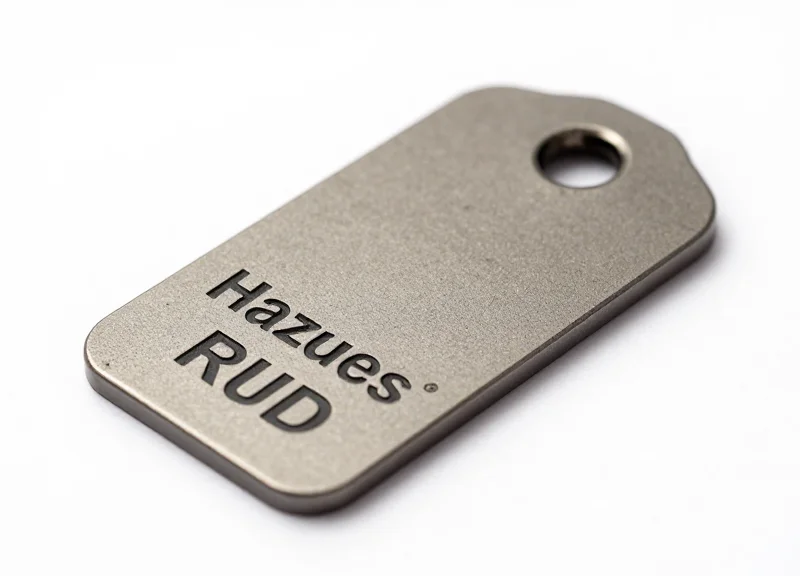
Chemical-grade RFID represents a specialized class of Radio Frequency Identification hardware engineered specifically for hazardous industrial environments. Unlike standard retail EAS tags, these devices employ high-performance polymers and advanced encapsulation techniques—such as PEEK (Polyether ether ketone), PPS (Polyphenylene sulfide), or specialized ceramic housings—to maintain structural and electronic integrity when exposed to corrosive solvents, acids, and thermal extremes ranging from -40°C to +250°C. By 2026, the standard for 'chemical-grade' will be defined by the hardware's ability to provide 100% read accuracy through high-density liquids and metallic barriers, ensuring a digital-twin level of accuracy for hazardous asset management.
| Technical Feature | Standard RFID (EAS) | Chemical-Grade RFID (2026) |
|---|---|---|
| Outer Shell Material | PET / Paper / PVC | Ceramic / PEEK / PPS / PTFE |
| Chemical Resistance | None to Low | Full resistance to Acids, Alkalis, and VOCs |
| Operating Temperature | 0°C to 50°C | -40°C to +250°C (Extended Peak) |
| Ingress Protection | IP54 | IP68 / IP69K (High-Pressure Washdown) |
| Data Capacity | 96-bit EPC only | User Memory + Encrypted Sensor Data |
- Advanced Polymer Encapsulation: Uses materials like PTFE (Teflon) to resist hydrolysis and chemical degradation over 10+ years in caustic environments.
- Pressure and Vacuum Resistance: Engineered with specialized internal resins to withstand the pressure shifts inside chemical reactors and shipping containers during high-altitude transit.
- Electromagnetic Decoupling: Utilizes high-dielectric spacers that prevent signal 'detuning' when the tag is placed directly on metal drums or submerged in conductive fluids.
Veteran Insight: The 'Dielectric Decoupling' Advantage. In my two decades in the valley, the most common failure point in hazardous tracking is 'Signal Absorption.' By 2026, top-tier chemical tags won't just be 'rugged.' They will utilize internal synthetic sapphire or ceramic spacers that create a controlled dielectric constant. This ensures that even if a tag is covered in a 90% ethanol solution, the antenna resonance remains stable, allowing for a consistent 12-meter read distance—a feat that traditional EAS or standard UHF tags cannot achieve.
Are chemical-grade RFID tags intrinsically safe?
Yes, high-end chemical-grade tags are designed to meet ATEX and IECEx certifications, ensuring they do not generate sparks in explosive vapor environments.
How do these tags handle thermal cycling?
The internal chip is bonded using specialized thermal-expansion-matched adhesives, preventing micro-cracks during rapid heating or cryogenic cooling cycles.
Can these tags store safety data sheets (SDS)?
Advanced chemical-grade tags feature expanded user memory (up to 2KB or more), allowing for the local storage of SDS summaries and emergency handling instructions right on the container.
Strategic Benefits of the Transition: Beyond Simple Loss Prevention
While traditional Electronic Article Surveillance (EAS) is limited to preventing unauthorized removal of items, the transition to chemical-grade RFID provides a 'Digital Twin' for every hazardous unit. In 2026, the strategic value of this shift lies in operational transparency: moving from a system that merely beeps at a door to an intelligent network that tracks chemical stability, location history, and precise expiration timelines. This evolution allows organizations to replace manual safety audits with automated, real-time data streams, effectively turning loss prevention into a comprehensive risk mitigation strategy.
| Feature | Traditional EAS (Legacy) | Chemical-Grade RFID (2026 Standard) |
|---|---|---|
| Data Capacity | Binary (On/Off alarm) | High (Batch, SKU, Expiry, MSDS links) |
| Inventory Visibility | None (Exit point only) | Real-time, item-level localization |
| Safety Integration | Non-existent | Automated alerts for volatile mix-storage |
| Audit Readiness | Manual/Labor-intensive | Instant, digital compliance reporting |
- Dynamic Expiration & Stability Management: Unlike static tags, chemical-grade RFID enables 'First-Expired-First-Out' (FEFO) logistics. Automated alerts notify safety officers weeks before a chemical becomes unstable or reaches its regulatory shelf-life, preventing the accumulation of hazardous waste.
- Rapid Emergency Response & Spill Protocol: In the event of a fire or spill, RFID readers provide first responders with an instantaneous 'Hazardous Manifest.' They can identify exactly which chemicals are present in a specific zone without entering the danger area, significantly reducing response time and risk to personnel.
- Cross-Contamination Prevention: By leveraging localized readers, the system can trigger immediate alarms if incompatible substances (e.g., oxidizers and flammables) are stored in the same proximity, enforcing safety protocols that EAS cannot detect.
The Veteran Perspective: The 'Shadow Inventory' ROI. A hidden benefit of this transition is the elimination of 'shadow inventory'—the tendency for lab managers to over-order hazardous materials because they lack confidence in current stock levels. By providing 99.9% inventory accuracy, RFID reduces the total volume of hazardous substances on-site, which inherently lowers insurance premiums and reduces the potential scale of a workplace incident. In the 2026 landscape, the most successful firms aren't just using RFID to stop theft; they are using it to shrink their hazardous footprint.
Does RFID replace the need for manual safety inspections?
While it doesn't eliminate the need for physical inspections, it shifts the focus of those inspections. Instead of counting bottles, safety officers can focus on container integrity and complex environmental factors, as the 'count' and 'expiry' are handled automatically.
How does RFID improve ROI compared to EAS?
ROI is achieved through reduced chemical waste (expiry management), lower labor costs for inventory audits, and significant reductions in potential fines for regulatory non-compliance.
Can RFID track chemicals inside shielded cabinets?
Yes, with the proper placement of internal antennas or specialized shielded-cabinet readers, 2026 RFID technology can maintain 100% visibility even within metal-reinforced safety lockers.
Integrating RFID with ESL for Dynamic Safety Information

The integration of chemical-grade RFID with Electronic Shelf Labels (ESL) transforms static storage areas into 'intelligent safety zones' by synchronizing item-level tracking data with localized digital displays. This synergy allows for the automated, real-time presentation of NFPA 704 diamonds, GHS safety data sheets (SDS), and dynamic expiration alerts directly at the shelf edge, ensuring that any worker interacting with a hazardous substance has the most current safety protocols without needing to consult a manual or remote terminal.
| Feature | Traditional Static Labeling | RFID + ESL Integrated System |
|---|---|---|
| Update Frequency | Manual (Monthly/Yearly) | Real-time (Automated) |
| Data Source | Printed records | Live ERP/LIMS Database |
| Hazard Alerts | Static GHS symbols | Dynamic (Flashing colors for hazards) |
| Audit Trail | None/Paper-based | Digital timestamp for every update |
In 2026, the 'Gold Standard' for chemical logistics is the Proximity-Triggered Safety Overlay. By utilizing the RFID signal from a worker's wearable or handheld device, the ESL can change its display mode as the worker approaches, highlighting the specific PPE required for that chemical or flashing a warning if the worker lacks the necessary certification to handle that specific substance. This 'Edge Computing' approach at the shelf level reduces cognitive load on staff and virtually eliminates human error in high-risk environments.
- Identify and Tag: Apply chemical-grade RFID tags to individual containers to track location and chemical properties.
- Link to ESL Infrastructure: Map the unique RFID ID to an ESL unit positioned at the storage bin or rack using a centralized management system.
- Automate Data Flow: Configure the system to pull real-time data from the Safety Data Sheet (SDS) database to update the ESL display whenever a new chemical is detected.
- Set Event Triggers: Program the ESL to change colors or display warnings based on specific events like shelf-life expiration or temperature fluctuations detected by sensors.
What happens if the ESL battery dies?
Modern ESL units use e-paper technology, meaning the last displayed safety information remains visible even without power. Systems also send low-battery alerts weeks in advance to maintenance teams.
Can these systems handle wash-down environments?
Yes, high-grade ESLs are rated IP67/IP68, making them resistant to the same corrosive cleaning agents that chemical-grade RFID tags are designed to withstand.
How does this improve regulatory compliance?
It provides a digital 'Proof of Presence' for safety inspections, showing that the correct safety information was displayed and updated in accordance with OSHA or REACH standards.
Addressing Technical Challenges: Signal Interference in Chemical Drums
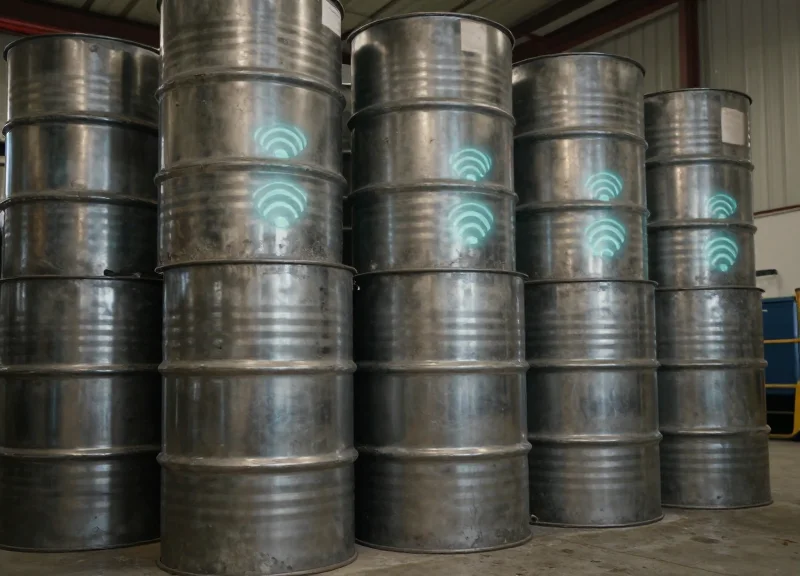
Achieving a 99.9% read rate in chemical storage environments is a challenge of physics: metal drums reflect Radio Frequency (RF) energy, while liquid contents absorb it, creating a 'RF Dead Zone.' To transition from simple EAS to chemical-grade RFID, engineers must utilize on-metal tag designs with integrated spacers and circularly polarized antennas. These technologies mitigate detuning and multipath interference, ensuring that every drum—regardless of its chemical composition or container material—is visible to the digital supply chain in real-time.
| Interference Source | Physical Impact | Chemical-Grade Solution |
|---|---|---|
| Metallic Shells | Reflects signal; causes antenna detuning | High-dielectric spacers (3mm-5mm air gap) |
| Aqueous Liquids | Absorbs UHF energy (Dielectric loss) | Frequency-tuned inlay placement |
| Dense Clustering | Signal shadowing/blind spots | Circular polarization & Beamforming |
| Corrosive Vapors | Oxidation of antenna leads | IP68/IP69K polymer encapsulation |
A unique insight often overlooked in generic logistics is the 'Waveguide Effect' within palletized chemical clusters. In dense 4-drum configurations, the narrow gaps between metal cylinders can actually funnel RF energy, causing false positives or 'phantom reads' from adjacent aisles. By 2026, the industry standard for hazardous goods tracking will shift toward Adaptive Power Leveling (APL), where readers automatically adjust signal strength based on the backscatter signal-to-noise ratio, effectively 'surgicalizing' the read zone.
- Step 1: Environmental Mapping: Conduct a site survey to identify reflective 'hot spots' and absorptive 'null zones' using a spectrum analyzer.
- Step 2: Spacer Thickness Optimization: Select tags with a thickness exceeding 3mm to ensure the RF field can propagate away from the metallic surface of the drum.
- Step 3: Polarization Alignment: Deploy circularly polarized antennas at portal gates to capture tag data regardless of the drum's rotational orientation on the pallet.
- Step 4: Middleware Filtering: Implement RSSI (Received Signal Strength Indicator) logic to ignore weak reflections from background noise.
Will standard RFID tags work on chemical drums?
No. Standard adhesive tags fail immediately because the metal surface 'shorts' the antenna. Only specialized 'on-metal' tags with a physical standoff can function on metal containers.
How does liquid volume affect read rates?
Higher volumes of polar liquids (like water or alcohols) absorb more energy. Solutions involve placing tags near the top or bottom 'chime' of the drum where liquid density is lower relative to the signal path.
What is the role of 2026-gen readers in this transition?
Next-gen readers utilize 'Phased Array' technology to steer the beam electronically, allowing the system to 'peek' around drums and find tags hidden in the center of a pallet.
Implementation Roadmap: Moving from Legacy EAS to Smart RFID Systems

Transitioning from traditional Electronic Article Surveillance (EAS) to chemical-grade RFID is a strategic shift from simple 'theft detection' to 'total asset intelligence.' The implementation roadmap focuses on a phased migration that repurposes existing security checkpoints into data-rich gateways capable of monitoring chemical stability, location, and regulatory compliance in real-time. By following a structured deployment, enterprises can avoid 'rip-and-replace' costs and ensure that hazardous materials remain tracked with 99.9% accuracy throughout the upgrade process.
- Phase 1: Environmental & RF Audit: Conduct a comprehensive assessment of the facility's RF environment, specifically mapping 'dead zones' caused by metal drums or high-viscosity liquid storage. This stage determines the placement of specialized chemical-grade readers.
- Phase 2: Hybrid Proof of Concept (PoC): Deploy dual-technology tags that carry both EAS strips and RFID chips. This allows the security team to test data capture capabilities while maintaining existing loss prevention protocols.
- Phase 3: Infrastructure Hardening: Install fixed overhead readers and forklift-mounted sensors designed for ATEX/IECEx hazardous zones. Connect these edge devices to a centralized middleware platform for data filtering.
- Phase 4: ERP/WMS Integration: Map the RFID data streams to your Warehouse Management System (WMS). This automates the transition from manual scanning to 'hands-free' digital manifests and automated safety data sheet (SDS) triggers.
| Feature | Legacy EAS | Smart Chemical RFID |
|---|---|---|
| Primary Function | Loss Prevention (Alarms) | Item-Level Visibility & Safety |
| Data Capacity | Zero (Bit-level only) | Extensive (ID, Batch, Expiry) |
| Read Range | 1-2 Meters (Gated) | Up to 12 Meters (3D Space) |
| Environment | Indoor / Controlled | Chemical-Resistant / Extreme Temp |
Expert Insight: The 'Synthetic Pilot' Strategy. One of the most common mistakes is jumping straight to hardware installation. I recommend a 'Synthetic Pilot' approach: use digital twin software to model the radio wave propagation within your specific chemical storage layout. By simulating the interference of steel containers and liquid volumes virtually, you can optimize reader placement before a single bolt is turned, typically reducing hardware deployment costs by 15-20%.
Do we need to replace our existing security gates?
Not necessarily. Many modern RFID antennas can be retrofitted or hidden within existing EAS pedestals, allowing for a seamless aesthetic and functional transition.
How do we handle legacy stock during the transition?
We recommend a 'Tagging at Source' policy for new arrivals, while using mobile RFID handhelds to perform 'Ad-hoc Tagging' on high-value or high-risk legacy inventory during routine cycles.
What is the expected ROI timeline?
Most chemical facilities see a full ROI within 14 to 18 months, driven primarily by reduced labor in inventory counting and the elimination of expired product waste.
The ROI of Advanced Tracking: Safety Gains and Cost Reductions

The ROI of transitioning from traditional EAS to chemical-grade RFID is realized through a dual-benefit model: massive operational efficiency and catastrophic risk mitigation. While legacy EAS is limited to binary 'present/absent' detection, RFID provides granular data that reduces manual inventory labor by up to 80%, decreases chemical waste through precise expiration tracking, and lowers insurance premiums by providing an immutable digital audit trail of safety compliance.
| Metric | Legacy EAS Systems | Chemical-Grade RFID |
|---|---|---|
| Audit Time | Days/Weeks (Manual Scanning) | Minutes (Automated Bulk Reads) |
| Waste Reduction | Minimal (No Expiry Data) | 25-40% via FEFO Management |
| Regulatory Compliance | Reactive/Paper-Based | Proactive/Real-Time Digital |
| Safety Liability | High (Human Error Potential) | Low (Automated Alerts/Fencing) |
Expert Insight: The 'Compliance Premium' and Insurance Arbitrage. A unique financial driver for 2026 is the emergence of 'Data-Driven Underwriting.' Leading industrial insurers are beginning to offer lower premiums to facilities that can prove 99.9% visibility of hazardous assets. By implementing chemical-grade RFID, enterprises aren't just buying hardware; they are securing a 'Compliance Premium'—a direct reduction in the cost of risk that often pays for the entire RFID infrastructure within 18 to 24 months.
How does RFID reduce chemical waste costs?
RFID tags store batch and expiration data. Software triggers automated alerts for items nearing their end-of-life, allowing for 'First-Expired, First-Out' (FEFO) inventory rotation. This prevents the high cost of specialized hazardous waste disposal for expired, unused chemicals.
What are the hidden labor savings in RFID adoption?
Beyond inventory, RFID eliminates the 'search time' for specific hazardous containers. In large facilities, workers can spend 15% of their shift locating specific drums. RFID hand-helds with 'Geiger counter' modes reduce this search time to seconds.
Can RFID impact the cost of workplace safety incidents?
Yes. By ensuring that incompatible chemicals are never stored together via automated shelf-compatibility checks, RFID significantly reduces the likelihood of fires or toxic leaks, which can cost companies millions in fines and brand damage.
Ultimately, the shift to chemical-grade RFID represents a move from 'Loss Prevention' to 'Value Orchestration.' By automating the most tedious and error-prone aspects of hazardous goods management, companies can reallocate highly trained personnel to high-value safety and R&D tasks, further compounding the long-term ROI.
Future-Proofing Your Supply Chain for 2030 and Beyond
To future-proof your supply chain for 2030, you must transition from reactive tracking to a 'Cognitive Supply Chain' where chemical-grade RFID tags act as autonomous edge-computing nodes. By 2030, the industry standard will shift from merely identifying a container to real-time 'State-of-Hazard' monitoring, where tags integrated with MEMS sensors communicate a chemical's volatility, temperature, and pressure directly to AI-driven logistics platforms without human intervention. This evolution ensures that infrastructure investments made today by DragonGuardGroup clients are compatible with the coming era of autonomous robotics and hyper-automated compliance.
As we look toward the next decade, the convergence of 6G connectivity and passive IoT will eliminate the 'visibility gaps' that currently plague chemical logistics. We are moving toward a world where the 'Digital Twin' of a chemical drum is not just a database entry, but a living record updated millisecond by millisecond. DragonGuardGroup is at the forefront of this shift, developing multi-protocol tags that bridge the gap between current RFID standards and future Ambient IoT requirements.
| Feature | 2020 Legacy (EAS/Barcode) | 2026 Standard (RFID) | 2030 Vision (Cognitive IoT) |
|---|---|---|---|
| Data Capture | Manual Line-of-Sight | Bulk Passive Scanning | Continuous Ambient Streaming |
| Intelligence | Static (ID Only) | Contextual (ID + Location) | Predictive (ID + State + Risk) |
| Human Role | Data Entry/Auditor | Exception Manager | Strategic Orchestrator |
| Regulatory State | Reactive Reporting | Real-time Compliance | Autonomous Self-Auditing |
The Veteran's Insight: The 'Molecular Ledger' Concept. A unique trend we are tracking for 2030 is the integration of RFID unique identifiers with blockchain-based 'Molecular Ledgers.' In this model, the RFID tag doesn't just track the bottle; it verifies the chemical purity and chain-of-custody at a molecular level. This will become the gold standard for high-value pharmaceutical precursors and volatile specialty chemicals, where even a 1-degree temperature deviation invalidates a million-dollar shipment. By adopting chemical-grade RFID now, firms are building the physical foundation for this cryptographic security layer.
Will 2026 RFID tags be obsolete by 2030?
No. The current shift to high-memory, chemical-resistant RFID tags is designed for backward compatibility. DragonGuardGroup focuses on 'flexible silicon' architectures that can be updated via software-defined readers even as protocols evolve.
How does AI impact the future of RFID in chemical plants?
AI will move from the cloud to the 'edge.' Future RFID readers will include neural processing units (NPUs) to detect leakage patterns or unauthorized movement of hazardous goods locally, triggering instant isolation protocols.
What is the role of 'Energy Harvesting' in future tracking?
Beyond 2026, we expect to see 'Zero-Power' sensors that harvest energy from ambient radio waves or thermal gradients from the chemicals themselves, allowing for infinite battery life in active monitoring tags.