Managing high-density data centers involves tracking thousands of servers, switches, and storage units. Traditional manual audits are notoriously prone to error, leading to the phenomenon of 'ghost assets'—equipment that exists on spreadsheets but is nowhere to be found on the floor. These discrepancies don't just mess up the books; they pose significant security risks and financial waste. By leveraging advanced RFID tagging, data center operators can transform their audit process from a week-long manual slog into a near-instantaneous, 99.9% accurate automated scan. This article explores how RFID technology is setting a new standard for infrastructure visibility and financial accountability.
Understanding Ghost Assets and Their Impact on Operations

Ghost assets are fixed hardware components—such as servers, storage arrays, or networking switches—that are recorded in a data center's inventory management system or financial ledger but cannot be physically located or are no longer in service. These 'phantoms' typically emerge from fragmented decommissioning workflows, manual data entry errors during equipment refreshes, or unauthorized hardware movements. In a typical un-automated data center, ghost assets can account for 15% to 30% of the total inventory, creating a massive discrepancy between digital records and physical reality.
| Impact Category | Operational Consequence | Financial/Compliance Risk |
|---|---|---|
| Financial Accuracy | Inflated asset values on balance sheets. | Overpayment of property taxes and insurance premiums. |
| Resource Allocation | Ghost assets occupy 'logical' rack space and power capacity. | Artificial capacity constraints leading to unnecessary CAPEX. |
| Security & Compliance | Unaccounted hardware may contain sensitive data. | Failure of SOC2, HIPAA, or PCI-DSS audits. |
| Maintenance & Support | Paying for service contracts on non-existent hardware. | Wasted OPEX on 'phone-home' support for missing nodes. |
How do ghost assets trigger audit failures?
During a physical audit, if a sample of assets listed in the CMS cannot be found, the entire audit fails. This triggers a 'reconciliation event' which is costly, time-consuming, and signals to stakeholders that the facility's chain of custody is broken.
Why are ghost assets considered a 'silent killer' of budgets?
They cause 'zombie spending.' Organizations frequently pay for software licenses and maintenance contracts for hardware that was retired months ago, simply because the records were never updated to reflect the decommission.
What is the link between ghost assets and data breaches?
A ghost asset is an unmanaged asset. If a decommissioned server is removed from the floor without being wiped and logged, it becomes a 'ghost' that potentially carries unencrypted data into the secondary market or a landfill, violating privacy regulations.
Unique Silicon Valley Insight: In my two decades of infrastructure auditing, I've observed that the most dangerous aspect of ghost assets isn't just the 'missing' hardware—it is the 'Phantom Power Capacity.' Data center managers often refuse to provision new high-density racks because their software indicates they are at power capacity, when in reality, 20% of that power is reserved for ghost servers that aren't even on the floor. Eliminating ghost assets isn't just about taxes; it’s about reclaiming your 'dark' power and space to delay multi-million dollar facility expansions.
The Failure of Manual Audits: Why 100% Accuracy is Impossible
Traditional manual audits are fundamentally limited by the 'human factor,' where fatigue, transcription errors, and 'pencil whipping'—the practice of checking boxes without physical verification—result in data sets that are inaccurate the moment they are completed. In a high-density data center environment, the sheer volume of assets makes it impossible for manual teams to achieve 100% accuracy; even a professional auditor with a 99% accuracy rate will still leave dozens of ghost assets or misplaced servers in a standard 5,000-unit facility. This discrepancy is exacerbated by the time-lag between the physical scan and the database update, creating a permanent state of data entropy.
| Metric | Manual/Barcode Audit | RFID-Automated Audit |
|---|---|---|
| Audit Speed | ~30-60 seconds per rack | ~2-5 seconds per rack |
| Error Rate | 5% to 15% (Human error/missed scans) | < 0.1% (Automated capture) |
| Labor Requirement | High (Multi-person teams) | Minimal (Single operator) |
| Data Freshness | Point-in-time (Stale within days) | Near-real-time (Continuous) |
| Line-of-Sight | Required (Barcode must be visible) | Not Required (Through-cabinet reading) |
The Data Decay Paradox: My years working with hyperscalers have shown that manual audits suffer from a 'decay constant.' Because data centers are dynamic environments—with constant MACs (Moves, Adds, Changes)—an audit that takes two weeks to complete is already 5-10% inaccurate by the time the final report is generated. You aren't just fighting human error; you are fighting the speed of business. Relying on spreadsheets is essentially trying to manage a high-frequency trading floor with a ledger and a quill pen.
- Transcription and Entry Errors: Manually typing serial numbers or asset tags into a spreadsheet leads to inevitable keystroke errors. Even with barcode scanners, the human operator must ensure every tag is reached, often requiring climbing ladders or moving cables, which increases the likelihood of skipping hidden units.
- The 'Line-of-Sight' Bottleneck: Barcode-based audits require a clear path between the scanner and the tag. In congested racks with dense cabling, auditors often 'assume' the identity of a device rather than physically verifying it, leading to the creation of ghost assets.
- High Opportunity Cost: Using highly skilled IT engineers to walk the floor and scan stickers is a massive waste of human capital. This 'audit fatigue' leads to decreased focus and higher error rates over long shifts.
Why can't barcodes achieve the same accuracy as RFID?
Barcodes require individual, manual interaction with every asset. RFID allows for bulk-scanning of entire racks without opening cabinet doors, removing the human interaction point where most errors occur.
How does spreadsheet lag impact compliance?
When auditors or regulators ask for an asset report, a spreadsheet-based system often reflects the state of the data center from the last manual 'sweep,' not its current state. If a server was decommissioned or moved yesterday, the manual records won't show it, leading to failed compliance audits.
What is 'Pencil Whipping' in data center management?
It is a common phenomenon where auditors, overwhelmed by the volume of assets, mark items as 'present' based on previous records rather than physical sighting to speed up the process, effectively institutionalizing ghost assets.
How RFID Technology Transforms Data Center Visibility

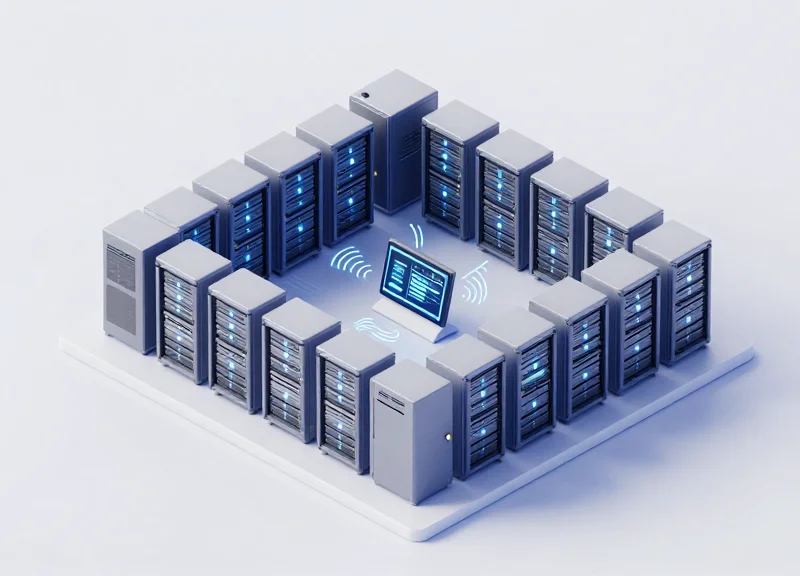
RFID (Radio Frequency Identification) transforms data center visibility by replacing manual, line-of-sight barcode scanning with an automated radio-wave system that can identify, locate, and inventory thousands of assets simultaneously. Unlike traditional methods, RFID enables high-speed data capture through cabinet doors and within high-density racks, providing a real-time digital twin of the physical infrastructure. By leveraging specialized Ultra High Frequency (UHF) 'on-metal' tags, this technology maintains 99.9% accuracy even in the presence of the dense electromagnetic interference and metallic surfaces typical of modern server environments.
| Feature | Passive RFID (UHF) | Active RFID |
|---|---|---|
| Power Source | Powered by reader signal (no battery) | Internal battery powered |
| Read Range | Up to 10-15 meters | Up to 100+ meters |
| Cost per Tag | Low ($0.50 - $2.00) | High ($15.00 - $50.00) |
| Primary Use Case | Inventory audits and rack-level tracking | Real-time environmental monitoring/security |
| Lifespan | Indefinite (20+ years) | 3-5 years (battery limited) |
In a data center, the primary challenge is the environment itself: metal racks and cabling act as reflectors and absorbers of radio waves. To solve this, industry-standard data center RFID utilizes 'on-metal' passive tags. These tags feature a specialized spacer or 'shroud' that creates a precise air gap or uses a ceramic substrate to tune the tag's antenna. This prevents the metal of the server chassis from detuning the tag, effectively using the metal surface as an extended ground plane to actually improve signal propagation rather than inhibiting it.
- Signal Initiation: An RFID reader sends a radio pulse through a fixed or handheld antenna into the rack environment.
- Energy Harvesting: Passive tags within range capture the radio energy to power their internal microchips.
- Backscatter Transmission: The tags transmit their unique Electronic Product Code (EPC) and asset data back to the reader.
- Data Aggregation: The reader filters out redundant reads and sends the validated asset location data to the DCIM (Data Center Infrastructure Management) software.
Expert Insight: To achieve 99.9% accuracy, veteran engineers use 'Antenna Polarization Tuning.' In dense server racks, standard linear antennas often miss tags due to orientation mismatches. By deploying circular polarization in the reader antennas, the system catches tags regardless of whether they are mounted horizontally on a blade server or vertically on a PDU, virtually eliminating 'null zones' in the rack.
Do RFID tags interfere with server performance?
No. Passive RFID operates at frequencies (typically 860-960 MHz) that do not interfere with Wi-Fi, Bluetooth, or internal server clock speeds.
Can I read tags through a closed metal rack door?
Yes, if the rack door is perforated (which most are for airflow). The radio waves pass through the perforations to reach the assets inside.
How many tags can be read at once?
High-end industrial RFID readers can process up to 700 to 1,000 tags per second, making full-room audits possible in minutes.
The Path to 99.9% Accuracy: Real-Time Data Collection

The jump from 70% to 99.9% accuracy isn’t achieved by working harder; it is achieved by removing the human-in-the-loop requirement. RFID (Radio Frequency Identification) allows for non-line-of-sight, bulk data collection where hundreds of assets—racked servers, PDUs, and networking gear—can be inventoried simultaneously without opening cabinet doors or scanning individual stickers. This real-time data stream ensures that the digital record in your DCIM or ITAM tool is a precise mirror of the physical floor, effectively eliminating the 'reconciliation lag' where ghost assets are born.
| Capability | Manual/Barcode Audits | RFID Real-Time Collection |
|---|---|---|
| Reading Method | Line-of-Sight (Serial) | Non-Line-of-Sight (Parallel) |
| Scanning Speed | 1 Asset / 10-15 Seconds | 100+ Assets / 1 Second |
| Human Error Margin | High (Fatigue, Missed Tags) | Near Zero (Automated Capture) |
| Audit Frequency | Quarterly/Annually | Daily or Continuous |
Beyond simple speed, the technical superiority of RFID lies in its ability to penetrate non-metallic obstructions and communicate via radio waves. In a dense data center environment, this means a technician can walk down an aisle with a handheld reader and capture the unique ID of every blade in every chassis. For even higher precision, fixed overhead portals or rack-mounted readers can automate this process entirely, reporting movements in real-time.
- Bulk Signal Capture: Readers emit a signal that wakes up all passive tags within range, allowing the system to identify thousands of items per hour compared to dozens with barcodes.
- Automated Reconciliation: Captured data is instantly compared against the existing database. Any discrepancies—such as a server present in the rack but missing from the ledger—are flagged immediately.
- Environmental Mapping: Advanced RFID software uses signal strength and triangulation to pinpoint the exact rack and U-position, preventing the 'misplaced but present' scenario common in manual audits.
Expert Insight: In my two decades in the industry, I have seen that the 'Ghost Asset Gap' is often a result of 'Asset Velocity.' In modern agile environments, hardware moves faster than spreadsheets can be updated. RFID solves this by moving from periodic snapshots to a continuous motion-picture view of your inventory. If you aren't capturing data at the speed of your change requests, you will never hit 99.9% accuracy.
Can RFID read through server cabinet doors?
Yes, provided the cabinet isn't a solid Faraday cage. Perforated doors, standard in most data centers, allow radio waves to pass through easily for accurate scanning without unlocking the rack.
Why isn't it 100% accurate?
The 0.1% margin accounts for 'edge cases' like signal interference from high-density liquid cooling manifolds or physical damage to a tag during a hardware swap.
Does real-time collection require fixed readers?
While fixed readers provide the most 'real-time' experience, frequent handheld 'walk-throughs' using RFID are still considered real-time compared to the weeks-long cycles of manual audits.
Strengthening Security and Compliance Protocols
RFID tagging transforms data center security by replacing reactive manual checks with proactive, real-time hardware monitoring. By ensuring that every server, drive, and blade is accounted for 24/7, organizations can maintain an immutable chain of custody essential for meeting global data sovereignty laws and preventing the physical breach of sensitive infrastructure. In an era where a single missing hard drive can result in millions of dollars in fines, RFID provides the forensic-level visibility required to prove that hardware containing sensitive data has never left a secure zone.
For organizations operating under strict regulatory frameworks, 'ghost assets' are more than just a budgetary nuisance; they are a massive compliance liability. If an auditor asks for the physical location of a server containing PII (Personally Identifiable Information) and your team cannot locate it within minutes, you are technically in violation of data sovereignty and protection protocols. RFID technology eliminates this risk by creating a digital 'heartbeat' for every asset, ensuring that the physical reality of the data center floor always matches the digital records in your DCIM or ITSM software.
| Security Metric | Manual/Barcode Method | RFID-Enabled Method |
|---|---|---|
| Chain of Custody | Fragmented, reliant on manual logs | Continuous, automated time-stamped logs |
| Exit Detection | Visual inspection only | Instant portal alerts upon unauthorized movement |
| Audit Readiness | Weeks of preparation/reconciliation | On-demand, real-time compliance reporting |
| Data Sovereignty | High risk of unknown asset migration | Geofenced tracking of hardware location |
The Expert Perspective: Combating 'Compliance Drift' - In my two decades in Silicon Valley, I have seen that most data centers are only truly compliant on the day of their annual audit. The following day, 'Compliance Drift' begins as assets are moved, swapped, or decommissioned without perfect documentation. RFID solves this by moving from 'point-in-time' compliance to 'continuous' compliance. An original expert tip: Integrate your RFID portal readers with your NVR (Network Video Recorder) systems. This allows you to automatically bookmark video footage the exact second an asset is moved, providing instant visual forensics of who touched what and when.
How does RFID help with GDPR and HIPAA compliance?
These regulations require strict control over the physical locations of data. RFID provides an automated audit trail that proves hardware containing protected data is exactly where it is supposed to be, significantly reducing the risk of 'unaccounted for' drives during a breach investigation.
Can RFID prevent the theft of high-value components?
Yes. By installing RFID readers at entry and exit points (portal gates), the system can trigger immediate alarms or lock down exits if a tagged asset is moved without an authorized work order.
Does RFID simplify the decommissioning process?
Absolutely. It ensures a 100% accurate 'Certificate of Destruction' by tracking the asset from the rack to the shredder, ensuring no hardware slips through the cracks during large-scale refreshes.
Financial ROI: Beyond Simple Inventory Management
The Financial ROI of RFID in the data center is defined by the elimination of 'Zombie Spend'—the continuous drainage of capital on assets that are either missing, decommissioned, or underutilized. While labor savings are the most visible benefit, the true fiscal impact lies in the correction of the balance sheet. By achieving 99.9% accuracy, organizations stop paying personal property taxes and insurance premiums on 'ghost assets' (equipment that exists on the books but not in the rack) and eliminate 'procurement leakage' where redundant hardware is purchased simply because existing inventory cannot be located.
| Financial Pillar | The Ghost Asset Penalty (Manual Audits) | The RFID Advantage (99.9% Accuracy) |
|---|---|---|
| Personal Property Tax | Overpayment on non-existent assets due to 15-30% error rates. | Tax liability matched to physical reality; 100% reclamation of overpayments. |
| Insurance Premiums | Inflated premiums based on outdated total replacement value (TRV). | Lowered premiums through verified asset counts and risk mitigation. |
| Maintenance Contracts | Paying for 'support' on hardware that has been scrapped or stolen. | Immediate termination of contracts for missing serial numbers. |
| Capital Expenditure | Redundant 'safety stock' purchases due to poor visibility. | Just-in-time procurement; zero redundant hardware spend. |
The '15% Shadow Buffer' Insight: In my two decades working with enterprise data centers, I have observed a consistent 'shadow buffer' phenomenon. Because manual inventory is notoriously unreliable, procurement officers often over-order server and storage components by 15% as a hedge against data gaps. RFID tagging eliminates this psychological and financial buffer. When you trust your data to 99.9% accuracy, you no longer buy 'just in case'; you buy 'just in time.' This shift alone often pays for the entire RFID implementation within the first two fiscal quarters.
How does RFID affect data center insurance premiums?
Insurers reward accurate risk management. By proving a 99.9% audit trail and real-time tracking, data centers can negotiate lower premiums based on reduced 'lost asset' risk and a highly accurate Total Replacement Value (TRV).
Can RFID help with tax depreciation?
Absolutely. RFID provides the 'proof of disposal' required by tax authorities to accelerate depreciation or write off assets entirely. This prevents the common mistake of depreciating an asset for 5 years when it was actually decommissioned in year 2.
What is the typical timeframe for RFID ROI?
While varied, most high-density data centers see a full ROI within 12 to 18 months. This is calculated by combining labor hours saved, reclaimed tax overpayments, and the cancellation of unnecessary maintenance contracts.
Ultimately, moving to RFID tagging transforms the data center from a black box of 'estimated costs' into a precision-tuned financial instrument. The ability to provide an auditor with a timestamped, error-free report of every serial number in a 50,000-square-foot facility in minutes—not weeks—changes the conversation with the CFO from one of cost containment to one of strategic capital efficiency.
Integrating RFID with DCIM and ITAM Software

Integrating RFID technology with Data Center Infrastructure Management (DCIM) and IT Asset Management (ITAM) software is the process of creating a real-time, bidirectional communication link between the physical hardware and the digital management layer. Instead of treating asset management as a periodic manual task, this integration transforms it into a continuous automated service. By leveraging Application Programming Interfaces (APIs) and specialized middleware, RFID reader data is pushed directly into the 'single source of truth' database, ensuring that the digital twin of your data center always mirrors the physical floor with 99.9% accuracy.
| Feature | Siloed/Manual ITAM | RFID-Integrated DCIM/ITAM |
|---|---|---|
| Data Update Trigger | Manual entry/scanning | Automated physical movement |
| Database Integrity | High risk of 'Data Drift' | Self-healing/Live sync |
| Location Accuracy | Room or rack level (delayed) | Specific U-position (real-time) |
| Audit Readiness | Requires weeks of preparation | Always audit-ready |
The true power of this integration lies in the elimination of 'Data Drift'—the inevitable divergence between what your software says you have and what is actually on the racks. In a traditional environment, a server might be decommissioned or moved, but if the technician forgets to update the ticket, that asset becomes a 'ghost.' With RFID-integrated software, the moment a tag passes through a portal or is removed from a smart rack, the system triggers an immediate alert or status change in the ITAM platform, effectively automating the reconciliation process.
- API Mapping and Middleware Selection: Identify the data fields required by your ITAM (e.g., Serial Number, Asset Tag ID, Warranty Info) and map them to the RFID tag's unique Electronic Product Code (EPC). Middleware acts as the translator between the raw RFID 'pings' and the software's data requirements.
- Threshold and Trigger Logic: Configure business rules within the DCIM software. For example, if a reader at 'Exit Door A' detects a high-value asset that is marked as 'Active,' the system should instantly lock the door or alert security via the integrated platform.
- Validation and Exception Handling: Establish a workflow for discrepancies. If the RFID reader detects an asset in Rack 04 that the ITAM says should be in Rack 12, the system generates an automated 'Exception Report' for immediate human verification.
Expert Tip: To maximize ROI, move beyond simple inventory tracking and implement 'Zero-Touch Lifecycle Management.' By integrating RFID with your procurement software, an asset can be 'born' in your ITAM the moment the RFID-tagged crate enters the loading dock, and 'retired' the moment the reader detects it entering a secure shredding bin. This creates a provable chain of custody that is indispensable for high-compliance industries like finance and healthcare.
Does RFID integration work with legacy ITAM systems?
Yes, most legacy systems support CSV imports or basic API calls. Middleware can be used to format the RFID data to match the legacy system's input requirements.
How often should the software sync with the RFID readers?
For security-sensitive zones, real-time 'push' notifications are recommended. For general inventory, a 'pull' sync every 15 to 60 minutes is usually sufficient to maintain high accuracy without overloading the network.
What happens if the network goes down?
Modern RFID controllers have local storage (Edge computing) that caches asset movements and synchronizes them with the DCIM/ITAM software once connectivity is restored, ensuring no data loss.
Best Practices for Deploying RFID in High-Density Racks

To achieve 99.9% audit accuracy in high-density data centers, deployments must account for the high concentration of metal and electromagnetic interference (EMI) that characterizes server racks. The primary best practice is the adoption of 'On-Metal' RFID tags, which utilize a specialized spacer to prevent the tag's antenna from being detuned by the metallic surface of the server chassis. Success depends on a holistic approach that balances tag physics with spatial orientation to ensure no 'dead zones' exist within the cabinet.
- Conduct a Radio Frequency (RF) Site Survey: Before deployment, map the ambient RF noise and identify sources of interference such as high-voltage power lines or heavy cooling equipment to determine optimal reader placement.
- Standardize Tag Orientation: Apply tags in a consistent horizontal or vertical orientation across all assets. This allows for predictable antenna polarization, significantly increasing the read rate during bulk scans.
- Implement Z-Axis Mapping: In high-density racks, record the precise RU (Rack Unit) position during the initial tagging process. This creates a digital twin that helps readers distinguish between stacked devices.
| Tag Type | Best Use Case | Read Range Performance |
|---|---|---|
| Foam-Backed On-Metal | Standard 1U/2U Server Chassis | High (up to 4 meters) |
| Flag Tags | Cables and Network Patch Panels | Moderate (up to 2 meters) |
| Hard-Shell Encapsulated | External Storage Arrays / Hot-Swappable Drives | Very High (Impact Resistant) |
| Micro-Tags | Small Form Factor (SFP) Modules | Low (designed for proximity) |
Expert Insight: The 15-Degree Tilt Rule. One industry secret for overcoming the 'Faraday Cage' effect of perforated metal rack doors is to mount fixed antennas at a 15-degree downward angle relative to the rack face. This specific tilt encourages signal penetration through the door perforations and utilizes 'multipath' reflections to reach tags hidden deep within the server chassis, effectively capturing assets that a direct 90-degree scan might miss.
How do I deal with 'Shadow Assets' behind power strips?
Use high-gain circular polarized antennas. These create a corkscrew-shaped RF field that can 'wrap' around obstructions like PDUs to energize tags that are not in a direct line of sight.
Does liquid cooling affect RFID accuracy?
Yes, water is an RF absorbent. For immersion-cooled or liquid-to-chip environments, place tags on the external, dry portions of the manifold or use specialized low-frequency (LF) tags that are less affected by moisture.
How often should I recalibrate fixed readers?
Recalibration should occur after any major hardware refresh or rack density change. A change in the metallic mass of the room alters the RF environment significantly.
Future-Proofing Your Infrastructure with DragonGuardGroup
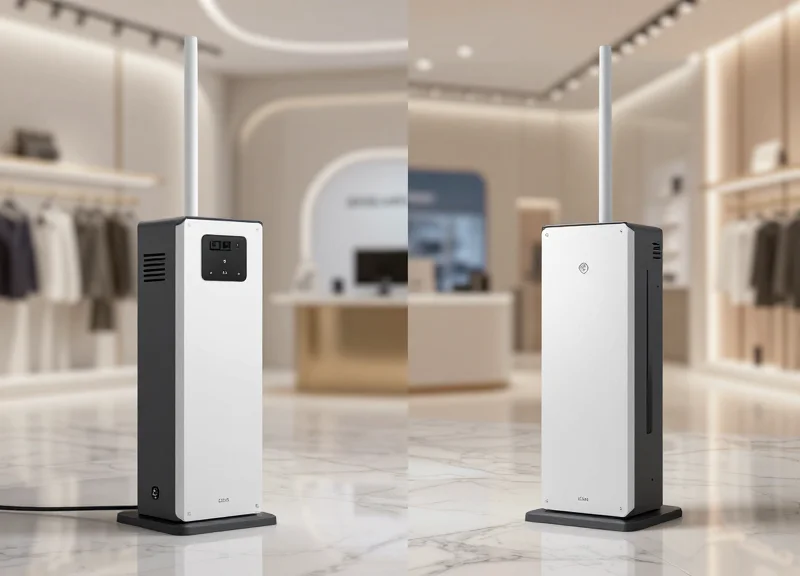
Future-proofing your data center infrastructure with DragonGuardGroup means transitioning from reactive inventory counts to a proactive, modular asset management ecosystem. By integrating high-performance RFID hardware with Electronic Article Surveillance (EAS) technology, DragonGuardGroup builds a foundation where every server, blade, and disk is visible in real-time. This approach ensures that as your facility transitions to high-density racks or AI-driven clusters, your tracking capabilities scale effortlessly without requiring a complete hardware overhaul.
| Feature | Standard RFID Solutions | DragonGuardGroup Ecosystem |
|---|---|---|
| Scalability | Limited to manual scan zones | Enterprise-wide coverage (Edge to Core) |
| Security Integration | Standalone tracking only | Dual-Layer RFID + EAS Security |
| Signal Performance | Affected by high metal density | Interference-shielded industrial tags |
| Data Integrity | Prone to 'Ghost Asset' drift | 99.9% Audit accuracy guarantee |
How does DragonGuardGroup handle increasing rack densities?
We utilize specialized 'On-Metal' RFID tags and high-sensitivity sensors that maintain read rates of 99.9% even in environments packed with liquid cooling systems and dense electrical shielding.
Why is the integration of EAS important for future-proofing?
While RFID tracks location, EAS provides an immediate physical security layer at egress points. This prevents the 'silent exit' of decommissioned drives that still contain sensitive data, ensuring long-term compliance with evolving privacy laws.
Can these solutions integrate with legacy hardware?
Yes, our hardware-agnostic approach allows DragonGuardGroup tags to be retrofitted to existing server chassis while remaining compatible with next-generation DCIM and ITAM software platforms.
Expert Insight: The 'Signal-to-Scale' Ratio. In my 20 years of infrastructure optimization, I have seen many data centers fail their audits not because they lacked tags, but because their hardware couldn't handle 'Signal Saturation.' DragonGuardGroup solves this by utilizing frequency-agile readers that automatically adjust to the environmental noise of high-performance computing (HPC) environments. This ensures that as you add more compute power, your tracking accuracy doesn't degrade—a common pitfall of consumer-grade RFID implementations.
- Assessment & Baseline: We perform a site-wide signal audit to identify interference zones and establish your current 'Ghost Asset' percentage.
- Tagging Strategy Deployment: Implementation of industrial-grade RFID tags designed for the specific thermal and material properties of your hardware.
- Security Perimeter Fortification: Installation of EAS gates and overhead sensors to bridge the gap between inventory management and loss prevention.
- Continuous Optimization: Leveraging real-time analytics to refine asset lifecycles and predict hardware refreshes before failures occur.