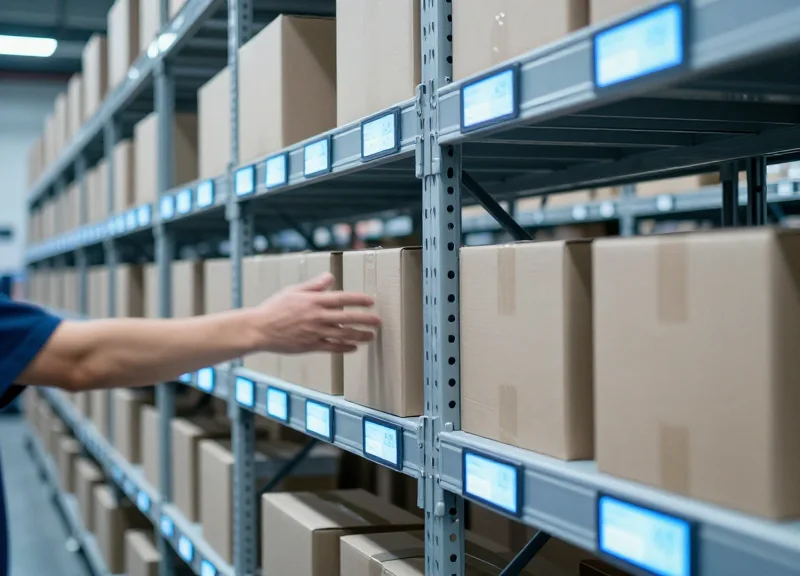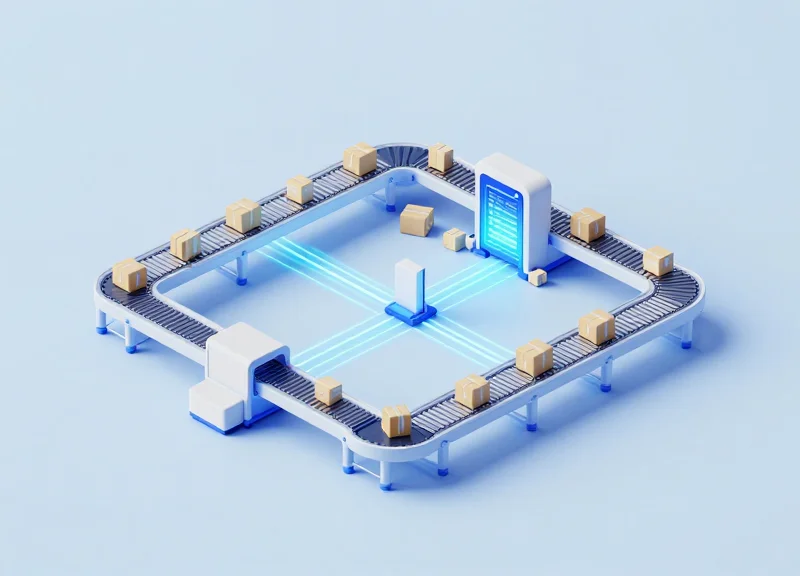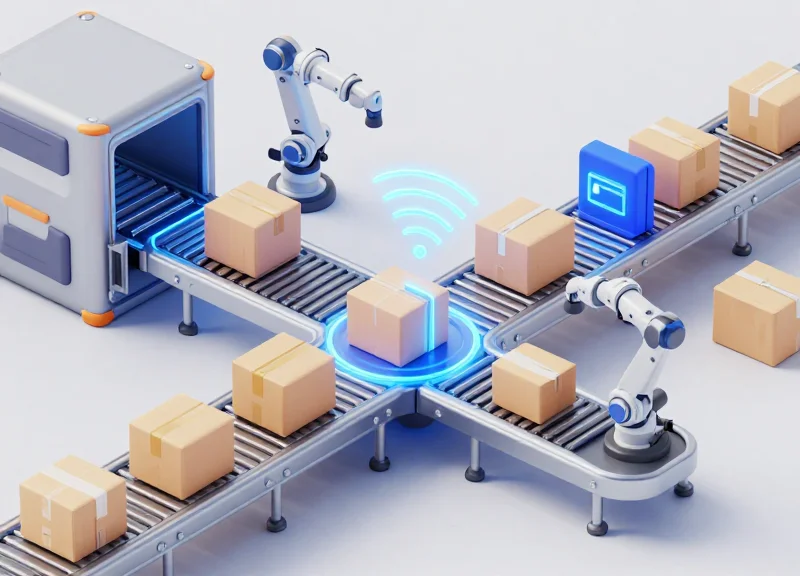
As we approach 2026, the global e-commerce landscape is facing an unprecedented surge in order volumes that traditional optical scanning systems can no longer handle efficiently. For decades, the barcode has been the gold standard, but its inherent limitations—specifically the requirement for line-of-sight and one-by-one processing—have become bottlenecks in the modern supply chain. Enter RFID group reading technology: a transformative leap that allows hundreds of items to be identified simultaneously without manual intervention. This article examines why forward-thinking enterprises are abandoning optical scanners in favor of RFID to redefine speed, accuracy, and scalability in next-gen sorting facilities.
The 2026 Logistics Bottleneck: Why Barcodes are Failing

The 2026 logistics bottleneck is the definitive point where the exponential growth of e-commerce parcel volumes finally hits the hard ceiling of optical scanning physics. While 1D and 2D barcodes have served as the backbone of global supply chains for decades, they are failing today because they necessitate a 'Line-of-Sight' (LoS) requirement. This means every single package must be physically oriented so a camera or laser can 'see' the label. By 2026, the predicted 15% annual increase in global parcel volume will make this manual or mechanical orientation process a primary source of systemic delay, rendering traditional scanning architectures obsolete in high-velocity environments.
As we approach 2026, the 'Amazon Effect' has shifted from a competitive advantage to a baseline consumer expectation. Logistics providers are no longer just fighting for speed; they are fighting against a shrinking labor pool and rising operational costs. Optical scanning systems, which require expensive, high-maintenance conveyor belts and precise package spacing, are becoming the single greatest point of failure in the automated warehouse. When a single label is smudged, hidden, or poorly positioned, the entire sorting line halts or requires manual intervention, creating a cascading 'bullwhip effect' through the distribution network.
| Metric | Legacy Barcode Scanning | 2026 Demand Requirement |
|---|---|---|
| Scanning Methodology | Sequential (One-by-One) | Concurrent (Bulk/Group) |
| Line-of-Sight | Required (100% Visibility) | Not Required (Radio Waves) |
| Processing Speed | 2-4 Seconds per Unit | <0.1 Seconds per Unit |
| Error Resilience | Zero (Fails if label is hidden) | High (Reads through packaging) |
| Labor Dependency | High (Manual orientation) | Low (Automated bulk entry) |
Why is the labor shortage specifically killing barcode efficiency?
Barcode systems rely on humans or complex 'six-sided' camera tunnels to ensure the label is visible. As labor costs rise and availability drops, the 'Human-in-the-loop' becomes an expensive bottleneck that cannot scale with peak seasonal demands.
Can't we just upgrade optical cameras?
Better cameras don't solve the fundamental problem of occlusion. If a package is buried under another or the label is facing down, even a NASA-grade camera cannot read it. RFID bypasses this physical limitation entirely.
What is the 'Recirculation Penalty'?
In modern hubs, a 'no-read' barcode forces the package to be recirculated through the sorter or sent to a manual 'exception' station. By 2026, the volume of exceptions in barcode-only facilities will exceed the physical space available to handle them.
Expert Insight: The 'Orientation Tax' is the hidden killer of 2026 logistics. In my two decades observing Silicon Valley supply chain tech, we have calculated that up to 40% of a sorter's total energy and time is spent simply ensuring a label is 'scannable.' In a world of razor-thin margins and instant delivery, paying this 'Orientation Tax' is no longer a viable business model. The shift to RFID group reading isn't just an upgrade; it is the removal of a physical constraint that has reached its breaking point.
Defining RFID Group Reading: The End of Line-of-Sight
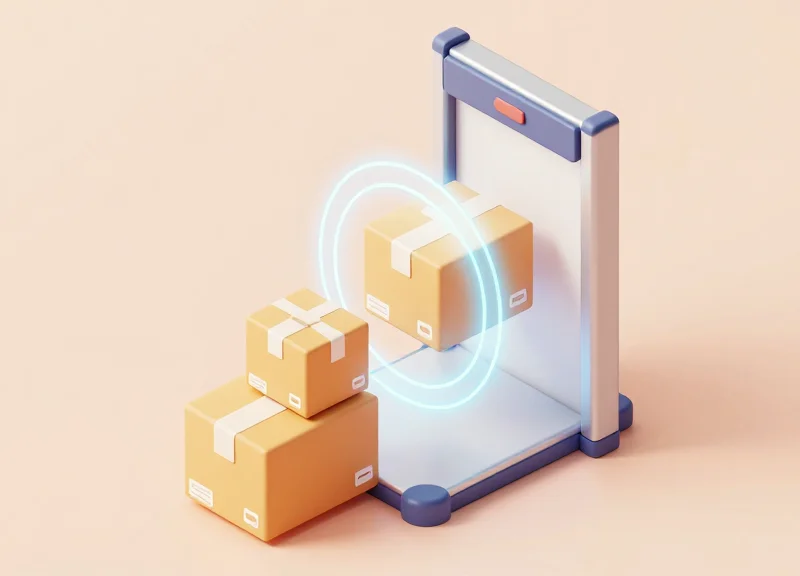
RFID Group Reading is the automated, simultaneous capture of hundreds of unique data tags within a single radio-frequency field, effectively terminating the 'line-of-sight' constraint that has bottlenecked logistics for decades. While traditional optical scanners require a direct, unobstructed visual path to a barcode, RFID (Radio Frequency Identification) utilizes electromagnetic coupling—specifically in the Ultra-High Frequency (UHF) spectrum—to penetrate packaging materials like cardboard, wood, and plastic. This allows a single reader to ingest the data of an entire pallet or parcel container in milliseconds, regardless of how the individual items are oriented inside.
| Feature | Optical Barcode Scanning | RFID Group Reading |
|---|---|---|
| Visibility Requirement | Direct Line-of-Sight (Visual) | Non-Line-of-Sight (RF Penetration) |
| Data Capture Mode | Sequential (One-by-One) | Parallel / Bulk (Massive Concurrent) |
| Manual Intervention | High (Aligning labels to scanner) | Zero (Automated gate or tunnel reading) |
| Read Through Barrier | Impossible (Blocked by film/dirt/packaging) | Possible (Cardboard, shrink-wrap, fabrics) |
| Reading Speed | ~2-3 items per second (Automated) | Up to 1,000+ items per second |
The fundamental shift here is the move from light-based data to wave-based data. In an e-commerce environment where 2026 throughput targets are set to triple, the manual labor spent orienting a box so a laser can 'see' a 2D barcode is a wasted operational cost. RFID tags act as passive transponders; when they enter an interrogation zone created by a reader's antenna, they are energized by the radio waves and broadcast their identity. This 'spatial transparency' means that the physical arrangement of goods no longer dictates the speed of the data flow.
Expert Insight: The Myth of 'Perfect Alignment'. In my twenty years in Silicon Valley logistics tech, the most overlooked cost I've seen is 'Shadow Blindness'—where a single poorly placed sticker in a 50-box pallet causes a complete line stoppage. RFID eliminates this by utilizing 'Multipath Propagation,' where radio waves bounce off warehouse surfaces to reach tags that are buried deep in the center of a stack, a feat physics makes impossible for optical lasers.
Does RFID group reading work through metal or liquids?
Standard UHF RFID struggles with direct metal contact or high-moisture content. However, 2026-grade 'on-metal' tags and flagship spacers have largely mitigated these issues for modern e-commerce packaging.
What is the 'Read Zone' accuracy in bulk sorting?
Modern algorithms use RSSI (Received Signal Strength Indicator) to ensure readers only 'talk' to tags within a specific 3D coordinate, preventing 'stray reads' from adjacent conveyor lines.
Can RFID read tags that are overlapping?
Yes. Unlike barcodes, which become unreadable if partially covered, RFID tags use anti-collision protocols that allow them to take turns responding to the reader in microseconds.
Throughput Comparison: RFID vs. Optical Scanners
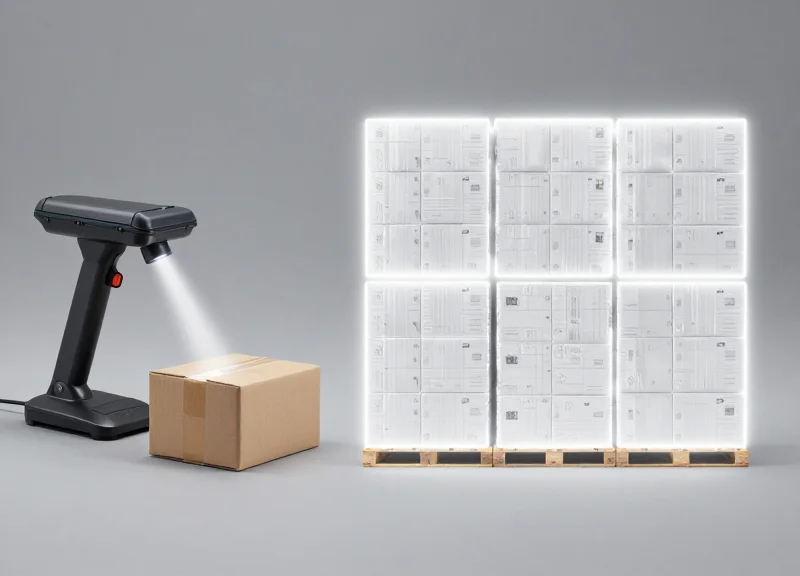
In the context of 2026 e-commerce logistics, throughput is defined by Units Per Hour (UPH). The fundamental difference between technologies is that optical scanners are 'Sequential Processors' requiring each item to be isolated and oriented, while RFID group reading functions as a 'Parallel Processor.' By capturing data from hundreds of tags simultaneously without requiring line-of-sight, RFID removes the mechanical and human bottlenecks that limit traditional sorting facilities to a linear pace. In high-volume environments, this transition typically results in a 500% to 1,000% increase in total facility output.
| Performance Metric | Optical Barcode Scanning | RFID Group Reading (Next-Gen) |
|---|---|---|
| Max Throughput (UPH) | 800 - 2,500 items | 15,000 - 30,000+ items |
| Read Methodology | Sequential (One-by-one) | Simultaneous (Bulk/Batch) |
| Orientation Requirements | Strict (Label must face sensor) | None (Omnidirectional) |
| Conveyor Speed Limits | Limited by shutter speed/focus | Limited only by physical belt speed |
| Handling Labor | High (Manual 'facing' of boxes) | Minimal (Automated bulk intake) |
Expert Insight: The 'Volumetric Throughput' Advantage. Traditional optical scanners measure throughput by the linear meter of a conveyor belt because items cannot be stacked or overlapping. RFID group reading introduces the concept of volumetric throughput, where items can be processed in 3D clusters—such as an entire pallet or a densely packed bin—moving through a single portal. This allows warehouses to shrink their sorting footprint while simultaneously increasing the volume of processed goods, a critical factor for urban 'last-mile' distribution centers where real estate is at a premium.
Does RFID throughput decline with package density?
No. Modern anti-collision algorithms allow readers to distinguish between up to 1,000 tags per second, ensuring that even the most densely packed containers are inventoried instantly without loss of accuracy.
Can optical scanners ever match RFID speeds?
Not without significant physical space. To match the throughput of one RFID portal, a facility would need 5-10 parallel optical scanning lines, dramatically increasing equipment costs and energy consumption.
How does RFID affect 'Recirculation' rates?
Optical systems often have a 3-5% 'No-Read' rate due to torn or hidden labels, requiring items to be recirculated or manually handled. RFID reduces this to nearly 0%, ensuring maximum flow-through efficiency.
Accuracy and Error Reduction in High-Velocity Sorting
Accuracy in high-velocity e-commerce sorting is the primary differentiator between profitable logistics and operational failure. Unlike optical scanners that require a clear 'line-of-sight' to a printed label, RFID group reading utilizes radio frequency to capture data from hundreds of items simultaneously, regardless of orientation. By removing the human and mechanical requirement to perfectly align a scanner with a barcode, RFID technology drives sorting accuracy from a standard 97% in optical systems to a near-perfect 99.9%+, virtually eliminating the 'no-read' incidents that plague modern distribution centers.
| Metric | Optical Scanning (Barcode) | RFID Group Reading |
|---|---|---|
| Typical Read Accuracy | 95% - 98% | 99.9%+ |
| Primary Failure Cause | Label occlusion, smudge, or orientation | RF interference (mitigated by shielding) |
| Manual Intervention | High (Requires 'exception handling' lanes) | Minimal (Automated error correction) |
| Verification Speed | Linear (One by one) | Bulk (Simultaneous verification) |
A unique insight often overlooked by supply chain managers is the 'Hidden Loop' cost. In optical sorting, a single misread forces a package into an exception lane, where a human operator must manually scan the item. This creates a secondary, slower logistics flow that consumes up to 20% of warehouse labor hours. RFID group reading introduces 'Spatial Validation'—where the system doesn't just read the tag, but confirms its exact position within a 3D sortation field. This ensures that even if packages are stacked or tumbling at 3 meters per second, the digital identity and physical location remain perfectly synced, preventing the dreaded 'ghost package' error.
How does RFID handle overlapping packages that confuse optical sensors?
Unlike cameras that see only the top layer, RF signals penetrate packaging. Even if ten items are stacked deeply, the reader captures every unique ID simultaneously through 'anti-collision' algorithms, ensuring no item is missed.
Does environmental interference affect 2026-grade RFID accuracy?
Modern UHF RFID systems use 'Adaptive Beamforming' to focus signals and ignore background noise or metallic interference, maintaining high accuracy even in complex industrial environments.
What is the impact of RFID on 'Mis-sorts'?
Mis-sorts occur when a barcode is misread or attributed to the wrong parcel. RFID's constant 'heartbeat' signal allows the system to track the item’s progress along the conveyor in real-time, correcting the diverter path instantly if a discrepancy is detected.
By 2026, the margin for error in e-commerce will shrink to zero. High-velocity sorting environments will rely on RFID not just for speed, but as a fail-safe against the high costs of reverse logistics and lost customer trust caused by misrouted shipments.
Integration with ESL and EAS: Creating a Unified Ecosystem
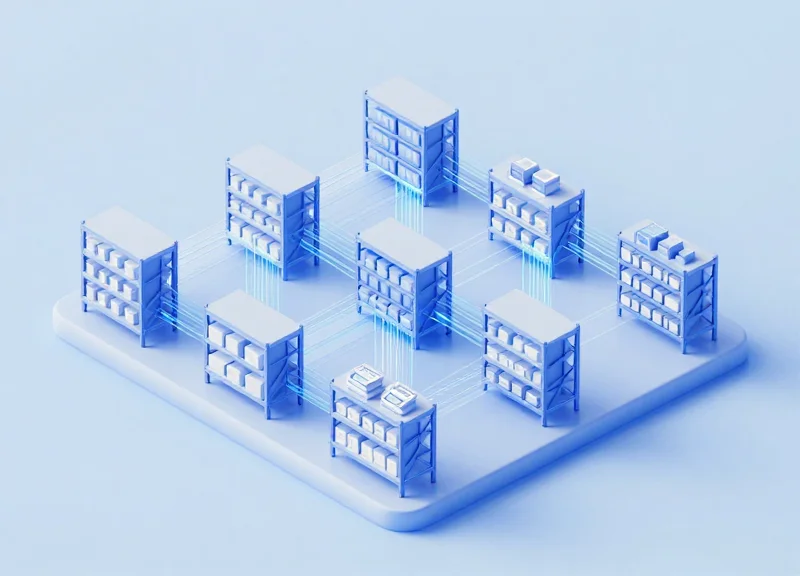
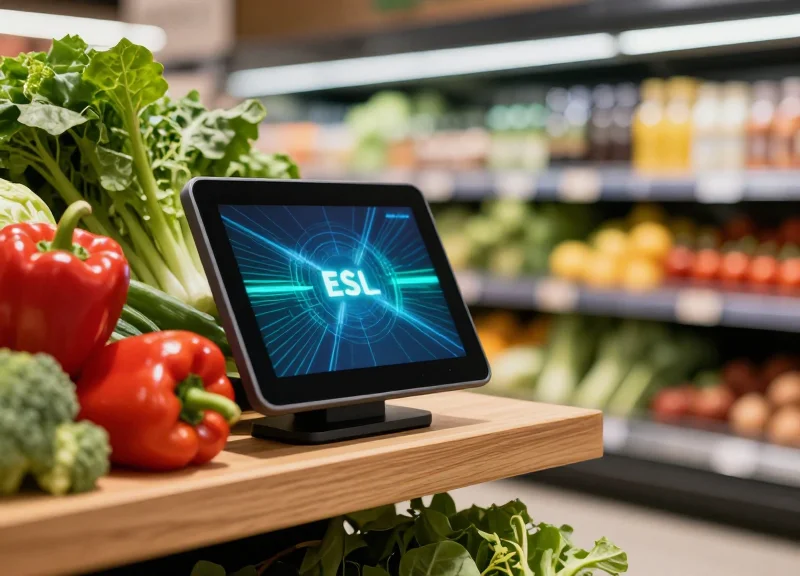
A unified ecosystem in 2026 e-commerce logistics refers to the convergence of RFID group reading technology with Electronic Shelf Labels (ESL) and Electronic Article Surveillance (EAS) into a single, interoperable data layer. By using a common ultra-high frequency (UHF) RFID standard, businesses can eliminate the traditional silos between inventory management, front-end retail pricing, and loss prevention. When an item is processed through an RFID sorting gate, the system doesn't just route the package; it simultaneously updates the digital twin of that item across the entire supply chain, ensuring that ESLs reflect real-time stock levels and EAS systems are alerted to the item's transition from 'in-stock' to 'sold' or 'in-transit'.
| Feature | Legacy Siloed Systems | RFID-Unified Ecosystem |
|---|---|---|
| Data Source | Separate Barcodes, Security Tags, and Paper Labels | Single RFID Tag for all functions |
| Update Latency | Manual (hours to days) | Instantaneous (milliseconds) |
| Security Action | Hard tags removed at checkout | Soft-deactivation via RFID group read |
| Pricing Agility | Manual shelf updates | Dynamic pricing synced with warehouse throughput |
- Dynamic Inventory Balancing: As RFID group readers process bulk shipments, ESLs can automatically trigger 'Low Stock' alerts or adjust prices based on real-time velocity data captured during sorting.
- Invisible Loss Prevention: EAS functionality is embedded into the RFID tag, allowing for 'frictionless' security gates that identify exactly which item is leaving the facility without a physical hard-tag.
- Omnichannel Fulfillment Speed: Unified systems allow 'Buy Online, Pick Up In Store' (BOPIS) orders to be picked with 99.9% accuracy because the shelf (ESL) and the sorter (RFID) share the same live database.
Expert Insight: The 'Digital Pivot' strategy for 2026 involves moving beyond 'identification' to 'contextual awareness.' In a unified ecosystem, the RFID tag acts as a sensor. For example, if a group reader detects high-value electronics moving toward a high-velocity sorting lane but the EAS status hasn't been updated to 'Ship-Ready,' the system can autonomously halt the conveyor. This is 'Contextual Security'—a level of automated oversight that optical scanners and legacy EAS systems simply cannot replicate.
Can RFID tags replace traditional EAS hard tags?
Yes. Modern RFID tags include 'soft-tag' capabilities that trigger EAS alarms if they pass through a portal without an 'authorized' status in the management database.
Does ESL integration require a separate network?
No. Most 2026-grade ESL systems operate on IoT protocols (like Zigbee or Bluetooth Low Energy) that can be managed through the same controllers used for RFID group reading infrastructure.
Is the unified ecosystem cost-effective for small warehouses?
While the initial setup is higher, the reduction in labor costs for manual price tagging and the elimination of shrink (theft) typically result in an ROI within 12 to 18 months.
The Economic Imperative: Calculating ROI for 2026 Upgrades
To justify the shift from optical scanning to RFID group reading by 2026, organizations must look beyond the initial capital expenditure (CapEx) of tags and readers. The true Return on Investment (ROI) is found in the drastic reduction of operational expenditure (OpEx). In a typical high-velocity e-commerce hub, the transition to RFID group reading results in a 30-50% increase in sorting throughput and a near-total elimination of 'no-reads' that plague optical systems. Most enterprises reach a break-even point within 14 to 18 months by factoring in labor savings, inventory accuracy, and the significant mitigation of reverse logistics costs.
| Cost Factor | Legacy Optical Scanners | Next-Gen RFID Group Reading |
|---|---|---|
| Labor Cost per 1k Items | High (Requires manual orientation) | Low (Bulk automated capture) |
| Error Rate (Sorting) | 1% - 3% (Misreads/Obstructions) | < 0.01% (Redundant Signal Capture) |
| Maintenance Needs | Frequent (Lens cleaning/Alignment) | Minimal (Solid-state sensors) |
| Data Richness | Basic SKU/Tracking ID | Batch, Expiry, Serial, and Origin |
Expert Insight: The 7x Reverse Logistics Rule. Silicon Valley logistics audits consistently show that the cost to rectify a single sorting error—including return shipping, customer service labor, and restocking—is approximately seven times the cost of the original outbound shipment. While optical scanners 'fail' silently by missing a barcode, RFID group reading provides a digital audit trail that virtually eliminates these $15-$50 per-package mistakes, providing a hidden revenue stream that most CFOs overlook in initial projections.
- Labor Redistribution: RFID allows you to move staff from 'scanning and flipping' packages to higher-value roles like quality control and exception handling, reducing headcount requirements by up to 40% in the sorting zone.
- Shrinkage and Loss Prevention: Because RFID readers track items through the entire facility without human intervention, 'black holes' in the warehouse disappear, reducing internal theft and misplaced inventory costs by 20% annually.
- Hardware Longevity: Optical systems rely on sensitive mirrors and lasers that degrade. RFID antennas are passive, durable, and have a longer functional lifespan, lowering the long-term replacement cycle costs.
What is the biggest cost barrier to RFID adoption in 2026?
The individual tag cost remains the primary hurdle. However, as e-commerce giants mandate source-tagging (tagging at the point of manufacture), the cost per unit is falling below $0.04, making it economically viable for even low-margin goods.
Can RFID and Optical scanners coexist during the transition?
Yes, 'Hybrid Sorting Lanes' are becoming the standard for 2026 upgrades, allowing facilities to process legacy barcode packages while gradually phasing in full RFID group reading capabilities to manage risk.
Future-Proofing Your Warehouse: Scalability through RFID
Future-proofing a warehouse through RFID scalability means transitioning from a reactive, line-of-sight tracking model to a proactive, 'ambient intelligence' ecosystem. Unlike optical scanners that require rigid, fixed-point infrastructure and specific physical alignment, RFID group reading creates a digital mesh. This allows e-commerce operations to scale throughput and floor space without the massive re-engineering costs associated with re-mounting cameras or re-calibrating laser grids. In the 2026 landscape, RFID acts as the 'spatial nervous system' that enables AI-driven Warehouse Management Systems (WMS) to track inventory dynamically across three-dimensional space.
| Feature | Static Optical Grids | Dynamic RFID Infrastructure |
|---|---|---|
| Hardware Flexibility | Fixed cameras/lasers; high relocation cost | Mobile/Modular readers; easy to relocate |
| System Expansion | Linear scaling; requires more physical scan points | Exponential scaling; one reader covers entire zones |
| Robot Integration | Hard-coded paths to intercept scanners | Full spatial awareness; robots read tags on the fly |
| Data Granularity | Point-in-time timestamp | Continuous real-time presence |
How does RFID support the integration of Autonomous Mobile Robots (AMRs)?
AMRs equipped with RFID readers can inventory an entire aisle simply by driving through it. Unlike optical systems that require the robot to stop and align with every barcode, RFID allows the robot to 'sense' every item within a 10-meter radius simultaneously, even if items are inside boxes or behind other goods.
Can RFID infrastructure adapt to changing warehouse layouts?
Yes. Because RFID does not rely on line-of-sight, you can reconfigure shelving or change pick-paths without having to move your scanning hardware. The software simply updates the zone definitions, making it the most agile solution for rapidly growing e-commerce hubs.
Does RFID work with AI for predictive analytics?
Absolutely. RFID provides the high-velocity data stream (thousands of pings per second) required for AI to identify patterns in inventory movement, allowing for predictive slotting and the automated replenishment of fast-moving items before they go out of stock.
The Expert Insight: The 'Digital Twin' Advantage. A unique advantage of RFID in 2026 is its ability to maintain a 'high-fidelity digital twin' of your warehouse. While barcodes tell you where an item was (at the last scan point), RFID tells you where an item is. This eliminates 'dead zones' in your data. My top tip: When scaling, look for 'Software-Defined RFID' readers that allow you to adjust read ranges and sensitivity via firmware. This ensures your hardware can adapt to higher density storage or new product materials (like liquid or metal packaging) without requiring a hardware overhaul.
- Phase 1: Zone Saturation: Identify high-velocity zones and install overhead RFID gateways to create an ambient reading environment.
- Phase 2: Robotic Handshake: Equip existing AMRs or AGVs with RFID modules to bridge the gap between fixed-gate data and floor-level movement.
- Phase 3: AI Layering: Feed the aggregated RFID data into an AI-driven WMS to automate decision-making regarding labor allocation and space optimization.
Overcoming Implementation Challenges in Large-Scale Facilities
Overcoming the implementation hurdles of next-gen RFID in large-scale e-commerce facilities centers on three pillars: precise electromagnetic environment mapping, the deployment of intelligent middleware to filter 'phantom reads,' and a phased 'Hybrid-Link' strategy that integrates legacy optical scanners with new UHF sensors. By treating the warehouse floor as a dynamic RF ecosystem rather than a static storage space, operators can eliminate the interference common in high-density metal environments and achieve the 99.9% read rates required for 2026 sorting standards.
One of the primary physical barriers in high-velocity sorting is 'Signal Multi-pathing.' In facilities filled with metal conveyors, steel racking, and liquid-containing products, RF waves can bounce or be absorbed, leading to inconsistent data. Modern solutions utilize circular polarization antennas and localized shielding to create 'controlled read zones,' ensuring that only the tags on the targeted sorter lane are captured.
| Implementation Challenge | Technical Root Cause | 2026 Mitigation Strategy |
|---|---|---|
| RF Interference/Noise | High density of metal structures and motors. | Frequency Hopping Spread Spectrum (FHSS) and shielding. |
| Data Flooding | Multiple tags responding simultaneously to one query. | Adaptive Anti-collision Algorithms and edge filtering. |
| Legacy Incompatibility | WMS/ERP systems built for 1D/2D barcode inputs. | API-first Middleware for real-time translation. |
| Tag Detuning | Liquid or metal proximity affecting tag impedance. | Specialized 'On-Metal' or spacer-backed RFID tags. |
Expert Insight: The 80/20 Shielding Rule. My experience across Silicon Valley logistics hubs shows that 80% of read errors are caused by only 20% of the facility's physical environment—usually narrow 'choke points' near high-voltage motors. Instead of shielding the entire warehouse, focus on 'RF-Hardening' these specific zones to see immediate ROI without the massive infrastructure cost.
- Site Survey & Spectrum Analysis: Conduct a comprehensive RF audit to identify 'dead zones' and existing interference from Wi-Fi networks or heavy machinery.
- Middleware Orchestration: Implement a software layer that can aggregate individual tag reads into logical 'units' (e.g., a pallet or a tote) before sending data to the ERP.
- Pilot Hybrid Induction: Install RFID portals at critical transition points while keeping optical scanners as a fail-safe 'heartbeat' during the initial 90-day transition.
- Staff Training and Tagging Workflow: Update inbound protocols to ensure tags are applied in optimal orientations, reducing the reliance on high-power reader adjustments.
Will RFID interfere with existing warehouse Wi-Fi?
No. Modern UHF RFID operates in the 860-960 MHz range, whereas Wi-Fi typically occupies the 2.4GHz, 5GHz, or 6GHz bands, preventing direct overlap.
How do we handle 'Cross-Talk' between adjacent sorter lanes?
By using low-gain, near-field antennas and adjusting the RSSI (Received Signal Strength Indicator) thresholds to ignore signals below a specific power level.
Can we reuse our existing barcode labels?
Yes. Most facilities adopt RFID-integrated labels which feature a standard thermal-printed barcode on the front and an RFID inlay on the back for dual-mode compatibility.
The DragonGuardGroup Advantage in RFID Innovation
DragonGuardGroup distinguishes itself in the 2026 e-commerce landscape by delivering an integrated ecosystem of ultra-high-frequency (UHF) RFID readers and customized antennas that achieve near-perfect read rates in high-velocity sorting environments. While competitors struggle with signal collisions in dense package stacks, DragonGuardGroup’s proprietary hardware is engineered to solve the 'Density Paradox,' allowing for the simultaneous identification of over 1,000 unique items in under two seconds without the line-of-sight limitations of legacy optical scanners.
| Feature | DragonGuardGroup Next-Gen Tech | Standard Market RFID Solutions |
|---|---|---|
| Read Rate (1,000+ Items) | 99.9% Accuracy in < 2 Seconds | 92-95% Accuracy in 5+ Seconds |
| Interference Shielding | Active AI Signal Filtering | Passive Physical Shielding Only |
| Environment Adaptability | Dynamic RSSI Gating (High Precision) | Static Sensitivity (Prone to Ghost Reads) |
| Implementation Logic | Bespoke Consultation & Tunnel Tuning | Off-the-shelf Hardware Only |
- Proprietary Phased-Array Antennas: Our custom-engineered antenna arrays eliminate 'dead zones' within the sorting tunnel, ensuring every tag is energized and read regardless of its orientation or position within a bulk pallet.
- Edge-Processing Intelligence: DragonGuardGroup readers process data locally at the source, reducing latency to near-zero. This allows for instantaneous decision-making by automated mechanical sorters, crucial for high-speed 2026 fulfillment centers.
- Multi-Protocol Integration: Our hardware is designed to bridge the gap between legacy barcode systems and future IoT standards, supporting seamless data flow into WMS, ERP, and AI-driven inventory platforms.
A unique insight into our innovation is 'Spatial Gating' via Dynamic RSSI (Received Signal Strength Indicator). Unlike standard readers that pick up every tag within a 30-foot radius—causing 'cross-reads' from adjacent lanes—DragonGuardGroup systems use real-time signal analysis to only validate tags that are physically within the 'Hot Zone' of the conveyor. This eliminates the ghost-reads that plague many early-stage RFID logistics deployments, ensuring that the package on lane A is never confused with the package on lane B.
How does DragonGuardGroup handle high-metal or liquid content in packages?
We utilize specialized Flag-Tags and high-gain readers that compensate for signal absorption and reflection, ensuring 2026 sorting reliability even for complex consumer electronics and liquids.
Is the hardware compatible with existing 2024 sorting infrastructure?
Yes, our 'Bridge-Ready' modules are designed to retrofit into existing conveyor frameworks, allowing for a phased transition from optical scanning to RFID group reading without a total facility overhaul.
What is the lifespan of DragonGuardGroup industrial readers?
Our hardware is rated for industrial 24/7 operation with a MTBF (Mean Time Between Failures) of over 100,000 hours, significantly outlasting consumer-grade RFID equipment.