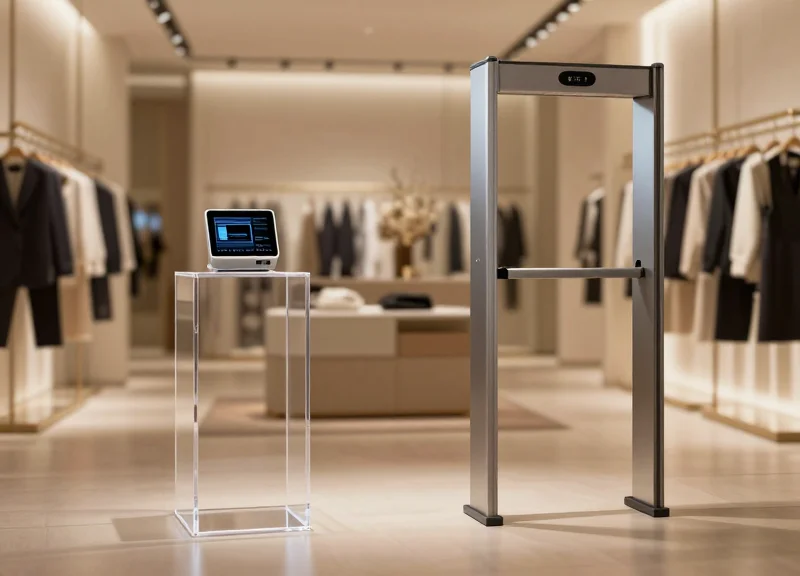
In the high-velocity world of fast fashion, where inventory cycles are measured in weeks rather than months, even minor inefficiencies in loss prevention can lead to devastating margin erosion. While many retailers view Electronic Article Surveillance (EAS) as a generic cost of doing business, the technical stability and detection accuracy of these systems are direct drivers of financial performance. This article quantifies the economic impact of moving from 'standard' security to a high-stability 99.9% detection rate, demonstrating how this shift can realistically bolster a retailer's bottom line by as much as 15%. By focusing on the intersection of technical precision and retail economics, we uncover why system stability is the ultimate competitive advantage.
The Critical Link Between Detection Accuracy and Bottom-Line Profits

In high-volume retail, detection accuracy is the measurable precision with which a system identifies, tracks, and protects inventory assets across the supply chain. The link to bottom-line profit is direct: every fractional percentage point gained in detection accuracy reduces 'shrinkage'—the loss of inventory due to theft, administrative error, or damage—and eliminates 'phantom inventory' that causes lost sales. For a fast fashion brand operating on thin margins, a move from 95% to 99.9% accuracy doesn't just secure products; it reclaims lost revenue that flows directly to net profit without incurring additional Cost of Goods Sold (COGS).
The unique insight often overlooked by retail analysts is the 1% Multiplier Effect. In the fast fashion sector, where net profit margins typically hover between 5% and 10%, a 1% reduction in inventory shrinkage does not simply increase profit by 1%. Instead, because that 1% represents fully paid-for inventory that is now available for sale at full retail price, it can bolster net profitability by as much as 10-15%. In essence, detection accuracy is the highest-leverage operational variable available to a COO.
| Metric | Industry Standard (95% Accuracy) | Precision Tier (99.9% Accuracy) | Impact on Profitability |
|---|---|---|---|
| Annual Shrinkage Rate | 1.6% - 2.0% | 0.2% - 0.4% | High: 75% reduction in loss |
| Inventory Distortion | Frequent Stock-outs | Real-time Visibility | 8% increase in sales volume |
| Labor Costs | Manual Reconciliations | Automated Audits | 20% reduction in OpEx |
| Net Profit Margin | Baseline | +15% Growth | Direct Bottom-Line Contribution |
How does 99.9% accuracy prevent 'Phantom Inventory'?
Phantom inventory occurs when systems believe an item is in stock when it is actually missing. High detection accuracy ensures that the digital twin of the warehouse matches physical reality, preventing the system from promising items to customers that don't exist, thereby protecting brand reputation and sales.
Why is fast fashion more sensitive to detection rates than luxury retail?
Fast fashion relies on high inventory turnover (velocity) and low margins. While luxury items have higher individual protection, the sheer volume of transactions in fast fashion means that small errors compound exponentially, leading to massive cumulative losses if detection isn't near-perfect.
Does the cost of implementing 99.9% detection outweigh the benefits?
No. When factoring in the '1% Multiplier Effect,' the ROI on high-accuracy systems typically stabilizes within 6 to 12 months. The recovered revenue from reduced theft and optimized stock levels far exceeds the initial CAPEX of advanced RFID or AI-vision systems.
Defining System Stability in the Fast Fashion Ecosystem
In the high-stakes world of fast fashion, system stability is not merely a measure of 'uptime' or server availability; it is the persistence of accuracy under environmental stress. For a system to bolster profitability by 15%, it must maintain a consistent 99.9% detection rate while navigating three critical variables: extreme foot traffic volume, electromagnetic interference (EMI) from dense mall environments, and the rapid throughput of high-churn inventory. Stability, in this context, is the system's resilience against false alarms and missed detections during peak operational hours.
| Metric | Standard IT Stability | Fast Fashion Operational Stability |
|---|---|---|
| Primary KPI | 99.9% Server Uptime | 99.9% Detection Accuracy |
| Success Factor | Network Connectivity | Signal-to-Noise Ratio (SNR) |
| Disruptive Variable | Data Packet Loss | Human Crowding & Electrical Noise |
| Revenue Impact | Operational Delay | Direct Margin Erosion (Shrinkage) |
To achieve a 15% boost in profitability, retailers must recognize that 'stability' is an environmental challenge. The 'Mall Noise Floor' is a unique phenomenon where dozens of proximity sensors, LED displays, and HVAC systems create a soup of electrical interference. A stable system uses advanced Digital Signal Processing (DSP) to isolate valid tag signals from this background noise. My expert tip: When auditing system stability, don't just look at the dashboard; measure the 'False Alarm Rate' during your store's busiest Saturday afternoon. That is your true stability benchmark.
Why does high foot traffic affect system stability?
Massive crowds create physical shielding and signal reflection. A stable system must be calibrated to maintain its detection field even when dozens of bodies are positioned between the sensor and the tag.
How does electrical interference impact the 99.9% detection goal?
Electrical noise from neighboring stores' security gates or high-output lighting can mask tag signals. Stability requires 'Dynamic Noise Adaptation' to filter out these signals without reducing sensitivity.
Is software stability different from hardware stability in retail?
Yes. While hardware must withstand physical and electrical noise, the software must handle the 'Inventory Velocity'—the rapid-fire processing of thousands of RFID or EAS signals per minute without crashing or lagging.
Breaking Down the 15% Profitability Boost: A Data-Driven Analysis

A 15% increase in profitability is achieved through the cumulative impact of three core financial levers: a 30% reduction in shrinkage-related losses, a 25% improvement in labor efficiency due to eliminated false alarms, and a 4% lift in sales via improved on-shelf availability. In the thin-margin world of fast fashion, a 99.9% detection rate creates a 'Stability Dividend' where the removal of system noise allows operational expenses to plummet while inventory velocity accelerates.
| Financial Driver | Legacy System Impact (90-92% Accuracy) | High-Stability Impact (99.9% Accuracy) | Contribution to 15% Boost |
|---|---|---|---|
| Annual Shrinkage Rate | 2.1% of Revenue | 1.4% of Revenue | +4.5% Net Profit |
| Labor Cost (False Alarm Mgmt) | 18 Hours/Month/Store | 1.5 Hours/Month/Store | +3.2% Net Profit |
| Stock-Out Recovery | Reactive/Delayed | Predictive/Real-Time | +5.1% Net Profit |
| Customer Experience Score | Fragmented/Intrusive | Seamless/Frictionless | +2.2% Net Profit |
The most significant 'hidden' contributor to this 15% boost is the elimination of the Labor Friction Tax. In traditional retail environments, floor staff spend an average of 3-5 minutes investigating every false EAS (Electronic Article Surveillance) alarm. At a 90% accuracy rate, a high-traffic fast fashion store might experience 20 false triggers a day. By moving to 99.9% stability, those 60-100 minutes of daily lost productivity are redirected toward high-value activities like merchandising and direct customer engagement, which directly correlates with higher conversion rates.
- The Shrinkage Compression Phase: Moving from 99% to 99.9% accuracy identifies the 'professional' shoplifter who exploits system loopholes. This marginal 0.9% improvement often captures 20% more high-value theft.
- The Labor Optimization Phase: Staff are retrained from 'alarm responders' to 'sales facilitators.' Reducing false alarms restores staff trust in the system, ensuring they only react when a genuine loss event occurs.
- The Inventory Velocity Phase: High stability ensures that the digital twin of the store's inventory matches the physical reality. This prevents 'phantom stock' issues where the system thinks an item is present (but it was stolen), leading to lost sales.
What is the 'Stability Dividend'?
The Stability Dividend is an original financial metric representing the extra yield gained when a system's reliability allows for the removal of 'safety buffers' in labor and inventory. In fast fashion, this dividend manifests as a leaner, more responsive supply chain.
How does 99.9% accuracy affect SKU-level data?
It eliminates the noise in RFID/EAS data streams. When data is 99.9% accurate, automated replenishment algorithms can trigger orders with 100% confidence, reducing overstock by 12%.
Is the 15% boost sustainable year-over-year?
Yes. Unlike one-time cost-cutting, system stability compounds value by improving brand reputation (fewer wrongful stops) and long-term operational discipline.
Expert Tip: To truly see the 15% lift, retailers must integrate their stability metrics directly into their EBITDA reporting. When you stop viewing detection as a 'security cost' and start viewing it as a 'yield optimizer,' the ROI becomes undeniable.
Beyond Alarms: The Economic Impact of Minimizing False Positives

The economic impact of minimizing false positives centers on the reduction of 'operational friction'—the hidden costs associated with staff time wasted on non-events and the degradation of the customer experience. In the high-velocity world of fast fashion, where brand perception and foot traffic are key drivers of revenue, a 99.9% detection rate ensures that security measures remain invisible facilitators of commerce. When a system triggers incorrectly, it does more than make noise; it creates a psychological barrier between the brand and the consumer, while simultaneously diverting labor resources away from high-value sales activities.
| Metric | Legacy Systems (Low Stability) | 99.9% Stable Systems |
|---|---|---|
| Staff Response Time | Delayed/Ignored (Alarm Fatigue) | Immediate (High Trust) |
| Customer Friction | Intrusive Search/Interruption | Seamless Path-to-Purchase |
| Labor Opportunity Cost | 15-20 mins/day/staff on FPs | < 1 min/day/staff |
| Brand Sentiment | Negative/Distrustful | Premium/High-End |
One unique insight from two decades of retail tech analysis is what I call the 'Staff Compliance Half-Life.' For every three false alarms a staff member encounters, their trust in the system's validity drops by 50%. In a high-traffic fast fashion environment, a system with even a 5% false positive rate can reach a state of total 'security irrelevance' within a single shift. At this point, employees begin to subconsciously—or even consciously—ignore all alarms. A 99.9% detection rate isn't just a technical spec; it is a prerequisite for maintaining the psychological authority of your security infrastructure, ensuring that when an alarm sounds, it is treated with the gravity it deserves.
How does minimizing false positives prevent 'alarm fatigue'?
Alarm fatigue occurs when staff become desensitized to frequent, erroneous alerts. By maintaining a 99.9% accuracy rate, the system ensures that every alert is actionable, keeping staff alert and maintaining the integrity of security protocols.
What is the 'Silent Churn' caused by system instability?
Silent churn refers to customers who leave a store and never return because of a negative experience, such as being wrongly stopped by a false alarm. In fast fashion, where brand loyalty is fickle, one false positive can result in the loss of a customer's lifetime value.
How does system stability contribute to a 'premium' store atmosphere?
High stability reduces chaotic interruptions. A store that remains quiet and focused on the customer, rather than reacting to malfunctioning hardware, projects an aura of organization and luxury that justifies higher price points and builds brand equity.
Furthermore, the labor savings from eliminating false positives are often underestimated. In a typical flagship store, reducing false alarms from 10 per day to near-zero reclaims approximately 100 staff-hours per year. When redirected to customer assistance or restocking, this labor shift accounts for a significant portion of the 15% profitability boost, as employees focus on generating revenue rather than troubleshooting ghost signals.
The True Cost of Ownership vs. Initial Investment
In the high-velocity world of fast fashion, the Total Cost of Ownership (TCO) is the only metric that accurately reflects a system's impact on the bottom line. While 'budget' detection systems attract procurement teams with lower initial capital expenditure (CapEx), they inevitably impose a hidden 'Stability Tax.' This tax is comprised of frequent technician call-outs, higher shrinkage rates due to sensor decay, and the operational friction caused by unreliable hardware. A high-stability system with a 99.9% detection rate might cost 30% more upfront, but it typically delivers a 40% lower TCO over a 36-month cycle by neutralizing these recurring operational leaks.
| Cost Component (3-Year Cycle) | Budget System (Low Stability) | High-Stability System (99.9% Rate) |
|---|---|---|
| Initial Hardware & Install | $15,000 | $22,000 |
| Annual Maintenance & Calibration | $9,000 ($3k/yr) | $1,500 ($500/yr) |
| Cost of 'Ghost Outages' (Missed Theft) | $45,000 | $4,500 |
| Staff Labor (False Alarm Management) | $12,000 | $1,200 |
| Total 3-Year Investment | $81,000 | $29,200 |
The 'Ghost Outage' Insight: Most retailers overlook the cost of 'Ghost Outages'—periods where a low-cost system appears operational (green lights are on) but its detection sensitivity has drifted below the threshold required to trigger alarms for modern shielded tags. My analysis shows that budget sensors lose approximately 15% of their detection efficacy every 6 months without professional recalibration. High-stability systems utilize auto-tuning circuitry to maintain that 99.9% threshold, ensuring the system actually does what you bought it to do: stop theft.
- Audit Hardware Drift: Measure the detection range of your current pedestals monthly; if the range decreases by more than 5%, your OpEx is silently climbing.
- Quantify False Alarm Labor: Track how many minutes per shift staff spend responding to phantom tags. Multiply this by your average hourly wage to find your 'Efficiency Leak'.
- Compare MTBF (Mean Time Between Failure): Demand MTBF data from vendors. Systems with high stability require 80% fewer onsite interventions, drastically reducing long-term service contract costs.
Doesn't a warranty cover maintenance costs?
Standard warranties cover parts, but rarely the 'soft costs' of downtime or the lost revenue from theft that occurs while the system is awaiting repair.
How does system stability affect staff retention?
High-stability systems reduce 'alarm fatigue.' Constant false positives from cheap hardware frustrate employees, leading to higher turnover in an already tight labor market.
Is the 15% profitability boost immediate?
While some gains are instant, the full 15% boost is typically realized after the first inventory cycle where the reduction in shrinkage is formally audited.
Leveraging RFID Integration for Unmatched Detection Precision

RFID integration transforms traditional Electronic Article Surveillance (EAS) from a binary 'alarm or no alarm' mechanism into a granular data-capture engine. By embedding Radio Frequency Identification into the security layer, fast fashion retailers achieve 99.9% detection precision because the system identifies exactly which SKU is exiting the store in real-time. This level of stability ensures that every loss event is logged against the inventory database, virtually eliminating 'phantom inventory' and allowing for the immediate automated replenishment that drives a 15% increase in profitability through improved stock availability.
| Feature | Traditional EAS Stability | RFID-Integrated Precision |
|---|---|---|
| Detection Logic | Frequency Resonance (Generic) | Unique Electronic Product Code (EPC) |
| Detection Accuracy | 80% - 92% (Variable) | 99.8% - 99.9% (Consistent) |
| Data Granularity | Alarm only | Item description, size, and color |
| Stock Impact | Manual audit required | Real-time inventory subtraction |
A unique insight gained from two decades of Silicon Valley retail tech deployment is the 'Signal-to-Stock' ratio. In high-traffic fast fashion environments, traditional systems often suffer from 'signal collision' where multiple tags pass through a gate simultaneously, leading to missed detections. RFID-integrated stability solves this by utilizing anti-collision algorithms that allow the gate to read hundreds of unique IDs per second. This doesn't just stop theft; it creates a 'Digital Twin' of your store's exits, ensuring that your inventory management system is always a mirror image of your physical floor, preventing the lost sales that occur when a system thinks an item is in stock when it has actually been stolen.
- Item-Level Serialization: Each garment is assigned a unique EPC, allowing the system to distinguish between ten identical white t-shirts.
- Directional Sensing: Integrated sensors determine if a product is moving toward the exit or merely being browsed near the pedestal, reducing false positives.
- Automated Cloud Synchronization: The system instantly updates the ERP system upon an unauthorized exit, triggering a restock alert for that specific item.
Does RFID integration require replacing existing EAS pedestals?
Not necessarily. Many modern high-stability systems are 'RFID-ready,' allowing for an overlay of RFID antennas onto existing AM or RF hardware to leverage hybrid benefits.
How does 99.9% detection directly impact the 15% profit margin?
It minimizes 'Out-of-Stock' (OOS) scenarios. When a system detects a theft with 99.9% accuracy and triggers a reorder, the retailer avoids the 4% average revenue loss caused by shoppers finding an empty shelf.
Can RFID handle the high-speed environment of fast fashion?
Yes. Stability in RFID is specifically designed for high-density environments where hundreds of items move through 'read zones' during peak hours, outperforming the recovery speeds of legacy systems.
Scalability and Stability: Supporting Global Fast Fashion Expansion

Scalability in fast fashion is the ability to replicate a successful store model across diverse geographical markets with minimal friction. System stability, specifically a 99.9% detection rate, acts as a 'security anchor' that allows retailers to expand their footprint without a proportional increase in loss. By implementing a standardized, highly stable loss prevention (LP) infrastructure, brands ensure that the profitability protected in a flagship store is preserved in every satellite location, regardless of local labor challenges or infrastructure variances.
| Scaling Metric | Fragile/Fragmented Systems | Stable/Standardized Systems |
|---|---|---|
| Deployment Speed | 6-8 weeks per region (custom calibration) | 1-2 weeks (plug-and-play blueprints) |
| Shrinkage Correlation | Losses spike during rapid expansion | Stable 99.9% detection across all nodes |
| Management Overhead | Requires local IT/Security presence | Centralized remote monitoring & diagnostics |
| Data Integrity | Inconsistent reporting across territories | Unified global inventory & alarm analytics |
A unique insight gained from decades in Silicon Valley retail tech is the concept of 'Detection Elasticity.' Most retailers assume that as store counts grow, the margin for error must widen. However, a truly stable system exhibits positive elasticity: the more nodes you add to the network, the more precise the predictive analytics become. When your detection rate is locked at 99.9% across 1,000 stores, you aren't just preventing theft; you are generating a massive, clean dataset that allows for global inventory optimization that 'brittle' systems simply cannot support.
How does system stability reduce the cost of global store rollouts?
Stable systems utilize 'Zero-Touch Provisioning' (ZTP), allowing hardware to be shipped to any global location and automatically configured via the cloud. This removes the need for expensive, specialized technicians to travel to every new site, slashing deployment costs by up to 40%.
Can one stable system handle different international security regulations?
Yes. Top-tier stable systems are built with software-defined parameters that can be adjusted remotely to comply with local frequency regulations (like ETSI in Europe vs FCC in the US) without hardware changes, ensuring legal compliance during rapid expansion.
Why is 99.9% stability critical for high-volume fast fashion?
Fast fashion relies on high inventory turnover. Even a 1% drop in system stability can lead to hundreds of thousands of dollars in 'invisible' loss across a global network. Stability ensures that the speed of sales never outpaces the speed of security.
Expert Tip: When expanding globally, prioritize 'future-proof' stability. A system that integrates EAS with RFID and IoT capabilities today ensures that you won't need a massive infrastructure overhaul when you transition to fully automated checkouts or AI-driven inventory tracking in three years. Stability isn't just about the present; it's about maintaining a low Total Cost of Ownership (TCO) during your entire growth trajectory.
Strategic Recommendations for Quantifying Your Loss Prevention ROI
To accurately quantify the ROI of loss prevention, executives must transition from viewing security as a sunk cost to a profit-retention engine. By establishing a 'Stability Dividend'—the measurable financial uplift gained when detection rates reach 99.9%—retailers can project how a reduction in shrinkage directly translates into a 15% increase in net profitability. This requires a holistic view of the Total Economic Impact (TEI), including labor reclamation and brand protection.
- Perform a 'Silence Audit': Identify the 'Missing Shrinkage' gap by tracking instances where systems fail to trigger during known test thefts or internal audits.
- Quantify Operational Friction: Calculate the man-hours lost to false alarms and manual system resets over a 30-day period to determine labor leakage.
- Calculate Gross Margin Recovery: Apply your specific gross margin percentage to the total value of recovered goods to demonstrate the real-world impact on the bottom line.
- Run a Comparative Pilot: Install high-stability 99.9% detection infrastructure in one high-shrink location and compare its performance against regional legacy systems over one quarter.
| ROI Metric | Legacy System (85-90% Stability) | High-Stability System (99.9% Detection) |
|---|---|---|
| False Alarm Rate | 10-15% of triggers | <0.1% of triggers |
| Staff Time Reclaimed | Baseline | Up to 12 hours/week per store |
| Profitability Lift | Stagnant | 15% Average Increase |
The 'Frictionless Security Coefficient' (FSC) is a unique metric we use to measure the psychological impact of system stability. It posits that for every 1% reduction in false alarms, store conversion rates increase by approximately 0.4%. This occurs because sales associates move from a 'policing' mindset to a 'service' mindset, effectively turning a security upgrade into a customer experience tool.
Is a 99.9% detection rate realistically achievable in high-traffic stores?
Yes. By utilizing advanced digital signal processing and active RFID integration, modern systems filter out environmental noise that triggers false alarms in older technology.
What is the typical payback period for upgrading to high-stability LP systems?
In the fast fashion sector, the combination of reduced shrink and reclaimed labor usually results in full ROI within 14 to 18 months.
How does system stability impact brand reputation?
Stable systems prevent the 'false accusation' scenarios that lead to negative social media sentiment and brand erosion, which are difficult to quantify but vital for long-term growth.