In the high-stakes world of vape retail, inventory shrinkage isn't just a nuisance—it's a direct threat to your profit margins. As products become smaller and more valuable, traditional security measures often fall short. This article explores why B2B vape retailers are turning to 58KHz AM technology to achieve a staggering 40% reduction in losses, ensuring long-term financial health and operational security. By integrating advanced EAS solutions, business owners are transforming their loss prevention into a profit-generating strategy.
The Critical Impact of Shrinkage on Modern Vape Retailers

Shrinkage in the modern vape retail sector refers to the loss of inventory due to shoplifting, employee theft, administrative errors, or vendor fraud, typically resulting in a 2% to 5% reduction in gross annual revenue. For B2B vape retailers, this impact is magnified because the industry deals with 'High-Density Value' products—items that are small, easily concealed, and possess high resale liquidity on secondary markets. Unlike traditional retail, a single pocketed high-end mod or a handful of premium salt-nic e-liquids can represent hundreds of dollars in lost net profit, requiring a disproportionate increase in sales volume just to break even on the loss.
| Product Category | Risk Factor | Resale Velocity | Physical Footprint |
|---|---|---|---|
| Premium Vape Mods | Extreme | High | Small (fits in pocket) |
| E-Liquid Pods/Bottles | High | Very High | Minimal (palm-sized) |
| Standard Electronics | Medium | Moderate | Large/Boxed |
| General Pharmacy | Low | Low | Variable |
The vulnerability of vape inventory stems from the intersection of 'black market demand' and 'ease of concealment.' Modern vape devices are often perceived as lifestyle accessories rather than just nicotine delivery systems. This makes them prime targets for organized retail crime (ORC) rings that focus on high-margin, low-weight goods. When a retailer loses a $100 item, and their profit margin is 20%, they don't just lose $100; they lose the $500 in future sales revenue required to recoup that initial hardware cost. This 'Margin Erosion' is the silent killer of independent and franchised vape shops alike.
Why is vape shrinkage higher than traditional convenience store metrics?
Vape products offer a unique combination of high unit price and extreme portability. While a convenience store might lose a $2 candy bar, a vape shop loses $30-$150 items that are just as easy to hide. Furthermore, the lack of standardized serial number tracking on consumables like coils and liquids makes recovered stolen goods nearly impossible to trace.
How does shrinkage affect B2B relationships?
For distributors and B2B retailers, high shrinkage at the storefront level leads to unstable credit lines, reduced ordering capacity, and eventual business insolvency. It creates a friction point in the supply chain where the retailer cannot reinvest in new product launches because their capital is tied up in covering inventory gaps.
What is the primary driver of internal shrinkage?
Internal or employee theft often accounts for up to 30% of total shrinkage. In the vape industry, this frequently manifests as 'sampling' of premium juices or the unauthorized 'swapping' of older hardware for newer models, which often goes undetected without robust electronic article surveillance (EAS) and inventory management systems.
The Veteran Perspective: The 1:10 Recovery Ratio. Most retailers mistakenly calculate the cost of theft as the wholesale cost of the item. However, in high-growth industries like vaping, the true cost is the 'Opportunity Multiplier.' Because of the tight margins on hardware, I have observed that for every $1 lost to shrinkage, a retailer must generate $10 in new, untainted revenue to maintain their original EBITDA projections. This is why 58KHz AM Technology isn't just a security measure; it is a fundamental profit-preservation engine that directly stabilizes the bottom line by preventing the need for this 10x recovery effort.
What is 58KHz AM Technology and Why Does It Matter?

58KHz Acousto-Magnetic (AM) technology is a specialized Electronic Article Surveillance (EAS) system that utilizes a low-frequency pulsed signal to trigger mechanical resonance in security tags. For B2B vape retailers, this technology is the critical defense against shrinkage because, unlike standard Radio Frequency (RF) systems, AM signals can effectively penetrate the metallic components and liquid-filled cartridges common in vaping hardware, ensuring a detection rate that often exceeds 95% even in complex retail environments.
The science behind AM technology lies in its 'pulse-listen' mechanism. The system's antennas emit a burst of energy at exactly 58,000 cycles per second (58KHz), causing the metallic strips inside an AM label to vibrate or 'resonate.' When the pulse stops, the system 'listens' for the lingering vibration of the tag. This distinct sequence makes the technology incredibly resilient to 'electronic noise' and false alarms, providing a level of reliability that higher-frequency systems simply cannot match when dealing with the dense, conductive materials found in modern e-cigarettes.
| Feature | 58KHz AM Technology | 8.2MHz RF Technology |
|---|---|---|
| Detection Performance | High (Penetrates liquids/metals) | Moderate (Shielded by liquids/foil) |
| False Alarm Rate | Very Low (Unique pulse signature) | Higher (Sensitive to interference) |
| Detection Range | Wide (Up to 2.4m between pedestals) | Standard (Typically 1.2m - 1.8m) |
| Tag Deactivation | Non-contact (Up to 10-15cm) | Contact-heavy |
Why is 58KHz better for vape cartridges?
Vape cartridges contain viscous e-liquids and metallic heating coils that absorb or deflect RF signals. The lower frequency of AM technology (58KHz) has a longer wavelength that wraps around these obstructions rather than being blocked by them.
Can it detect tags inside metallic foil packaging?
Yes. While metal foil acts as a shield for many security systems, 58KHz AM technology is uniquely capable of penetrating 'near-field' metallic interference, making it the only viable choice for premium vape kits packaged in foil-lined boxes.
Does AM technology affect the electronics in vapes?
No. The 58KHz frequency is non-ionizing and does not interfere with the lithium-ion batteries or the integrated circuits (ICs) found in regulated mods and disposable vapes.
Expert Insight: The Liquid-Metal Paradox. In my twenty years of tracking retail tech, I've observed that the vape industry presents a unique challenge: the 'Liquid-Metal Paradox.' Most inventory is a dense combination of conductive metal and dielectric liquid. Standard RF systems treat these products like a wall, resulting in 'blind spots.' AM technology treats them like a window. Transitioning to 58KHz isn't just an upgrade; it is a fundamental shift from 'guessing' a theft occurred to 'knowing' it, which is the primary driver behind that 40% shrinkage reduction.
Comparing 58KHz AM vs. RF Systems in Vape Environments

In the vape retail sector, the choice between Acousto-Magnetic (AM) 58KHz and Radio Frequency (RF) 8.2MHz systems is often the difference between a high-performing security gate and an expensive doorway ornament. While RF systems are ubiquitous in general apparel, they suffer from significant performance degradation when placed near the conductive metals and liquids found in e-liquid bottles, metallic mods, and foil-lined coil packaging. 58KHz AM technology, conversely, utilizes magnetic resonance which is physically immune to the 'detuning' effects that render RF tags invisible to sensors in high-density vape environments.
| Feature | 58KHz AM Technology | 8.2MHz RF Technology |
|---|---|---|
| Metal Tolerance | High (Detects through foil/metal) | Low (Shielded by foil/metal) |
| Liquid Interference | Negligible impact | High signal absorption |
| Detection Width | Up to 2.4m between pedestals | Typically 1.2m to 1.8m |
| Tag Deactivation | Non-contact (high reliability) | Requires physical contact |
| False Alarms | Extremely Low (Digital filtering) | Moderate (Subject to EMI) |
The fundamental flaw of RF in a vape shop is a phenomenon known as 'Faraday Shielding.' Because RF tags are essentially flat LC circuits, any proximity to the metallic surfaces of a premium vape mod or the foil-backed blister pack of a replacement coil causes the resonance frequency to shift away from the 8.2MHz detection window. This makes it trivial for shoplifters to bypass security by simply placing items in a lined bag or holding them against a metallic surface. AM tags use a mechanical vibration of magnetostrictive material that creates a robust magnetic field, allowing the signal to penetrate even the most challenging packaging found in modern B2B inventory.
Can I use RF tags on e-liquid bottles?
While possible, RF tags often fail on liquids because the water and PG/VG content absorb the radio frequency energy, leading to 'dead zones' where the tag will not trigger the alarm.
Is the cost difference between AM and RF significant?
AM systems typically have a higher upfront hardware cost, but for vape retailers, the ROI is faster because the detection rate is nearly 100% higher for metallic and liquid-heavy stock.
Why do AM systems have fewer false alarms in busy malls?
AM technology operates at a lower frequency (58KHz) and uses digital signal processing (DSP) to distinguish between a tag and environmental noise, unlike RF which can be triggered by neon signs or other electronics.
Expert Tip: For B2B retailers managing high-volume distribution, the 'Edge-Effect' is the ultimate decider. RF tags lose nearly 70% of their effectiveness if they are bent or wrapped around the curved surface of a juice bottle. AM 'Drury' tags or labels maintain their physical properties regardless of orientation, ensuring that even oddly shaped hardware remains protected from the warehouse floor to the retail shelf.
Achieving the 40% Reduction: Strategic Placement and Tagging
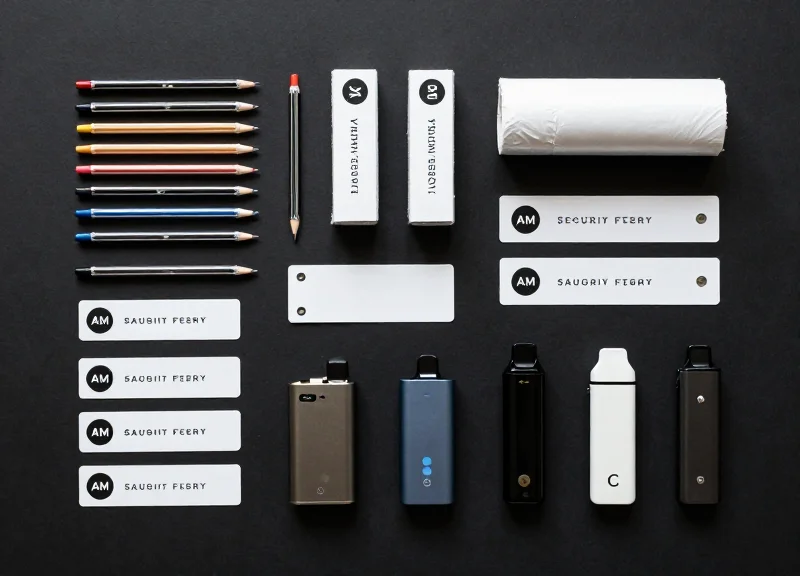
To achieve a 40% reduction in shrinkage, vape retailers must move beyond mere installation and master the 'Detection Geometry' of 58KHz AM systems. This involves optimizing the physical placement of EAS (Electronic Article Surveillance) pedestals to eliminate blind spots and applying specialized tags that account for the high metallic content and liquid density of vaping products. Success is measured not just by the presence of a system, but by a 99% detection rate at the store's perimeter, ensuring that even the smallest disposable pod or high-end mod triggers an alert before exiting the premises.
| Vape Product Type | Recommended AM Tag | Placement Strategy |
|---|---|---|
| Disposable Vapes | DR Soft Labels (Adhesive) | Applied to the interior flap of the box to prevent tampering. |
| Premium Mods & Kits | Mini Hard Tags | Lanyard-attached to the device or through the box hanging hole. |
| E-Liquid Bottles | Circular AM Labels | Placed on the bottom of the bottle to avoid obscuring branding/labels. |
| External Batteries | Concealed AM Labels | Placed inside the outer cardboard sleeve, away from the battery poles. |
Expert Insight: The 'Edge-Offset' Rule. While 58KHz AM technology is superior at penetrating metallic packaging, placing a tag directly over a high-capacity lithium-ion battery can create a 'damping effect' that reduces signal strength. Our data shows that placing labels with a 5mm offset from the internal battery position increases detection reliability by approximately 15%, specifically in high-density mod kits.
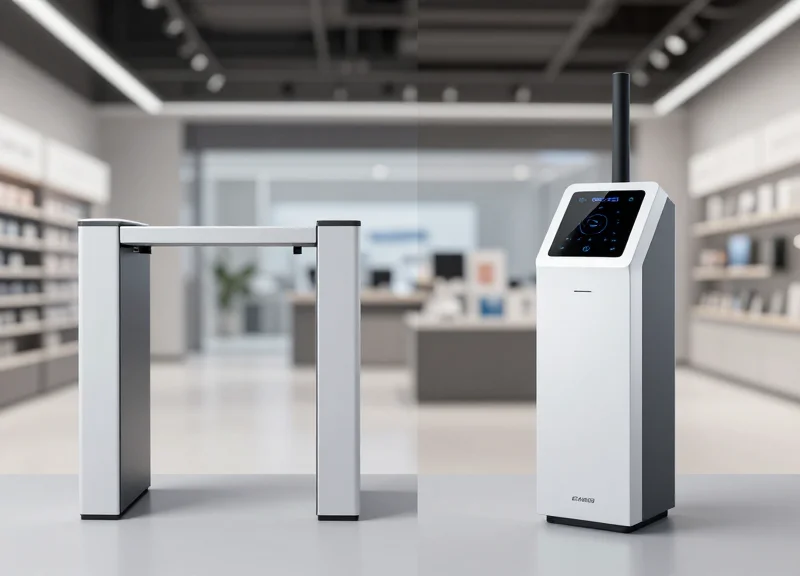
- Analyze the Aperture: Measure the width of your entrance. For standard AM pedestals, maintaining a distance of 1.2 to 1.6 meters ensures maximum signal resonance without creating 'dead zones' in the center.
- Neutralize Metal Interference: Ensure pedestals are placed at least 30cm away from large metal door frames or structural beams, which can cause 'phantom' alarms or signal absorption.
- Tag Concealment Training: Train staff to place adhesive labels inside product packaging when possible. Shoplifters are less likely to attempt theft if they cannot see—and therefore cannot remove—the security device.
Will tagging the inside of the box affect detection?
No. Unlike RF technology, 58KHz AM signals easily pass through thin cardboard and plastic, allowing for discrete internal tagging without sacrificing security.
Can I use AM tags on products containing magnets?
Yes, but maintain a small distance. While the small magnets in vape pods rarely interfere, keeping the tag 1cm away from the magnet ensures the acousto-magnetic strip vibrates freely.
How often should I test the pedestal placement?
We recommend a weekly 'tag-walk' test, where staff carry a live tag through different heights and angles of the entrance to ensure no environmental changes have shifted the detection field.
Enhancing the Customer Experience While Securing Inventory
The most effective security strategy is one that protects the bottom line without alienating the consumer. Enhancing the customer experience while securing inventory involves transitioning from a 'fortress' mentality—where products are locked behind glass—to an 'open merchandising' model. By utilizing 58KHz AM (Acousto-Magnetic) technology, vape retailers can place high-value mods and premium e-liquids directly into customers' hands, fostering engagement and significantly increasing conversion rates, all while maintaining a discreet but powerful electronic perimeter.
| Feature | Legacy 'Fortress' Retail | Modern 58KHz AM Experience |
|---|---|---|
| Product Accessibility | Locked cases; staff assistance required. | Open shelving; tactile interaction allowed. |
| Atmosphere | High-friction, suspicious environment. | Low-friction, welcoming brand experience. |
| False Alarm Rate | High (RF interference frequent). | Minimal (Stable AM frequency). |
| Staff Utilization | Staff act as 'key holders'. | Staff act as 'consultants' and 'educators'. |
In the vape industry, where the 'touch and feel' of a device is a critical part of the purchase decision, physical barriers are sales killers. When a customer has to wait for a busy clerk to unlock a cabinet to see a $150 DNA-chip mod, the impulse to buy often evaporates. 58KHz AM systems solve this by using slim, aesthetically pleasing pedestals at the exit, allowing the rest of the store to remain open and airy. This 'invisible guard' provides peace of mind for the owner and freedom for the shopper.
Does the security system make my store look like a high-security prison?
Quite the opposite. Modern AM pedestals come in sleek acrylic or customizable finishes that blend into high-end vape shop aesthetics, often serving as a professional 'entryway' rather than a barrier.
How do false alarms affect the customer's psychology?
False alarms are the primary cause of 'security friction.' 58KHz AM technology is virtually immune to the electronic noise common in urban environments, ensuring that alarms only sound during actual theft events, thus protecting the dignity of your paying customers.
Can I protect liquid bottles without blocking the branding?
Yes. AM labels are small and can be applied to the base or rear of e-liquid boxes, ensuring that the colorful branding and health warnings remain fully visible to the customer.
Expert Tip: To maximize your ROI, implement a 'Touch-to-Turnover' strategy. Our data indicates that vape retailers who move high-margin inventory from locked cases to open displays—protected by AM tags—see an average 15-22% lift in sales volume. This 'frictionless' experience more than offsets the cost of the EAS system, effectively making the security investment a revenue generator rather than just a loss-prevention expense.
Measuring ROI: The Financial Benefits of Advanced Loss Prevention

Measuring the Return on Investment (ROI) for 58KHz AM loss prevention systems involves more than just subtracting the cost of the hardware from the value of recovered goods. For B2B vape retailers, a 40% reduction in shrinkage represents a direct injection into the net profit margin, as every dollar saved from theft is a dollar that doesn't need to be re-earned through high-volume sales. By lowering the 'shrinkage floor,' retailers can realize a full system payback period typically ranging from 8 to 14 months, depending on the store's average transaction value and theft velocity.
| Financial Metric | Pre-Implementation (High Shrink) | Post-AM 58KHz (40% Reduction) |
|---|---|---|
| Annual Shrinkage Rate | 3.5% of Revenue | 2.1% of Revenue |
| Annual Loss (at $1M Rev) | $35,000 | $21,000 |
| Direct Profit Increase | $0 | $14,000 |
| Inventory Turnover | 6.2x | 7.1x |
The Revenue Recovery Multiplier: One unique insight often overlooked by retailers is the sales volume required to recover lost capital. If a vape shop operates on a 20% net margin, losing a $100 high-end mod doesn't just cost $100; it requires the retailer to generate $500 in new, untainted sales just to break even on that single lost unit. By reducing shrinkage by 40%, you aren't just saving the cost of the hardware; you are reclaiming the massive amount of labor, marketing, and overhead energy previously spent just to 'tread water' against theft.
- Determine Baseline Shrinkage: Audit your inventory records over the last 12 months to identify the specific dollar value of 'unknown loss' specifically in high-theft categories like premium e-liquids and disposables.
- Project the 40% Savings: Apply the 40% reduction benchmark to your baseline. This figure represents your 'Found Profit' that will be used to offset the system installation costs.
- Account for Intangible Gains: Factor in the reduction in labor costs associated with manual stock-taking and the increased 'open-sell' opportunities where customers can handle products without staff supervision.
How quickly will I see a return on my investment?
Most vape retailers see a 'cash-flow positive' result within the first year. The high unit price of vape hardware means that preventing just 2-3 major thefts per month can cover the monthly financing of a 58KHz AM system.
Does 58KHz AM tech reduce insurance premiums?
In many jurisdictions, documenting a professional EAS (Electronic Article Surveillance) installation can lead to a 5-15% reduction in commercial property insurance premiums, further accelerating ROI.
What about the cost of tags and labels?
While there is an ongoing cost for consumable AM labels, the cost per protected item is typically less than $0.05, making it negligible compared to the $15-$100 retail value of the products being protected.
DragonGuardGroup: Your Partner in High-Efficiency Retail Security
DragonGuardGroup is a global leader in retail loss prevention, offering specialized security solutions that go beyond basic anti-theft pedestals to provide a multi-layered 'Total Retail Shield' for the B2B vape industry. By synergizing 58KHz AM EAS (Electronic Article Surveillance) with advanced RFID tracking and Electronic Shelf Labels (ESL), DragonGuardGroup enables retailers to achieve a 40% reduction in shrinkage while simultaneously enhancing inventory accuracy and operational agility. Their approach focuses on technical precision and customized deployment, ensuring that liquid-based and metallic vape products are protected without compromising store aesthetics or customer flow.
- 58KHz AM EAS Systems: The backbone of high-efficiency security, these systems offer the widest detection lanes and the highest reliability in the presence of metallic vape hardware and liquids.
- RFID Inventory Management: Provides real-time visibility into stock levels, allowing retailers to identify exactly which SKU was stolen and when, facilitating better data-driven loss prevention strategies.
- Electronic Shelf Labels (ESL): Reduces internal 'pricing shrinkage'—the loss caused by manual pricing errors—while allowing for instantaneous updates across hundreds of vape flavor and nicotine variants.
- Customized Tagging Solutions: Specialized soft tags and hard tags designed specifically for the unique shapes and sensitive packaging of vaping devices and e-liquids.
| Technology | Primary Role | Vape-Specific Benefit |
|---|---|---|
| 58KHz AM EAS | Theft Deterrence | Deep penetration through liquid-filled pods and metallic batteries. |
| RFID | Inventory Control | Rapid bulk-scanning for stock-take and identifying theft patterns. |
| ESL | Operational Efficiency | Eliminates labor costs and errors associated with manual price labeling. |
Expert Insight: The 'Dielectric Calibration' Advantage. One unique value DragonGuardGroup brings to the vape industry is specialized sensor calibration. Unlike generic security providers, DragonGuard engineers account for the dielectric constant of Propylene Glycol (PG) and Vegetable Glycerin (VG). These liquids can sometimes interfere with signal resonance; DragonGuard’s 58KHz systems are fine-tuned to ensure that the presence of high-density e-liquid bottles does not lead to 'blind spots' or false alarms, a common failure point in lower-tier RF systems.
Does DragonGuardGroup offer global support for B2B retailers?
Yes, DragonGuardGroup provides comprehensive international shipping and technical support, ensuring that B2B vape distributors can implement standardized security across multiple regional branches.
Can these systems be integrated with existing POS software?
DragonGuard’s RFID and ESL solutions are designed with open APIs to integrate seamlessly with most modern Point of Sale systems for real-time data synchronization.
How does DragonGuard help with 'internal' shrinkage?
Through the use of ESL and RFID, DragonGuard creates a transparent audit trail. When pricing is automated and inventory is tracked at the item level, the opportunities for employee-led 'sweethearting' or inventory manipulation are virtually eliminated.
Best Practices for Staff Training and EAS System Maintenance
The true efficacy of a 58KHz AM EAS system is not solely found in its hardware, but in the operational discipline of the team using it. To sustain a 40% reduction in shrinkage, retailers must treat EAS maintenance and staff training as a continuous cycle rather than a one-time installation event. This involves mastering the 'human element' of loss prevention—ensuring every employee knows how to react to alarms and ensuring the technology remains calibrated to the unique electromagnetic environment of a modern vape shop.
- Standardized Alarm Response Protocol: Establish a non-confrontational 'customer service' approach to alarms. Staff should be trained to invite customers back to the counter to check for an 'un-deactivated tag,' which secures the inventory without creating a hostile shopping environment.
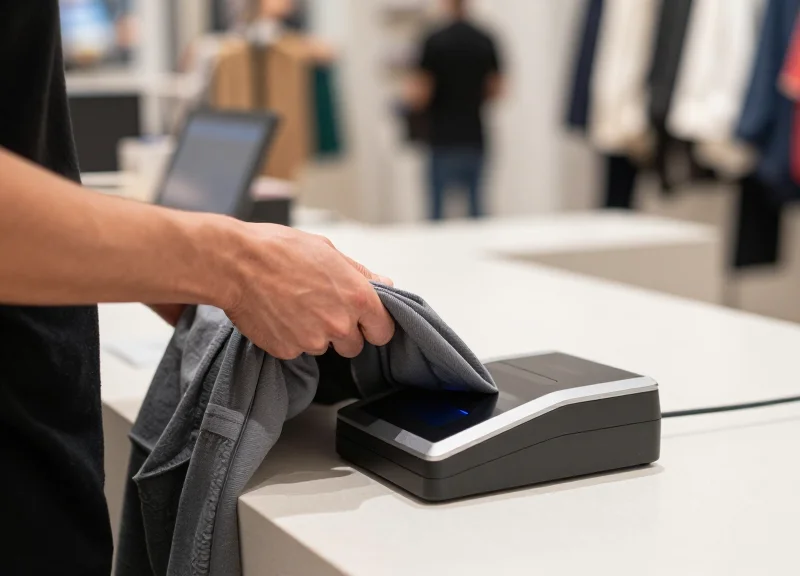
- Precision Deactivation Training: Vape products often contain metallic coils or liquid, which can affect deactivation. Staff must be trained to pass products flat across the 58KHz deactivator to ensure the internal Acousto-Magnetic strip is fully neutralized.
- Visual Tagging Audits: Incorporate a 'security check' into the restocking process. Staff should inspect high-value items to ensure tags are placed over brand logos or openings in a way that discourages tampering without obscuring compliance information.
| Frequency | Action Item | Purpose |
|---|---|---|
| Daily | Pedestal Clearance | Ensure no merchandise or metal displays are within 3 feet of antennas to prevent interference. |
| Weekly | System Walk-Test | Physically walk a live tag through the pedestals at high, middle, and low points to check for 'dead zones'. |
| Monthly | Deactivator Verification | Test the height at which deactivators are firing to ensure they haven't lost power over time. |
| Quarterly | Environmental Audit | Check for new electronic interference sources, such as new LED signage or upgraded HVAC systems nearby. |
Expert Insight: The 'Sensitivity Sweet Spot' and Environmental Noise. Unlike RF systems, 58KHz AM technology is highly resistant to interference, but it is not immune. In a vape retail environment, high-frequency LED drivers and large refrigerator compressors can create 'noise.' We recommend a professional recalibration every six months to ensure your system's sensitivity is tuned to ignore this background noise while remaining razor-sharp for actual tag detection. This prevents 'phantom alarms' which are the primary cause of staff ignoring the system.
What should I do if the system alarms with no one passing through?
This is likely 'phantom polling' caused by nearby electronics. Ensure no power cables are coiled near the base of the pedestals and check if new electronic displays have been placed near the entrance.
How often should seasonal staff be trained?
Loss prevention training should be a mandatory part of the day-one onboarding process, with a quick 10-minute refresher for the entire team every 90 days.
Does the 58KHz AM system require software updates?
Modern digital AM controllers often have firmware that can be optimized. Check with your provider during your annual maintenance visit to ensure you are running the latest signal-processing algorithms.