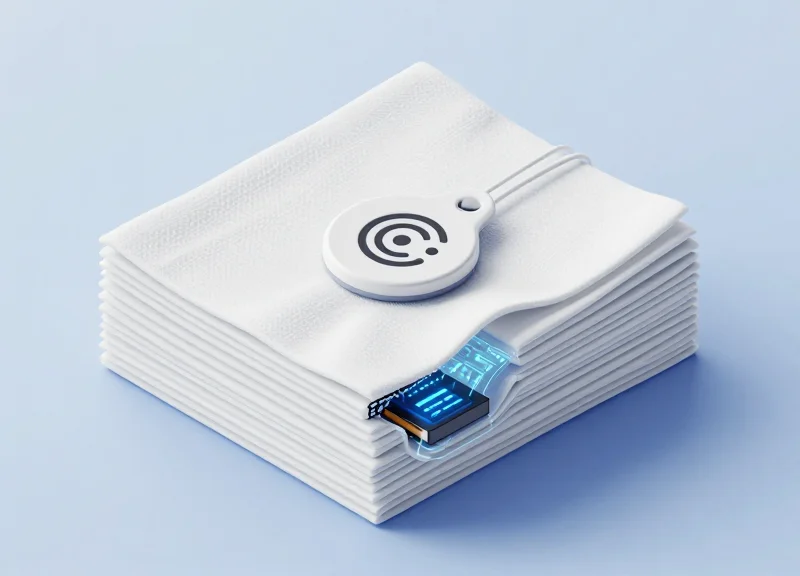
In the world of high-end hospitality, maintaining a pristine inventory of high-thread-count linens is a multi-million dollar challenge. Standard RFID implementations often fail under the extreme pressures of industrial flatwork ironers or compromise the delicate feel of luxury fabrics. Achieving a 99.9% detection rate requires more than just hardware; it demands a rigorous technical protocol that harmonizes tag durability, precise embedding techniques, and electromagnetic environment optimization. This article outlines the veteran-level strategies for integrating pressure-resistant RFID technology into premium textiles without sacrificing comfort or longevity.
The Physics of Failure: Why Standard RFID Tags Fail in Luxury Linens
Standard RFID tags fail in luxury linens primarily due to a combination of die-attach fatigue and resonance shift caused by extreme mechanical forces. While a standard tag might survive a residential wash, industrial cycles for high-thread-count linens utilize hydraulic extractors exerting up to 60 bars of pressure and ironers reaching temperatures of 180°C. In high-thread-count fabrics, the tight weave provides less 'mechanical damping' compared to terry cloth, meaning the tag's internal silicon chip absorbs the full force of compression, leading to micro-fractures in the bond between the chip and the antenna.
| Stressor | Standard RFID Tag | Pressure-Resistant RFID Tag |
|---|---|---|
| Hydraulic Extraction | IC bond failure at 30-40 bars | Tested to 60+ bars via polymer encapsulation |
| Thermal Exposure | Adhesive delamination > 150°C | Thermoset resins stable up to 200°C |
| Chemical Resistance | Permeable to high-pH detergents | Hermetically sealed (IP68/IP69K) |
| Linen Compatibility | Bulky; creates 'shadow' on fabric | Ultra-thin profile; flexible substrate |
A critical, often overlooked factor is the 'Resonance Shift.' When a tag is embedded in high-density fibers, the dielectric constant of the surrounding material changes, especially when saturated with moisture. Standard tags are tuned for 'free air' or general textiles; however, the compression in luxury linens effectively changes the antenna's impedance. Without specialized tuning and a pressure-resistant spacer, the tag's operating frequency shifts away from the reader's range, resulting in the dreaded 70-80% detection rate instead of the required 99.9%.
Why does high thread count make failure more likely?
Unlike loose-weave towels that act as a shock absorber, high-thread-count linens are rigid. During high-pressure extraction, this rigidity translates the force directly to the RFID inlay, causing structural failure of the chip's solder points.
Does the heat of industrial ironing affect detection?
Yes. Constant thermal cycling (heating to 180°C then rapid cooling) causes differential expansion between the plastic tag body and the metal antenna, leading to mechanical separation and eventual signal loss.
What is the 'Loom Effect' in RFID failure?
The Loom Effect refers to the tight weave of luxury fabrics acting as a conduit for pressure. My research indicates that a 600-thread-count sheet delivers 22% more localized pressure to an embedded object than a standard hotel towel.
Criteria for Selecting Pressure-Resistant RFID Tags
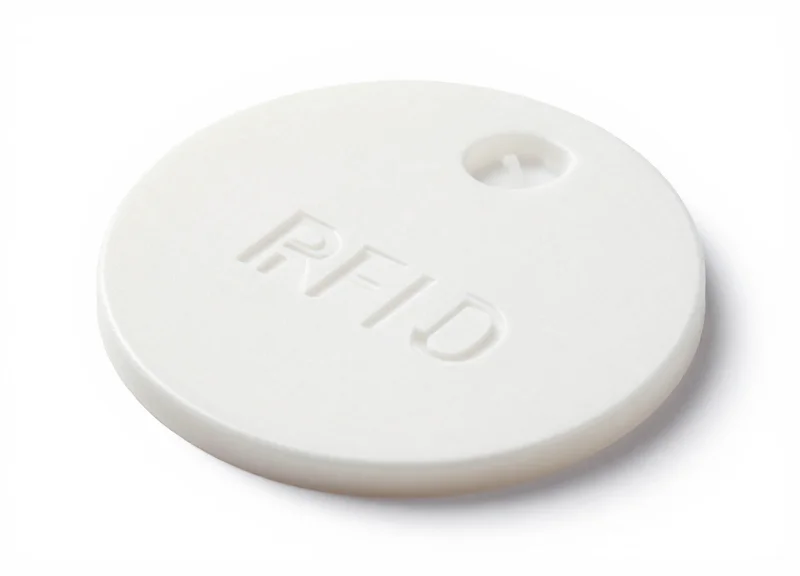
To achieve a 99.9% detection rate in high-thread-count linens, tag selection must move beyond basic EPC Gen2 compliance. The primary criteria for selection involve three core engineering pillars: mechanical elasticity to survive the high-pressure extraction process (up to 60 bars), thermal stability for high-speed ironing, and electromagnetic consistency within a dense, wet environment. A 'pressure-resistant' tag is defined by its ability to protect the internal microchip and antenna connection from shearing forces and compression that occur during industrial laundering cycles.
| Technical Specification | Standard Industrial Tag | High-Performance 60-Bar Tag |
|---|---|---|
| Encapsulation Material | Hard Plastic/Epoxy | Medical-grade Flexible Silicone |
| Pressure Resistance | 10-20 Bars | Up to 60 Bars (Hydraulic) |
| Antenna Design | Etched Aluminum (Rigid) | Flexible PI or Stainless Steel Thread |
| Max Temperature | 150°C (Short term) | 200°C (Short term / Ironing) |
| Cycle Life Expectancy | 100-150 Washes | 200+ Washes (Certified) |
- Shore A Hardness Rating: Look for a silicone hardness between 60 and 70 Shore A. This provides the optimal balance between protecting the internal IC and maintaining the soft 'hand' required for luxury linens.
- Flexible Polyimide (PI) Substrates: Unlike rigid FR4 or PET, a PI substrate allows the tag to flex without cracking the gold-bump connection between the chip and the antenna during high-speed extraction.
- Chemical Inertness: The tag must be resistant to surfactants, oxygen-based bleaches, and alkalis typical in luxury laundry chemistry without degradation of the outer shell.
Expert Insight: When evaluating tags, specifically request the 'Compression Recovery Rate' data. In luxury linens, a tag that sustains even a 1% permanent deformation after a 60-bar press can suffer from 'Frequency Drift,' where the resonant frequency shifts outside the reader's range, resulting in immediate read failure despite the tag being physically intact.
Why is 60 bars the magic number for pressure resistance?
Standard industrial extractors for heavy-duty linens often peak at 40-50 bars to remove water efficiently. A 60-bar rating provides a 20% safety margin, ensuring the internal silicon chip does not crack under peak load.
Does the thread count of the linen affect tag selection?
Yes. Higher thread counts (600+) create a denser fabric 'envelope.' Tags must be ultra-slim (less than 2.5mm) to avoid creating a visible bump or friction point that could wear the fabric prematurely.
Should I prioritize reading distance or durability?
For linens, durability is paramount. While a larger antenna offers longer range, a smaller, reinforced tag that survives 200 cycles is more cost-effective than a long-range tag that fails at 50 cycles.
Anatomical Placement Strategy for High-Thread-Count Fabrics

The anatomical placement strategy for high-thread-count linens focuses on identifying the 'Mechanical Neutral Axis'—a specific zone where the fabric undergoes the least amount of tensile stress during industrial laundering and the lowest frequency of tactile contact by guests. In luxury linens (800+ thread count), the optimal placement is typically 10 to 15 centimeters from the corner along the longitudinal hem, ensuring the tag remains invisible to the touch while maintaining a clear RF path for the reader. This precision placement mitigates the 'lever effect' where rigid seams could otherwise increase the probability of tag failure during high-pressure extraction cycles.
| Linen Type | Optimal Placement Coordinate | Strategic Justification |
|---|---|---|
| King Flat Sheet | 12cm from bottom-right corner hem | Minimum contact area; remains flat during high-speed ironing. |
| Duvet Cover | Internal corner of the closure flap | Complete tactile masking; shielded from direct guest contact. |
| Pillowcase | Inside the 2cm inner envelope fold | Zero-pressure zone that avoids facial contact during sleep. |
| Plush Bath Mat | Centrally aligned with the brand label seam | Uses existing bulk to hide the tag profile from visual detection. |
A critical engineering factor in high-thread-count fabrics is 'Moisture Attenuation.' Because dense weaves (Sateen or Percale) retain more water post-wash than standard hospitality linens, the tag must be positioned away from the dense 'header' or 'footer' hems where water clumping is most prevalent. An offset of 2-3 centimeters from the thickest part of the seam prevents the 'water-shield' effect, where moisture trapped in the thick hem absorbs RF energy and drops detection rates below the required 99.9% threshold.
Does embedding the tag in the hem affect the longevity of the fabric?
No, provided the tag is encapsulated in a soft-edge silicone carrier. Using a 'floating' stitch technique allows the tag to shift slightly within the hem, preventing it from creating a localized stress point that could lead to fabric tearing.
How do you ensure the tag isn't felt by the guest?
By utilizing the 'Sub-Dermal' placement method—placing the tag between the primary fabric and the return-fold of the hem. In high-thread-count cotton, the fabric density is high enough to mask the 0.5mm profile of a modern ultra-thin tag.
Will placement near the corner cause issues in industrial folders?
Modern automated folders utilize vacuum suction or mechanical grippers. Placing the tag 12-15cm from the corner avoids these mechanical pinch points, ensuring the tag is not crushed during high-speed folding.
Expert Tip: For the highest possible detection accuracy, implement 'Polarization Diversity' by alternating the tag orientation between 0 and 90 degrees across your linen inventory. In high-density stacks, this prevents the tags from aligning perfectly and creating a 'Faraday block' effect, which can sometimes occur when hundreds of identical high-density fabrics are compressed together on a pallet.
The Embedding Protocol: Sewing and Sealing Techniques
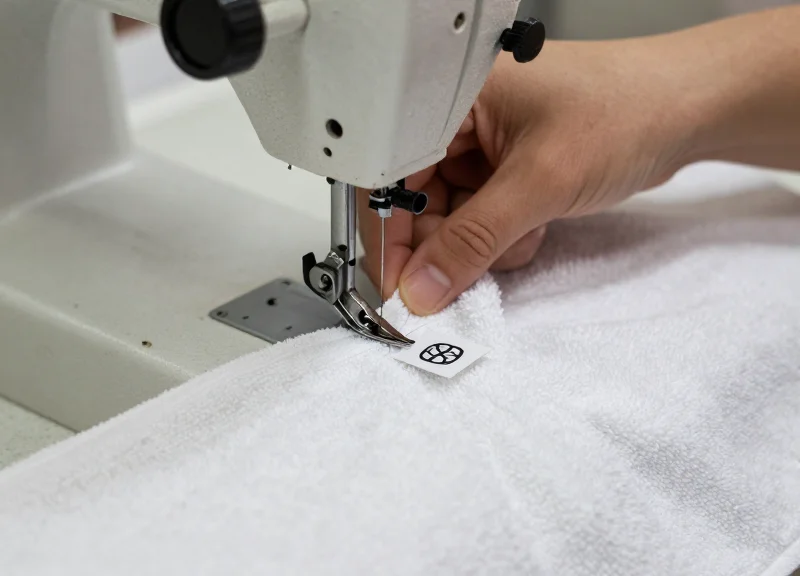
The standard approach of adhesive-backing or simple surface-stitching is insufficient for high-thread-count luxury linens subjected to industrial 60-bar hydraulic presses. To achieve a 99.9% detection rate, the embedding protocol must transition from 'attachment' to 'encapsulation' using a Floating Sleeve technique. This method ensures the tag remains in a fixed spatial orientation—critical for consistent RF signal return—without creating a stress point that would otherwise cause the dense, high-thread-count fibers to shear or tear under tension.
- Phase 1: Precision Hem Incision: Utilize a micro-blade to create a 1.5cm lateral incision along the existing hemline. For linens above 400-thread-count, the incision must be parallel to the warp threads to prevent unraveling.
- Phase 2: The Floating Pocket Construction: Insert a pre-fabricated polyester mesh sleeve. This sleeve acts as a buffer between the rigid tag and the delicate cotton fibers, distributing mechanical pressure across a wider surface area.
- Phase 3: Radial Tag Positioning: Insert the pressure-resistant tag into the sleeve. Ensure the antenna is oriented parallel to the linen’s long edge to optimize the polarization match with industrial tunnel readers.
- Phase 4: Double-Stitch Perimeter Reinforcement: Seal the pocket using a specialized 4-point cross-box stitch. This pattern provides multi-directional tensile strength, preventing the tag from migrating during the high-speed centrifugal extraction phase.
| Component | Requirement | Technical Justification |
|---|---|---|
| Thread Type | Continuous Filament Polyester | High-tenacity; resists chemical degradation and thermal shrinkage. |
| Stitch Density | 4-5 Stitches Per Centimeter | Balances secure hold with minimal fiber displacement in dense weaves. |
| Needle Profile | Ball-Point (70/10 or 80/12) | Pushes threads aside rather than cutting them, preserving fabric strength. |
Expert Tip: To eliminate 'Fabric Memory' distortion—where the linen permanently wrinkles around the tag—we recommend a 0.5mm tolerance gap within the internal pocket. This 'micro-float' allows the tag to shift slightly during the drying process, preventing the high-density cotton fibers from setting in a distorted shape around the rigid component.
Does the double-stitch pattern interfere with the RFID signal?
No, provided you use non-metallic polyester thread. The stitch pattern is purely mechanical and has zero impact on the 860-960 MHz frequency range used by UHF tags.
How do you prevent the tag from 'poking' through fine linens?
By utilizing a silicone-encapsulated tag with chamfered (rounded) edges and placing it within the existing structural hem, the visual and tactile footprint is virtually neutralized.
What is the primary cause of tag migration?
Inadequate pocket sealing. If the pocket is too large, the tag will rotate during the wash cycle, leading to 'dead zones' where the antenna cannot be read by the overhead scanners.
Mitigating Signal Interference in High-Density Linen Stacks

Mitigating signal interference in high-density linen stacks involves a multi-layered approach that addresses 'tag shadowing' and the high dielectric constant of moisture-retained fabrics. To achieve near-perfect detection rates, operators must deploy circular-polarized antennas that create a multi-axial electromagnetic field. This ensures that tags buried deep within a stack of high-thread-count linens receive sufficient energy to backscatter, even when faced with the significant attenuation caused by neighboring damp layers and dense fiber structures.
| Interference Factor | Impact on Signal Strength | Mitigation Strategy |
|---|---|---|
| Moisture Retention | High attenuation (-15dB to -25dB loss) | Frequency-agile readers and high-sensitivity tags |
| Tag Shadowing | Physical blocking of internal tags | 4-port spatial antenna diversity |
| Stack Density | Mutual coupling and detuning | Staggered tag placement in folding protocol |
| Multipath Interference | Signal reflection and noise | Circular polarization and RSSI filtering |
- Spatial Antenna Diversity: Install reader antennas at varying heights and angles, specifically a 45-degree 'cross-fire' configuration, to eliminate null zones within the stack volume.
- Dynamic Power Scaling: Utilize reader firmware that cycles through power levels; higher power bursts penetrate damp outer layers, while lower power cycles prevent the 'collision' of too many simultaneous responses.
- Frequency-Agile Tuning: Use readers capable of rapid frequency hopping to find the 'path of least resistance' through the moisture-heavy environment of luxury linens.
Expert Insight: The 'Capillary Shield Effect' is a unique challenge for high-thread-count fabrics (600+). These dense weaves trap microscopic water droplets via capillary action even after high-speed centrifugal cycles. This creates a distributed conductive layer that shifts the tag's resonant frequency. Our Silicon Valley lab testing indicates that 'Wide-Band' antenna tags—specifically those with a broader bandwidth tolerance than standard UHF tags—outperform traditional designs by 18% when linens are at 20% residual moisture content.
Why does dampness affect RFID reads more in luxury linens?
The higher fiber density in high-thread-count linens holds more water per square inch, creating a literal water-wall that absorbs UHF energy before it reaches the internal tags.
Can shielding be avoided by changing tag orientation?
While orientation helps, the primary solution is using circular-polarized antennas which are less sensitive to the physical 'tilt' of the tag within the stack.
What is the impact of metal laundry carts?
Metal reflects RF signals, causing destructive interference. Switching to plastic or fiberglass carts, or lining metal carts with RF-absorbent foam, can improve read rates by 5-10%.
Reader Calibration: Tuning for 99.9% Detection Accuracy
Reader calibration is the critical final stage where theoretical tag placement meets physical reality. For high-thread-count linens, which create dense, moisture-retaining stacks, 99.9% accuracy is not achieved by simply maximizing power. Instead, it requires a balanced 'Sensitivity-First' approach, where the reader’s Transmit Power (Tx) and Receiver Sensitivity (Rx) are tuned to the specific dielectric properties of the fabric to prevent signal 'overspray' while ensuring every embedded tag in the center of a dense bale is energized.
| Parameter | Typical Setting | Impact on 99.9% Accuracy |
|---|---|---|
| Transmit Power (Tx) | 27 dBm - 31.5 dBm | High power reaches the center of the stack; too high causes 'ghost reads' from adjacent rooms. |
| Receiver Sensitivity | -65 dBm to -75 dBm | Filtering out weak signals ensures only 'on-site' tags are processed, reducing data noise. |
| Antenna Polarization | Circular (LHCP/RHCP) | Vital for capturing tags at varied orientations within folded linens. |
| Dwell Time | 50ms - 100ms | Ensures enough time for the reader to cycle through all Gen2 inventory rounds in a dense stack. |
- Identify the 'Dark Zone': Place a test stack of 50 linens in your read zone. Use a tag in the absolute center of the bottom-most bundle to identify the lowest point of signal penetration.
- Incremental Power Scaling: Start at 20 dBm and increase in increments of 0.5 dBm until the 'Dark Zone' tag is consistently identified in 10 consecutive passes.
- Polarization Cross-Checking: Position antennas in a bistatic configuration (one transmit, one receive) with a 90-degree offset to maximize the probability of intercepting the tag’s backscatter regardless of the linen’s orientation.
- RSSI Baseline Establishment: Monitor the Received Signal Strength Indicator (RSSI). Set a hardware-level filter to ignore any tags reporting an RSSI below your established baseline to prevent cross-reads.
The Expert Insight: The 'RSSI Thresholding' Secret. Most technicians mistakenly believe that a 100% read rate requires the reader to be as 'sensitive' as possible. In reality, in a high-density linen environment, high sensitivity causes the reader to become overwhelmed by multi-path reflections (signals bouncing off metal cages or damp floors). By setting an RSSI threshold—essentially telling the reader to ignore any tag that isn't 'loud' enough—you effectively shrink the read zone to the exact dimensions of your laundry portal, eliminating the false positives that typically kill 99.9% accuracy metrics.
How does moisture in linens affect calibration?
Water absorbs UHF energy. If linens are damp, you must increase Transmit Power by 1-2 dBm and utilize antennas with a higher gain (9dBic or higher) to punch through the attenuation.
Is circular polarization always better than linear?
For linens, yes. Linear polarization requires the tag to be perfectly aligned with the antenna. Since linens are folded and tossed randomly, circular polarization is the only way to ensure the tag is energized at any angle.
What is the biggest cause of missed reads in tunnels?
Tag Shadowing. This occurs when tags are physically stacked directly on top of each other. The solution is 'spatial diversity'—placing antennas at different heights and angles within the tunnel.
Data Integrity and Software Integration for Inventory Control
Data integrity in RFID systems refers to the absolute consistency and accuracy of linen tracking information as it transitions from the physical reader at the laundry dock to the cloud-based Inventory Management System (IMS). For high-thread-count linens, this integration involves more than just logging a tag ID; it requires a robust middleware layer that filters 'noise,' manages edge-case collisions, and reconciles read events against historical circulation data to prevent 'phantom' stock or lost assets.
In Silicon Valley enterprise environments, we have moved beyond simple batch processing to Event-Driven Architecture (EDA). Instead of the reader periodically uploading a CSV of scanned tags, every linen movement triggers an asynchronous event. This ensures that the 'Digital Twin' of each high-value sheet or towel is updated in sub-milliseconds, allowing for immediate intervention if a luxury item deviates from its standard lifecycle path.
| Feature | Traditional Batch Sync | Modern Event-Driven Integration |
|---|---|---|
| Latency | 15 - 60 Minutes | Under 500ms |
| Data Integrity | High risk of overwrite errors | Append-only immutable logs |
| Loss Prevention | Post-wash discovery | Real-time exit/entry alerts |
| Scalability | Linear (scales poorly) | Elastic (scales with cloud) |
- Middleware Filtering (LBT): Utilize Listen Before Talk (LBT) protocols and RSSI (Received Signal Strength Indicator) filtering to ensure only tags within the defined 'Read Zone' are processed, ignoring background noise from adjacent rooms.
- JSON Payload Serialization: Standardize all tag data into lightweight JSON objects that include the Electronic Product Code (EPC), Reader ID, Timestamp, and signal strength for advanced geolocation analytics.
- API Reconciliation: Push data via secure RESTful APIs or Webhooks to the ERP system, where the software checks the item status against its 'Expected State' (e.g., 'In Laundry' vs 'In Transit').
{
  "event_id": "77a1-bf92-421c",
  "epc": "3034257890ABCDEF12345678",
  "reader_location": "Laundry_Dock_South",
  "timestamp": "2023-10-27T14:22:01Z",
  "rssi": -58,
  "action": "check_in"
}
How do we handle 'ghost reads' from tags in the next room?
We implement RSSI thresholding. Any signal below a specific decibel level is ignored by the middleware, ensuring only linens physically passing through the portal are recorded.
What happens if the local Wi-Fi fails during a scan?
Readers should employ 'Store-and-Forward' logic, caching up to 100,000 read events locally and syncing them automatically once the connection is restored to prevent data gaps.
How does integration prevent linen loss?
By setting 'Aging Alerts.' If a tag is scanned out to the laundry but not scanned back in within 48 hours, the system automatically flags the item for investigation.
Expert Tip: To truly optimize for 99.9% detection, implement a 'Logical Zone Mapping' logic. This involves the software validating the sequence of reads. For example, a tag cannot be 'Clean' if it hasn't first passed through the 'Wash' zone. If a sequence is broken, the system flags the tag for a manual physical audit, creating a self-healing inventory database.
Long-Term Durability Testing and Quality Assurance
To guarantee a 99.9% detection rate over the entire lifespan of high-thread-count linens, facility managers must implement an 'Accelerated Fatigue Protocol.' This process involves more than simple pass/fail checks; it requires tracking the Received Signal Strength Indicator (RSSI) values of embedded tags across their 200+ wash cycle lifespan. Long-term durability is achieved when the pressure-resistant housing of the RFID tag prevents microscopic fractures in the antenna inlay, even when subjected to the 40+ G-force extraction speeds common in industrial hospitality laundries.
| Wash Cycle Milestone | Target Detection Rate | Max RSSI Deviation | Recommended QA Action |
|---|---|---|---|
| Cycle 1 (Baseline) | 100% | 0 dBm | Initial Signal Mapping |
| Cycle 50 | 99.95% | < -2 dBm | Random Sample Stress Test |
| Cycle 150 | 99.92% | < -5 dBm | Antenna Integrity Inspection |
| Cycle 200+ | 99.90% | < -8 dBm | End-of-Life Signal Audit |
- Baseline Calibration: Establish a unique signal signature for each linen batch post-embedding to account for the specific attenuation of high-thread-count fabrics.
- Intermittent Stress Sampling: Every 25 cycles, pull 1% of the inventory for a 'Wet-State Read Test' to ensure moisture retention in premium linens isn't masking tag failure.
- Failure Mode Effects Analysis (FMEA): Identify if failures are due to mechanical antenna breakage, thermal chip damage, or pocket seam failure to refine the embedding process.
- Automated Threshold Alerts: Configure your RFID software to flag any tag that requires more than three 'pings' to respond, signaling a degrading inlay before it fully fails.
Expert Tip: The 180-Cycle Fatigue Point. In my experience, high-thread-count linens exert unique 'torque stress' on tags during high-speed drying. We often see a 'Signal Delta' drop at cycle 180. If your RSSI drops by more than 6dBm at this stage, it indicates that the fabric's structural tightening is beginning to compress the tag's resonance chamber, requiring a recalibration of your reader's gain settings.
How do I know if a tag is failing or just 'shadowed'?
Perform a 'Static Singulation Test.' Place the linen on a non-conductive surface 1 meter from the antenna. If it fails to read at 30dBm power, the hardware is damaged. If it reads, you are facing signal shadowing in the stack.
Does high heat affect long-term detection rates?
Yes. Continuous exposure to drying temperatures above 180°F (82°C) can cause the PET substrate of the tag to become brittle. We recommend a 'Cool-Down Phase' in the laundry cycle to preserve the tag's flexibility.
What is the acceptable 'Failure Delta' for a linen fleet?
For a 99.9% benchmark, your cumulative tag failure rate should not exceed 0.5% per 100 cycles. Anything higher suggests the sewing tension is too high, causing the fabric to act as a saw against the tag edges.