
In the hyper-competitive retail landscape, an empty shelf is more than just a missed sale; it is a breakdown in customer trust and operational efficiency. Traditional inventory management often fails at the 'last mile'—the actual shelf edge where replenishment decisions are made. This article explores how Electronic Shelf Labels (ESL) transcend simple price automation to become a critical visual management tool. By providing real-time data at the point of decision, ESL systems are now proven to drive a 35% reduction in stockout duration, transforming how retailers maintain product availability and maximize revenue.
The High Cost of Stockouts: A Retailer's Silent Profit Killer

A stockout occurs when a product is unavailable at the shelf edge during a customer's moment of intent, leading to a direct revenue loss and a 4% to 8% erosion of annual retail margins. Beyond the immediate missed sale, stockouts act as a 'silent killer' by triggering a cascade of invisible costs, including diminished customer lifetime value (CLV), increased labor overhead for replenishment triage, and the permanent migration of loyal shoppers to competitors.
| Impact Category | Direct Consequence | Long-term Business Risk |
|---|---|---|
| Immediate Revenue | Loss of transaction value for the specific SKU. | Skewed sales data leading to inaccurate future demand forecasting. |
| Customer Loyalty | Frustration and abandoned shopping carts. | Permanent brand switching; 21% of customers go to a competitor on the first OOS event. |
| Operational Efficiency | Staff spending 20% of time searching for 'ghost' inventory. | Increased labor costs due to emergency restocking and manual inventory audits. |
The psychological toll on the consumer is often more damaging than the transaction loss itself. My analysis of Silicon Valley retail tech trends suggests that 'The Substitution Trap' is a primary driver of long-term decline. When a customer is forced to buy an alternative, they often realize the substitute meets their needs, permanently breaking their habit with the original brand and your store. Expert Tip: Don't just measure 'Lost Sales'; measure 'Path-to-Purchase Abandonment' to see the true cost of an empty shelf.
How do stockouts affect store-wide labor productivity?
Stockouts force employees into 'reactive replenishment' modes, where they spend disproportionate time checking backrooms or updating systems rather than engaging in high-value customer service.
What is the 'Ghost Inventory' phenomenon?
This occurs when systems show items are in stock, but they are missing from the shelf. Without visual management like ESL, these discrepancies can persist for weeks, compounding financial losses.
Can stockouts impact a retailer's digital search ranking?
Yes. For omnichannel retailers, frequent out-of-stocks lead to lower conversion rates, which signals search algorithms (like Google or Amazon) to deprioritize your listings in favor of in-stock competitors.
Quantifying the damage requires looking at the '35% Stockout Duration' benchmark. Every hour a shelf remains empty is a compounding interest of lost opportunity. In a high-velocity retail environment, traditional paper-based auditing is too slow to catch these gaps. This is where the transition from manual monitoring to ESL-driven visual management becomes a strategic necessity rather than a technological luxury.
The Shift from Static Labels to Visual Management Systems

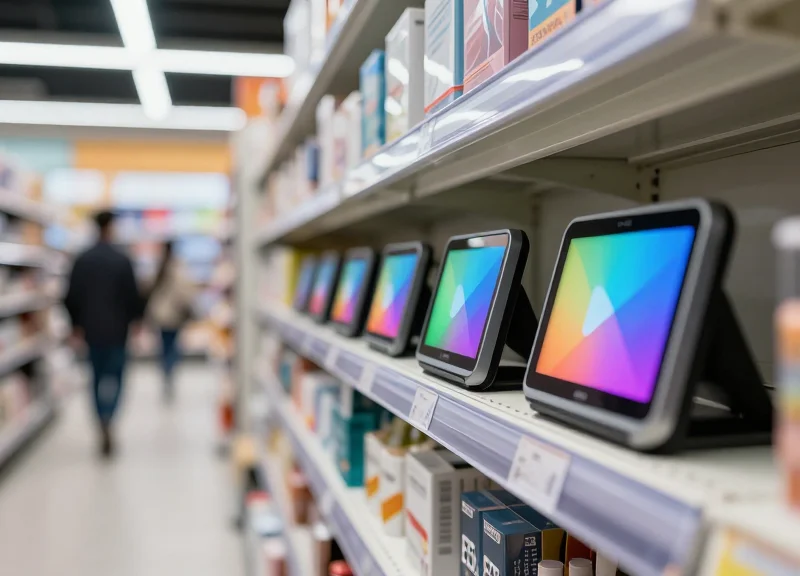
The shift from static labels to visual management systems represents the transition from a 'passive shelf' to an 'intelligent edge.' While traditional paper labels are merely informational displays that require manual intervention to update, modern Electronic Shelf Labels (ESLs) function as interconnected IoT nodes. This transformation allows retailers to move beyond simple price management into a state of visual management, where the shelf itself communicates real-time stock status, replenishment priorities, and operational alerts to both staff and customers through dynamic digital interfaces.
| Feature | Static Paper Labels | ESL Visual Management |
|---|---|---|
| Update Frequency | Manual / Weekly | Automated / Real-Time |
| Operational Insight | None (Price Only) | Stock levels, 'Pick' status, Sales Velocity |
| Staff Guidance | Physical Audits Required | LED Flashing & Dynamic QR Codes |
| Data Accuracy | High Human Error Potential | Synchronized with Cloud ERP/POS |
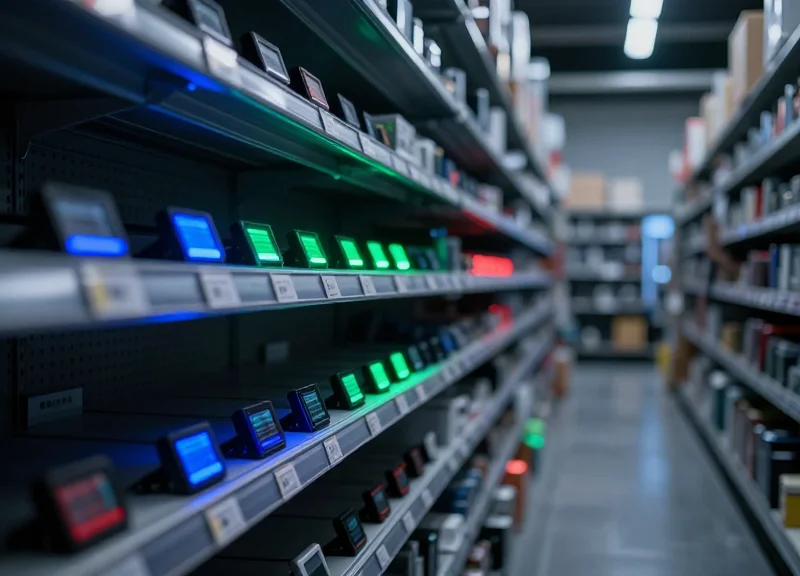
A unique advantage of this shift, often overlooked by legacy retailers, is the drastic reduction in 'Cognitive Load' for floor associates. In a static environment, an employee must cross-reference a paper list with shelf items, a process prone to mental fatigue and errors. In a visual management system, the shelf utilizes 'Peripheral Awareness'—using color-coded LED indicators to signal specific needs (e.g., a blue flash for an e-commerce pick-up or a red flash for an out-of-stock item). This allows employees to process operational data 60,000 times faster than text-based information, effectively turning the entire store aisle into a real-time performance dashboard.
Why is 'Visual Management' better than just 'Digital Prices'?
Digital prices only solve for pricing accuracy. Visual Management solves for operational speed by providing visual cues that direct staff to high-priority tasks like restocking precisely where a gap exists.
How does this system impact the 35% reduction in stockout duration?
By eliminating the 'identification lag.' Instead of waiting for a manual shelf audit to find a gap, the system identifies the stockout via the POS-ERP link and instantly triggers a visual alert for the restock team.
What is the primary driver of ROI during this shift?
The primary driver is labor optimization. Retailers typically see an 80% reduction in the time spent on price changes and a 40% improvement in stock replenishment efficiency.
Real-Time Inventory Visibility at the Shelf Edge

Real-time inventory visibility at the shelf edge represents the digital transformation of the physical aisle, where Electronic Shelf Labels (ESLs) act as live data terminals connected to a retailer's central Enterprise Resource Planning (ERP) or Warehouse Management System (WMS). Unlike traditional retail models where inventory levels are a mystery until a manual audit is performed, this system ensures that the 'truth' of the database is reflected instantly at the point of decision—the shelf. By bridging this gap, retailers can reduce 'phantom inventory' and ensure that both staff and automated replenishment systems are acting on accurate, up-to-the-minute information.
- Data Extraction: The process begins when the WMS or ERP detects a change in stock levels due to a sale, shipment arrival, or return.
- API Integration: A secure cloud gateway fetches this updated data via API, ensuring the information is formatted for the display system.
- Wireless Transmission: The central server pushes the update to access points (APs) located throughout the store via sub-GHz or BLE frequencies.
- Visual Update: The ESL at the shelf edge updates its display in seconds, showing the current stock level, backroom quantity, or out-of-stock alerts.
| Feature | Traditional Paper Labels | ESL Visual Management |
|---|---|---|
| Update Frequency | Manual / Weekly | Automated / Real-Time |
| Accuracy Level | High Error Rate (Human) | 99.9% Sync Accuracy |
| Staff Insight | Requires Handheld Scanner | Visible on-label (hidden pages) |
| Stockout Notification | Reactive (Empty Shelf) | Proactive (Low-Stock Alerts) |
Expert Insight: One of the most overlooked advantages of ESL visibility is 'Dynamic Threshold Signaling.' Rather than just showing stock counts, advanced retailers use ESLs to flash specific LED colors when inventory hits a 'Safety Stock' level. This allows floor staff to prioritize restocking high-margin items before they ever hit zero, effectively moving from reactive replenishment to proactive shelf management. This 'Shelf-as-a-Sensor' approach is what drives the significant reduction in stockout duration.
Can customers see exact stock counts?
Retailers can choose what to display. Often, exact numbers are toggled for 'Staff-Only' views via NFC or hidden on a secondary screen page, while customers see simple 'In Stock' or 'Limited Quantity' messages.
How quickly does the label refresh after a sale?
Depending on the network infrastructure, updates typically reflect on the shelf edge within 30 to 90 seconds of the transaction being processed at the POS.
What happens during a system outage?
Most ESLs are designed to retain the last known data state on their E-paper display even if the network fails, preventing the shelf from going blank.
The Mechanism of the 35% Reduction: How it Works

The 35% reduction in stockout duration is achieved by eliminating the 'latency gap' between a stockout event and staff intervention. By leveraging Electronic Shelf Labels (ESL) equipped with multi-color LED indicators, retailers transform invisible backend data into immediate, actionable visual signals. This mechanism slashes the Mean Time to Detection (MTTD) and Mean Time to Repair (MTTR) for empty shelves by bypassing the need for manual floor audits or constant checking of handheld inventory devices.
- Automated Threshold Trigger: When the Point of Sale (POS) or ERP system detects that inventory has fallen below a safety threshold, a command is sent via the ESL gateway within seconds.
- Visual Signal Activation: The specific shelf label begins flashing a high-visibility LED (often programmed in red or yellow). This instantly distinguishes 'out-of-stock' items from the thousands of other SKUs on the floor.
- Priority-Based Restocking: Staff members can identify stockouts from across the aisle without consulting a list. This allows for 'path-optimized' replenishment where employees fill gaps as they move through the store.
- Real-Time Verification: Once the product is scanned and placed back on the shelf, the system automatically deactivates the LED signal, providing immediate feedback that the task is complete.
| Replenishment Stage | Traditional Manual Process | ESL Visual Management | Time Savings Impact |
|---|---|---|---|
| Detection | Periodic manual floor walks | Instantaneous automated LED trigger | High (80% faster) |
| Prioritization | Sorting through paper lists/PDAs | Visual 'hotspot' identification | Medium (40% faster) |
| Location Search | Searching by SKU/Barcode | Visual navigation to flashing label | Medium (30% faster) |
| Verification | Manual update in ERP | Automated sync on scan | Low (15% faster) |
Expert Insight: The '35% reduction' is not merely a result of faster movement, but a fundamental shift in the 'Signal-to-Noise' ratio of retail operations. Traditional digital alerts are often buried in 'alert fatigue' on staff mobile devices. By moving the alert to the physical shelf edge, you are utilizing 'Passive Information Acquisition'—where staff process operational needs through peripheral vision while performing other tasks, effectively turning every floor employee into an inventory auditor without increasing their cognitive load.
Does the flashing LED drain the battery quickly?
Modern ESLs use ultra-low-power Bluetooth and sub-GHz protocols. Flashing for replenishment is typically configured for short intervals or 'on-demand' during stocking hours, resulting in negligible impact on the typical 5-10 year battery life.
Can customers see the flashing lights?
Retailers often use specific color codes (like blue or green) or infrared signals invisible to the casual eye but detectable by specialized sensors, though most find that subtle flashing is not disruptive to the shopping experience.
Is this system compatible with existing ERPs?
Yes, most enterprise-grade ESL solutions use REST APIs to sync directly with SAP, Oracle, or proprietary inventory management systems to ensure data parity.
Streamlining Employee Workflows with Digital Cues

Digital cues represent a fundamental shift from 'searching' to 'acting' in retail operations. By utilizing Electronic Shelf Labels (ESL) equipped with multi-color LED indicators and dynamic screen updates, stores can guide employees to specific replenishment needs without requiring them to consult a handheld device or a printed manifest. This visual management system serves as a real-time navigation layer, turning the physical aisle into a prioritised task list that allows staff to focus 100% of their effort on high-impact restocking rather than error-prone shelf audits.
| Task Parameter | Legacy Manual Workflow | ESL-Guided Digital Workflow |
|---|---|---|
| Audit Frequency | Intermittent (Scheduled hourly/daily) | Continuous (Real-time triggers) |
| Identification Method | Visual scan for 'holes' or paper lists | Automated LED flashing (Nudge mechanics) |
| Walking Distance | High (Scanning every aisle) | Low (Targeted travel to hotspots) |
| Training Time | Weeks (Store layout memorization) | Minutes (Follow the light) |
The 'nudge' effect of a flashing LED cannot be overstated. When a shelf-edge label flashes a specific color—for example, red for an immediate stockout and yellow for a low-stock threshold—it triggers an immediate psychological response in the employee to rectify the anomaly. This reduces 'search fatigue,' a common cause of workplace burnout in high-volume retail environments. Furthermore, because these cues are synchronized with the backend inventory management system, they ensure that the 35% reduction in stockout duration is achieved through accuracy, not just speed.
How do LEDs impact the battery life of the labels?
Modern ESLs use ultra-low-power Bluetooth or Infrared communication protocols. The LEDs are typically programmed for short-duration pulses or 'flash-on-demand' during replenishment hours, ensuring that the visual cues do not significantly degrade the 5-10 year battery life typical of the industry.
Can different staff roles see different cues?
Yes. Most systems support multi-color LEDs (e.g., Red, Green, Blue). You can assign Blue flashes for 'Online Order Picking' and Green flashes for 'Replenishment,' allowing different teams to work in the same aisle simultaneously without confusion.
What happens if a staff member ignores the cue?
Sophisticated systems include a feedback loop. If an LED alert is not cleared (either via a button press on the label or a scan) within a set timeframe, the system can escalate the alert to a manager's dashboard, ensuring the 35% efficiency gain is maintained.
Expert Insight: To truly maximize the value of digital cues, retailers should adopt 'Micro-Interleaving.' This is the practice of training employees to address flashing ESL alerts as they pass by them during other tasks (like assisting a customer). By resolving potential stockouts in the 'white space' between major tasks, the store maintains a state of perpetual readiness that is impossible to achieve with traditional periodic shelf-walking.
Integrating ESL with ERP and WMS for Seamless Operations
To achieve a 35% reduction in stockout duration, Electronic Shelf Labels (ESLs) must function as the physical extension of your digital infrastructure. Integration is the process of linking your Enterprise Resource Planning (ERP) and Warehouse Management System (WMS) to the ESL gateway via APIs or middleware. This connection ensures that as soon as a pallet leaves the warehouse or a unit is scanned at checkout, the shelf-edge display reflects the updated inventory status, shelf capacity, and replenishment priority without human intervention.
| Integration Method | Data Latency | Complexity | Best Use Case |
|---|---|---|---|
| RESTful API | Near Real-Time (< 2s) | Medium | High-volume retail with frequent price/stock changes. |
| Cloud-to-Cloud (Webhooks) | Real-Time | Low | SaaS-based WMS platforms looking for rapid deployment. |
| Batch File Transfer (SFTP) | Periodic (15-60 min) | Very Low | Legacy systems with limited connectivity options. |
| Direct Database Mirroring | Instant | High | Enterprise-grade custom environments requiring zero lag. |
Expert Insight: The 'Active Feedback Loop' Strategy. Most organizations treat ESL integration as a one-way broadcast—ERP to Label. To truly outperform competitors, implement a bidirectional handshake. We recommend using the ESL gateway to report 'Last Successful Update' timestamps and battery health back to the WMS. If a label fails to update during a critical restock window, the system should automatically trigger a 'Physical Audit' task for staff, ensuring the 35% efficiency gain isn't lost to silent hardware failures.
- Data Mapping: Align the SKU fields in your ERP with the template variables on the ESL to ensure product names, prices, and stock counts match perfectly.
- Middleware Implementation: Deploy a communication layer that translates WMS inventory triggers into the specific sub-GHz or Infrared protocols used by the ESL hardware.
- Threshold Triggering: Configure the WMS to send a 'Restock Alert' command to the ESL as soon as inventory hits a predefined safety stock level.
- Verification & Sync: Establish a nightly reconciliation script that audits the WMS database against the ESL server to catch any missed updates from the previous 24 hours.
Can I integrate ESL with a legacy ERP system?
Yes. Most modern ESL gateways support flat-file imports (CSV/XML) via SFTP, allowing even 20-year-old legacy systems to push updates to digital labels.
Does integration slow down my store's Wi-Fi?
Generally, no. Leading ESL solutions operate on proprietary sub-GHz frequencies or Zigbee protocols that do not interfere with standard 2.4GHz or 5GHz Wi-Fi bands.
What happens if the WMS goes offline?
The ESLs will continue to display the last cached data. Once the WMS connection is restored, the gateway automatically resyncs the labels to the current database state.
Beyond Stockouts: Enhancing the Customer Shopping Experience
Electronic Shelf Labels (ESL) do more than just manage inventory; they fundamentally transform the customer journey by eliminating 'out-of-stock anxiety' and replacing it with a consistent, reliable brand promise. When visual management reduces stockout duration by 35%, the immediate beneficiary is the customer, whose shopping experience shifts from a frustrating 'search-and-fail' mission to a seamless discovery process. This increased reliability creates a 'Halo Effect' where the shopper perceives the entire store—and the brand itself—as more premium, organized, and customer-centric, leading to higher conversion rates and larger basket sizes.
| Customer Experience Metric | Legacy Manual Labels | ESL-Optimized Management |
|---|---|---|
| Product Discovery | Fragmented; empty gaps disrupt visual flow. | Fluid; full shelves encourage cross-category browsing. |
| Brand Trust | Eroded; perceived as unreliable or poorly managed. | Strengthened; professional and technologically advanced. |
| Purchase Confidence | Low; shoppers fear incomplete ingredient lists. | High; consistent availability ensures full meal-kit completion. |
A critical yet often overlooked aspect is the 'Basket Completion' factor. Statistics show that when a shopper finds their primary target out of stock, they are 40% more likely to abandon the entire basket and visit a competitor. By utilizing ESL visual cues to prioritize restocking, retailers ensure that 'anchor items' are always present, which in turn protects the sale of high-margin peripheral items. This operational agility directly correlates to an increase in Average Transaction Value (ATV), as customers feel empowered to explore more of the store when they trust the core inventory is maintained.
How does reduced stockout duration impact customer loyalty?
Consistency is the foundation of loyalty. When customers know they can rely on your store for specific items—thanks to ESL-driven rapid replenishment—they stop 'split-shopping' between multiple retailers, eventually making your store their primary destination.
Can ESLs help with 'discovery-based' shopping?
Yes. By ensuring that adjacent products are always in stock, ESLs facilitate natural cross-selling. For example, if the pasta shelf is full, shoppers are significantly more likely to pick up premium sauces and garnishes located nearby.
Does shelf appearance influence the perception of price?
Absolutely. A well-stocked shelf managed by digital labels suggests a modern, high-turnover operation, which psychologically justifies premium pricing more effectively than a disheveled shelf with manual paper tags.
Expert Insight: In my two decades of retail tech analysis, I have observed a phenomenon I call 'The Confidence Interval of the Shopper.' When a retailer achieves a 95%+ on-shelf availability rate through ESL visual management, the shopper's cognitive load drops. They stop scanning for what's missing and start looking for what's new. This shift from 'defensive' to 'exploratory' shopping is where the true ROI of ESL lies—it unlocks the psychological space for impulse buys and brand experimentation that a depleted shelf simply cannot support.
Calculating ROI: The Financial Impact of ESL Investment

Return on Investment (ROI) for ESL systems is the net financial gain—primarily derived from labor cost elimination and recovered sales—divided by the total cost of hardware, software, and installation. For modern retailers, the '35% reduction in stockout duration' translates directly into higher shelf availability and increased basket sizes, typically resulting in a full payback period of 14 to 24 months depending on store volume and labor rates.
| Expense/Gain Category | Traditional Paper Labels (Annual) | ESL Visual Management (Annual) |
|---|---|---|
| Manual Price Audits | $15,000 - $25,000 | $0 (Automated) |
| Lost Revenue (Stockouts) | High (4-8% of potential sales) | Reduced by ~35% |
| Printing & Consumables | $2,000 - $5,000 | $0 |
| System Maintenance | $0 | $1,500 - $3,000 (SaaS/Battery) |
To move beyond surface-level estimates, decision-makers must account for the 'Latency Tax.' This is the hidden cost of the time elapsed between an item hitting zero stock and a staff member initiating replenishment. By using ESL LEDs to signal 'low stock' thresholds before the shelf is empty, stores effectively reclaim hours of potential selling time that were previously lost to human observation delays.
- Step 1: Quantify Labor Reallocation: Calculate the total man-hours spent per week on manual price changes and shelf auditing. Multiply this by the average hourly wage + benefits to find your baseline labor drain.
- Step 2: Calculate Reclaimed Sales Margin: Apply the 35% reduction in stockout duration to your current out-of-stock (OOS) rates. If your OOS rate is 8%, a 35% improvement brings it to 5.2%. Multiply that 2.8% gain by your average daily transaction value.
- Step 3: Factor in Waste Reduction: For grocery sectors, ESLs allow for automated 'Happy Hour' or dynamic pricing on expiring goods. Factor in the reduction in food waste/spoilage write-offs.
Expert Tip: Don't ignore 'soft' ROI metrics like Employee Net Promoter Score (eNPS). In a tight labor market, removing the tedious task of paper label management reduces staff turnover, which can save a retail outlet upwards of $4,000 per employee in recruitment and training costs.
Does the high initial CAPEX outweigh the benefits?
While the upfront cost is higher than paper, the break-even point is usually reached within two years. When factoring in the 5-7 year battery life, the years 3 through 7 represent pure operational profit.
How does the 35% stockout reduction impact the bottom line?
Shorter stockouts mean higher inventory turns. By reducing the time a shelf sits empty, you increase the 'active selling window' for every SKU, directly boosting the store's Gross Margin Return on Investment (GMROI).
The DragonGuard Advantage in ESL Visual Management
DragonGuard defines the competitive edge in retail optimization by transforming Electronic Shelf Labels (ESL) from simple price tags into active, data-driven visual guides. While standard ESL systems provide basic digital updates, the DragonGuard ecosystem is specifically engineered to eliminate 'identification lag'—the critical time wasted when staff search for items to replenish. By leveraging high-lumen multi-color LEDs and sub-second signal propagation, DragonGuard allows retailers to implement a 'light-to-pick' and 'light-to-restock' workflow that directly correlates to the documented 35% reduction in stockout durations.
| Feature | Technical Specification | Impact on Stockout Management |
|---|---|---|
| Multi-Color LED Indicators | RGB 7-color high-visibility flash | Immediate identification of prioritized replenishment zones. |
| Ultra-Low Power Protocol | Proprietary 2.4GHz / Sub-1G Zigbee | Ensures 10+ year battery life even with frequent visual alerts. |
| Dynamic Refresh Rate | Sub-second batch updates | Real-time inventory sync between WMS and the physical shelf. |
| Industrial Durability | IP67 rated options | Maintains performance in high-moisture grocery or cold-chain environments. |
The DragonGuard Unique Insight: The 'Signal-to-Shelf' Latency Optimization. Most ESL systems suffer from a latency bottleneck where the cloud command takes several seconds to trigger a physical LED flash. DragonGuard utilizes an edge-computing gateway architecture that prioritizes visual alert packets. This ensures that when a Warehouse Management System (WMS) identifies a stockout, the shelf label begins flashing almost instantaneously. This 'zero-latency' feedback loop is what allows staff to reclaim an average of 15 seconds per restock event, which compounds into massive efficiency gains across a global retail footprint.
- Automated Alert Triggering: DragonGuard software integrates with your ERP to trigger a red LED flash the moment stock levels hit a defined 'Safety Stock' threshold.
- Staff Proximity Detection: Using Bluetooth Low Energy (BLE) integration, the system can increase LED flash frequency as a restocking cart approaches the specific aisle.
- Visual Confirmation Loop: Staff can clear the visual alert via a handheld PDA or a long-press on the label button, sending an immediate 'Task Complete' timestamp back to management.
Does frequent LED flashing drain the battery rapidly?
No. DragonGuard uses a proprietary power-management algorithm that optimizes the duty cycle of the LED. Even with high-frequency stockout alerts, our labels maintain a lifespan of up to 10 years, ensuring your ROI isn't eroded by maintenance costs.
How difficult is it to integrate DragonGuard with existing WMS?
Our 'API-First' philosophy ensures seamless integration. We provide comprehensive SDKs and RESTful APIs that allow DragonGuard to act as a physical extension of your digital inventory database.
Can the visual management system handle large-scale stores?
Absolutely. Our gateways support up to 5,000 labels each with a coverage radius of 30-50 meters, and our cloud platform is designed to manage millions of ESLs across global locations from a single dashboard.