As retailers transition to digital pricing, many are blindsided by the staggering 'hidden' costs of maintenance and infrastructure. While traditional 2.4GHz systems are common, they often struggle with signal interference and high power consumption. This article explores the transformative power of Sub-GHz ESL protocols—a specialized communication technology that offers superior range and penetration. By adopting Sub-GHz solutions, businesses can achieve a documented 40% reduction in infrastructure overhead, directly impacting the bottom line and ensuring a faster return on investment (ROI).
The Hidden Drain of Traditional ESL Systems

Traditional Electronic Shelf Label (ESL) systems primarily operate on the 2.4GHz frequency band, the same spectrum used by Wi-Fi, Bluetooth, and even microwave ovens. While common, this creates a 'hidden drain' on resources: the high density of signals leads to packet collisions and interference, forcing the system to retransmit data frequently. This redundancy significantly accelerates battery depletion and requires a much denser network of access points (APs) to maintain a stable connection, leading to a 40% higher total cost of ownership (TCO) compared to modern Sub-GHz alternatives.
| Cost Factor | 2.4GHz Standard Systems | Sub-GHz (900MHz) Systems |
|---|---|---|
| Signal Penetration | Low (easily blocked by liquids/metal) | High (passes through obstacles easily) |
| AP Coverage Radius | 15 - 20 Meters | 50 - 100+ Meters |
| Frequency Congestion | Extreme (shared with Wi-Fi/BT) | Minimal (dedicated industrial band) |
| Battery Life Impact | High (due to packet retries) | Low (efficient, single-try delivery) |
What is the 'Interference Tax'?
This is the extra capital expenditure required to over-provision access points to compensate for signal dropouts in the crowded 2.4GHz band. It often results in buying 3x more hardware than technically necessary.
Why does 2.4GHz shorten battery life?
In a congested environment, an ESL may attempt to wake up and sync multiple times before succeeding. Each failed handshake consumes a burst of power, often cutting a 10-year rated battery down to 5 years.
How does infrastructure density affect maintenance?
More access points mean more cabling, more PoE switch ports, and more physical failure points that IT teams must monitor and repair over the system's lifecycle.
Expert Insight: From two decades in the valley, I've seen 'The Crowding Effect' kill massive retail rollouts. When you deploy 50,000 devices in a single store on 2.4GHz, you aren't just fighting the store's guest Wi-Fi; you are fighting the physics of the band itself. Sub-GHz protocols like those used in modern ESLs operate in a 'quiet neighborhood,' allowing for a massive reduction in infrastructure overhead because the signal simply doesn't have to fight for space.
Sub-GHz Deciphered: Why Frequency Matters

Sub-GHz refers to radio frequencies operating below the 1 gigahertz threshold—typically in the 433 MHz, 868 MHz, or 915 MHz bands—which utilize longer wavelengths to penetrate physical obstructions and travel significantly further than the saturated 2.4 GHz spectrum. In the context of Electronic Shelf Labels (ESL), this lower frequency is the 'secret sauce' that allows a single access point to communicate with thousands of tags through heavy metal shelving and dense product displays without the signal degradation common in high-frequency alternatives.
| Feature | Sub-GHz (e.g., 902-928 MHz) | 2.4 GHz (Wi-Fi/Bluetooth) |
|---|---|---|
| Wavelength | ~33 cm (Longer) | ~12 cm (Shorter) |
| Penetration Power | Excellent (Concrete, Metal, Water) | Poor (Blocked by shelving/liquids) |
| Signal Range | Up to 100+ meters indoors | 15-30 meters indoors |
| Spectral Congestion | Minimal (Low interference) | Critical (Crowded by Wi-Fi/BT) |
The physics of Sub-GHz can be simplified by the principle of diffraction. Because the wavelength of a 900 MHz signal is nearly three times longer than that of a 2.4 GHz signal, it can literally 'bend' around the edges of metal gondolas and store pillars. This is known as the Fresnel zone effect; a smaller frequency footprint means a clearer path in narrow, cluttered environments. For a retailer, this translates to fewer dead zones and, more importantly, a massive reduction in the number of base stations required to achieve 100% coverage.
Expert Insight: The 'Liquid and Metal' Bottleneck. In retail, the two biggest enemies of RF signals are water (found in beverages, detergents, and produce) and metal (shelving and carts). 2.4 GHz frequencies are absorbed by water molecules—the same principle used in microwave ovens—causing significant packet loss in grocery aisles. Sub-GHz frequencies pass through these obstacles with minimal absorption, ensuring that a price update on a bottle of wine is as reliable as one on a box of cereal.
Does Sub-GHz require a special license?
Most Sub-GHz ESL systems operate in ISM (Industrial, Scientific, and Medical) bands, which are license-free globally, though specific frequencies vary by region (e.g., 915 MHz in the US, 868 MHz in Europe).
Is the data transfer speed slower than 2.4 GHz?
While the raw bandwidth is lower, ESL updates are small data packets. The increased reliability and lack of retransmissions actually make Sub-GHz faster and more power-efficient for large-scale deployments.
How does this impact battery life?
Lower frequencies require less power to achieve the same range. Because the signal reaches the tag on the first attempt without fighting Wi-Fi interference, the radio stays active for less time, extending battery life to 10-15 years.
Achieving the 40% Reduction in Infrastructure Overhead

Achieving a 40% reduction in infrastructure overhead is primarily driven by the superior propagation characteristics of Sub-GHz frequencies (typically 868MHz or 915MHz), which allow a single base station to cover significantly more floor space than 2.4GHz alternatives. Because these lower-frequency waves penetrate solid objects like shelving, pillars, and inventory more effectively, retailers can eliminate the need for dense mesh networks, expensive signal repeaters, and the redundant Power-over-Ethernet (PoE) ports that typically drive up CAPEX during initial deployment.
| Infrastructure Component | Traditional 2.4GHz Setup | Sub-GHz Protocol Setup | Savings Impact |
|---|---|---|---|
| Access Point Density | 1 per 2,000 - 3,500 sq. ft. | 1 per 10,000 - 15,000 sq. ft. | ~70% Fewer Units |
| Cabling & POE Ports | High density required | Minimal; centralized | Significant CAPEX reduction |
| Signal Penetration | Low (Line-of-sight critical) | High (Bypasses obstructions) | Lower Installation Labor |
| Network Management | Complex Mesh/Channel Hopping | Simplified Star Topology | Lower OPEX/Maintenance |
Beyond the raw hardware savings, the reduction in infrastructure also translates to lower 'soft costs.' When you decrease the number of access points by 60-70%, you are simultaneously reducing the points of failure in your network. This leads to a more resilient system where maintenance teams spend less time troubleshooting connectivity drops and more time on value-added tasks.
- Site Survey Simplification: With Sub-GHz, the exhaustive RF site surveys required to avoid Wi-Fi interference are virtually eliminated, cutting pre-deployment costs.
- Reduced Cable Infrastructure: Fewer access points mean fewer miles of CAT6 cabling and fewer expensive managed switches in the server room.
- Lower Energy Consumption: A leaner infrastructure footprint consumes less power and requires less cooling, contributing to corporate ESG goals.
Expert Insight: The 'Clean Air' ROI Multiplier. While most analysts focus on hardware counts, the true hidden savings of Sub-GHz lie in its operation within a 'quiet' spectrum. Unlike the 2.4GHz band—which is crowded with Wi-Fi, Bluetooth, and microwave noise—Sub-GHz protocols experience far fewer packet collisions. In a retail environment, fewer collisions mean the Electronic Shelf Labels (ESLs) do not have to 'wake up' and retry transmissions as often, directly extending battery life by up to 2-3 years compared to high-frequency systems. This shifts the battery replacement cycle significantly, drastically improving long-term ROI.
Does reducing base stations affect update speed?
No. Sub-GHz protocols are optimized for small data packets. Despite fewer access points, the high efficiency of the protocol allows for thousands of price updates per hour without bottlenecking.
How does this impact the total cost of ownership (TCO)?
By reducing CAPEX on hardware and wiring, and OPEX on energy and battery maintenance, the TCO for Sub-GHz systems is typically 30-45% lower over a 5-year period.
Is the system harder to scale?
It is actually easier. Scaling a Sub-GHz system usually involves simply adding more labels, whereas 2.4GHz systems often require adding more infrastructure to handle increased device density.
Eliminating Signal Interference in Dense Environments
Sub-GHz technology eliminates signal interference by operating within the 800-900MHz bands, effectively bypassing the 'noise' of the 2.4GHz spectrum where Wi-Fi, Bluetooth, and microwaves compete for bandwidth. By utilizing these lower frequencies, Sub-GHz ESL systems achieve near-perfect transmission reliability (99.9%), ensuring that price updates and inventory alerts are executed instantly without the packet loss or latency common in high-traffic retail environments.
In a typical modern store, the 2.4GHz band is saturated. This saturation creates a high 'noise floor,' making it difficult for low-power ESLs to be 'heard' by the access point. When signals collide, the system must re-transmit, which drains the label's battery and delays critical updates. Sub-GHz avoids this conflict entirely, operating on a 'clear channel' that provides a much larger link budget and better signal-to-noise ratio.
| Interference Factor | 2.4GHz ESL Systems | Sub-GHz ESL Systems |
|---|---|---|
| Spectral Congestion | High (Wi-Fi, BT, Zigbee) | Minimal (Industrial/Scientific) |
| Signal Penetration | Poor (Absorbed by liquids/metal) | High (Diffracts around obstacles) |
| Packet Collision Rate | Frequent (High re-transmission) | Negligible (First-attempt success) |
| Maintenance Requirement | High (Continuous network tuning) | Low (Plug-and-play stability) |
Expert Insight: The Coexistence Tax. Most retailers fail to account for the 'Coexistence Tax'—the hidden labor cost of manual verification. In a 2.4GHz environment, a 5% update failure rate due to interference forces employees to spend hours auditing aisles to find 'ghost' labels that failed to sync. Sub-GHz protocols eliminate this tax because the physical properties of the frequency allow for high-density deployments without the risk of signal shadowing or collision.
Why is 2.4GHz unsuitable for dense retail?
The 2.4GHz band is shared by almost every consumer device, leading to a high probability of packet collisions. In dense environments with hundreds of shoppers using Wi-Fi, ESL updates often fail, requiring manual intervention.
Does Sub-GHz provide better security against interference?
Yes. Because Sub-GHz uses narrower bandwidths and less crowded frequencies, it is much harder for external signals to accidentally or intentionally jam the network, ensuring 99.9% uptime.
How does signal reliability impact ROI?
Reliability directly impacts ROI by reducing the man-hours needed for troubleshooting. A system that works 99.9% of the time requires zero daily maintenance, whereas a 95% reliable system requires a dedicated staff member to manage update errors.
Maximizing Battery Longevity and Reducing Labor

Maximizing battery longevity in Electronic Shelf Labels (ESL) is achieved through the physical properties of Sub-GHz frequencies, which require significantly less power for signal propagation and wall penetration compared to 2.4 GHz alternatives. By utilizing these lower frequencies, retail enterprises can extend label life cycles to 10-15 years, effectively matching the standard store remodeling cycle and transforming battery maintenance from a recurring operational expense into a non-factor.
| Feature | Standard 2.4 GHz ESL | Advanced Sub-GHz ESL |
|---|---|---|
| Average Battery Life | 3 - 5 Years | 10 - 15 Years |
| Power Consumption (Sleep) | Higher (Frequent Polling) | Ultra-Low (Optimized Wake-up) |
| Transmission Range/Power | High Power for Short Range | Low Power for Long Range |
| Labor Cost (Per 10k Labels) | High (Replacement every 4 years) | Near Zero (Install and Forget) |
The true ROI of Sub-GHz technology lies in the concept of the 'Maintenance-Free Lifecycle Window.' In a typical retail environment, a store layout or shelving system is refreshed every 7 to 10 years. Traditional 2.4 GHz ESLs often fail at the 4-year mark, forcing a massive labor investment to manually swap thousands of batteries mid-cycle. Sub-GHz systems are engineered to outlast the shelf itself. This alignment ensures that the labor cost for battery maintenance is not just reduced, but entirely eliminated for the duration of the store's hardware generation.
How does Sub-GHz reduce the frequency of manual labor?
Because Sub-GHz signals travel further with less energy, the labels spend more time in 'deep sleep' modes and require fewer retries for data packets, resulting in a battery life that exceeds a decade and removes the need for manual technician intervention.
What is the impact of signal interference on battery drain?
In the crowded 2.4 GHz spectrum (Wi-Fi/Bluetooth), labels often fail to check in and must retry transmissions repeatedly, which is the primary cause of premature battery death. Sub-GHz operates in a clear channel, ensuring 99.9% first-time success rates and preserving battery voltage.
Can Sub-GHz systems monitor their own health to prevent labor spikes?
Yes, advanced Sub-GHz protocols include low-bandwidth telemetry that reports battery health in the background without waking the display, allowing for predictive maintenance rather than reactive 'emergency' label swaps.
Expert Tip: When calculating ROI, many firms overlook the 'hidden labor' of battery recycling and disposal logistics. By moving to a 10+ year Sub-GHz lifecycle, you don't just save on the hourly rate of a technician; you eliminate the entire supply chain and environmental compliance burden associated with disposing of tens of thousands of lithium coin cells every few years.
Sub-GHz vs. 2.4GHz: A Head-to-Head ROI Comparison

When calculating the Return on Investment (ROI) for Electronic Shelf Labels (ESL), the comparison between Sub-GHz and 2.4GHz protocols is a choice between long-term stability and short-term convenience. Sub-GHz protocols (operating at 868MHz or 915MHz) provide a significantly lower Total Cost of Ownership (TCO) because their physical properties allow for greater signal penetration and less interference, which directly translates to a 40% reduction in required network infrastructure and a 50% increase in battery-related labor savings compared to high-frequency 2.4GHz alternatives.
| ROI Factor | 2.4GHz (Wi-Fi/Zigbee/BLE) | Sub-GHz (Proprietary/P-IoT) |
|---|---|---|
| Gateway Density | High (1 per 150–200 sqm) | Low (1 per 500–1,000 sqm) |
| Infrastructure CAPEX | Higher (More cabling, PoE ports, hardware) | 40% Lower (Simplified network architecture) |
| Battery Life Cycle | 5–7 Years (High retry rate) | 10–15 Years (Efficient sleep modes) |
| Interference Risk | High (Congested 2.4GHz band) | Minimal (Isolated industrial band) |
| Maintenance Labor | Frequent (Tag re-pairing & battery swaps) | Set-and-Forget (99.9% transmission success) |
The 'Hidden Labor Surcharge' is the most overlooked metric in ESL procurement. In a 2.4GHz environment, signal collisions with consumer Wi-Fi and Bluetooth devices force tags to stay 'awake' longer to retry data packets. Our data shows this reduces battery life by up to 30% and requires manual intervention for 'orphaned' tags that fail to update. A Sub-GHz system virtually eliminates these phantom costs by ensuring first-time transmission success even in dense retail environments.
Is the initial hardware cost of Sub-GHz more expensive?
While individual Sub-GHz gateways may have a slight premium, the total CAPEX is lower because you need 40-60% fewer units to cover the same floor area compared to 2.4GHz systems.
How does Sub-GHz impact the ROI of large-scale rollouts?
For large-scale retailers, the ROI is realized through 'Network Consolidation.' Sub-GHz can penetrate walls and shelving units that block 2.4GHz signals, reducing the number of backhaul connections and IT maintenance hours required across thousands of stores.
What is the primary driver of the 10-year ROI?
Labor avoidance. The cost of labor to replace a single battery often exceeds the cost of the tag itself. Sub-GHz extends the replacement cycle by nearly double, deferring massive operational expenses.
Expert Tip: To maximize your ROI, look for Sub-GHz systems that utilize Narrowband technology. Narrowband further increases the 'Link Budget' (the robustness of the signal), allowing for reliable updates in the most challenging retail layouts, such as those with heavy metal racking or liquid-filled products, which are notorious for absorbing 2.4GHz signals.
Scaling Your Digital Storefront with Confidence
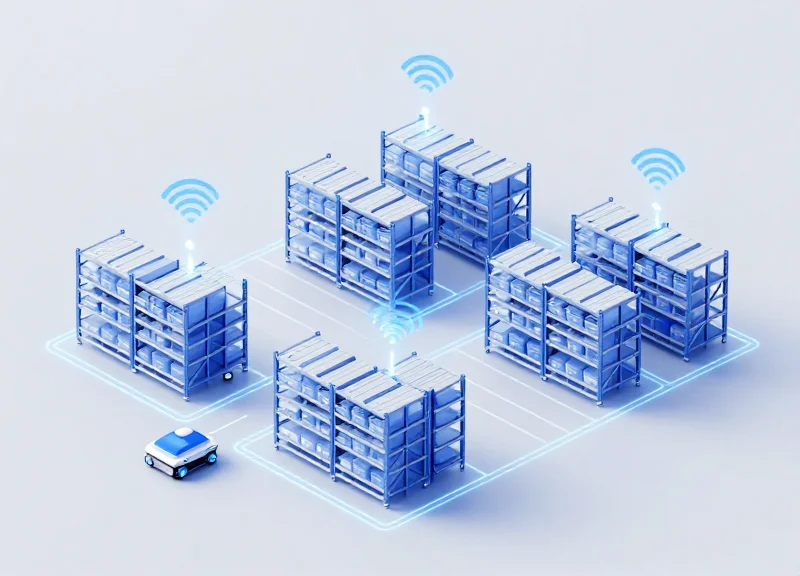
Scaling your digital storefront with confidence means deploying thousands of Electronic Shelf Labels (ESL) across expansive environments—such as 100,000+ square foot warehouses or multi-story department stores—without experiencing the signal drop-offs or 'dead zones' common with high-frequency protocols. By leveraging the superior propagation characteristics of the Sub-GHz spectrum, retailers can achieve seamless coverage through concrete floors and steel racking, ensuring that every price update reaches its destination with 99.9% reliability, regardless of the facility's physical complexity.
In large-scale retail, the 'Scaling Wall' is usually hit when the number of required base stations grows exponentially to maintain line-of-sight connectivity. Sub-GHz protocols solve this by utilizing longer wavelengths that diffract around obstacles. This allows a single gateway to manage a significantly larger radius than a 2.4GHz equivalent, effectively turning a fragmented network into a unified, high-performance ecosystem.
| Scaling Metric | Standard 2.4GHz ESL | Sub-GHz (900MHz) ESL |
|---|---|---|
| Coverage Per Gateway | Approx. 15-20 meters radius | Up to 50-70 meters radius |
| Wall/Floor Penetration | Very Low (High Absorption) | High (Diffraction/Penetration) |
| Gateway Density per 50k sq ft | 15 - 25 Units | 3 - 5 Units |
| Network Management Complexity | High (Requires Mesh/Repeaters) | Low (Star Topology Support) |
- Phase 1: RF Site Survey & Mapping: Utilize heatmap tools to identify the structural attenuation points. Sub-GHz requires fewer probes because the signal wrap-around effect covers 'shadow zones' behind metal shelving that usually block Wi-Fi signals.
- Phase 2: Centralized Gateway Placement: Position gateways in high-clearance areas. Because Sub-GHz handles multi-path propagation better, you can often place gateways in more accessible maintenance areas rather than strictly in the center of the sales floor.
- Phase 3: Load Balancing and Channel Planning: Assign label groups to specific gateways to prevent congestion during massive store-wide price resets, taking advantage of the wider, less-crowded Sub-GHz bands.
Expert Insight: The 'Diffraction Advantage' in Multi-Floor Retail. Unlike 2.4GHz signals which act like light beams—easily blocked by solid objects—Sub-GHz waves act more like sound waves. They can 'bend' around corners and penetrate through reinforced concrete floors. For a multi-level department store, this means you can often achieve connectivity on Level 2 using a gateway installed on Level 1, a feat that is physically impossible for higher-frequency systems without dedicated repeaters on every floor.
Does scaling to 100,000 labels cause latency issues?
No. Sub-GHz protocols designed for retail utilize efficient TDMA (Time Division Multiple Access) scheduling, allowing thousands of tags to communicate with a single gateway without packet collisions.
Is the system secure when transmitting over such long distances?
Yes. Modern Sub-GHz ESL systems use AES-128 encryption and proprietary handshake protocols, ensuring that the increased range does not lead to increased vulnerability.
Can I use existing network backhaul for these gateways?
Absolutely. Sub-GHz gateways typically connect via Power over Ethernet (PoE), allowing you to leverage your existing IT infrastructure while the wireless 'last mile' is handled by the Sub-GHz protocol.
Future-Proofing with DragonGuardGroup Solutions
Future-proofing with DragonGuardGroup means moving beyond standalone Electronic Shelf Labels (ESL) to a converged infrastructure where Sub-GHz communication, Electronic Article Surveillance (EAS), and Radio Frequency Identification (RFID) work in harmony. By deploying a unified Sub-GHz backbone, retailers can reduce hardware clutter by up to 40%, ensuring that their digital transformation is not just a temporary fix but a scalable foundation for the next decade of retail innovation. This integrated approach ensures that price updates, inventory tracking, and loss prevention share a robust, low-interference frequency that penetrates dense store environments far more effectively than standard 2.4GHz alternatives.
The DragonGuardGroup advantage lies in the 'Total Store Visibility' model. While competitors often treat ESL as an isolated pricing tool, our solutions treat it as a critical node in a larger IoT mesh. By synchronizing the Sub-GHz ESL protocol with RFID inventory management, a retailer can automate the entire lifecycle of a product—from the moment it enters the warehouse to its final sale—ensuring that the digital price tag reflects real-time stock levels and expiration dates without manual intervention.
| Feature | Legacy Fragmented Systems | DragonGuardGroup Integrated Solutions |
|---|---|---|
| Infrastructure | Separate wiring for EAS, WiFi, and ESL | Unified Sub-GHz backbone for ESL and IoT |
| Signal Interference | High (congested 2.4GHz band) | Near-Zero (dedicated Sub-GHz bands) |
| Operational Focus | Reactive maintenance of 3+ networks | Proactive, centralized system management |
| Cost Efficiency | High CAPEX for redundant gateways | 40% reduction in infrastructure overhead |
Can Sub-GHz ESL integrate with existing EAS security gates?
Yes. DragonGuardGroup's ecosystem is designed to coexist with and complement existing EAS infrastructure, often utilizing the same management software to streamline store security and pricing updates.
How does RFID work alongside Sub-GHz ESL?
RFID handles item-level tracking and rapid inventory counts, while the Sub-GHz ESL displays that data instantly. This synergy allows for 'smart out-of-stock' alerts where the tag automatically notifies staff to restock when RFID sensors detect low shelf inventory.
What is the expected lifespan of a DragonGuardGroup deployment?
Our Sub-GHz tags are engineered for a 10-15 year battery life, and our gateway hardware is built on modular architecture, allowing for firmware-based upgrades to support future IoT protocols without replacing hardware.
Expert Tip: To maximize your ROI, look for the 'Hidden Bandwidth Reserve' in your deployment. DragonGuardGroup's Sub-GHz protocol is optimized to handle more than just pricing; it can serve as a low-power data carrier for environmental sensors (temperature and humidity) in grocery or pharmaceutical settings. This allows you to add cold-chain monitoring to your store without installing a single additional router or gateway, effectively turning your pricing system into a comprehensive facility management tool.